📽️Is Britain REALLY facing a 1970s-style fiscal crisis?
Why are investors so freaked out about UK debt?
Is this REALLY worse than under Liz Truss?
Who's to blame? Rachel Reeves? The Bank of England?
And would a bit of productivity really solve everything?
📈 Your 6 min primer👇
Why are investors so freaked out about UK debt?
Is this REALLY worse than under Liz Truss?
Who's to blame? Rachel Reeves? The Bank of England?
And would a bit of productivity really solve everything?
📈 Your 6 min primer👇
OK, so let's break it down.
Start with the chart everyone (well, everyone in Whitehall) is talking about.
The 30yr UK government bond yield. Up to the highest level since 1998. And it's still rising.
Does this mean the UK is facing a fiscal crisis? Let's look at the evidence
Start with the chart everyone (well, everyone in Whitehall) is talking about.
The 30yr UK government bond yield. Up to the highest level since 1998. And it's still rising.
Does this mean the UK is facing a fiscal crisis? Let's look at the evidence

First let's compare the UK to other G7 countries.
There's two ways to do this.
First, look at absolute levels👇
And it looks pretty awkward for the UK.
Pre-mini Budget we were middle of the pack. That changed post-Truss. And now, under Labour, the UK is even more of an outlier.
There's two ways to do this.
First, look at absolute levels👇
And it looks pretty awkward for the UK.
Pre-mini Budget we were middle of the pack. That changed post-Truss. And now, under Labour, the UK is even more of an outlier.

Now let's take the same data - 30yr gilt yield - and look at it in a different way. Here we're looking not at the level of yields but the CHANGE in the yield since the start of the year.
The distinction matters, as you'll see in a moment...
Anyway: UK up 0.48% so far this year.
The distinction matters, as you'll see in a moment...
Anyway: UK up 0.48% so far this year.

So how does the UK compare to its counterparts?
If investors were MUCH more worried about Britain in recent months you'd prob expect the red line to be higher than the others. It's not.
In fact, Japan, Germany & France saw their 30yr yields rise far more than the UK this year
If investors were MUCH more worried about Britain in recent months you'd prob expect the red line to be higher than the others. It's not.
In fact, Japan, Germany & France saw their 30yr yields rise far more than the UK this year

Nor are the other red alerts you'd expect at the time of a fiscal market crisis flashing red. Back in the height of the euro crisis the cost of insuring Greek/Spanish debt against default went through the roof. But UK credit default swaps remain low and stable. No-one panicking
In short, while growth IS quite weak, inflation quite high and the deficit still pretty high - the precise cocktail of factors that usually get people worried- they are nowhere near panic levels.
For the time being, this is not 1976. It's not 2008. It's not 2022 either. But...
For the time being, this is not 1976. It's not 2008. It's not 2022 either. But...
By the same token, it's not nothing.
So why are UK yields still so high? What does this MEAN??
Here we run into an annoying problem, which is that there's rarely any single explanation for bond movements.
👇More on this in my piece today news.sky.com/story/no-room-…
So why are UK yields still so high? What does this MEAN??
Here we run into an annoying problem, which is that there's rarely any single explanation for bond movements.
👇More on this in my piece today news.sky.com/story/no-room-…

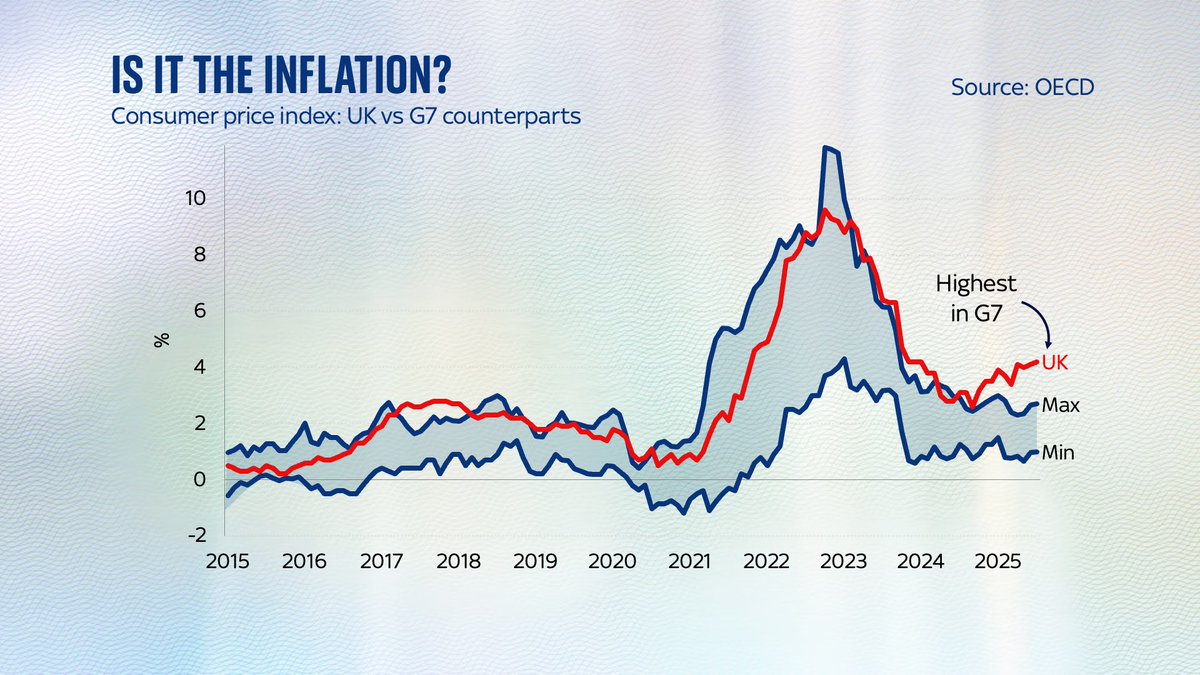
So while many assume this is ALL about the public finances (we'll come to that in a moment), it's just as plausible that gilt yields are higher in the UK than the G7 in part because INFLATION is higher here.
👀Look how similar this chart is to the gilts one we started with
👀Look how similar this chart is to the gilts one we started with
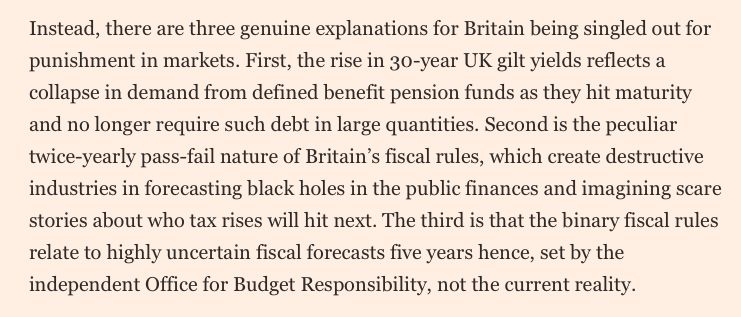
Nor is this the only alternative explanation for higher UK bond yields that doesn't involve making scary noises about the state of the public finances. @ChrisGiles_ ran through some of the "market dynamics" explanations in his column today on.ft.com/4p3FQVx
All of that being said, it is ALSO quite plausible that markets are nervous about the state of the public finances. They look at charts like this and think to themselves: can this government (or any) actually bring that red line (spending) under control?

More to the point, the mere fact that govt interest rates are higher makes the arithmetic harder for the Chancellor because it means she (well, we) end up spending more on debt interest in the coming years. Which, all else equal, means less money to spend on everything else.
Final thing to keep in mind.
In the coming weeks you're going to hear a LOT from the Chancellor about productivity. Economic output per hour worked.
This might seem arcane. I mean, it is arcane. It's an economic statistic.
But it's important. Massively so. Let me show you why
In the coming weeks you're going to hear a LOT from the Chancellor about productivity. Economic output per hour worked.
This might seem arcane. I mean, it is arcane. It's an economic statistic.
But it's important. Massively so. Let me show you why
The more productive the economy is the more cash we're generating and, among other things, the more tax flows into the Exchequer.
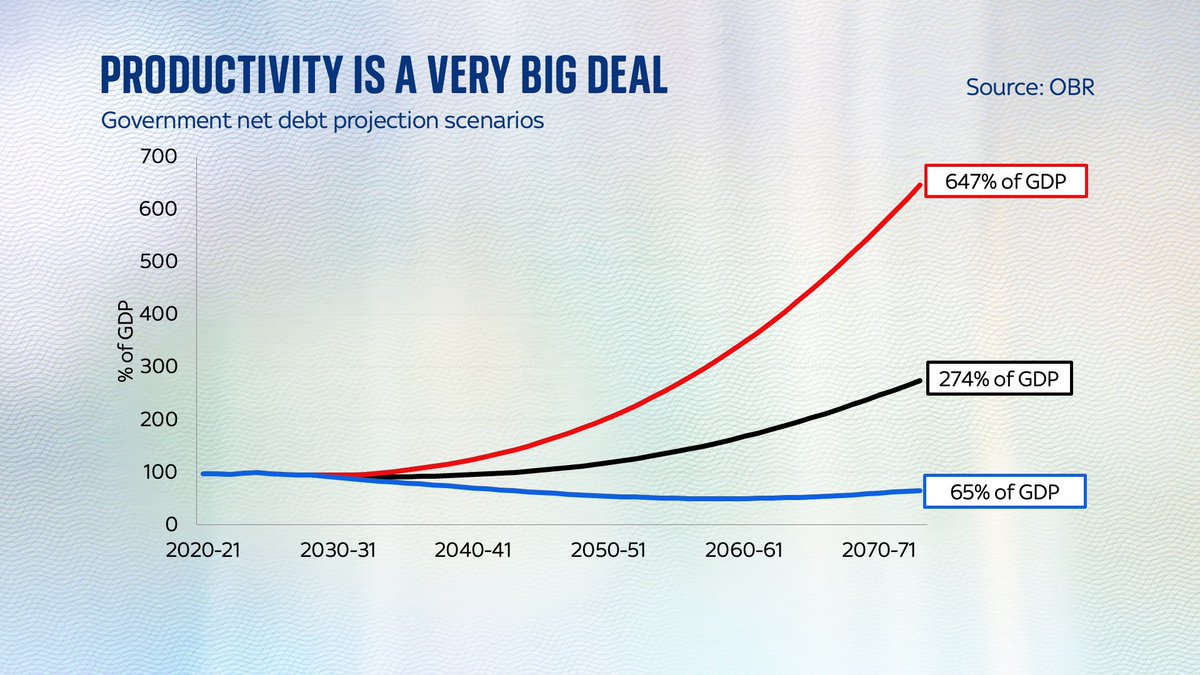
As things stand the OBR is assuming that in the long run UK productivity is growing by about 1.5% a year. Considerably lower than before the crisis.
As things stand the OBR is assuming that in the long run UK productivity is growing by about 1.5% a year. Considerably lower than before the crisis.
If that's right and if the government doesn't bring that exponentially increasing red spending line in the chart above back under control, this is what happens to the national debt in the coming years, according to the @OBR_UK 👇
Up to 274% of GDP. Even higher than during WW2
Up to 274% of GDP. Even higher than during WW2

OK but now let's assume that productivity in the coming decades is weaker: 0.5% rather than 1.5%. Here's what happens to the national debt in that scenario. Look at the red line (NB I've changed the axis to fit it on).
The national debt rises to 647% of GDP.
🤯 levels
The national debt rises to 647% of GDP.
🤯 levels

How about if productivity is a wee bit stronger: 2.5% rather than 1.5%?
Short answer: all of a sudden, without having to impose any aggressive spending cuts, the UK's national debt FALLS rather than rising.
Now you see why every economist is so obsessed with productivity(!)
Short answer: all of a sudden, without having to impose any aggressive spending cuts, the UK's national debt FALLS rather than rising.
Now you see why every economist is so obsessed with productivity(!)
Anyway, do have a watch of the full video which, believe it or not, actually includes even more charts than I've had time for here. And stay tuned. We'll have plenty more on the economic soap opera in the UK (and elsewhere) in the coming weeks.
https://x.com/EdConwaySky/status/1962949268852854905
• • •
Missing some Tweet in this thread? You can try to
force a refresh