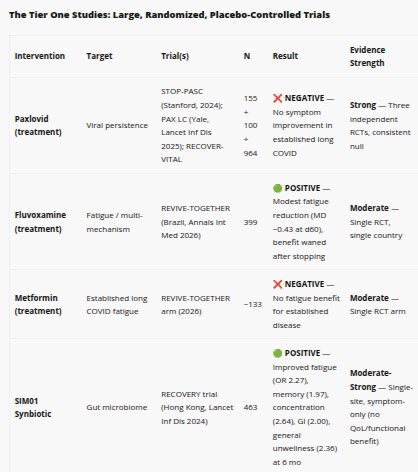
Here's a great roundup on what the Long COVID Community has learned from recent clinical trials, from the always insightful @CortJohnson Definitely worth a read! 🤔🧠
Cort draws several key points from these trials, including:
👉Short term antiviral treatments don't work. It's somewhat surprising after we've all heard the anecdotes of some patients improving on 5-10 days of Paxlovid. Unfortunately, trial results do not show a benefit here.
👉Treatments that prevent Long COVID don't necessarily work to treat it - as in the case of Metformin
👉Interestingly, the reverse is true. Treatments that don't prevent Long COVID at all - as in the case of the antidepressant fluvoxamine - actually have been shown to treat it.
👉Narrow treatments are less helpful than broadly acting ones. For example, Paxlovid has been proven to be less helpful in preventing Long COVID than metformin. Paxlovid ONLY targets SARS-CoV-2 replication, whereas metformin is a host-directed antiviral that affects multiple bodily systems.
There's a lot more great info here - highly recommend checking out the article!
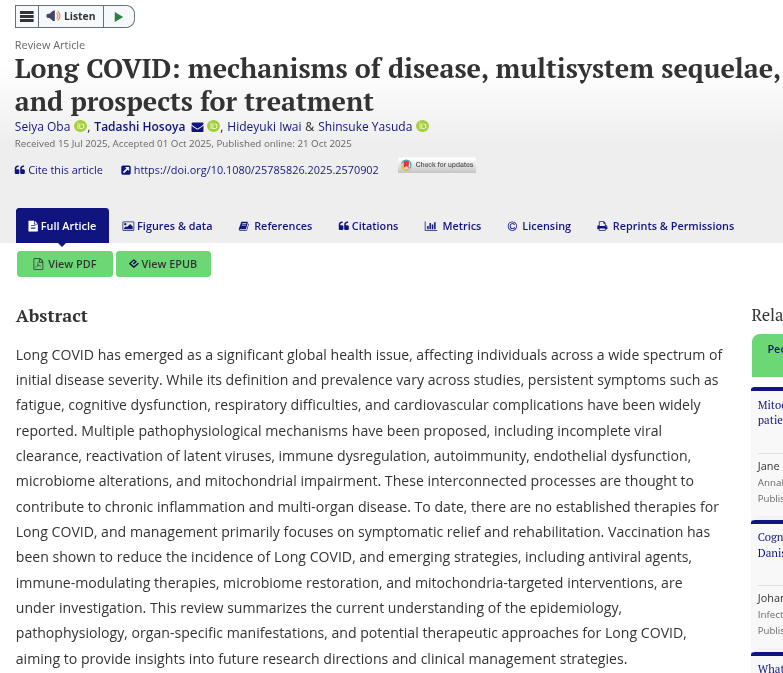
Highly recommend this review from Oba et al. on the current status of Long COVID research & treatment -- worth a read!
Here, the authors outline the major hypotheses for the root causes of LC. The research community has largely been coalescing around these ideas in the last 1-2 years.
The Long COVID community will likely be familiar with these hypotheses.
However, these authors do a great job of explaining mechanistic insights for how and why these phenomena may be occurring - with info you may not have heard before.
Of particular interest was their section on why the SARS-CoV-2 interest may persist - believed by many, including our team, to be the leading root cause of Long COVID.
Let's take a look at what they said!
1/
Possible reasons why SARS-CoV-2 may persist in the human body:
1) Viral persistence has also been reported after infections with other single-stranded RNA viruses, such as Ebola. Ebola RNA has been found throughout the human body months and years after acute infection - and SARS-CoV-2 may be persisting for a similar reason.
2) SARS-CoV-2 possesses multiple immune evasion mechanisms, where it suppresses our own human responses to infection. Its proteins NSP1 and ORF6, inhibit the production of Interferon, which is an important chemical signal our bodies normally produce to fight viruses.
Meanwhile, its ORF8 protein downregulates MHC-1 expression, which is a mechanism our body normally uses to tell the immune system which of our cells are infected by a virus, so it can kill them. When MHC-1 is inhibited, the SARS-CoV-2 virus can remain in our cells, undetected.
2/
3) Chronic inflammation may lead to immune exhaustion—particularly of CD8+ T cells and NK cells.
CD8+ T cells and Natural Killer (NK cells) are two types of immune cells our body uses to kill virally-infected cells. Over time, if these fighters are asked to do a job that's too big for them to handle, they can become "exhausted" - no longer able to do their job.
4) The virus may have gotten into immunologically-privileged sites in the body.
There are certain places in the body, such as the GI tract, the eyes, and the reproductive organs, where the immune system is more tolerant. For various reasons, the immune system is less likely to invade and destroy cells in those places - even if they are virally-infected.
Unfortunately, these locations can be the perfect site for SARS-CoV-2 to hide.
3/
Thanks @MensHealthMag for this great article on new research towards our understanding of brain fog!
In a new study published in Brain Communications, researchers identified a major possible cause of brain fog in Long COVID.
They used PET-scan imaging to compare the brains of Long COVID patients to healthy controls.
They found that the Long COVID patients had increased numbers of a particular type of receptor within the brain, called AMPA receptors.🧐
1/
AMPA receptors help brain cells communicate with one another.
These receptors are crucial for processes like learning new things and storing new memories.
The brain learns and stores new information by forming connections between neurons.🧠
When the number of AMPA receptors has increased, it strongly suggests that something has gone wrong in this process.
2/
In fact, changes in AMPA receptor activity have been found to be associated with other conditions such as depression, schizophrenia, and dementia.
The fact that they are altered in Long COVID patients - many of whom struggle with cognitive and mood difficulties - is very important.
Not only does this development add to our understanding of why some patients experience these symptoms, but it also opens the door to more targeted treatments and prevention strategies.
3/
Here it is: the long-awaited recap of yesterday's space with @rd108 and @MichaelPelusoMD!
Dr. Peluso is an infectious diseases specialist, and HIV and Long Covid researcher at @UCSF Medical School. He is a member of the @Polybio research consortium, as well as the UCSF LIINC team specifically focusing on Long Covid.
Dr. Peluso shared his insights on the root causes of Long Covid, what's been holding research back, and how to move it forward!
To start with, he had some words of hope for LC sufferers.
He explained that while LC sufferers frequently express concern about being left behind as the media stops talking about Covid, he said nothing could be furfher from the truth!
His words:
“I want everyone know that there is a large group of scientists and clinicians who have been working in this field for five years now…. we are all-in in our efforts to try to figure this out.
We really want to see this through and get answers for the millions of people dealing with this debilitating disease.”
1/
Dr. Peluso shared some key insighrs with us from his years on the frontlines studying Long Covid.
Dr. Peluso explained one of the major problems with RECOVER - which as LC suffered know, blew through its initial $1 billion in funding with little to show for it.
A key shortcoming of RECOVER’s initial phase was that it stratified patients into different groups based on symptoms. This meant that, even if patients’ underlying symptoms were all caused by a common cause, such as viral persistence, it became harder to see what was truly going on underneath the surface.
That’s part of why it took the @NIH nearly five years from the start of the pandemic to identify viral persistence as their top hypothesis (as @NIHDirector announced this past spring).
Now, we’re in a situation where LC patients have been left to suffer with no formal treatments. Rohan and Dr Peluso talked about how to move trials forward as quickly as possible.
2/
@rd108: If you could wave a magic wand and had a pot of money to allocate, how would you structure Long COVID trials?
@MichaelPelusoMD: We should be testing multiple potential Long COVID therapeutics in parallel. You could imagine looking at a dozen different interventions simultaneously, in smaller studies of 30-60 patients, and then rapidly doubling down on what's working.
A central funding source and centralized resources for these trials could implement standardized FCC outcome metrics and timepoints, allowing direct comparison between therapeutics, but also give investigators the freedom to innovate and push the envelope.
The advantage here would be reducing the amount of time needed to test interventions, and not needing to reinvent the wheel for each study, while also increasing the ability to compare the outcomes apples-to-apples to help us to decide what moves forward.
A structure like this would also result in many sites that would be shovel-ready to test whatever seems promising, without having to rebuild the entire infrastructure each time.
3/
There are still no FDA-approved tests for Long Covid.
Yet a recent article in Nature Medicine estimates that the impact of Long Covid on the workforce is 1 TRILLION dollars.
1/ #LongCovid
According to this recent study from @YaleMedicine, up to 14% of 3,500 Long COVID patients surveyed in the US had not returned to work three months after getting sick. 2/
@YaleMedicine Primary author Arjun Venkatesh, MD, explained, "It’s a myth to assume this data reflects issues limited to unvaccinated individuals, retiring adults, or people with pre-existing medical conditions." 3/