Thread Reader helps you read and share Twitter threads easily!
I'm @ThreadReaderApp a Twitter bot here to help you read threads more easily. To trigger me, you just have to reply to (or quote) any tweet of the thread you want to unroll and mention me with the "unroll" keyword and I'll send you a link back on Twitter 😀
— Thread Reader App (@threadreaderapp) November 25, 2017
X thread is series of posts by the same author connected with a line!
From any post in the thread, mention us with a keyword "unroll"
@threadreaderapp unroll
Follow @ThreadReaderApp to mention us easily!
Practice here first or read more on our help page!
Recent

Different people have asked my advice after a vulnerable boy got lost and died despite massive search effort. I'm an engineer with telecom background and experience with mobile devices.
Here are my recommendations. I have no commercial interest in any of them.
@paul_dunphy
Here are my recommendations. I have no commercial interest in any of them.
@paul_dunphy




While most of my experience is Apple AirTag, I also recommend a product that is BOTH Apple Find My® and Google Find My Device (Android) compatible.
I cover situations with informed consent or protection of vulnerable people, from children to seniors.
apple.com/ca/airtag/
I cover situations with informed consent or protection of vulnerable people, from children to seniors.
apple.com/ca/airtag/
My usual recommendation is @LOGiiX $10 Armour Tag, which looks like a sports watch, and sits nice and flat against a wrist band, dog collar, backpack strap, or wheelchair sling strap.
Great for consenting older kids, seniors who wander, hidden in a car.
logiix.ca/products/armou…
Great for consenting older kids, seniors who wander, hidden in a car.
logiix.ca/products/armou…

EXCLUSIVE
Nigel Farage struck secret deal for return as Reform leader months before election — challenging claim he wasn't involved in politics so didn't need to report gifts.
In May 24 he showed deal to treasurer, who tonight acknowledged its existence thetimes.com/uk/politics/ar…
Nigel Farage struck secret deal for return as Reform leader months before election — challenging claim he wasn't involved in politics so didn't need to report gifts.
In May 24 he showed deal to treasurer, who tonight acknowledged its existence thetimes.com/uk/politics/ar…
The deal ensured that, if Farage returned as leader, he would repay up to £1m loaned to party by Richard Tice, its then leader. It included schedule of payments
Reform sources say deal was for if, not when, Farage returned. They insist it had still been plan to spend time in US
Reform sources say deal was for if, not when, Farage returned. They insist it had still been plan to spend time in US
George Cottrell was involved in the deal, supervising the process in March and April 2024.
He was with Farage in mid-May when he presented its contents to Mehrash A'zami, the party's treasurer, in an office space near Buckingham Palace.
He was with Farage in mid-May when he presented its contents to Mehrash A'zami, the party's treasurer, in an office space near Buckingham Palace.

matt furie lore 🧵

on weds july 29, @Matt_Furie follows hoodrat on x
we receive a dm hours later
we receive a dm hours later

conversation was spaced apart quite a bit, replying to us multiple hrs later with what seemed like genuine responses.
A few key things:
- no immediate wallet was sent
- wasn't in a rush with getting compensation etc
- follow and comment was live for an extended period of time.
- concern about the nft mint was raised (sparking genuine belief that matt was not hacked)
A few key things:
- no immediate wallet was sent
- wasn't in a rush with getting compensation etc
- follow and comment was live for an extended period of time.
- concern about the nft mint was raised (sparking genuine belief that matt was not hacked)


1/6 When roughly 60,000 people suddenly rushed across the heavily guarded borders of Ceuta, Spain's enclave in North Africa, mainstream observers called it a humanitarian accident.
They were wrong. It was a calculated geopolitical power play--of course the Jews get blamed. 🧵👇
They were wrong. It was a calculated geopolitical power play--of course the Jews get blamed. 🧵👇

2/6 The real culprit? Morocco. When Spain got too friendly with Morocco's rival, Algeria, Rabat flipped a switch on its border enforcement. Tens of thousands crossed into Ceuta in under 48 hours to remind Madrid who controls the border tap.
Classic statecraft, not an accident.
Classic statecraft, not an accident.
3/6 But instead of confronting this North African realpolitik, a loud group of European politicians and digital shock-jocks immediately jumped to a lazy, pre-packaged narrative: they blamed Israel.
How did a territorial squeeze in North Africa become an anti-Israel conspiracy?
How did a territorial squeeze in North Africa become an anti-Israel conspiracy?

Curtis Yarvin (a close associate of Peter Thiel & Marc Andreessen) wrote that “as the crappy govts we inherited … are smashed, they shld be replaced by a global spiderweb of…independent mini-countries, each governed by its own…corporation w/o regard to the residents’ opinions.” 1/

@pabloserdan 2/ Link: unqualified-reservations.org/2008/11/patchw…

@pabloserdan 3/ In 2013, Peter Thiel invested in a tech company founded by “patchwork society” blogger Curtis Yarvin aka Mencius Moldbug. So did Andreessen Horowitz, “led in the investment by Balaji Srinivasan, who was then a general partner”. archive.ph/2025.01.26-024…


Her wisdom was so great… even ‘Umar ibn al-Khattab (RA) trusted her judgment in matters of public welfare.
Who was she??
Who was she??
The streets of Madinah were alive. Merchants calling out prices, people trading, negotiating - the marketplace was the heartbeat of daily life, but also a place where injustice could quietly spread.
Among those trusted to uphold fairness was a woman.
Among those trusted to uphold fairness was a woman.
Her name was Shifā’ bint ‘Abdullāh (RA).
She was among the early Muslims of Makkah and was known for her intelligence and literacy at a time when reading and writing were not widespread.
She was among the early Muslims of Makkah and was known for her intelligence and literacy at a time when reading and writing were not widespread.

🚩 Children all over the UK have been the victims of sexual crimes in public swimming pool mixed-sex changing villages.
🚩 Sexual predators know that they can easily find their young victims in mixed-sex changing villages - especially during the school holidays.
🚩 When @Sport_England stated in its pool design guidance that ‘mixed-sex changing villages are the preferred option’ did they think of the safeguarding implications of presenting children to sexual predators?
🚩 When Councils built these pools - with public money - did they listen to local residents’ concerns? Did they even think of the hazards of allowing women and children to get undressed in cubicles next to predatory males?
🚩 Children are now suffering the consequences of decisions made without any regard for their safety. We have highlighted just a handful of the sexual crimes in swimming pool changing rooms. These all involve children, some as young as nine-years-old. 🧵
1/8
🚩 Sexual predators know that they can easily find their young victims in mixed-sex changing villages - especially during the school holidays.
🚩 When @Sport_England stated in its pool design guidance that ‘mixed-sex changing villages are the preferred option’ did they think of the safeguarding implications of presenting children to sexual predators?
🚩 When Councils built these pools - with public money - did they listen to local residents’ concerns? Did they even think of the hazards of allowing women and children to get undressed in cubicles next to predatory males?
🚩 Children are now suffering the consequences of decisions made without any regard for their safety. We have highlighted just a handful of the sexual crimes in swimming pool changing rooms. These all involve children, some as young as nine-years-old. 🧵
1/8


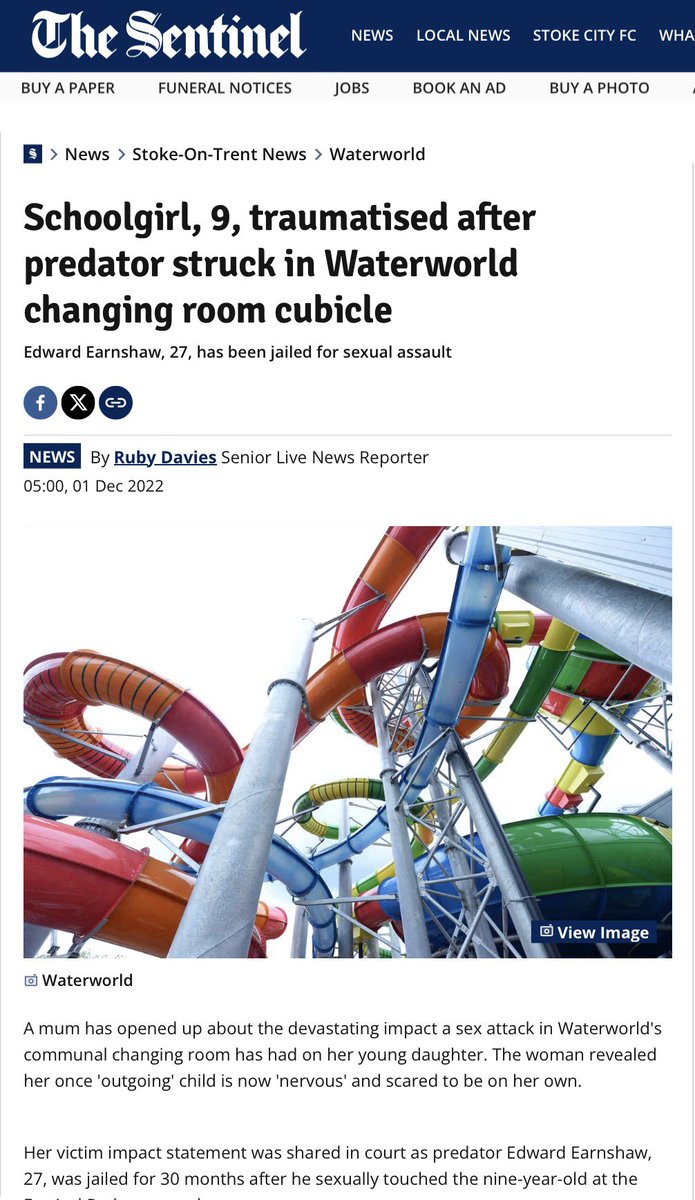
In Stoke-on-Trent, a mother took her daughter and another girl swimming at Waterworld.
Edward Earnshaw, 27, sexually assaulted the woman’s nine-year-old daughter while she was in a cubicle in the mixed-sex changing village.
The girl and her friend gave pre-recorded evidence to the court. The court recorder stated: “The trial put both girls through quite an ordeal having to give evidence… She was isolated and vulnerable in the cubicle.”
The girl’s mother said her daughter was normally a confident young girl, but she now suffers with separation anxiety and won't go upstairs on her own or remain downstairs alone. "She is receiving counselling through school and I worry about what long term effects this will have on her wellbeing as she approaches early adolescence. She will likely be more emotionally vulnerable than her peers on account of this awful experience.” 2/8
Edward Earnshaw, 27, sexually assaulted the woman’s nine-year-old daughter while she was in a cubicle in the mixed-sex changing village.
The girl and her friend gave pre-recorded evidence to the court. The court recorder stated: “The trial put both girls through quite an ordeal having to give evidence… She was isolated and vulnerable in the cubicle.”
The girl’s mother said her daughter was normally a confident young girl, but she now suffers with separation anxiety and won't go upstairs on her own or remain downstairs alone. "She is receiving counselling through school and I worry about what long term effects this will have on her wellbeing as she approaches early adolescence. She will likely be more emotionally vulnerable than her peers on account of this awful experience.” 2/8
Children aged 12 years old were among the many victims of ex-Scout Leader Ian Butcher, 55, who preyed on children in swimming pool changing rooms around Suffolk. The crimes were uncovered when a teenage girl reported that she had been filmed in a swimming pool cubicle by a man putting his hand over the top of the cubicle.
Police checks of his phone revealed 11 videos of voyeurism, mostly filmed in swimming pool changing rooms. Twenty screenshots from the videos capturing moments when nudity was visible were also found on Butcher’s phone.
Eight victims aged 12 to 32 were identified from the footage. A further six people could not be identified.
The crimes were investigated by the Internet Child Abuse Investigation Team. Detective Constable Santiago Nield said: “The crimes we discovered took place over a period of almost two years, so his offending was persistent for a significant length of time. Although not all of the victims were children, the majority were and so he clearly had a sexual interest in juveniles.”
DC Nield praised the bravery of the girl who first reported Butcher’s offending saying it had been crucial to his crimes being uncovered.
3/8
Police checks of his phone revealed 11 videos of voyeurism, mostly filmed in swimming pool changing rooms. Twenty screenshots from the videos capturing moments when nudity was visible were also found on Butcher’s phone.
Eight victims aged 12 to 32 were identified from the footage. A further six people could not be identified.
The crimes were investigated by the Internet Child Abuse Investigation Team. Detective Constable Santiago Nield said: “The crimes we discovered took place over a period of almost two years, so his offending was persistent for a significant length of time. Although not all of the victims were children, the majority were and so he clearly had a sexual interest in juveniles.”
DC Nield praised the bravery of the girl who first reported Butcher’s offending saying it had been crucial to his crimes being uncovered.
3/8


🚨🛑Spent all week tracing stolen crypto from 3 major hacks (Ronin, KelpDAO, Drift) linked to North Korean hackers.
Not the hack itself: what happens AFTER. Where does the money actually go?🛑
Thread 🧵
Not the hack itself: what happens AFTER. Where does the money actually go?🛑
Thread 🧵

Each hack laundered money completely differently:
• One used a privacy mixer
• One used a cross-chain swap tool
• One just sat on $90M+ for 110+ days before moving a cent
• One used a privacy mixer
• One used a cross-chain swap tool
• One just sat on $90M+ for 110+ days before moving a cent
I found the same "watcher" wallets touching all 3 unrelated hacks.
Almost certainly other researchers/bots doing exactly what I was doing.
Almost certainly other researchers/bots doing exactly what I was doing.

🚨When r small-scale field experiments in #SolarGeoengineering worth pursuing?
New paper argues they shouldn't be judged simply by whether they advance SRM research. Instead, they should meet 5 key criteria: scientific rigor, safety, usefulness, transparency & engagement.🧵1/13
New paper argues they shouldn't be judged simply by whether they advance SRM research. Instead, they should meet 5 key criteria: scientific rigor, safety, usefulness, transparency & engagement.🧵1/13

2/Paper focuses on small-scale field experiments, not solar geoengineering deployment
Authors stress that researching SRM doesn't automatically imply support for deployment
Their goal is to identify when outdoor exp r scientifically justified within an ongoing research program
Authors stress that researching SRM doesn't automatically imply support for deployment
Their goal is to identify when outdoor exp r scientifically justified within an ongoing research program
3/ The authors note that current understanding of stratospheric aerosol injection relies primarily on climate models.
Although models indicate SAI could reduce global temp, imp uncertainties remain regarding aerosol processes, precipitation, atmospheric chemistry and ozone.
Although models indicate SAI could reduce global temp, imp uncertainties remain regarding aerosol processes, precipitation, atmospheric chemistry and ozone.

lsræI promoted a definition of "tεrrorism" aimed at delegitimizing PαIεstiniαn resistance. Adopted by the Reagan admin, it made tεrrorism a US priority, deepening US-lsræIi defense ties, enabling the spy Jonathan Pollard to infiltrate US intel & pass classified material to Mo§ad.

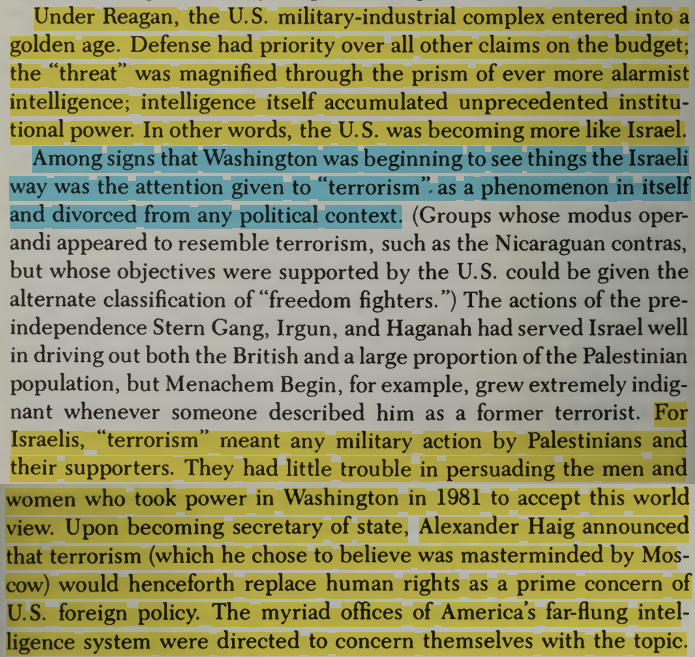
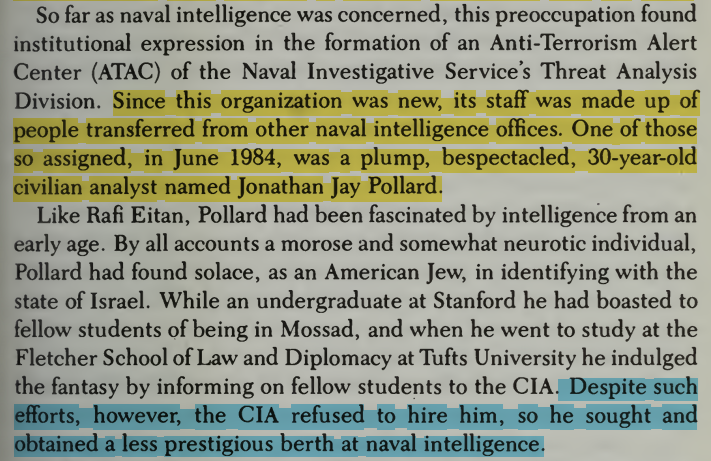
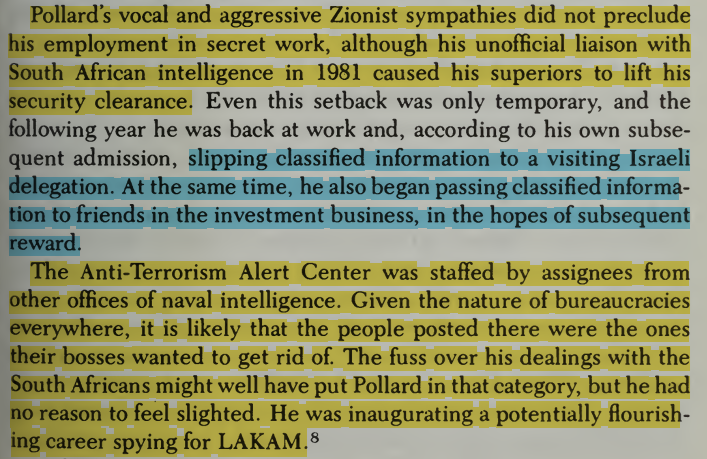
Jonathan Pollard infiltrated US intelligence, passing classified material to lsræIi agencies before his 1985 FBI arrest. In 1998, Nεtanyαhu threatened Clinton with Mo§ad recordings involving Monica Lewinsky in exchange for Pollard's pardon.

Source: Dangerous Liaison by Andrew and Leslie Cockburn

You know I am more weak and sensitive than I thought and that post I posted just proved it to me I AM STILL KEEPING IT UP THOUGH I just need to work on my own feelings which is absolutely hard I think 🤷♀️🤷♀️🤷♀️🤷♀️
@SurreyRCMP @surreyps @LangleyRCMP
@ChrisPentecos @Photosatwork_ @World_Watch_ @LangleyResident @BarbaraDoduk @Cdnwatcher @Istandtoreason @facepalmchris @trustednerd @felixcruggins @CultureGuard @WaxMyBallsShow @FranLa9 @kfurneaux20 @VernThurston @JonYaniv @JNonsense46242
@ChrisPentecos @Photosatwork_ @World_Watch_ @LangleyResident @BarbaraDoduk @Cdnwatcher @Istandtoreason @facepalmchris @trustednerd @felixcruggins @CultureGuard @WaxMyBallsShow @FranLa9 @kfurneaux20 @VernThurston @JonYaniv @JNonsense46242
@SurreyRCMP @surreyps @LangleyRCMP @ChrisPentecos @Photosatwork_ @World_Watch_ @LangleyResident @BarbaraDoduk @Cdnwatcher @Istandtoreason @facepalmchris @trustednerd @felixcruggins @CultureGuard @WaxMyBallsShow @FranLa9 @kfurneaux20 @VernThurston @JonYaniv @JNonsense46242 @threadreaderapp unroll

They made the last mounted cavalry charge in American history, scattered a Japanese force many times their size, and held the ground for five hours.
Three months later, starving on Bataan, the same men had to shoot their own horses to feed the army.
This is the story of the 26th Cavalry..🧵1/6
Three months later, starving on Bataan, the same men had to shoot their own horses to feed the army.
This is the story of the 26th Cavalry..🧵1/6
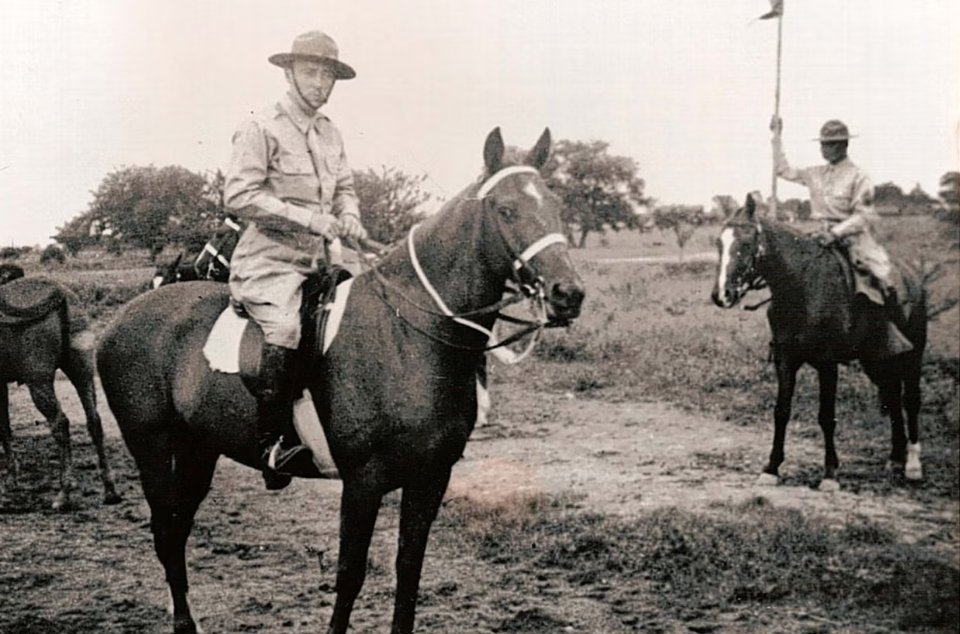
🧵 2/6
The 26th Cavalry Regiment was based at Fort Stotsenberg in the Philippines, and it was not a large unit. Fifty-four officers and around 780 enlisted men, most of them Filipino soldiers of the Philippine Scouts, led by American officers.
Veterans later remembered them as one of the finest regiments in the US Army. One of their own officers said exactly that.
By January 1942 they were fighting a losing battle. The Japanese had invaded, American and Filipino forces were falling back onto the Bataan peninsula, and the 26th Cavalry had been given the job of covering that retreat. They had been in near-constant action for weeks.
On 15 January, a young lieutenant named Edwin Ramsey came off a reconnaissance mission and was due some rest. Instead, when he heard that a village called Morong was to be taken, he volunteered to help, because nobody knew the ground better than he did.
He said afterwards that he had done the one thing they tell you never to do in the army.
The 26th Cavalry Regiment was based at Fort Stotsenberg in the Philippines, and it was not a large unit. Fifty-four officers and around 780 enlisted men, most of them Filipino soldiers of the Philippine Scouts, led by American officers.
Veterans later remembered them as one of the finest regiments in the US Army. One of their own officers said exactly that.
By January 1942 they were fighting a losing battle. The Japanese had invaded, American and Filipino forces were falling back onto the Bataan peninsula, and the 26th Cavalry had been given the job of covering that retreat. They had been in near-constant action for weeks.
On 15 January, a young lieutenant named Edwin Ramsey came off a reconnaissance mission and was due some rest. Instead, when he heard that a village called Morong was to be taken, he volunteered to help, because nobody knew the ground better than he did.
He said afterwards that he had done the one thing they tell you never to do in the army.
🧵 3/6
The next morning, General Wainwright ordered him forward with the advance guard. Ramsey took 27 riders into Morong.
The village was silent when they entered it. Then a Japanese advance guard opened fire, and Ramsey saw what was behind them. Hundreds of Japanese infantry, wading across the river toward the village, with tanks in support.
He had 27 men on horses, armed with pistols, in open ground, against a force many times their size.
There was no cover to reach and no time to withdraw. So he did the only thing that gave his men any chance at all. He raised his pistol and ordered the charge.
They went in bent low over their horses' necks, firing into the faces of the advancing Japanese infantry.
The next morning, General Wainwright ordered him forward with the advance guard. Ramsey took 27 riders into Morong.
The village was silent when they entered it. Then a Japanese advance guard opened fire, and Ramsey saw what was behind them. Hundreds of Japanese infantry, wading across the river toward the village, with tanks in support.
He had 27 men on horses, armed with pistols, in open ground, against a force many times their size.
There was no cover to reach and no time to withdraw. So he did the only thing that gave his men any chance at all. He raised his pistol and ordered the charge.
They went in bent low over their horses' necks, firing into the faces of the advancing Japanese infantry.
