
The people have spoken! Or at least, about 60 of my followers have voted in a poll. And the decision of that highly democratic process is that today I will be tweeting about our recent paper on X-ray diffraction (XRD), with @PHGriff as lead author.
The paper actually came out just before Christmas, but it’s excellent to be tweeting about it now because @PHGriff passed his PhD viva last week! Here’s a link to the full paper which was an Editor’s Pick in Journal of Applied Physics. aip.scitation.org/doi/full/10.10…
We’re using X-ray diffraction to study structures with alternating layers of porous and non-porous gallium nitride. If you’d like to know why on earth we’d do that, here’s a thread I wrote earlier about why these structures are super useful in LEDs:
Now, using X-ray diffraction to study structures consisting of multilayers of different materials is pretty common. This relies on the general idea is that X-rays reflect at boundaries between materials of different refractive index.
Two X-rays reflecting off two different interfaces, say at the bottom and top of a layer, will travel different distances. We call that the path difference.
d32ogoqmya1dw8.cloudfront.net/images/researc…
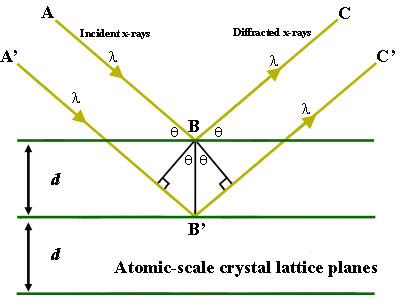
Now, X-rays are waves, like any other kind of electromagnetic radiation, so they have a wavelength. If the path difference between the two waves is equal to a whole number of wavelengths the waves reinforce each other, and we get a strong reflection.
That’s called constructive interference. Equally, if the waves are half a wavelength out of step, the trough of one wave will overlap with the peak of the other and they’ll cancel out. That’s destructive interference.
For a fixed x-ray wavelength, whether we get constructive or destructive interference will depend on the angles at which the x-rays meet the sample. As we increase the angle of the beam to the surface, we decrease the path difference.
As the path difference changes, we will alternate between constructive and destructive interference. We record this as fringes in our X-ray scan. We can use the fringe spacing to work out the thickness of the film. encrypted-tbn0.gstatic.com/images?q=tbn%3…
When we have lots of layers, the idea is the same, but now we have lots of interfaces all reflecting back an x-ray beam. So we have to work out the constructive and destructive interference from all those beams to understand out data.
That can get tricky fast, but thankfully for layers of – for example – GaN alloys of different composition, there is good software available to help us figure out what’s going on and we can estimate the compositions and the thicknesses of the layers pretty well.
(If you can get your hands on it, this paper talks about determining compositions and thicknesses in multilayers of InGaN and GaN using XRD. It’s an oldie but a goodie: aip.scitation.org/doi/10.1063/1.…)
Back finally to our original problem: we didn’t have GaN alloys of different composition in our new multilayers. We had layers of porous and non-porous GaN – all the same composition. Would XRD work to characterise these multilayer structure?
I guess I wouldn’t be writing this thread if it didn’t work! So yes, we can use XRD to understand porous GaN multilayers! However, the standard modelling approaches aren’t applicable, because they assume differences in composition – which we don’t have!
So @PHGriff (with some help from coauthors) built a new model for the interference of X-rays when they reflect from different layers in a porous multilayer, which depends on the thickness of the layers and their porosity (what proportion of the materials is pore).
That means we can then measure those key parameters of our layers using XRD, when previously we’ve had to break the wafers up and look at them in a scanning electron microscope, which makes pretty pictures but is destructive.
(We checked our measurements against conventional scanning electron microscopy measurements and against optical measurements, and the XRD is just as good as the SEM, if not better).
Not having to break wafers to check their properties means we can incorporate our porous multilayers into real working devices and still be able to characterise them which is really helpful.
Hope you enjoyed that brief introduction to our recent XRD work. Here’s the link again if you want to read the whole thing. This thread is part of my efforts to tweet #SomeNiceThings to cheer us all up during the pandemic. If you enjoyed it, please tweet something nice yourself!
(If you want to model your own porous multilayers in XRD, the modelling code written for this work is freely available under an MIT license at: bitbucket.org/phgriffin/poro… )
Share this Scrolly Tale with your friends.
A Scrolly Tale is a new way to read Twitter threads with a more visually immersive experience.
Discover more beautiful Scrolly Tales like this.