
@arynebaker 1/47》The "climate emergency" is imaginary.
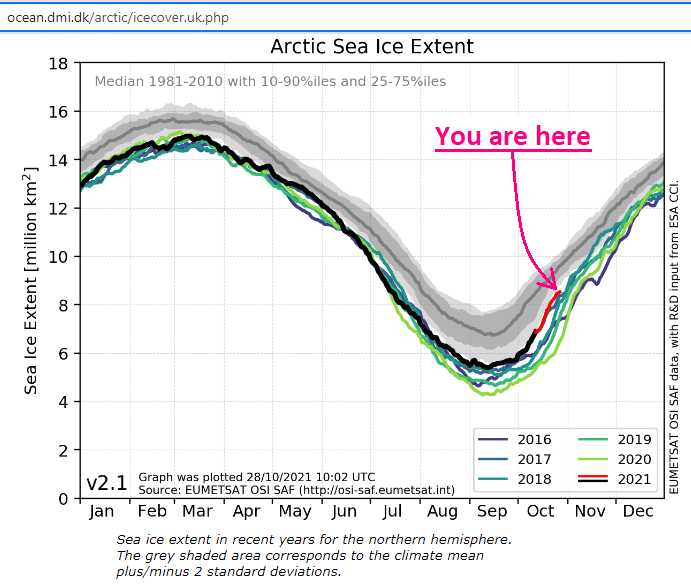
Here's current Arctic sea-ice extent. It is the highest it's been for this time of year in the last half-dozen years, so why aren't you writing about it NOT?
ocean.dmi.dk/arctic/icecove…
sealevel.info/DMI_Arctice_se…
@arynebaker 2/47》Your sources for the information that you reported told you a LOT of complete nonsense, but this part of what you reported is true:
"Global sea levels are largely unaffected by sea ice melt, as it was already displacing ocean water when frozen."
@arynebaker 3/47》However, this part of what you wrote is not true: "The loss of land based glaciers and ice shelves, however, has serious consequences."
Ice shelves are floating ice, just like sea ice. Consequently, they do not affect sea-level when they melt.
@arynebaker 4/47》You wrote: "Were it to melt entirely, Greenland’s ice sheet could raise sea levels by at least 20 feet… still a few centuries away."
Actually, at the current rate, the Greenland ice sheet would take about 130 centuries to melt (or 90 centuries w/ JPL's inflated estimate).
@arynebaker 5/47》The "climate emergency" scam won't last even 1/100ᵗʰ that long. (In fact, the Holocene interglacial, itself, probably won't last that long.)
@arynebaker 6/47》You wrote, "When there isn’t enough ice to reflect the sun’s rays back into space, that heat is instead absorbed by the ocean, accelerating… ice melt"
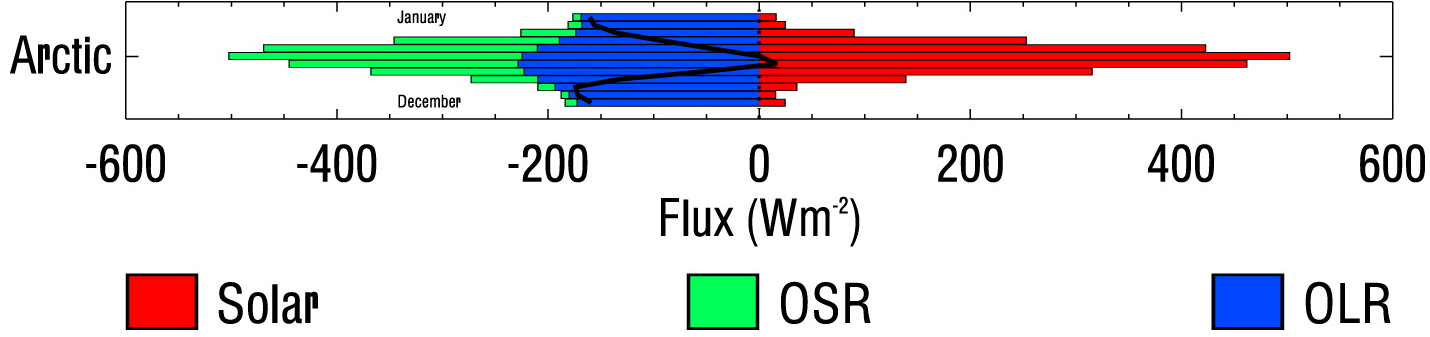
That's exactly backward. The Arctic emits far more energy than it absorbs in sunlight. Less ice cover increases heat LOSS.
@arynebaker 7/47》The reason the Arctic's much warmer than Antarctica is that currents (ocean & air) carry heat from lower latitudes. The Arctic radiative balance is negative 11 months of the year. I.e., it emits more radiation than it receives in sunlight. Reference:
sealevel.info/2015_lecuyer_e…
@arynebaker 8/47》Here’s a close-up of one of the graphs:
sealevel.info/2015_lecuyer_e…
Ice coverage impedes radiative heat loss from the Arctic ocean. Reduced ice coverage increases radiative and evaporative cooling of the Arctic Ocean. It COOLS the water, and warms the air above.
@arynebaker 9/47》That’s an important “negative feedback mechanism” which helps regulate Arctic water temperature:
warmer water temp → less sea ice coverage → more evaporation → cooler water temp
@arynebaker 10/47》Based on Nimbus-5 observations, Zwally, et al. 1983 reported:
“…the release of heat to the atmosphere from the open water is up to 100 times greater than the heat conducted through the ice.”
dtic.mil/dtic/tr/fullte…
@arynebaker 11/47》It's an important effect, as the NSIDC explains here:
nsidc.org/cryosphere/sot…
EXCERPT: “Sea ice regulates exchanges of heat, moisture and salinity in the polar oceans. It insulates the relatively warm ocean water from the cold polar atmosphere except where cracks,…
@arynebaker 12/47》
…or leads, in the ice allow exchange of heat and water vapor from ocean to atmosphere in winter. The number of leads determines where and how much heat and water are lost to the atmosphere, which may affect local cloud cover and precipitation.”
@arynebaker 13/47》The article is riddled with such errors. I suppose that you just reported what you were told, and didn't intentionally lie, but most of what you were told was complete nonsense.
@arynebaker 14/47》 For instance, you wrote, "ice melts during the summer months before starting to form again as winter returns— are… a problem for polar bears and Inuit hunters…"
In fact Polar bears & Inuits are prospering.
polarbearscience.com
@arynebaker 15/47》You wrote, "The effects ripple through the global ecosystem, manifesting in greater drought, heat, floods and storms."
Ever word of that is false except "heat." (I'll come back to that in tweet #36/47.)
@arynebaker 16/47》It's NOT true storms are worsening.
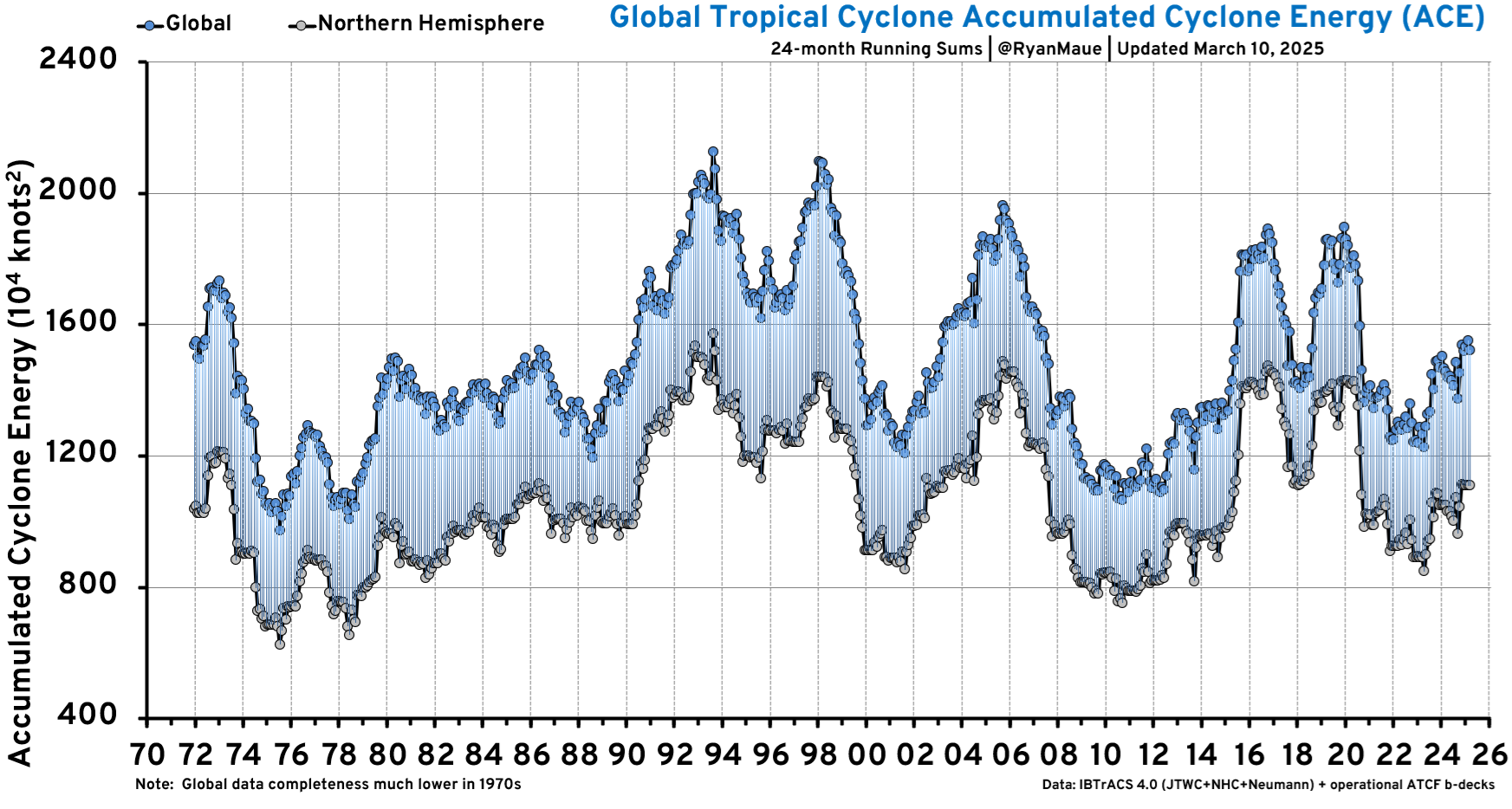
You mentioned hurricanes. But hurricanes & other tropical cyclones haven't worsened:
nature.com/articles/ncomm…
Do you understand graphs? This graph shows that tropical cyclones haven't worsened:
climatlas.com/tropical/globa…
@arynebaker 17/47》Extratropical "nor'easters" aren't worsening, either. Here are a couple of references:
acs.evsc.virginia.edu/storms/dataana…
alcf.anl.gov/news/innovativ…
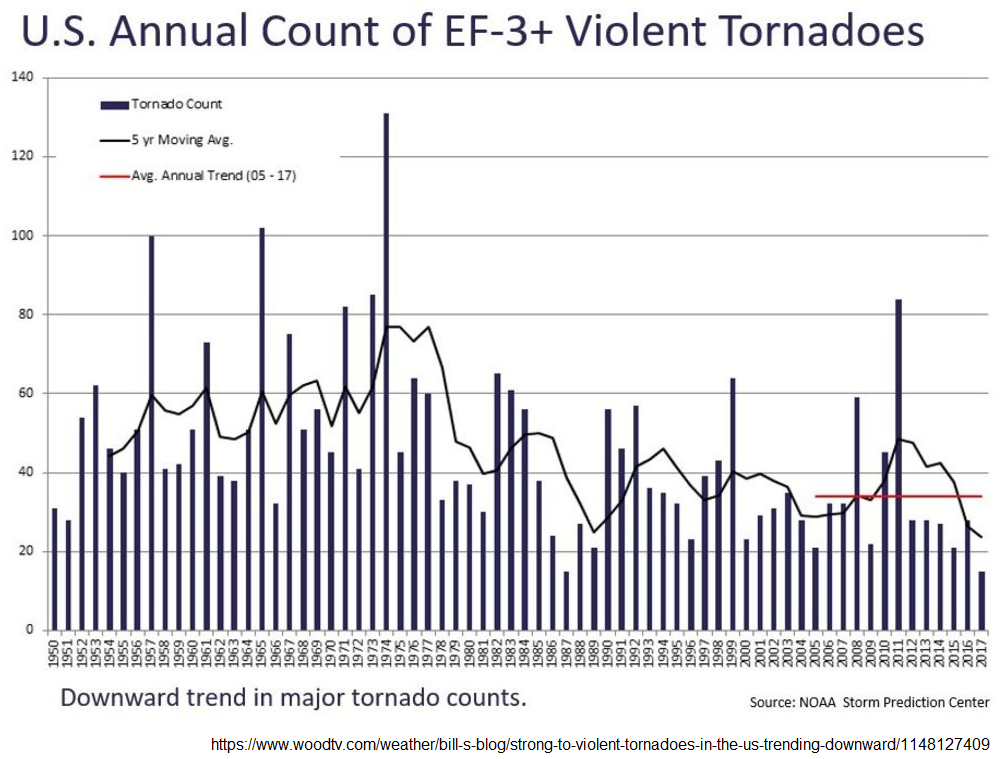
@arynebaker 18/47》The frequency of severe tornadoes has sharply declined. (Interestingly, nobody knows why.)
sealevel.info/learnmore.html…
sealevel.info/EF3_to_EF5_tor…
@arynebaker 19/47》The main factors affecting fire prevalence and severity are land management and forestry practices, not climate.
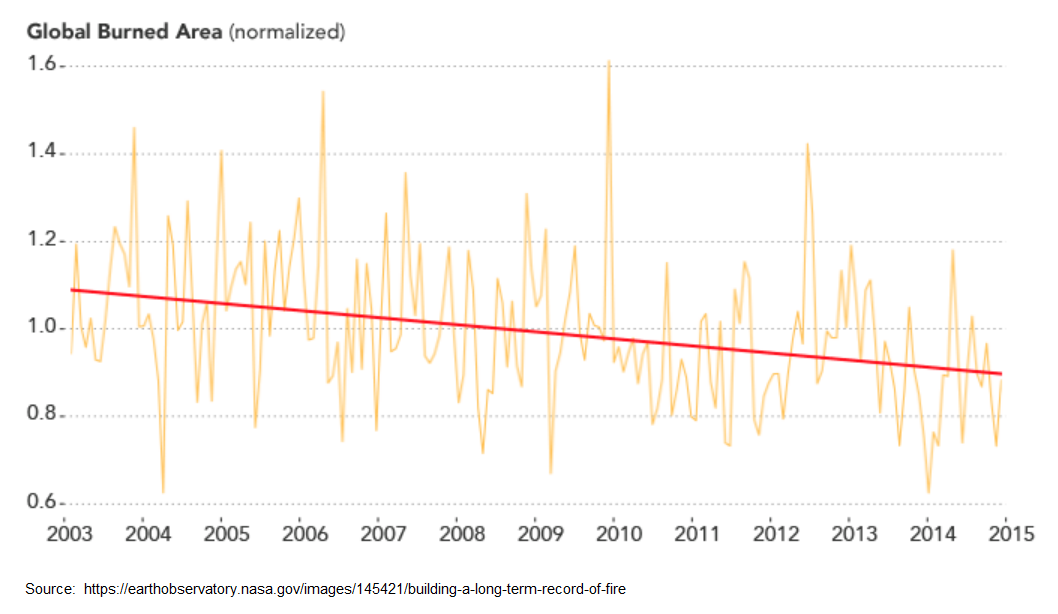
But fires haven't worsened, anyhow. NASA measures fire trends by satellite; here's an article:
earthobservatory.nasa.gov/images/90493/r…
@arynebaker 20/47》Here's another article:
earthobservatory.nasa.gov/images/145421/…
EXCERPT:
"...MODIS [satellite instruments have measured] a decrease in the total number of square kilometers burned each year. Between 2003 and 2019, that number has dropped by roughly 25 percent."
sealevel.info/NASA_building_…
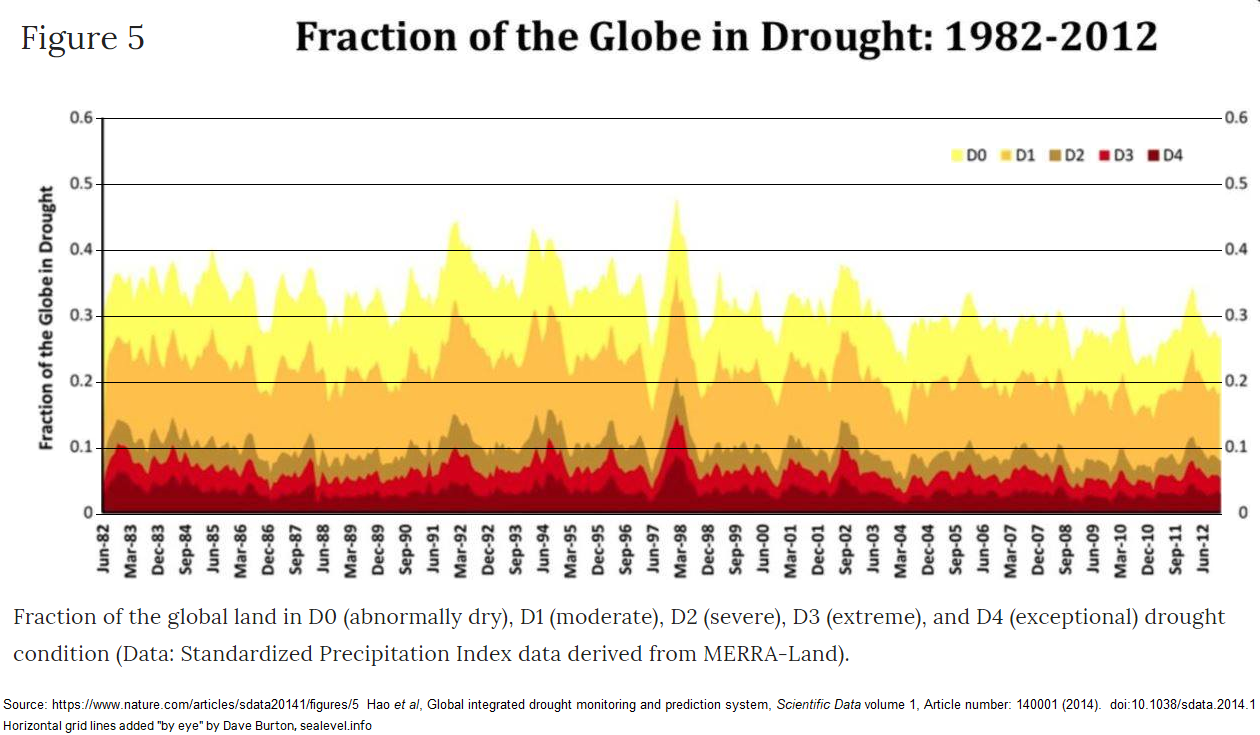
@arynebaker 21/47》Droughts are not worsening, either.
I really hope you understand graphs! Here's a paper, and a graph from it (except that I added the horizontal lines):
nature.com/articles/sdata…
sealevel.info/Fraction_of_th…
@arynebaker 22/47》Here's a NOAA chart. I hope it is obvious to you that the trend is flat (droughts aren't worsening):
ncdc.noaa.gov/temp-and-preci…
@arynebaker 23/47》Not only are droughts not worsening, elevated CO2 actually mitigates drought impacts!
Did you know that? It is settled science. If your sources discussed droughts but didn't mention that key fact, it means you weren't given balanced, scientific information.
@arynebaker 24/47》Droughts can be deadly, but droughts do not kill by thirst, they kill by starvation. So what really matters is droughts' impact on food production.
@arynebaker 25/47》Higher CO2 levels mitigate drought impacts by enabling crops to better withstand reduced moisture availability, by reducing plants' water requirements. That's one of the reasons that famines have become rare, for the first time in human history.
@arynebaker 26/47》Here's a relevant paper:
sciencedirect.com/science/articl…
EXCERPT: "There have been many studies on the interaction of CO2 and water on plant growth. Under elevated CO2, less water is used to produce each unit of dry matter by reducing stomatal conductance."
@arynebaker 27/47》Elevated CO2 greatly benefits legumes (beans, peas, alfalfa), which are grown for protein content. So it helps mitigate protein shortages in poor countries. Here's a paper:
frontiersin.org/articles/10.33…
It also greatly benefits wheat; here's a paper:
ncbi.nlm.nih.gov/pubmed/26929390
@arynebaker 28/47》The fact that elevated CO2 (eCO2) improves crop yields & mitigates drought impacts is helping to make famines rare for first time in history.
ourworldindata.org/famines
sealevel.info/Famine-death-r…
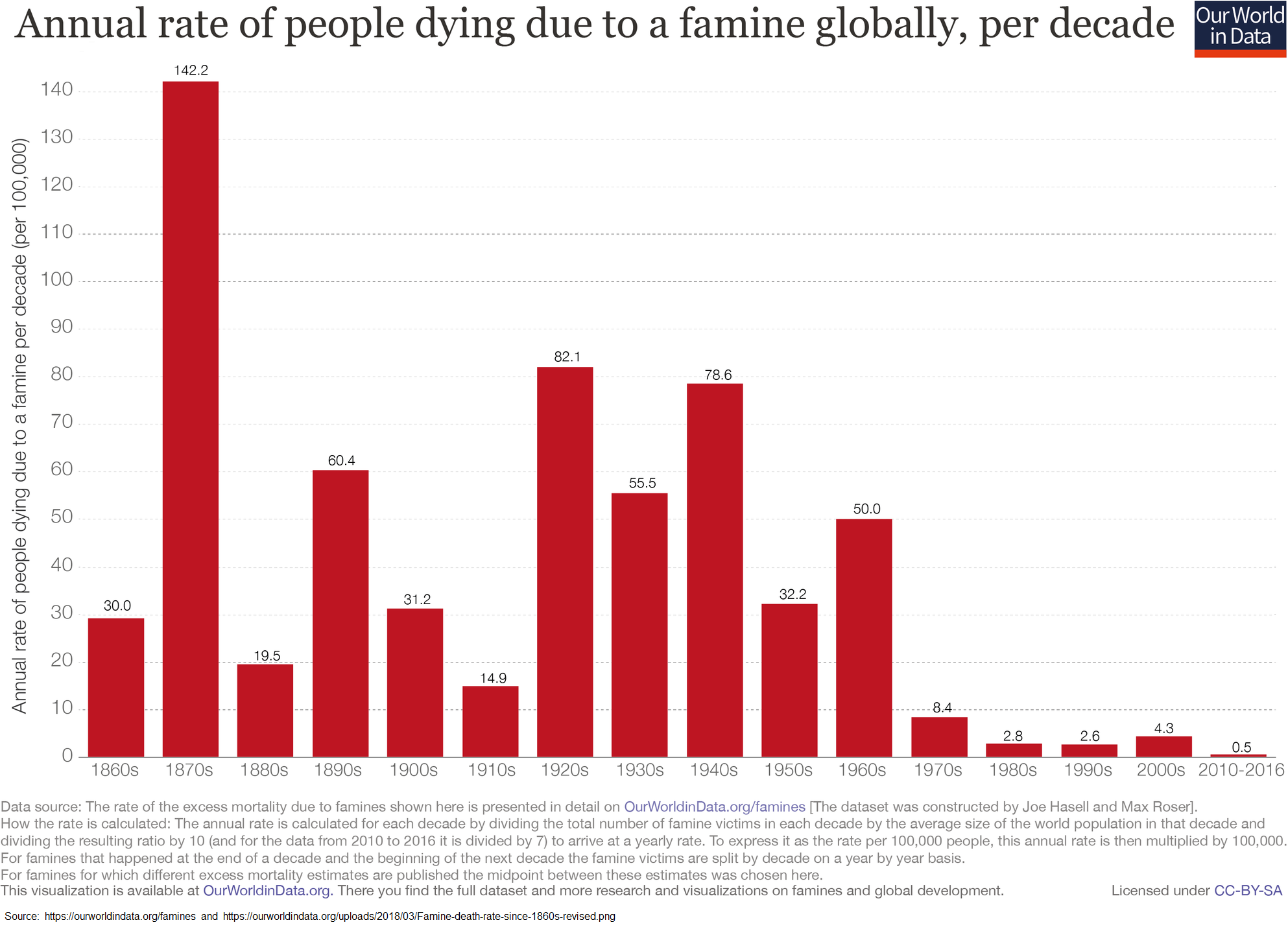
@arynebaker 29/47》The importance is impossible to overstate. Compare:
● Covid-19 has killed ≈0.064% of world population, so far.
● 1918 flu pandemic killed ≈2%.
● WWII killed ≈2.7%.
● The near-global drought & famine of 1876-78 killed ≈3.7%, when CO2 level was ≈289 ppmv.
@arynebaker 30/47》When I was a child, horrific famines were often in the news, in places like Bangladesh & Africa. But Bangladesh and India now have food surpluses, every year. Rising CO2 level is one of the reasons for that.
@arynebaker 31/47》The Earth is greening, thanks to elevated CO2 -- especially in arid regions:
sealevel.info/greening_earth…
@arynebaker 32/47》NASA measures it, from satellites; here's their video about it:
@arynebaker 33/47》Elevated CO2 (eCO2) is beneficial for almost all ecosystems. In fact, eCO2 even helps pine forests withstand bark beetles.
academic.oup.com/treephys/artic…
@arynebaker 34/47》Elevated CO2 helps warm the Earth, but there's no convincing evidence that's harmful. In fact, scientists call warm climate periods "climate optimums."
Plus, elevated CO2 is VERY beneficial for agriculture — a fact known to science for >100 years.
tinyurl.com/1920sciamCO2
@arynebaker 35/47》We'll never get CO2 to anywhere near optimum (Cretaceous/Jurassic) levels, but the modest increase so far is helping both man and nature.
@arynebaker 36/47》The one word you wrote which wasn't entirely wrong was "heat." (Tho a better term would be "reduced chilliness" or similar, because Arctic air's never hot.) Because less Arctic ice coverage accelerates heat transfer from water to air, it cools the water, but warms the air.
@arynebaker 37/47》But that is a Good Thing, because, by any sane measure, Arctic air is much too cold.
@arynebaker 38/47》In fact, that's one of the factors which causes "Arctic amplification" -- the happy fact that "global" warming isn't actually very global. It disproportionately warms high latitudes, making their frigid winters slightly less brutal. It has little effect on the tropics.
@arynebaker 39/47》The great Nobel Laurate Svante Arrhenius predicted beneficial Arctic Amplification from CO2 more than a century ago:
sealevel.info/Arrhenius_pola…
@arynebaker 40/47》Here's Arrhenius in the 1908 English translation of his 1906 book:
sealevel.info/Svante_Arrheni…
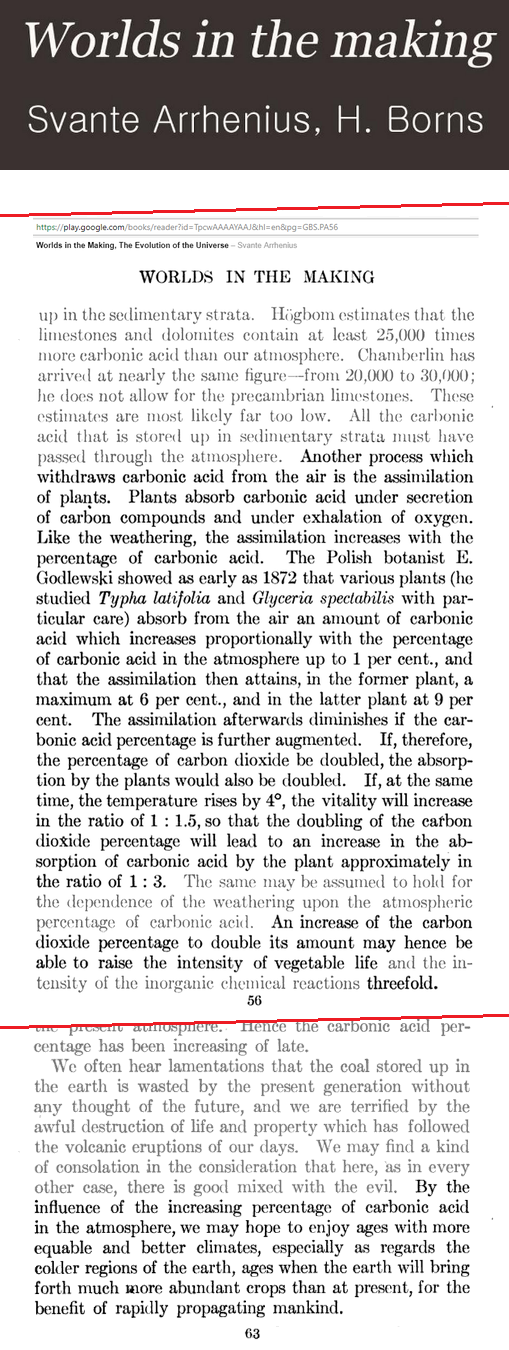
@arynebaker 41/47》Arrhenius understood that by any sane measure the Arctic is TOO COLD. How's that not obvious?
If anyone needed proof climate alarmism is cray cray, this should do it: climate alarmists actually complain that Canada, Sweden & the ARCTIC are too HOT.
@arynebaker 42/47》Observed warming is so slight that it is hardly noticeable, and difficult to measure. We’ve seen an average of between 0.4 & 0.9°C of warming since 1958 (when Mauna Loa CO2 measurements began), but it's disproportionately at high latitudes, which are much too cold, anyhow.
@arynebaker 43/47》We might get another 1°C of warming, but the last 1°C of warming we got was beneficial. So the prospect of another 1°C is unthreatening. In American breadbasket states, farmers can compensate for that much warming by planting about one week earlier.
@arynebaker 44/47》1°C of warming is an average isotherm shift of only 60-70 miles. It's what you get from an elevation change of only about 800 feet. It is hardly noticeable.
That's why farmers -- the people most affected by climate -- are so rarely worried about global warming.
@arynebaker 45/47》The best evidence is that CO2 emissions are beneficial, and the "social cost of carbon" is negative, and "decarbonization" is a fool's errand. Here are some relevant papers:
sealevel.info/negative_socia…
@arynebaker 46/47》Climate change is highly politicized, so, as for any politicized issue, if you want to understand it you must find balanced information. Here's a list of resources to help you learn about the SCIENCE of climate change, instead of political spin:
@arynebaker Typo correction:
I meant, "why aren't you writing about it NOW?"
Share this Scrolly Tale with your friends.
A Scrolly Tale is a new way to read Twitter threads with a more visually immersive experience.
Discover more beautiful Scrolly Tales like this.