
@thelindscape @skdh @sciam 1/21》Wow, with @NASAGoddard / @NASAGoddardPix putting out such colossally confused rubbish, it is no wonder you are confused, too, Lindsey. Literally the only thing correct in their video is the first 13 words.
@thelindscape @skdh @sciam @NASAGoddard @NASAGoddardPix 2/21》Lindsey, you wrote, "CO2 does act as a fertilizer, but only to a certain extent."
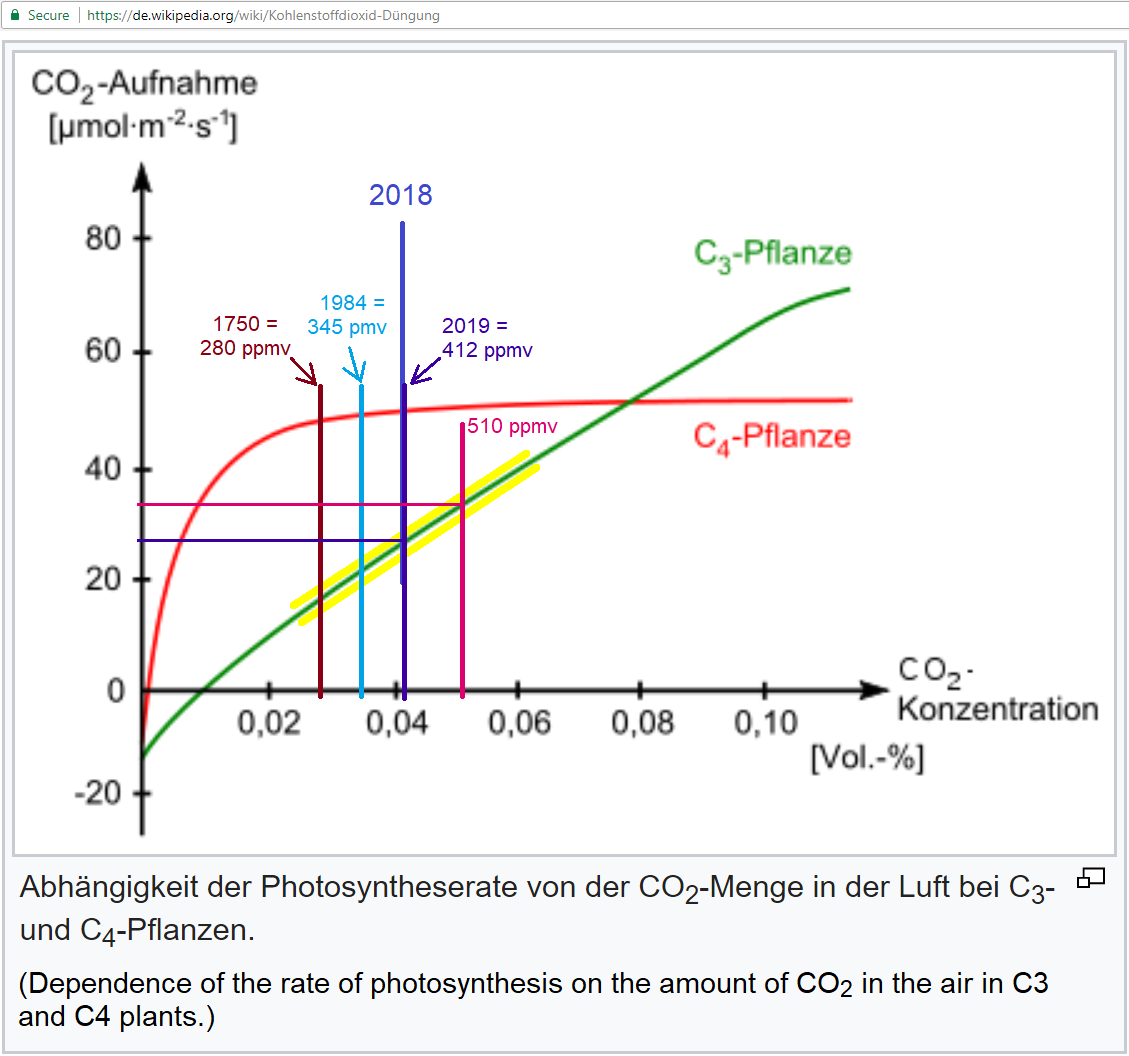
That's technically true, but wrong for practical purposes, because the "CO2 fertilization" benefit of rising CO2 level doesn't begin to taper off until about 1000 ppmv.
@thelindscape @skdh @sciam @NASAGoddard @NASAGoddardPix 3/21》That's far higher than we can ever hope to drive CO2 levels. So for practical purposes, the "fertilization" benefit of rising CO2 levels is approximately linear, and it's been measured by many rigorous studies:
sealevel.info/C3_and_C4_Pfla…
@thelindscape @skdh @sciam @NASAGoddard @NASAGoddardPix 4/21》You wrote, "Plants are extremely temperature-sensitive."
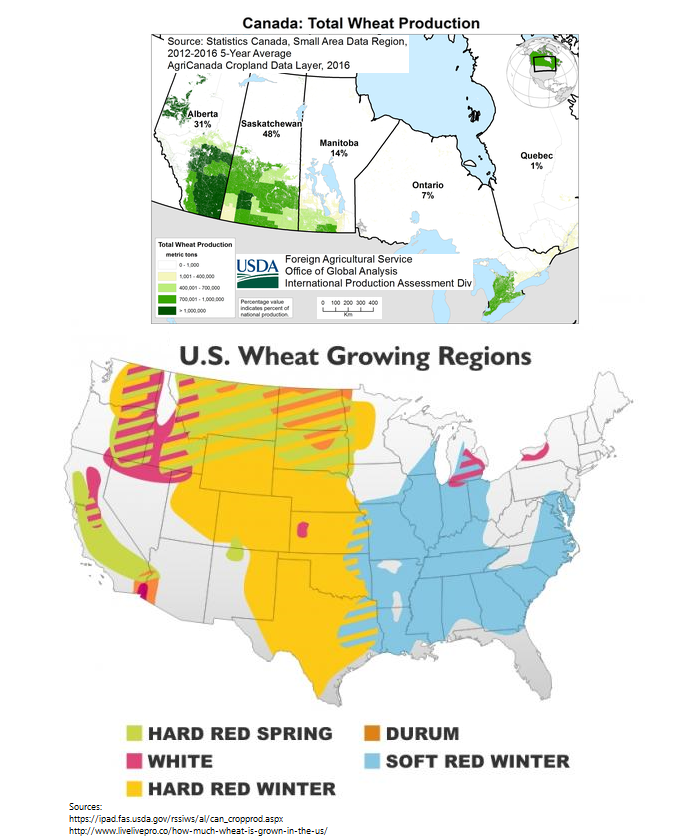
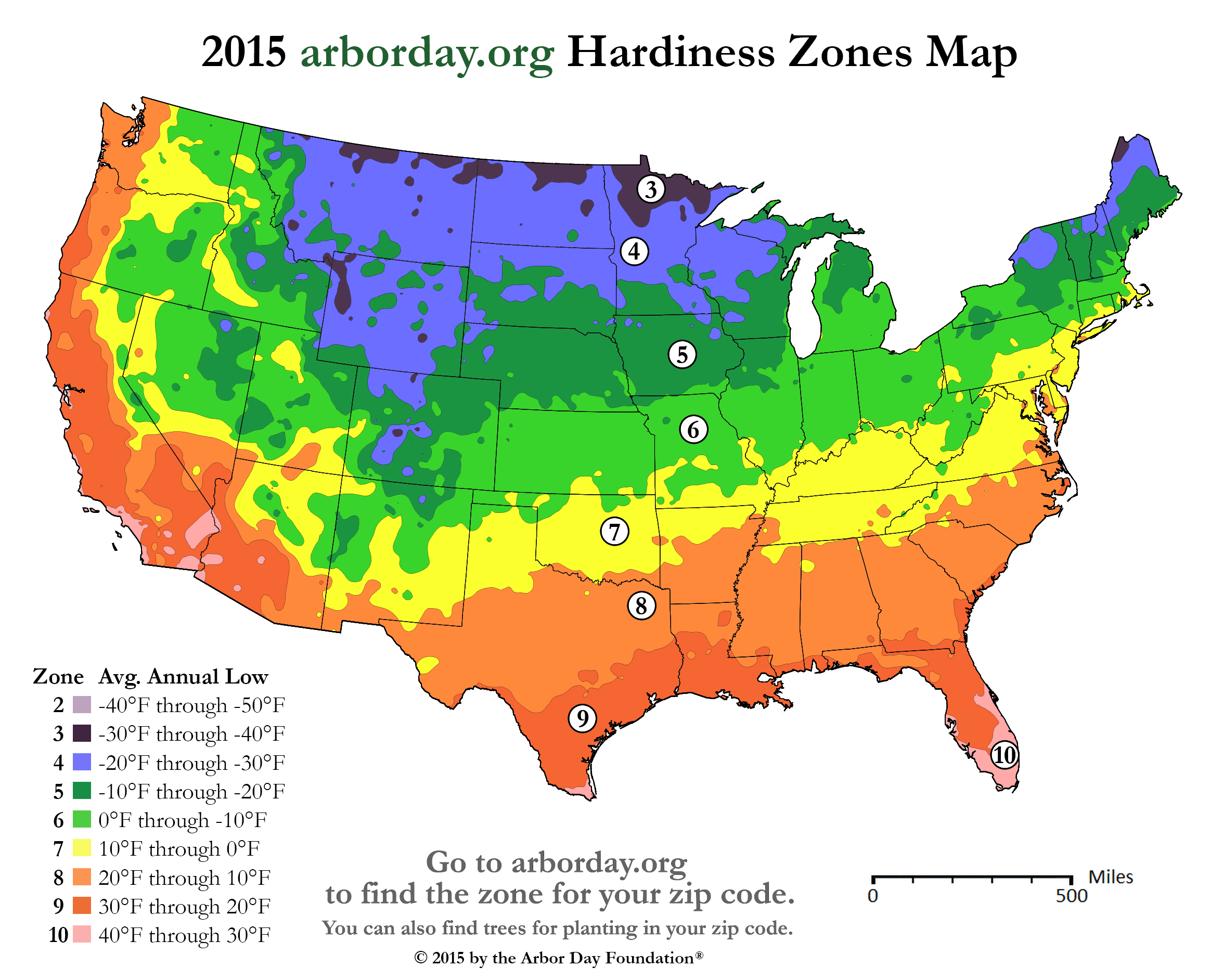
Wrong. 1°C is about the temp change from an elevation decrease of 500 feet, or (at mid-latitudes) a latitude decrease of 60 miles. It's dwarfed plant growing ranges:
sealevel.info/wheat_growing_…
sealevel.info/2015_zones_hig…
@thelindscape @skdh @sciam @NASAGoddard @NASAGoddardPix 5/21》Try telling a farmer that 1°C warmer climate would be a disaster for him and his crops. Be prepared for him to laugh out loud at you.
@thelindscape @skdh @sciam @NASAGoddard @NASAGoddardPix 6/21》In the American heartland, farmers can fully compensate for 1°C of warming by planting about 6 days earlier in springtime. {yawn} 🥱
@thelindscape @skdh @sciam @NASAGoddard @NASAGoddardPix 7/21》You wrote that "we're seeing the declining nutritional value of our crops."
That's wrong, too. That's the debunked Loladze/Myers "nutrition scare." Food grown in greenhouses at 1500 ppmv is just as nutritious as food grown outdoors at 415 ppmv.
@thelindscape @skdh @sciam @NASAGoddard @NASAGoddardPix 8/21》Better crops yields, due to eCO2 or any other reason, can reduce levels (but not total amounts) of nutrients which are in short supply in the soil. But it's insignificant with agricultural best practices.
@thelindscape @skdh @sciam @NASAGoddard @NASAGoddardPix 9/21》You wrote, "Plants are…. getting less efficient at using CO2"
You're misled by that ridiculous @NASAGoddard / @NASAGoddardPix video. It's completely wrong.
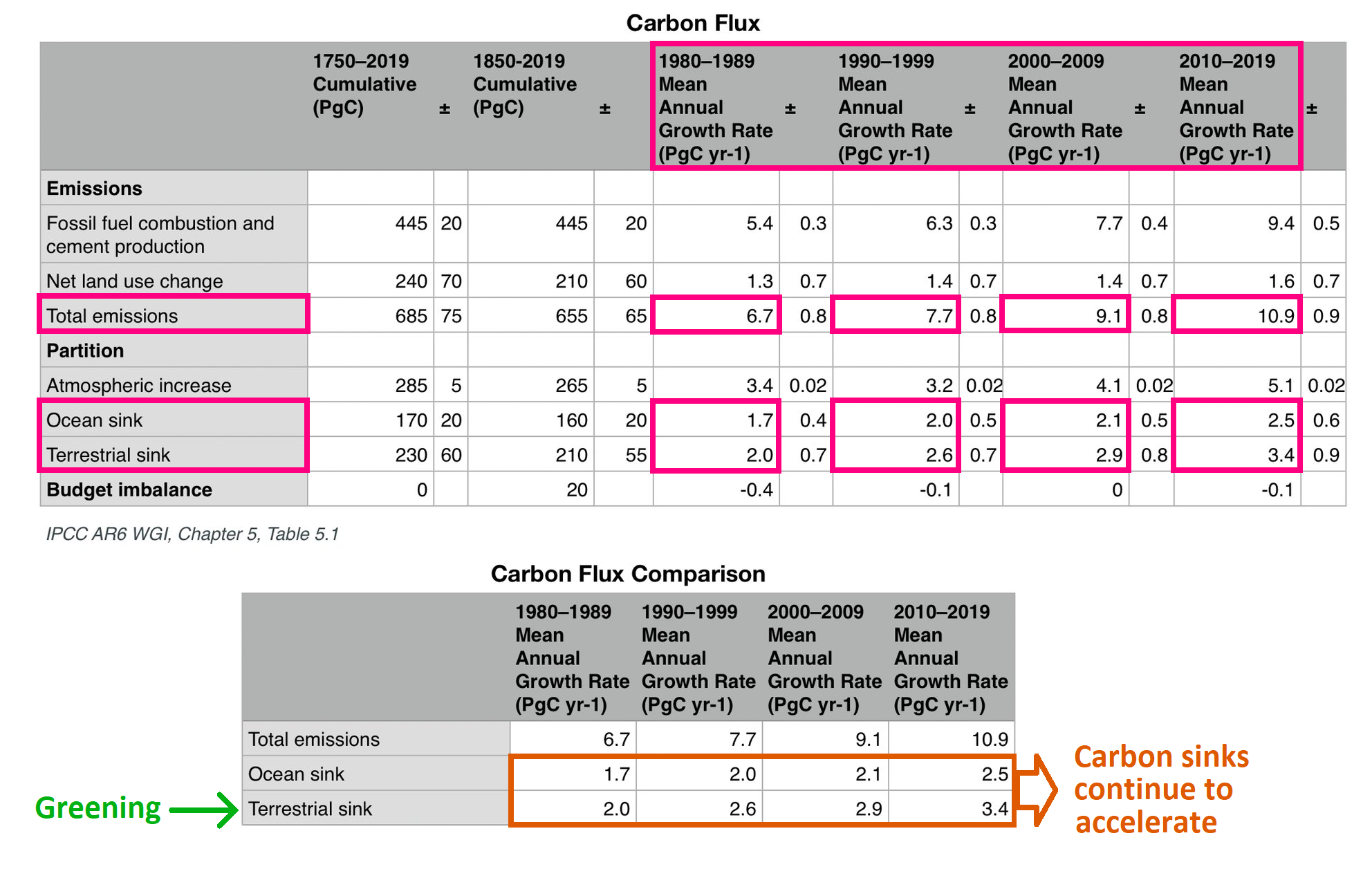
As CO2 levels rise, plant growth and CO2 removal by plants accelerates. This is from AR6:
sealevel.info/AR6_WG1_Table_…
@thelindscape @skdh @sciam @NASAGoddard @NASAGoddardPix 10/21》It is astonishing what a complete pile of steaming nonsense that @NASAGoddard / @NASAGoddardPix video is.
The narrator began by saying, "carbon dioxide is a kind of plant food."
That was literally the ONLY accurate sentence in the entire video! I'm not kidding.
@thelindscape @skdh @sciam @NASAGoddard @NASAGoddardPix 11/21》Then she said, "Plants break down carbon dioxide as they make energy through photosynthesis."
That's backward. Plants do not "make energy." They USE energy, from sunlight, to make hydrocarbons: stems, roots, leaves, fruits, seeds, etc.
@thelindscape @skdh @sciam @NASAGoddard @NASAGoddardPix 12/21》At 0:40 the narrator says, "as the planet gets warmer, plants are absorbing less carbon dioxide."
In fact, we have definitive measurements which show exactly the opposite. See, for example, Table 5.1 in the AR6 WG1 Report.
sealevel.info/AR6_WG1_Table_…
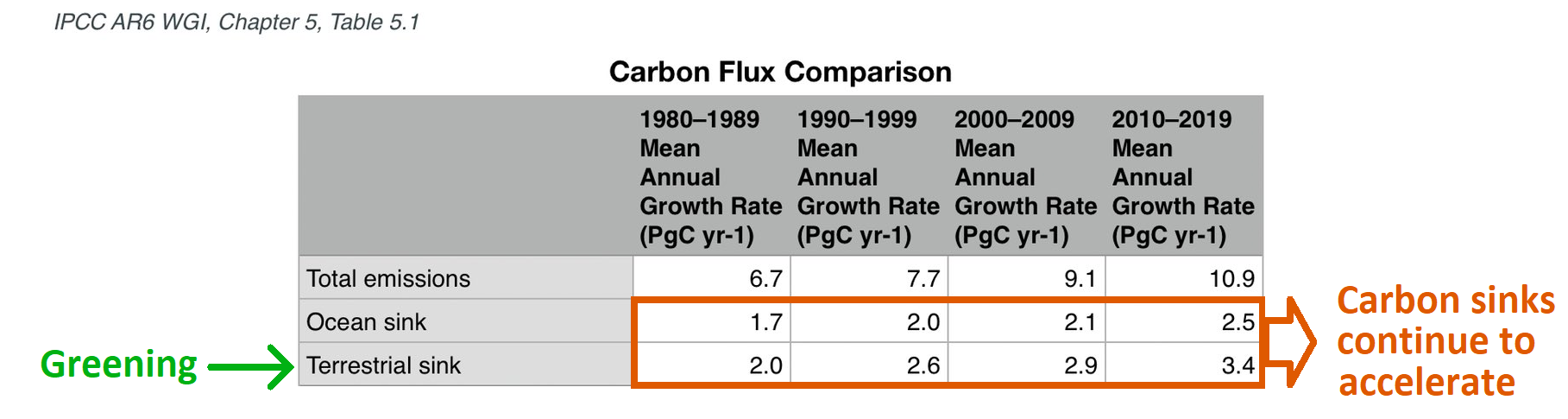
@thelindscape @skdh @sciam @NASAGoddard @NASAGoddardPix 13/21》Table 5.1 shows CO2 uptake by the "terrestrial sink" (greening) continuing to accelerate as CO2 levels rise:
1980s: 2.0 PgC/yr
1990s: 2.6 PgC/yr
2000s: 2.9 PgC/yr
2010s: 3.4 PgC/yr
@thelindscape @skdh @sciam @NASAGoddard @NASAGoddardPix 14/21》At 0:31 the narrator says, "the land and the ocean absorb about 55% of the carbon dioxide released by humans. The rest stays in the atmosphere."
That's completely wrong. 100% of the CO2 we release goes into the air. Obviously!
@thelindscape @skdh @sciam @NASAGoddard @NASAGoddardPix 15/21》Terrestrial greening and the oceans do not remove some fraction of our emissions. Rather, they remove CO2 from the air at an accelerating rate, which depends on the CO2 level in the air, not on the rate that we release CO2.
@thelindscape @skdh @sciam @NASAGoddard @NASAGoddardPix 16/21》At 0:45 she says, "in some places… water is becoming scarcer, acting as a limiting factor that inhibits plant growth."
That's highly misleading, because there is no evidence that droughts have become either more severe or more frequent, globally.
@thelindscape @skdh @sciam @NASAGoddard @NASAGoddardPix 17/21》What's more, drought impacts are diminishing, because elevated CO2 makes plants more water-efficient & drought-resilient, by reducing stomatal conductance. That fact has been known to agronomists for decades, and measured by many rigorous studies.
@thelindscape @skdh @sciam @NASAGoddard @NASAGoddardPix 18/21》At 1:07 the narrator says, "as the concentration [of CO2] in the atmosphere increases, plants seem to use less of it."
That is 100% nonsense, and it contradicts the first sentence of the video, in which she called CO2 "plant food," implying it makes plants grow faster.
@thelindscape @skdh @sciam @NASAGoddard @NASAGoddardPix 19/21》Faster plant growth means more CO2 consumed. ALWAYS.
As the atmospheric CO2 concentration increases, plants use less water, but they use more CO2. That's the only way that they can grow!
@thelindscape @skdh @sciam @NASAGoddard @NASAGoddardPix 20/21》CO2 is the sole source of the carbon for "carbon-based life." Plants are made of hydrocarbons, and for them to grow faster they must use more carbon, and, hence, more CO2. ALWAYS.
Share this Scrolly Tale with your friends.
A Scrolly Tale is a new way to read Twitter threads with a more visually immersive experience.
Discover more beautiful Scrolly Tales like this.