
1/27》Some people claim that James Hansen's late 1980s Congressional testimony & famous 1988 paper made accurate climate predictions. That's incorrect.
Hansen's testimony was extraordinarily misleading, and the paper was riddled with inexcusable errors.
sealevel.info/hansen1988_ret…
2/27》Inexcusably, Hansen and his NASA GISS team lost or discarded their computer code.
giss.nasa.gov/tools/modelii/….
Also inexcusably, they didn't release their GHG projections, though there are some clues in the paper.
Their temperature projections were wildly inaccurate:
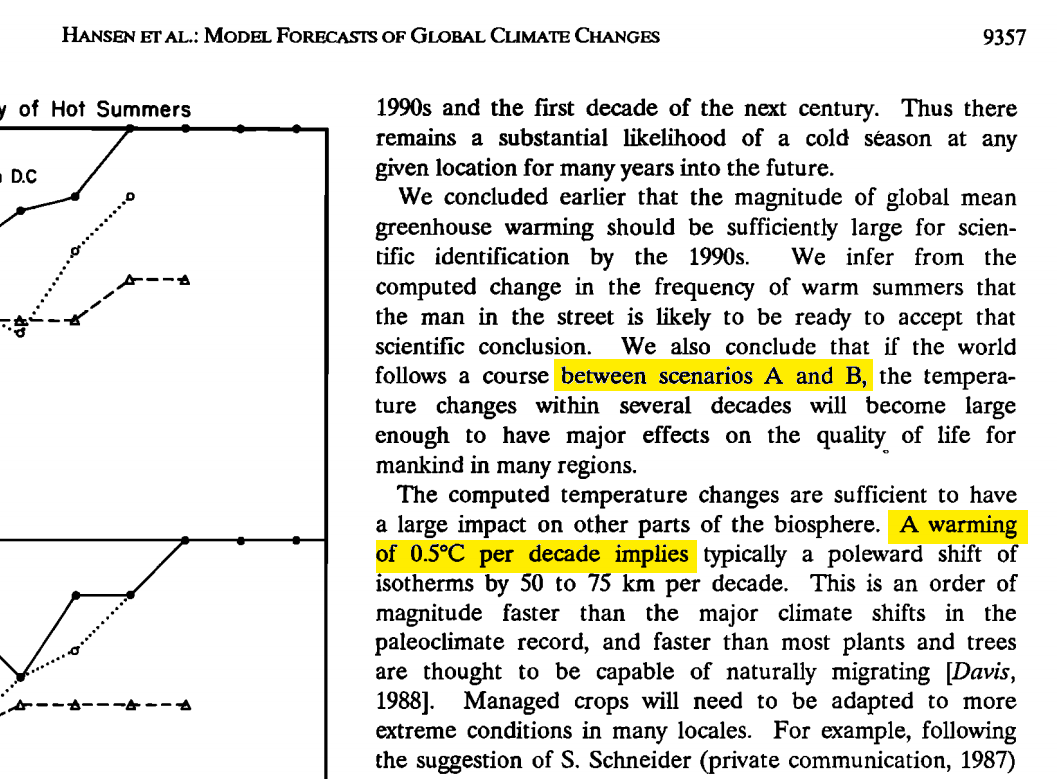
3/27》Hansen repeatedly claimed, both in his Congressional testimony and in the paper, that with "business as usual" emissions, global temperatures would rise at an average rate of about +0.5°C per decade. That's more than 3× faster than what really happened.
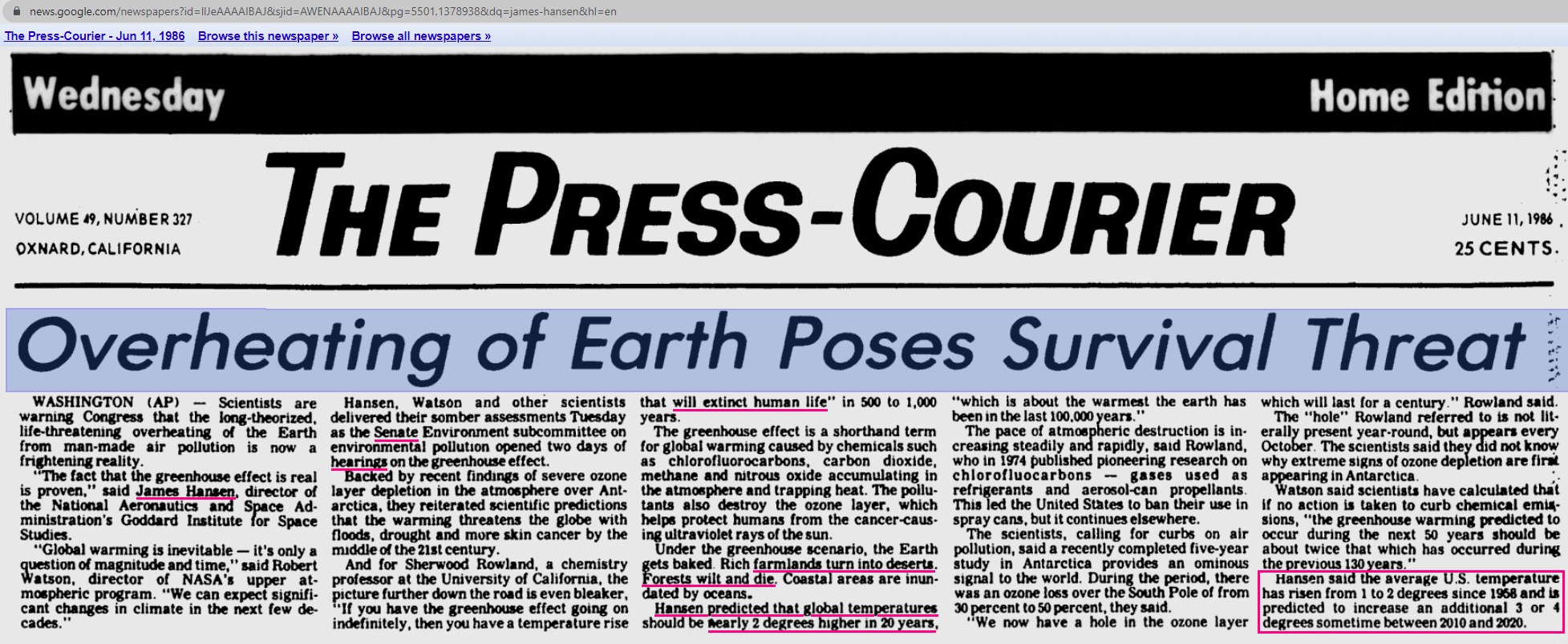
4/27》In fact, he was already predicting +0.5°C per decade warming even in 1986. Here's an article about it.
("Nearly 2° [Fahrenheit] higher in 20 years" is +0.5°C per decade.)
sealevel.info/Post-Courier_1…
5/27》In Their 1988 paper Hansen and his co-authors made it sound like their high-end "Scenario A" and its +0.5°C/decade warming prediction were based on a conservative estimate of future "business as usual" emissions. They wrote:
6/27》"Scenario A, since it is exponential, must eventually be on the high side of reality in view of finite resource constraints and environmental concerns, even though the growth of emissions in scenario A (≈1.5% yr⁻¹) is less than… typical of the past century (≈4% yr⁻¹)"
7/27》A major blunder in the paper was equating "emissions" with what they called the "annual increment" of changes in GHG concentration.
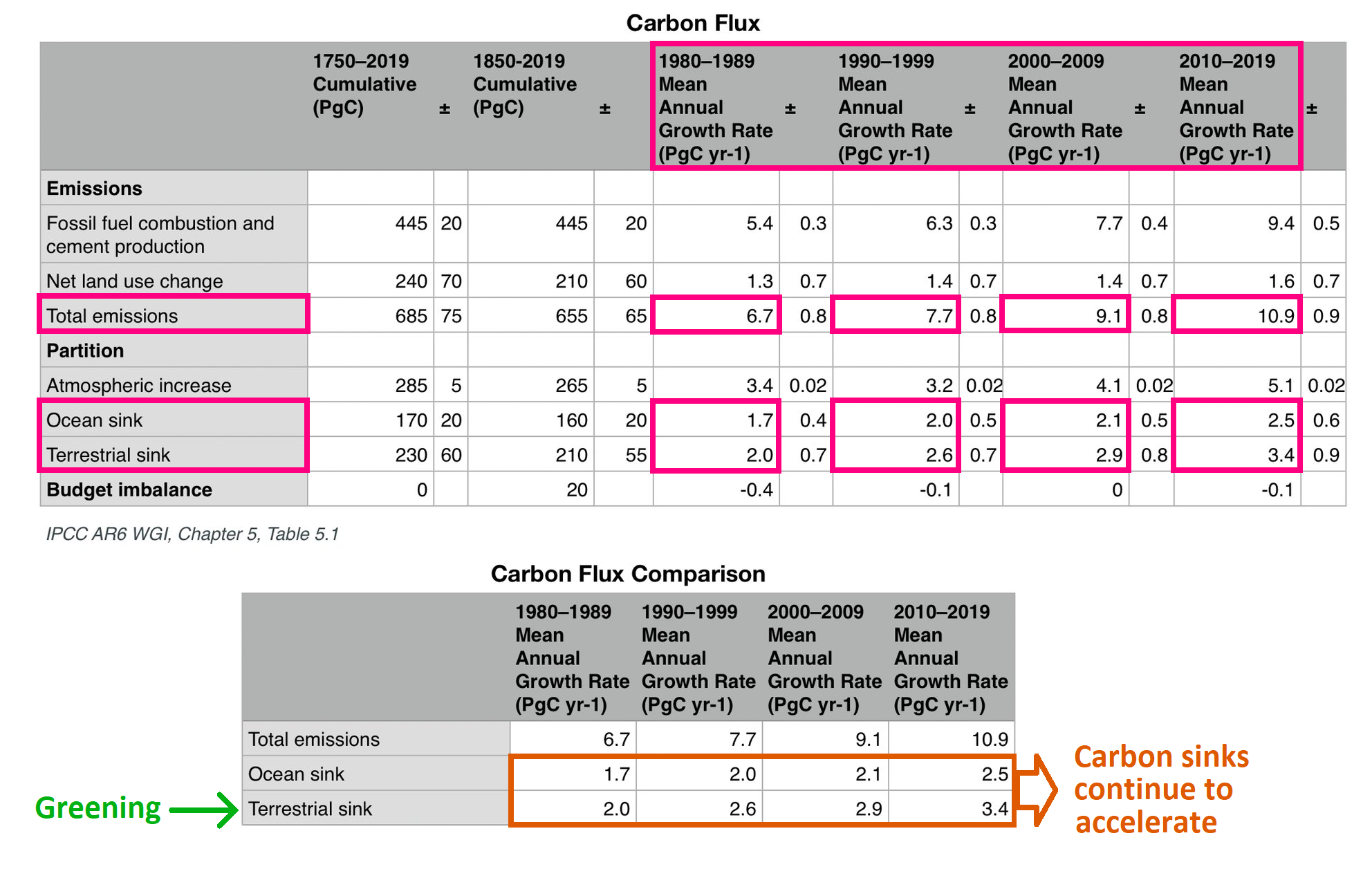
Concentrations, not emissions alone, determine radiative forcing — and powerful negative feedbacks 𝙧𝙚𝙢𝙤𝙫𝙚 CO2 at an accelerating rate.
8/27》Only by ignoring the natural processes that remove CO2 from the atmosphere at an accelerating rate can you make the mistake of equating "emissions" with changes in atmospheric concentration.
sealevel.info/AR6_WG1_Table_…
9/27》Hansen's apologists all pretend that his CO2 "annual increment" meant "emissions," so that they can pretend his paper & testimony weren't spectacularly wrong — as if the meaning of "emissions" were ambiguous, or something that can be redefined ex post facto for convenience.
10/27》That mistake was one of the worst of the many errors and contradictions in Hansen et al 1988.
Consider these two descriptions of "Scenario A," both quoted from the paper. The first is on page 3, the second is on page 21:
sealevel.info/hansen1988.pdf…
sealevel.info/hansen1988.pdf…
11/27》p.3: "Scenario A assumes that growth rates of trace gas emissions typical of the 1970s and 1980s will continue indefinitely; the assumed annual growth averages about 1.5% of current emissions, so the net greenhouse forcing increases exponentially."
sealevel.info/hansen1988.pdf…
12/27》Note: the actual CO2 emission growth rate was +2.0%/year, which was substantially more rapid than Scenario A's +1.5%/yr, as they described it on p.3.
13/27》p.21: "…in scenario A CO2 increases as observed by Keeling for the interval 1958-1981 [Keeling et al., 1982] and subsequently with 1.5% yr⁻¹ growth of the annual increment."
sealevel.info/hansen1988.pdf…
Do you see the inconsistency? Those two descriptions are incompatible!
14/27》They equated "emissions" (p.3) with "annual increment" (yearly increase in atmospheric CO2 concentration, p.21).
Incredibly, it appears they didn't even realize natural processes would remove CO2 from the atmosphere, let alone that they would do so at an accelerating rate.
15/27》Or perhaps they realized natural processes remove CO2, but assumed those processes remove a fixed percentage of human emissions.
That's also 100% nonsense (and a remarkably common error).
I think those are the only ways to reconcile those two contradictory descriptions.
16/27》Either way, Hansen 𝘦𝘵 𝘢𝘭 were hopelessly confused.
17/27》In reality, all the important natural processes which remove CO2 from the atmosphere (biological uptake / "greening," dissolution into water, and rock weathering) do so at rates which increase approximately linearly with rising atmospheric CO2 concentration.
18/27》That's the most important of the several reasons that CO2 emissions could increase even faster than the 1.5%/year assumed in their Scenario A, yet concentrations and temperatures nevertheless rose much more slowly than their 0.5°C/decade prediction.
sealevel.info/hansen88_predi…
19/27》Their p.3 description of scenario A had emissions increasing 1.5%/year, totaling 47% in 26 years. But CO2 emissions increased an average of 2.0%/year, totaling 66% in 26 years:
cdiac.ess-dive.lbl.gov/ftp/ndp030/glo…
Yet temperatures increased at only 1/3 to 1/4 of their predicted rate.
20/27》Another astonishing error in their paper was that on p.3 they wrote that an annual 1.5% (i.e., exponential) increase in GHGs causes an 𝙚𝙭𝙥𝙤𝙣𝙚𝙣𝙩𝙞𝙖𝙡 “net greenhouse forcing.”
21/27》Long before 1988 it was common knowledge that increases in atmospheric CO2 level cause a 𝙡𝙤𝙜𝙖𝙧𝙞𝙩𝙝𝙢𝙞𝙘𝙖𝙡𝙡𝙮 𝙙𝙚𝙘𝙧𝙚𝙖𝙨𝙞𝙣𝙜 forcing. So an exponential increase in CO2 level causes a forcing which asymptotically approaches 𝙡𝙞𝙣𝙚𝙖𝙧, not exponential.
22/27》So it's incredible that apparently none of those eight authors, nor their JGR editors & peer-reviewers, recognized that the absurd claim of an an exponential “net greenhouse forcing” was wrong.
In a more rigorous field such an blunder couldn't have withstood peer review.
23/27》𝑨𝒏𝒅 𝒕𝒉𝒆 𝒉𝒊𝒕𝒔 𝒋𝒖𝒔𝒕 𝒌𝒆𝒆𝒑 𝒐𝒏 𝒄𝒐𝒎𝒊𝒏𝒈…
24/27》Hansen also included an exponential increase in CFCs in his "business as usual” Scenario A. That is 𝙞𝙣𝙙𝙚𝙛𝙚𝙣𝙨𝙞𝙗𝙡𝙚, because the Montreal Protocol had already been agreed upon in 1987, and the Vienna Convention way back in 1985.
google.com/search?q=%28%2…
25/27》It is impossible to imagine that Hansen, his seven co-authors, the peer-reviewers, and JGR's editors, were all ignorant of those existing treaties. So there can be 𝙣𝙤 𝙚𝙭𝙘𝙪𝙨𝙚 for them nevertheless projecting exponential increases in CFCs, in any of their scenarios.
26/27》They obviously 𝙠𝙣𝙚𝙬 CFC emissions would decrease, not increase. Yet they dishonestly promoted a “scenario” as “business as usual,” which they 𝙠𝙣𝙚𝙬 was impossible… and the JGR editors and their peer-reviewers let them get away with it.
Share this Scrolly Tale with your friends.
A Scrolly Tale is a new way to read Twitter threads with a more visually immersive experience.
Discover more beautiful Scrolly Tales like this.