Michael Nielsen Profile picture
Sep 11, 2018 13 tweets 3 min read Read on X
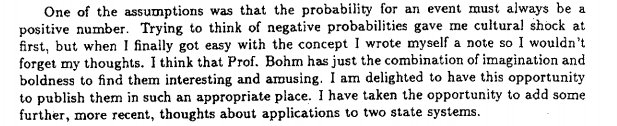
Just dug up one of my favourite papers, one I haven't looked at in years! Richard Feynman's paper trying to make sense of negative probabilities: cds.cern.ch/record/154856/…Image
Image
This might sound nuts. Actually, it has some really nice applications. For instance, there's a _really_ beautiful application known as "probability backflow".
Turns out that you can find quantum states of a particle (in 1 dimension) so that with certainty the particle is moving to the right. _But_ - and this is the crazy bit - in fact the probability the particle is found to the right of the origin actually _decreases_ with time.
This sounds impossible. But if what's happening is that it's _negative probability_ which is all flowing to the right, then it makes sense. This idea was developed in this lovely paper by Bracken and Melloy people.smp.uq.edu.au/TonyBracken/ba…
If you feel like you didn't get that the first time, you are not alone. You really need to read it half a dozen times for it to even parse. But it's a real feature of the world!
Often wondered if this might be a good way for developing good intuitions for new quantum algorithms - the idea is to explore many possibilities, and then to use negative probabilities to "unexplore" fruitless directions. But I never made it work usefully.
Let me try to unpack that description of probability backflow just a little more, so it makes more sense. You have a particle in one dimension - think of it as moving on a line, left to right. It has the following properties:
(1) If you measure the velocity, you're absolutely guaranteed to find that it is positive (i.e., moving to the right); and (2) nonetheless, the probability the particle is to the right of the origin actually _decreases_ over time.
That sounds just straight up impossible - if something is guaranteed to be moving to the right, it can't be less likely that it's to the right of the origin over time!
Well, there's a description of quantum particles based on what's called a quasiprobability function that actually makes it work. It provides a kind of "probability" p(x, v) that the particle has position x and velocity v.
Turns out - I wish I had a movie to show you, it makes it much easier to understand (hi @3blue1brown ) - that what's going on is that small amounts of _negative_ quasiprobability are flowing to the right, & that's why the probability of being to the right of the origin decreases
Now, how to think about the negative probabilities themselves? Well, quantum mechanics tells you that you can't ever observe position and velocity simultaneously. So there's no need to find a direct interpretation.
Still, that feels like a copout to me - I think there probably is a really good, clear interpretation of what it means. I'm not sure what that is, unfortunately!

• • •

Missing some Tweet in this thread? You can try to force a refresh

 

Keep Current with Michael Nielsen

Michael Nielsen Profile picture

Stay in touch and get notified when new unrolls are available from this author!

Read all threads

This Thread may be Removed Anytime!

PDF

Twitter may remove this content at anytime! Save it as PDF for later use!

Try unrolling a thread yourself!

how to unroll video
  1. Follow @ThreadReaderApp to mention us!

  2. From a Twitter thread mention us with a keyword "unroll"
@threadreaderapp unroll

Practice here first or read more on our help page!

More from @michael_nielsen

Oct 5, 2025
Enjoying Fermi's delight in hands-on understanding (figuring out the cross-section of graphite, to understand how good a moderator it would be for the first nuclear pile): Image
Teller on being convinced by FDR:

I find the absolution extraordinarily unconvincing; it makes Pilate look sympathetic, by comparison. But my sense of Teller is that he may actually have found this compelling, not be justifying himself after the fact. Still, it's eerily similar to "I was just following orders"Image
Image
Quotes from Richard Rhodes' extraordinary book "The Making of the Atomic Bomb". I've previously excerpted here:
Read 17 tweets
Jan 11, 2025
I hadn't realized that Hobbes knew both Bacon and Galileo(!!!) Image
I've been learning a little about the history of duality - the difference between description and experience. And I hadn't realized just how long a history it has - there are clear antecedents no later than ~500 BCE (and probably much earlier). Here's a latecomer Thomas Hobbes: Image
I had not realized how long it took space to become fundamental. It plays a bit part for a long time, but there's a real argument it only takes center stage post-Newton: Image
Read 8 tweets
Nov 8, 2024
@davidbessis Curious about this. I've met a fair number of aphantasics, people who have no ability to mentally see images. I haven't asked any about this specific problem, but certainly some have told me that they struggle with similar problems Image
I'm not quite sure what my question for you is. Perhaps it's this: how widely have you tested these ideas on other people?
Read 4 tweets
May 29, 2023
Striking fact learned the other night: the singlet-triplet measurement is (apparently) BQP-complete. Anyone have a pointer for a proof?

(I find this hard to credit. If true it's just amazing.
But I'll bet the proof fits in a tweet or two.)
Oh: arxiv.org/pdf/2105.04649…

I wonder if further progress has been made? Image
Huh: looks to be true:

(Admittedly, initial state assumptions are kinda funny here.)
Read 4 tweets
May 29, 2023
In what senses (if any) has a neural net been used to learn an operating system from scratch?
Or the design of a programming language?
Just attempting to construct cost functions is surprisingly entertaining
Read 4 tweets
May 28, 2023
Instinctively, my answer is no. I'd expect the Lyapunov exponents in the system to be zero - the degrees of freedom are rotation (no exp divergence, ignoring friction) & center of mass (ditto), so there's nothing to amplify quantum fluctuations, even in the absence of decoherence
That said, I'm not sure, and would need to reflect further

Fun problem; it'd make a nice essay question for a class on quantum chaos!
Reflecting more: there's something funny about unstable equilibria. Eg if I start a pendulum inverted, quantum fluctuations + decoherence will make the pendulum "choose" a side, pretty rapidly. But AFAICS there are no similar points for the coin...
Read 6 tweets

Did Thread Reader help you today?

Support us! We are indie developers!


This site is made by just two indie developers on a laptop doing marketing, support and development! Read more about the story.

Become a Premium Member ($3/month or $30/year) and get exclusive features!

Become Premium

Don't want to be a Premium member but still want to support us?

Make a small donation by buying us coffee ($5) or help with server cost ($10)

Donate via Paypal

Or Donate anonymously using crypto!

Ethereum

0xfe58350B80634f60Fa6Dc149a72b4DFbc17D341E copy

Bitcoin

3ATGMxNzCUFzxpMCHL5sWSt4DVtS8UqXpi copy

Thank you for your support!

Follow Us!

:(