Wrath Of Gnon Profile picture
Oct 26, 2018 16 tweets 7 min read Read on X
Perhaps the most eye-catching and the most beloved element of classical architecture is the column, and of the column, the capital. Interestingly it is also the part that has been most fruitfully adapted to local usages throughout the ages, all the way to our days. Let's explore.
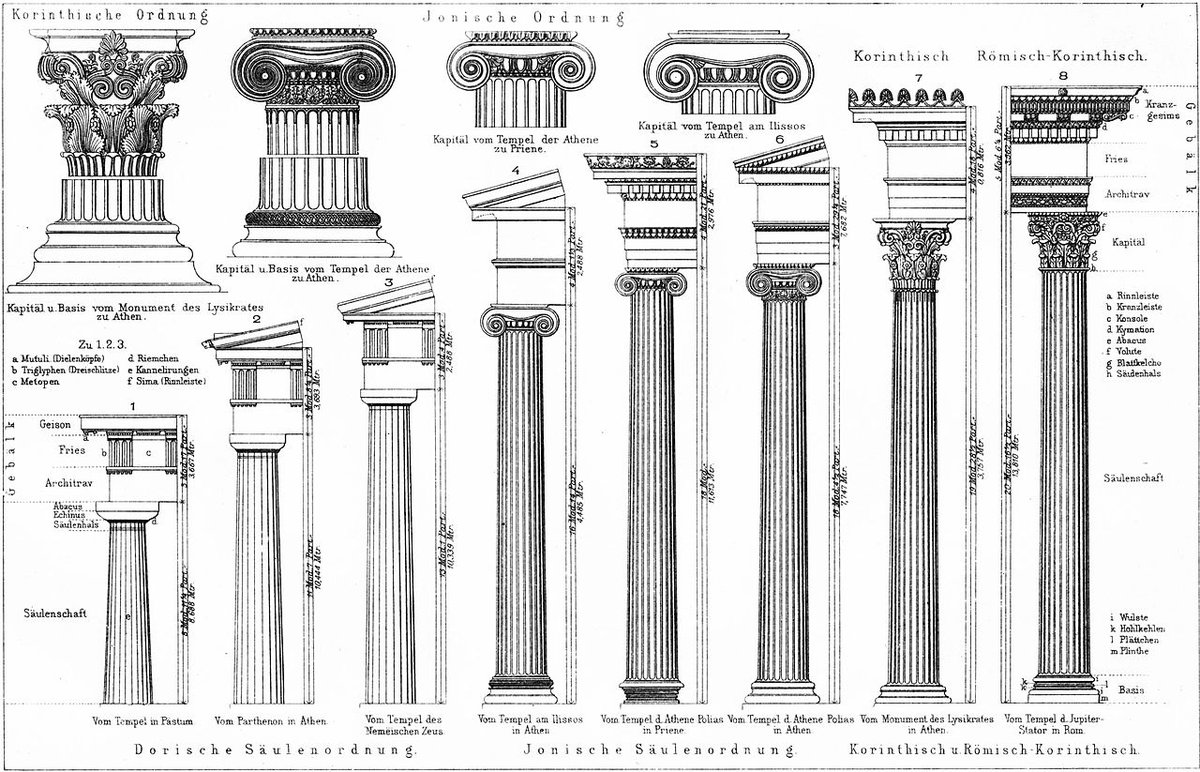
The history of the column and its capital go way back to the dawn of civilization but lets start with the greeks. They created the basic three orders that we have built upon: the doric (the simplest), ionic (with the volutes, or scrolls), corinthian (with the acanthus leaves).
As the names implies, these three orders came from different areas of ancient Greece and were used locally. A sort of classical vernacular. The ionic order for example came from a people of seafarers, who were inspired by the Egyptians (who liked lotus flower decorated capitals).
In the 1st c. B.C. the Romans took these orders and invented two more: the Tuscan (simpler than the Doric), for rustic agrarian or utility buildings, and what we call the Composite Order, for the grand buildings of government: basically an Ionic and Corinthian order combined.
The Romans thus set the precedent to base a building’s order on its usage and location rather than its origin. A small but important innovation and the nudge that made it possible for the classical orders to go global.
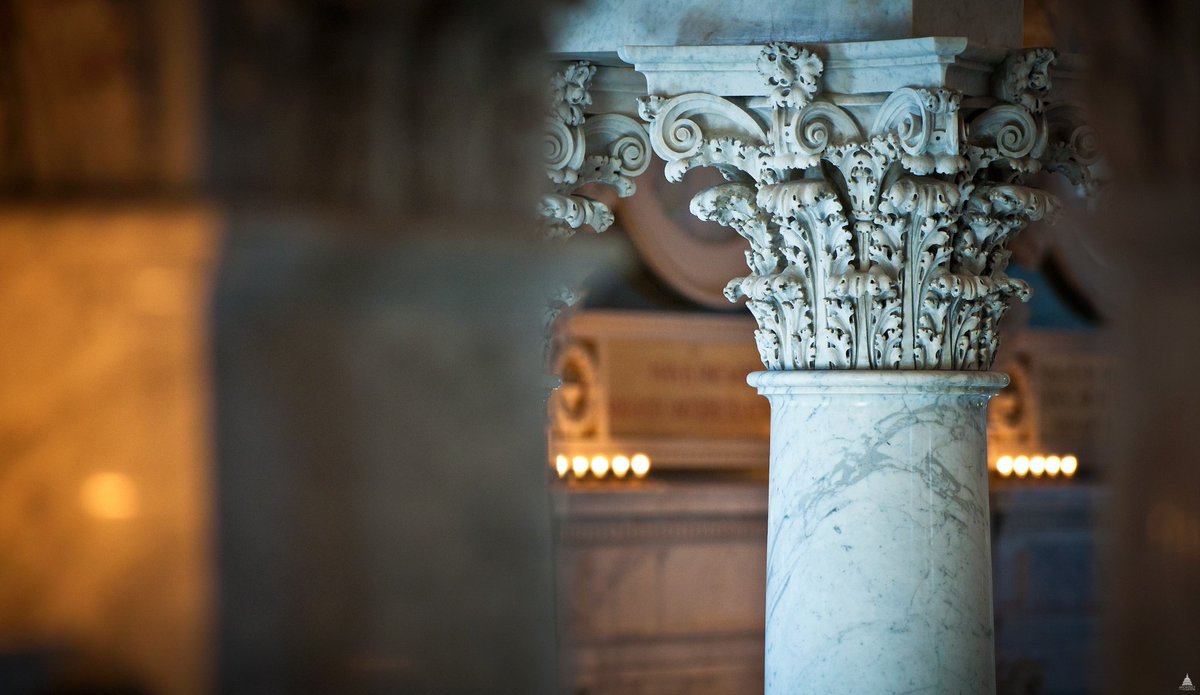
The Renaissance rediscovered classical architecture, and Palladio rediscovered a cheap way to build them, but it was Vignola’s ”The Five Orders of Architecture” in 1532 that solidified the concept of a classical order. It became canonical, with over 500 ed. published so far!
In the 17th and 18th centuries, parallel to the classical orders a sort of subculture of orders developed, often called ”nonce orders”, exchanging some aspect of an established order for something new, like different animals, fruits, vegetables, heraldic symbols or even fossils.
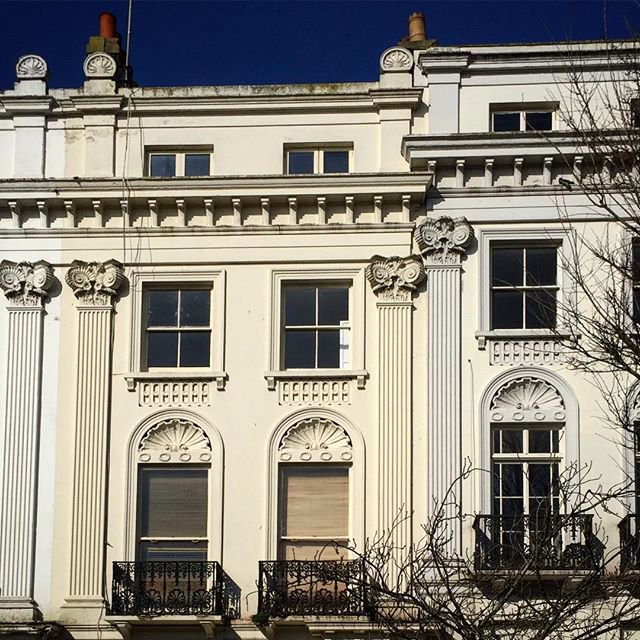
Trends and fashions in general society carried over into architecture. The Victorian craze for collecting ferns, for example, resulted in this beautiful variant of the ionic order, with ferns instead of volutes. An elegant and logical variation that blended in harmoniously.
In 1789 the British architect George Dance invented the Ammonite Order, another ionic variant, with fossil ammonites, a rare but beloved innovation in an era where the natural world was being catalogued and put in order: the era of the enthusiastic gentleman collector.
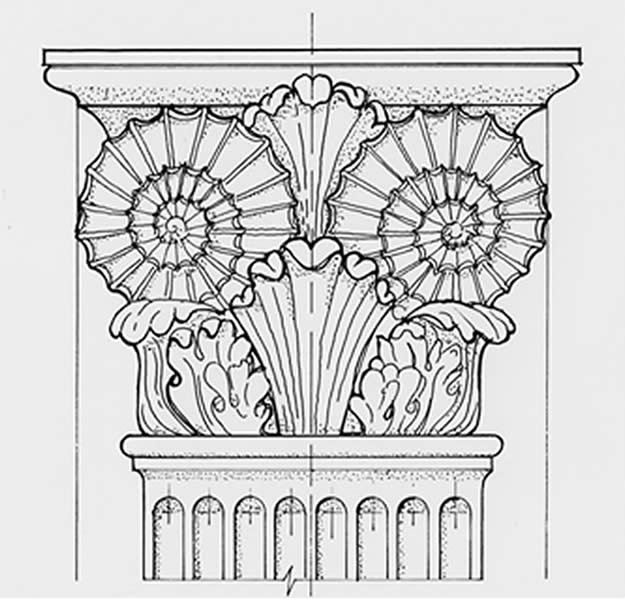
A few architects decided to make the classical orders vernacular again, and invented purely local orders. Like the British order, a variant on the Roman composite order with royal symbols, and a winged lion and unicorn rampant, by James Adams, 1762.
The Americans exchanged some of the acanthus leaves of the Corinthian order with the more American tobacco leaves, as in this ”Second American Order” by Philadelphia architect Thomas Ustick Walter (1804-1887).
Walter’s work was perhaps inspired by B. Henry Latrobe’s 1809 American Order, with magnolia flowers and leaves replacing the acanthus of the greek Corinthian order. Unfortunately all these were lost in the burning of the Capital in 1814, but we have a drawing, to be revived!
Benjamin Henry Latrobe also designed the famous Tobacco Capital Sent to Jefferson (executed by Francisco Iardella) in 1817. It can still be seen in model at Monticello, perhaps to be revived sometime in the future?
Maybe the last vernacular classical order to be designed was Edwin Lutyen's Dehli Order, the classical order for India, with details inspired by traditional Indian architecture and temple bells instead of the greek volutes. Here the elegant Durbar Hall, Rashtrapati Bhavan
So here is the point. To ensure the survival of these beautiful classical orders, perhaps it would be good to revive the vernacular, and let architects propose new orders suitable for their own cultures? Palmettos for Florida, Thistles for Scotland, Bamboo for Fukuoka, and so on.
If you teach art or architecture in school or at university, take your students out to draw a classical order capital in your own town, them ask them to modify it in the spirit of the ancient greeks, to make a local one, to maybe one day be picked up and adopted by their town?

• • •

Missing some Tweet in this thread? You can try to force a refresh

 

Keep Current with Wrath Of Gnon

Wrath Of Gnon Profile picture

Stay in touch and get notified when new unrolls are available from this author!

Read all threads

This Thread may be Removed Anytime!

PDF

Twitter may remove this content at anytime! Save it as PDF for later use!

Try unrolling a thread yourself!

how to unroll video
  1. Follow @ThreadReaderApp to mention us!

  2. From a Twitter thread mention us with a keyword "unroll"
@threadreaderapp unroll

Practice here first or read more on our help page!

More from @wrathofgnon

Dec 28, 2024
In reality meritocracy is more impossible than communism even: nothing has ever been so tempting to bend and distort for personal pleasure and gain. No other form of rule so fully denigrates those "lesser". A meritocracy will appeal to legitimacy by pride and selfishness. Opposites of the civic virtues.

"I rule because I am better than you."

No structure, no compassion. Just an endless clawing and kicking and biting.
Read 4 tweets
Apr 1, 2024
It is well known warehouses built in earth plaster using inoculated fermented straw and soil keeps fruits, vegetables fresh longer and inhibits mold and microbial growth on paper, books, clothes, antiques etc. Hence Japanese "Dozō". But you can build miniature storage boxes too.

Image
Image
A Japanese master plasterer designed boxes built exactly like regular earthen warehouse walls, except he reused wooden wine crates. He sells kits, or you can use your own materials to make your own if you feel up to it.


Image
Image
Image
Image
These boxes are intended for grain, vegetables and fruit that you would normally keep in a "dark and cool" place. And they work. Here is a comparison with a polystyrene box and three mandarin oranges after 45 days. The blue box is more like what most modern homes are built like.
Image
Image
Read 8 tweets
Mar 25, 2024
The practical skills in thatching can be difficult to acquire by videos or books alone, especially how to find materials and the binding. In Finland there is a traditional thatching technique that uses only easy to find reed and no binding: just spread it out and weigh it down. Image
A bound reed roof is far steeper and thus lasts longer, but it requires more skill to do correctly. Reed is often available for free and in vast quantities anywhere it grows, harvesting it is doing nature a favor. All materials used in a reed roof are compostable, all hand tools.


Image
Image
Image
Image
For a standard roof of say 100m² you need to harvest about three hectares. You can harvest that by hand in about a month, or in a day if you have a reed harvesting machine. In Finland you harvest in March, April.
Image
Image
Read 5 tweets
Feb 29, 2024
Maybe one of the oddest professions in Japan is that of the bokka (歩荷). Porters who carry supplies to remote mountain guesthouses inaccessible to vehicles. A bokka uses customized wooden ladder frames to carry 100-165kg of supplies on day long marches (walk up, run down).


Image
Image
Image
Image
The job is popular: not surprisingly veteran bokka routinely tests as fitter and healthier than elite athletes. Both men and women take on the job, the average weight of a bokka is 60-70kg.


Image
Image
Image
Image
Still not much of a chore compared to what some farmers used to handle.
Read 5 tweets
Sep 28, 2023
Iriairinya (入会林野) is the Japanese term for "commons". In the West the term "commons" are usually meant as fields for grazing but Japanese commons were traditionally the mixed grass and forest lands between mountains and flatlands usable in agriculture. Image
Iriairinya are typically from a couple of hectares up to 50-60 hectares. Still a valid legal concept, village's who manage commons also have the option to incorporate them (as modern organizations), to make them more compatible with modern legal practices. Image
Commons were meant to be vital lifelines for rural villages, providing its members with food (forage), feed (for livestock), fertilizer (leaves), fuel (wood, charcoal), building material (roof thatch). When modern lifestyles took over in the 1970s commons were mostly abandoned.


Image
Image
Image
Image
Read 6 tweets
Aug 24, 2023
The miracle of Usami: at 11:58 A.M. Sept. 1st 1923 a great earthquake struck the Tokyo region. Near the epicenter was Usami village, where no one was killed or injured while neighboring villages each had hundreds dead and wounded. How?
Image
Image
The villagers of Usami had an exceptionally long memory. Records, monuments and tales of a huge 1703 quake had been preserved and stories of what happened was still in vivid memory. The locals acted unbelievably fast, evacuations started as soon as the trembling stopped.
An 8m tsunami struck the seaside village only 5 min after the quake. Locals were already arrived at and safe within historical evacuation grounds: temples, bamboo thickets, stands of trees, where their ancestors had marked out safe spots centuries before (circle: 1703 tsunami) Image
Read 4 tweets

Did Thread Reader help you today?

Support us! We are indie developers!


This site is made by just two indie developers on a laptop doing marketing, support and development! Read more about the story.

Become a Premium Member ($3/month or $30/year) and get exclusive features!

Become Premium

Don't want to be a Premium member but still want to support us?

Make a small donation by buying us coffee ($5) or help with server cost ($10)

Donate via Paypal

Or Donate anonymously using crypto!

Ethereum

0xfe58350B80634f60Fa6Dc149a72b4DFbc17D341E copy

Bitcoin

3ATGMxNzCUFzxpMCHL5sWSt4DVtS8UqXpi copy

Thank you for your support!

Follow Us!

:(