We are often told that that the raids by chOzha emperor rAjendra I on the shrIvijaya-s were due to the latter's "interference with trade". Unfortunately, the exact nature of interference has been, for long, elusive to us.
It has been elusive for even the erudite nIlakaNTha shAstri as we had always relied on Indian documents. So what was this “interference”? An interesting (& rather hilarious) answer is found in the work of Tansen Sen & Noboru Karashima.
In getting the historical context, we have to appreciate the role of shrIvijaya as a leading entrepot state in the Indo-Chinese trading world; serving as a transit point for ships sailing from cIna coasts to various cities in the Indosphere-in Southeastern Asia & India.
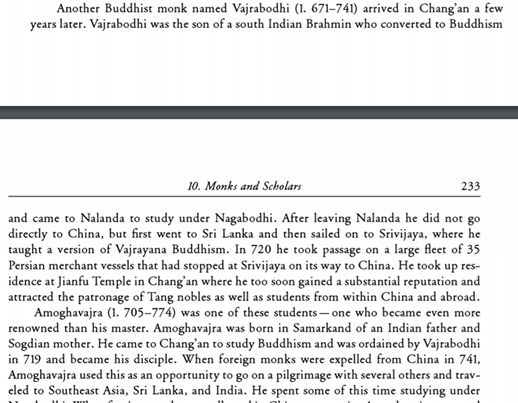
This role of shrIvijaya as an entrepot state par excellence can be traced to the last decades of the seventh century. We know this from the accounts of bauddha monks such as the cIna Yijing, vajrabodhi (from kA~nci) & the renowned amoghavajra of bAhlikadesha (Uzbekistan).
Yijing left cInadesha on a ship bound for shrIvijaya where he spent 6 months studying saMskRta & would hop between various S.E.Asian cities before he finally got a chance to leave for bhArata & would reach Nalanda, Bihar where he spent a good 17 years. iseas.edu.sg/images/pdf/nsc…
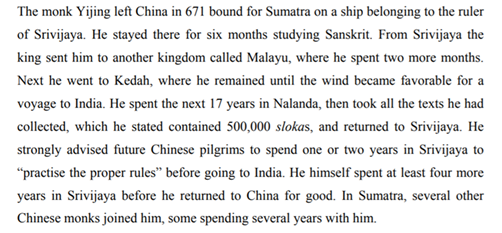
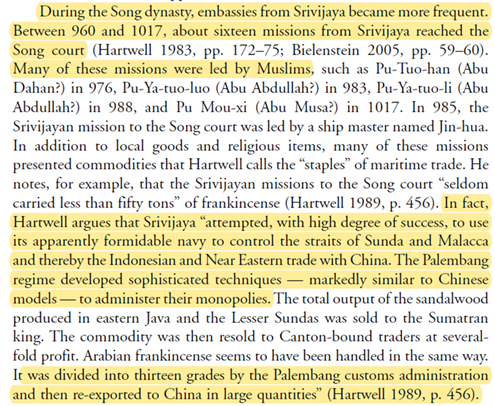
Coming back to shrIvijaya, Tansen Sen points out that diplomatic missions from shrIvijaya to cInadesha became rather frequent during the Song dynasty. There were 16 such missions in the period between 960 & 1017 CE. Sen notes the shrIvijaya ambition to monopolize trade.
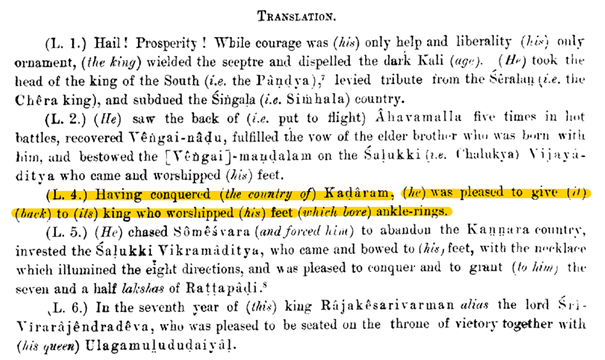
Now, before we move on, let us sort out a few key dates here. The chOzhas sent their very 1st mission to cInadesha in 1015. rAjendra-I launched two raids in the years 1017 & 1025 on shrIvijaya. But in 1068, vIrarAjendra invaded kadAram (shrIvijaya) before reinstating its ruler!
This is rather puzzling. Why would he send the chOzha military across the seas & then immediately reinstate the king? nIlakaNTha shAstri reads the inscription (SII, Vol.3, Inscription No.84) as indicating that vIrarAjendra reclaimed kadAram for the abdicated shrIvijayan ruler.
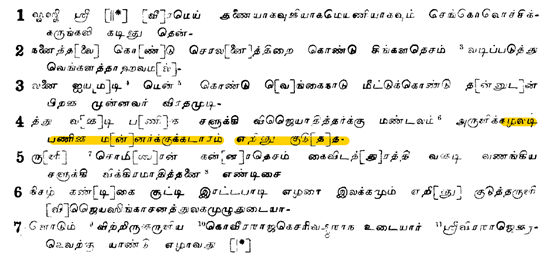
Whether this was done to favor the shrIvijaya king or was it hostile in intent like the raids of 1017 & 1025, I am not too sure. But in any case, it confirms that shrIvijaya was a dependent protectorate of the chOzhas by & in 1068.
We now look to the Songshi, the official historical account of the Song dynasty of the cIna-s, one of 25 such documents chronicling the histories of various dynasties. It is funny that we should get our motive behind the 1017/1025 raids from a letter in the Songshi dated 1106.
It is a letter (a “memo” of sorts) to the Song Emperor Huizong, expressing an objection by a Minister to the royal order to receive diplomats from the Pagan Kingdom (蒲甘—púgān, Myanmar) with same honors as chOzha (注輦—zhùniǎn) embassies. chinesenotes.com/songshi/songsh…
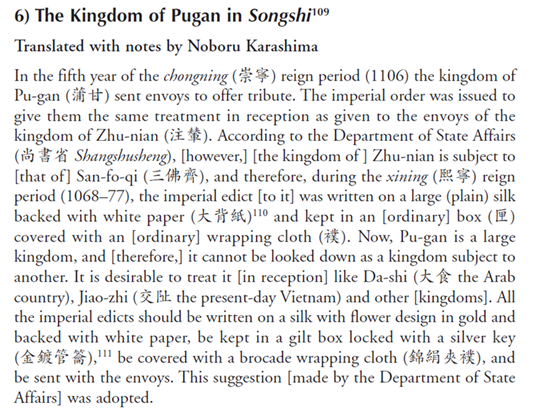
In the letter, the zhùniǎn (chOzha) are described as a vassal of the Sānfóqí (三佛齊—shrIvijaya)!! The Chinese had thought in 1106 that the mighty chOzhas were the vassals of the shrIvijayas despite the fact that this of course is complete nonsense!! What’s going on?!
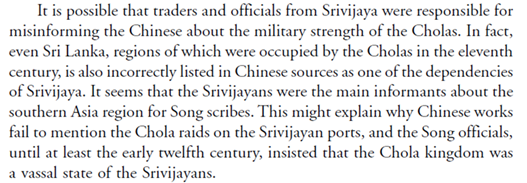
Sen surmises that for a century or even a little more, the shrIvijayans had been using their status as the primary entrepot/transit state to pass false data to the Song officials that the chOzhas were their vassals & had even done the same to siMhaladesha!
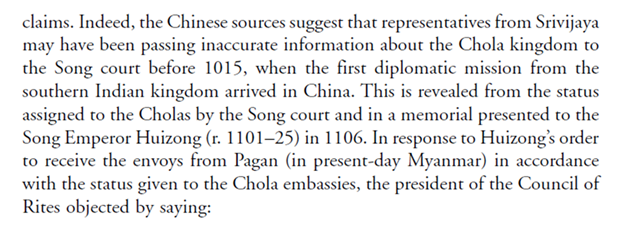
To understand how something ludicrous could happen, we have to understand that the Song world was rather distant from the chOzha world & communications were not quite like what they were today. So, what were the consequences of such false intelligence? slideplayer.com/slide/5815859/…
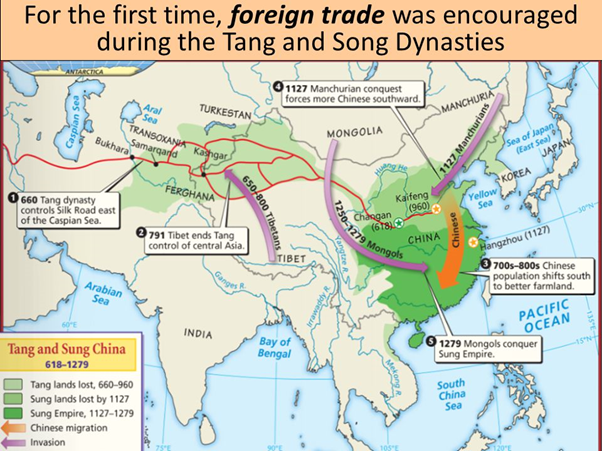
Sen explains that chOzha traders lost preferential access to Song markets as the cInas perceived them as a militarily weak dependency, having been “tricked” by the shrIvijayans into believing so. & even after the raids, the cInas continued (till 1106 as seen above) believing it!
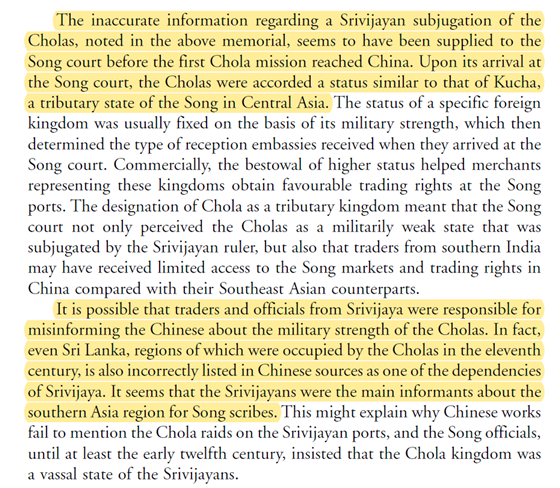
However, the raids did wield tremendous damage to the shrIvijayans at that time & post-raids, we are informed that they did not manage to send embassies to cIna (their trading fleet & economy being rather wrecked).
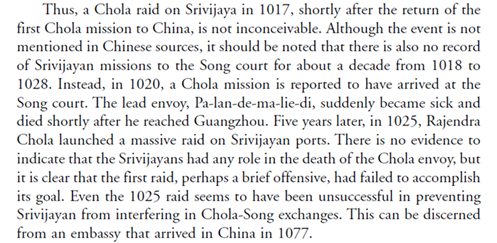
The geopolitical lessons from this rather funny story may seem to be irrelevant in light of how communications & intelligence works today. But it is perhaps interesting to see how states/economies/trade worked once & how the cInas had always responded when they smell weakness.
@threadreaderapp Unroll
From chapter 3, "THE MILITARY CAMPAIGNS OF RAJENDRA CHOLA AND THE
CHOLA-SRIVIJAYA-CHINA TRIANGLE" by Tansen Sen in "Nagapattinam to Suvarnadwipa: Reflections on the Chola Naval Expeditions to Southeast Asia" (2009).
Please also see Appendix II of the above-mentioned book, "Chinese Texts Describing or Referring to the Chola Kingdom as Zhu-nian" by Noboru Karashima & Tansen Sen.
Some lessons to keep in mind: 1. 1st-mover advantage in building relationships; shrIvijaya's headstart in setting the narrative (as blatantly false & BS it was)++
2. Ought to have established occasional high-level contact with the cInas, which may have resulted in clarity instead of sending chOzha traders with little royal official presence.++
2'Cont'd: This was definitely one of those situations where the chOzhas should have sensed disproportionate influence of shrIvijayans & "gotten rid of the middleman" sooner. Allowing an intermediary to set the discourse/relationships for that long is a recipe for disaster.++
3. Failing to be fully brutal by not annihilating the shrIvijayas for what they tried to pull; even "magnanimously giving back" the kingdom to an abdicated shrIvijayan ruler decades after these episodes.
4. Of course there was some efforts by rAjendra at proper diplomatic contact in 1020, just 5 years before the 2nd raid, as already noted here:
However, that had failed since the lead envoy died (suspicious much??).
5. The raids did achieve a 10-year disruption of shrIvijayan missions to cInadesha, but after this long absence, the shrIvijayans were able to convince the cInas with little effort that the chOzhas were their vassals all the way till 1106, despite relying on chOzha mercy in 1068!
6. While the shrIvijayans were persistent in their being pests to the chOzhas, the chOzhas were not persistent or brutal enough in their response.
7. Finally, it is interesting (although I lack data to conclude anything of significance) to note Muslim role in the shrIvijayan missions to China! (Although shrIvijaya was largely Hindu-bauddha, Islam seems to have penetrated the high state offices.
//End
A thread on Purāṇa-s and the answers they give for commonly held questions--I intend for this thread to be a long-continuing series--To save time, I will share screenshots of the original and translation:
A burning question that many of us have: Why do devotees of the Gods suffer?
Nārada relates to Arjuna in the Skāndapurāṇa (here, we will see the version of the text with seven khaṇḍa-s) the story of a pious trader, Nandabhadra, who has the same question. Nandabhadra was not just an external worshiper but one who was righteous within and theDevas themselves were pleased with his character. Nandabhadra had recently lost his son and wife. He had a neighbour--an atheist who found delight in causing the pious to deviate from their belief in Dharma, but called himself Satyavrata (one who has taken a vow to speak only the truth).
Given Nandabhadra's devastating personal losses, Satyavrata, using sympathy as pretext, uttered the following words to break Nandabhadra.
This consists of the usual tripe from atheists that we hear even today.
Where are the Devas? This is false; they would be visible if they existed - kva devāḥ saṃti mithyaitaddṛśyaṃte cedbhavaṃtyapi |
All these are the imagination of untruthful Vipras (Brāhmaṇa-s) for the sake of wealth/goodies - sarvā ca kūṭaviprāṇāṃ dravyāyaiṣā vikalpanā
There is nothing worse than human birth. It is full of miseries. Human birth is a tax. It is better to be born as animals.
Nandabhadra is not swayed by Satyavrata's atheistic speech and rebukes him. He then goes to worship the Kapileśvara Liṅga on the banks of Bahūdaka Kuṇḍa.
However, he does feel miserable with all that has been going on his life and recited the following verses to Sadāśiva, expressing his deep grievance with the nature of existence.
On the 4th day, a young boy, looking extremely ill with leprosy, appears before him and starts conversation with Nandabhadra. The young boy chides Nandabhadra for wishing to die and starts his discourse on the nature of suffering and the importance of being freed from greed.
Nandabhadra then takes up the four things which are reproached: kāma (desire), krodha (anger), ahaṃkāra (egoism/sense of I-ness) and indriya-s (sensory faculties). He makes an opt observation. Kāma is needed for even the pursuit of svarga and mokṣa.
Without krodha (anger), one is regarded by enemies, external and internal, as a blade of grass. Without ahaṃkāra (sense of I-ness), one will be regarded as mad. If one causes his Indriyas to withdraw from everything, how can one hear the Dharma (such as the Boy's discourses) and, as a matter of fact, even live?
The Boy then refers to the tattvas immediately higher than ahaṃkāra and the Indriyas: the Guṇas (sattvaguṇa, rajoguṇa & tamoguṇa) and buddhi (Intellect) and explains how to regulate the earlier 4 by means of sattvaguṇa. He ends that part of the discourse with a statement:
mānuṣyamāhustattvajñāḥ śivabhāvena bhāvitam || 76
The human condition, the knowers of Tattvas say, is imbued with Śiva-nature.
Contrast this with the atheist Satyavrata's statement that human existence is cursed. It is at this point Nandabhadra asks the question, "Why do the pious suffer?"
All you say may be true but the Īśvara-s, who are givers of everything, the Devas worshiped by all--why do they not protect their own devotees from sorrows? Particularly, some of these devoted ones are sunk in misery. My intellect is deluded because of this, boy! What do you think?
The Boy divides the devotees into two types--pure and impure--and warns about the consequences of worshiping Devas when 'impure'. When an 'impure' man worships Devas, the Bhūta-s take over him and make him resort to improper acts, causing him to perish quickly--adā bhūtānyā viśaṃti sa ca muhyati tatkṣaṇāt || vimūḍhaścāpyakāryāṇi tāni tāni niṣevate|--akārya here means an improper/unbefitting act.
What does impure mean here? Here, it means a spiritually impure person who does not do the duties placed upon him by Īśvara.
Now, what about the pure bhaktas, the real ones who perform their obligations faithfully and then worship? Why do bad things happen to them?
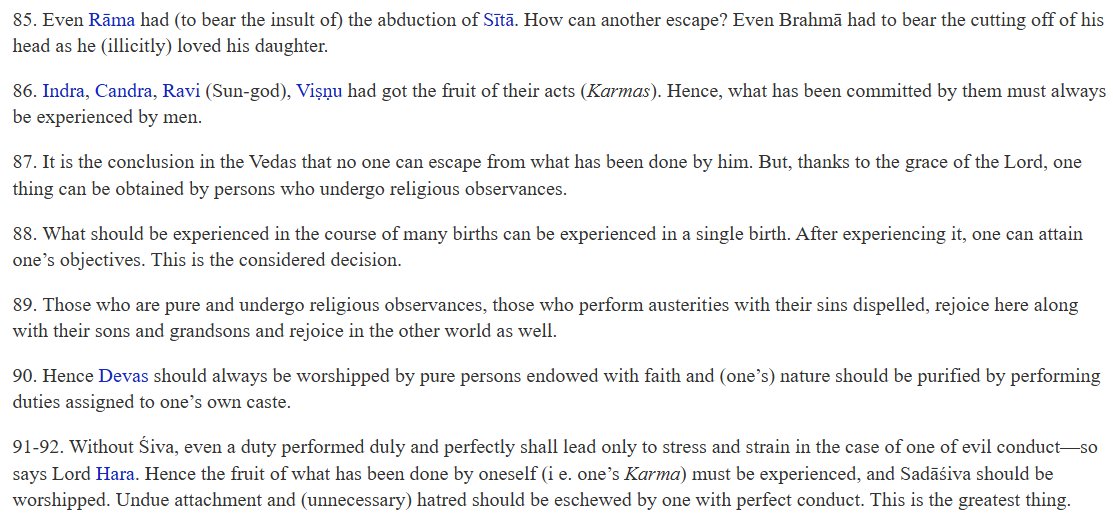
The Boy answers that a huge amount of previous karma-s, which may take several painful lifetimes, are rapidly consumed in the course of a single life--tasya pūrvakṛtaṃ vyaktaṃ karmaṇāṃ koṭi mucyate|--bahubhirjanmabhirbhojyaṃ bhujyetaikena janmanā
When such a huge amount of karmas is burnt off, the soul can proceed to realize its true objectives (happiness here and hereafter) without obstacles.
Sadly, there is no link between “constructive activities” and “sticking with the right path” in terms of values,
Carnatic music, etc are purely performative for many of these kids—something to master & carve out a niche place for oneself in terms of skill and something to serve as a source of fame.
If you define right path in terms of religious & moral values, Carnatic music or traditional dance have hardly an impact. Chess, etc-abysmally less significant.
Parents’ upbringing is the one *external* thing that comes closest in terms of having an impact and even that is not at all determinative. At best, it acts as a dam against bad, innate vāsanas or a force multiplier for good, innate vāsanas. That’s all.
We see many cases where a child is brought up in a very wholesome, traditional environment (traditional but not autistically absurd/harsh; firm but loving) and yet goes astray.
Problems which arise at the level of Svābhāvika machinery cannot be combatted by a purely empirical/pragmatic approach: parental upbringing, good schools, etc.
A truly potent & “awakened” temple, cleaning up the corrupt practices at temples, ensuring a competent & honest priesthood at every temple. reviving Tīrthakșetras in every nook & corner of the country, revival of Utsavas, mass sponsoring of anāthapreta-samskāras so that no Hindu body ever gets left behind, frequent recitation of Vedas, purāņas & āgamas at every corner of Bhārata, frequent pravacanas by truly learned Vidvāns, dīkșā-s & imparting of ntiyapūjās for eligible ones of all backgrounds—all these will do far more to suppress evil Vāsanas.
It won’t be immediate. May take 2-3 generations to see a truly tangible effect. But this is what I personally feel.
You can partake in zero “constructive” or cultural things and instead play sports or read books or watch anime as a child and still turn out alright. The sauce is not in these “constructive hobbies”. You want your kids to do it because you consider them as domains to manifest one’s excellence—that’s fine. But it has zero to do with one’s moral/religious quality.
This goes well with the Saiddhāntika conception of Ātmā (Self/Soul) & its inseparable Cicchakti (which is the Ātmā’s individuality). Every Ātmā, when divested of all non-innate, insentient characteristics (form, name, māyā which supplies it with the stream of bodies/faculties through births, karmic baggage, etc), is a unique sentient, whose fundamental nature cannot be further simplified.
I was also trying to formulate, yesterday night, the “categorical”/“univeraal” Śivatvam as an analog of the One before I decided to write this morning:
1. Every sentient is *a* Śiva (*a* Cidghana, a unique unit of consciousness) and therefore has an inseparable Cicchakti (individuality), which is but its Śivatvam/Śiva-ness.
2. Imagine a set consisting of every sentient’s Śivatvam. One may therefore speak of a universal Śivatvam, for discussion’s sake.
3. In the Siddhānta, universals are denied—there is no universal separate from the individuals which partake in it.
4. “The One/Śivatvam neither is”—Śivatvam as universal does not exist, separate from individual instances or Śivatvam.
5. “Nor is Śivatvam one”—There is no universal Śivatvam that is ‘one’—i.e. a unique entity—as it cannot partake in itself.
6. Therefore, Śivatvam is an infinite class of members, one for each sentient.
Hope this made some sense: @premavardhanam @EPButler
Or one may change the set of Śivatvam-s to a set of Śiva-s and the result will be the same because Śiva and Śivatvam are considered different-yet-non-different. It may be, in fact, more cogent.
Fact is, it is the Āgamika-Tāntrika religion that saved the Vaidika-Paurāņika religion. Firstly, it supplemented the latter in the form of material incorporated into the Purāņas.
Secondly, the developed methods in Tantrāgama have been incorporated into vaidika praxis (nyāsa, mudras, etc).
Thirdly, when the Aupanișada Vidyās and Upāsanas had mostly died off due to broken transmission, it is the Upāsanakrama of the Tantrāgama that was adopted by the Yatis of the different schools of Vedānta: Śrīvidyā by the Advaitīs, Pāñcarātra by the Vaișņavas.
Tantrāgama massively built on Sāńkhyā and its Tattvajñāna has proven to be an invaluable supplement to the Dharma as a whole.
Those who think Tantrāgama is about worship or Kșūdradevatas have zero idea of what they are discussing.
Even outside the realm of theology, Tantrāgama has helped the Vaidika-Paurāņika religion. For example, Kāmikāgama has a whole chapter dedicated to gifting qualified Vipras for their Vedic learning.
It is to the credit of Siddhānta (which falls under Tantrāgama) that Vedic institutions were supported in TN by groups across the board and a large group of non-Brāhmaņas became teetotalers and took up an Ācāra that was compatible with Vaidikācāra.
Who do you think made large swathes of people adopt such an Ācāra? Vaidikas?
No. It’s the Ācāryas of the Siddhānta who drew upon the power of Śiva to impress Vaidikācāra and its associated norms and habits on large groups of families, which were otherwise untouched by Vaidikācāra. The Pāñcarātra too made similar contributions.
Anyone who ignores the Brāhmaṇa texts of the Veda & the Karmakāṇḍa, and treats them as if they are non-existent, in their overall narrative on the meaning of the Veda, no matter how eloquent they are or sagacious they sound, cannot be authoritative, let alone a Ṛṣi.
Problem is even those who affirm the Vedatvam of the Brāhmaṇa texts ignore their importance & their overall interpretative framework makes Śrauta rituals & Karmakāṇḍa redundant & meaningless.
How good is your system if it does not, for example, have a stimulating explanation for why the Hautra Brāhmaṇa give 100s of correspondences (bandhas) between a particular Śastra (not Śāstra, but Śastra which is a particular combination of Ṛk-mantras) & the day/time of a particular sacrifice (To give a generalised form: “Let Hotṛs recite X-Śastra for Nth day of Y ritual as X contains word A & A is related to N”).
Where does this tie in with soteriology & metaphysics? Does this have a meaning beyond fulfilling desires? What was & is the point of all this? Are these rites still relevant given the advent of later rites & paths? What is the relationship between the old rites & new rites/knowledge?
What is the significance of Duryodhana being equated with the Yajamāna (the sacrificer for whose benefit the priests perform the Yajña) in Karṇa’s rich, allegorical description of the Raṇayajña (War-Sacrifice)?
What is the significance of Draupadī’s brother, Dhṛṣṭadyumna, being equated with the Dakṣiṇā (fees paid to the priests at the end of a sacrifice)? The priests are Kṛṣṇa & the three Kaunteyas among the Pāṇḍavas.
These identifications are not arbitrary & come to bear deep significance.
The war ends with a curse on Kṛṣṇa & the Yādavas & culminates in Kṛṣṇa’s giving up of his physical body & the advent of Kaliyuga (Duryodhana is him). In other words, the Yajamāna (Kaliyuga) attained full reign of the earth & prosperity through the war-sacrifice.
Being the Dakṣiṇā, Dhṛṣṭadyumna should have been given to the Ṛtvik-s (priests) of the war-sacrifice at the successful end of the sacrifice. i.e. He should have followed Kṛṣṇa, Yudhiṣṭhira, Bhīma & Arjuna.
Instead, on the 18th & last night, Kṛṣṇa asks the Pāṇḍavas to not sleep at the campsite as it would not be “auspicious” (presumably, not auspicious to return to the camp where warriors rest before the war resumes on the next day, as the war has now ended). But Dhṛṣṭadyumna (the Dakṣiṇā) is left behind at the camp.
Now, we have from the Veda a story where Manu, having divided all his wealth among all his sons but one, asks the remaining son to secure his wealth by assisting the Āṅgirasas at a sacrifice. At the successful completion of the ritual, the Āṅgirasas ask him to take the cows as Dakṣiṇā, which were left at the sacrificial site.
When Nābhānediṣṭha proceeds to collect the cows, Rudra comes from the northern quarter & tells him that whatever is left behind at the sacrificial site belongs to him. Nābhānediṣṭha goes to his father, Manu, & tells him all this & Manu confirms that is indeed the case. Now, this story has a happy ending where Rudra blesses the boy with the cows. Let that be.
Coming back to the Mahābhārata, the “Dakṣiṇā” (Dhṛṣṭadyumna) is left behind at the campsite. So, who comes to “collect” the Dakṣiṇā as his portion? It should be Rudra.
And Rudra indeed collects what is due to him. He enters Aśvatthāman’s body & then carries out a brutal raid of the camp site, killing Dhṛṣṭadyumna in a gruesome way.