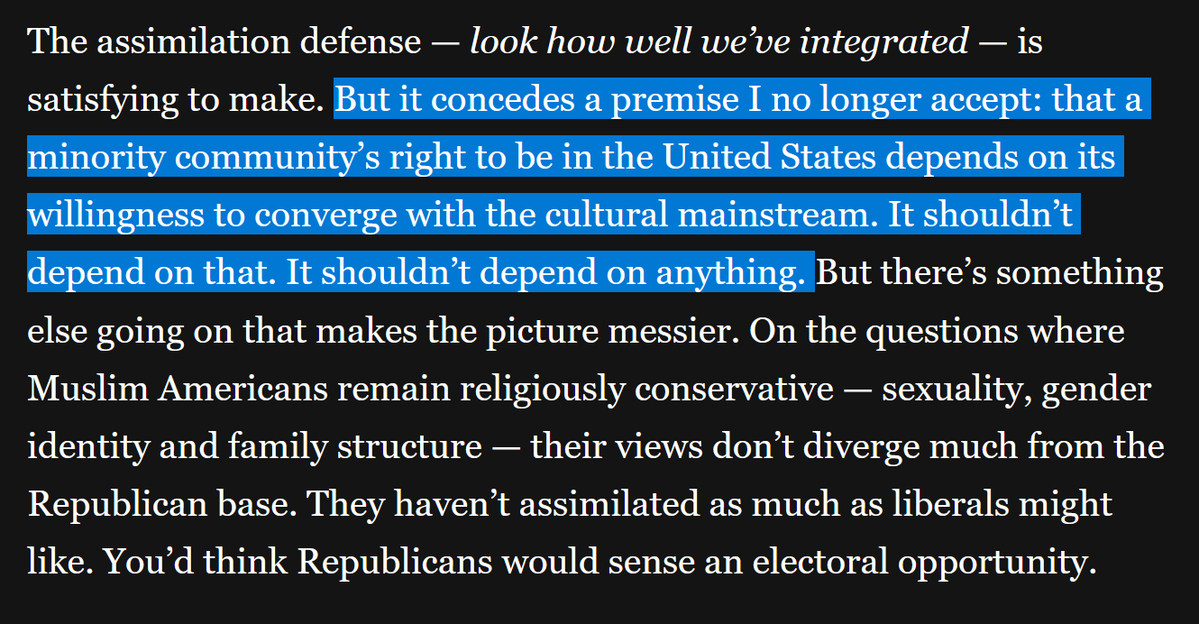
1. Because it's being discussed again, I'll repeat my theory that the reason why we see more people questioning "Jewishness" is because of the larger unfortunate trend of conflating identity with validity or truth.
2. When one's identity is explicitly invoked as a basis (if not *the* basis) for one's argument, it should not be surprising to find one's identity questioned, particularly if the boundaries for identity is disputed.
3. This even holds true for those who have invested so much in correlating an identity with a position that they will challenge the identities of dissenters, even if those dissenters do not invoke their identities (e.g. uncle tom, gender traitors, self-hating Jew, etc).
4. There are literal rule books for what makes someone Jewish. Certain details are up for dispute depending on situations, but others are not. People who meet these criteria are Jewish, full stop.
5. At the same time, simply being Jewish does not bestow the authority to speak for Judaism. As I detail below, the status of one's Jewish identity doesn't even guarantee inclusion in a Jewish community.
joshyuter.com/2018/09/16/spe…
joshyuter.com/2018/09/16/spe…
6. And as I argued here, the decoupling of identity and truth even applies to the *professional* identity of "Rabbi" in that the title alone does not convey automatic legitimacy.
joshyuter.com/2019/06/24/jud…
joshyuter.com/2019/06/24/jud…
7. So Rabbis who explicitly expect/demand recognition of their expertise, authority, or even legitimacy on the basis of their title (as in reminders of , "I'm a rabbi!!!") should not be surprised if the identity/title is questioned.
8. My own opinion is that both of these are true:
1. People should not question another's identity
2. People should not conflate identity for truth or legitimacy.
1. People should not question another's identity
2. People should not conflate identity for truth or legitimacy.
9. As Maimonides taught, "accept the truth from whom you hear it." Or as we learn in Avot 4:20, "Do not look at the vessel, but rather what is inside of it." 

• • •
Missing some Tweet in this thread? You can try to
force a refresh