Interim Rule from the @DOJ_EOIR rearranging EOIR's org chart to reflect changes made in the Trump era, plus some odd new changes to the BIA and to the Director's role.
@DOJ_EOIR The biggest new change to EOIR's organizational structure is the Office of Policy, created in 2017 and just now being formalized in regulations. This office has been the source of many of the Trump administration's worst changes to immigration courts.
@DOJ_EOIR Board of Immigration Appeals members, known since the creation of the Board as "Board Members," are now going to be officially also called "Appellate Immigration Judges."
The politics of that choice are... interesting.
@DOJ_EOIR The interim rule will also permit, in circumstances where an appeal hasn't been decided within certain time periods, for the EOIR Director to decide appeals!
The regulations previously allowed the A.G. to decide cases in those scenarios, and the A.G. says he's too busy.
@DOJ_EOIR Finally, because allowing the Director to decide appeals conflicts with a current regulation saying the Director cannot do that, the Interim Rule edits the old regulation to make the new delegation of authority permissible.
The rule goes into effect 60 days from Monday.
• • •
Missing some Tweet in this thread? You can try to
force a refresh

🚨 🚨 🚨 NEW: A shocking @USCIS memo seems to declare that hundreds of thousands of immigrants living in this country and applying for green cards must instead apply for visas abroad; which could MASSIVELY disrupt lives.
1. Apply for an immigrant visa at a U.S. consulate abroad. 2. Apply for a green card while already in the USA.
The new @USCIS memo seems to say that most people in group 2 should generally be denied a green card and forced to apply abroad.
@USCIS Why does it matter if people have to apply abroad?
- It could force people to leave their jobs, homes, and families for weeks or months, all at their own expense
- Consular decisions are virtually unchallengeable in court, even when egregiously wrong
- Backlogs can be much worse
Today the Supreme Court hears a case that will decide the fate of over 350,000 people currently living legally in the United States — and impact thousands more who are still in limbo.
So what is Temporary Protected Status and what is the case about? NEW 🧵 on the issue.
Temporary Protected Status was created to deal with the fact that sometimes, due to an outbreak of war, political crisis, or natural disaster, deportation becomes inhumane.
Without a law to address this, presidents responded on an ad hoc basis using inherent executive authority.
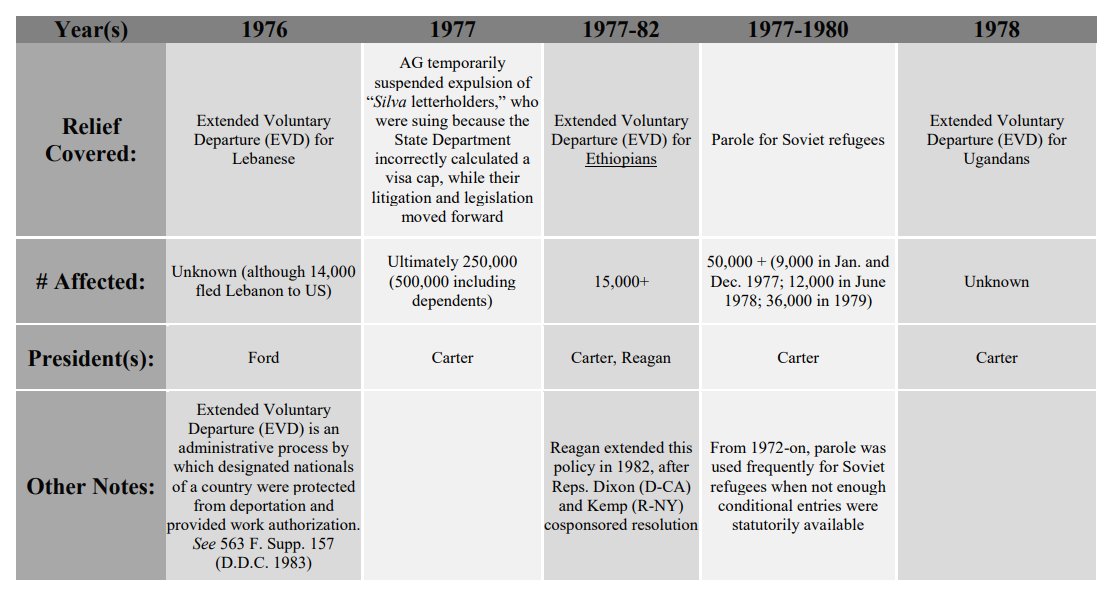
Before TPS, Presidents used a thing called "extended voluntary departure" to address these crisis. For example:
- Ford gave EVD to Lebanese in 1976 due to civil war
- Carter gave EVD to Ugandans in 1978 due to civil war
- Reagan gave EVD to Poles in 1981 due to Soviet crackdowns
From FY 2021 through FY 2024, roughly 3.5 million people became U.S. citizens through naturalization. The idea that Biden is somehow personally responsible if any of them later went on to commit crimes is beyond stupid; it's willfully ignorant and deliberately inflammatory.
Neither @nypost or @DHSgov has EVER blamed Trump for any crimes committed by an immigrant who entered the country or got status under Trump. Not once.
It's because they KNOW it's not a good faith argument.
Wait, sorry, so now the Trump admin is attempting to strip green cards from people just because of who their families are?! And people are cheering this on?
People with DACA came here as children. Every one of them has been here for a minimum 19 years. They grew up here. They went to school here. Many speak English with no accent. They are working legally, paying taxes, doing everything right.
Because that's not something a President can do. Only Congress can provide a path to permanent legal status for most DACA recipients. And Congress has sat on its ass for years, even though huge majorities of the American public supports the DREAM Act.
In 2018, the Supreme Court said DACA might be legal if it only protected against deportation, not provided work permits. The 5th Circuit, the most conservative in the country, upheld that version and limited their ruling only to Texas (the plaintiff).
Here I was thinking that what mattered was every single judge who has ruled on the issue, 125+ years of accepted understanding of the 14th, and centuries of common law on the contours of jus soli. But if you have SEVEN law professors, man, WOW.
Less sarcastically, this article has a GLARING flaw: dual citizenship. Many children of U.S. citizens acquire foreign citizenship at birth under jus sanguinis and so would not have an "exclusive" allegiance to the US under this theory. That can't be right.
If "exclusive allegiance" is required, then how could that cover Wong Kim Ark himself, who was a dual national?
Hamburger's answer is that U.S. law at the time did not recognize dual nationality. That's a bizarre answer that raises more questions than it answers.