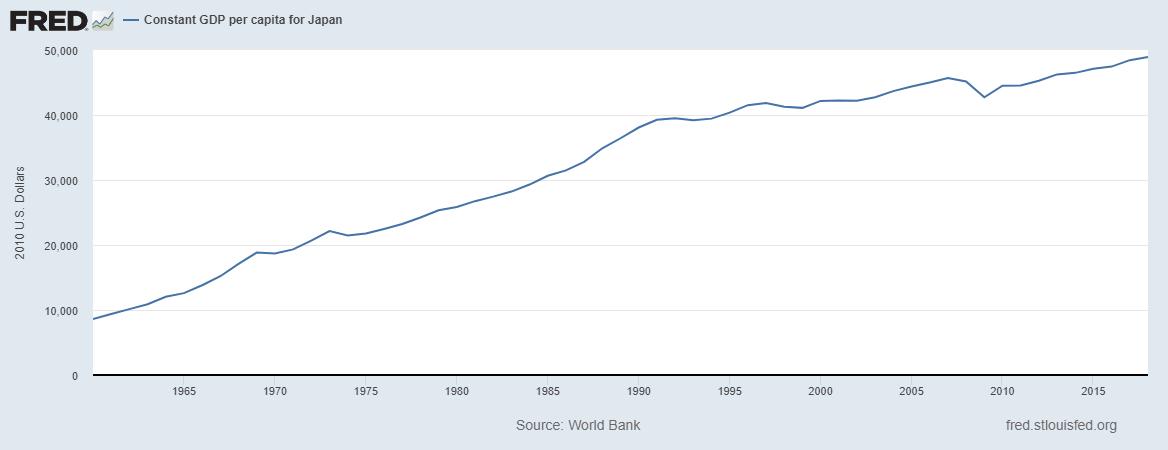
It's a thought-provoking piece. Made me sit back and reflect a bit. Are these really the issues that should concern us? Or are we barking up the wrong tree?
Q being asked is whether central banks (CBs) can be relied for macroeconomic stabilization in economies that have "turned Japanese." The U.S. economy is only one recession away from this prospect, evidently. Europe is apparently already there.
But maybe turning Japanese is not so bad. Just ask @Noahpinionnoahpinionblog.blogspot.com/2018/06/noah-s… Sure, RGDP growth has slowed since 1990. But so what? Material living standards are high. People are amazing, country is interesting and fun.
This is not to say there aren't issues, of course. But do "slow" growth and zero interest rates constitute some of these issues? I don't think so. First, growth may be "slow" but it's occurring at elevated levels. And why is achieving high RGDP growth so important anyway?
People enjoy "growing" to be sure. But keep in mind that people would experience income growth for standard life-cycle reasons even in a zero growth economy. Wanting aggregate growth is like wanting to make sure our children can live in 3-garage homes instead of 2-garage homes.
But isn't aggregate growth necessary to ensure that the less fortunate share in a nation's bounty? Makes it easier, to be sure, but why should it be necessary? We are rich enough already, collectively, to make sure all can live comfortably.
But what about the aging population? Yes, what about it? Is someone prepared to lecture me on how awful it is that we are living longer than ever? Older generations have contributed to building the capital that makes possible the living standards that we all enjoy today.
Let them enjoy the fruits of their past labor (many continue to work anyway). Let's maintain and augment this capital stock (which includes the environment) for future generations. Maybe social security systems need to be re-calibrated. But this is (or should) not a big deal.
But how will monetary policy work to stabilize the business cycle in a Japan-like economy? It will work fine, except not through the CB and not through interest rate policy. In a Japan-like economy, the fiscal authority has all the fiscal space it needs.
Deflationary recessions can be met with tax cuts (including money transfers via "helicopter drops"), money/bond financed government spending, treasury purchases of private assets, etc. One possibility is to have the CB responsible for this type of fiscal policy.
As for the U.S., things are similarly looking good at the aggregate level. The issue is not with the level of income or its growth. There are many more pressing issues that can (and should) be solved even if per capita RGDP flat-lined forever.
As for interest rate policy as a macrostabilization tool, can we all just agree that it's much over-rated? Maybe it works stabilizing "little" shocks that buffet the economy. But who cares about little shocks? We care about big shocks.
And to be fair, I think central bank LOLR operations are important macro stabilizers. But all major interventions are usually a coordinated affair anyway (between monetary and fiscal authorities).
So, the road ahead, in my view, is to make this coordinated effort a more explicit part of the macroeconomic policy stabilization toolkit.
• • •
Missing some Tweet in this thread? You can try to
force a refresh

Database management systems based on decentralized consensus mechanisms are (I think) inherently inefficient relative to centralized mechanisms. But if so, then what do firms mean when they claim "blockchain is more efficient?"
I think what they mean is that public blockchains economize on institutional coordination costs, not data management costs. That is, if one was to compare a properly designed standard database system run by trusted institutions, it would almost certainly outperform blockchains.
By "proper design," I mean a conventional payment system incorporating:
-instant final settlement,
-global interoperability,
-programmability,
-24/7 operation,
-open access,
-low-cost transfer,
-bearer-style functionality,
-and trusted neutral governance.
[1/10] This headline caught my attention. What does "tokenization" actually entail?
[2/10] My recollection is that in crypto culture, “token” often implied: (1) direct bearer ownership; (2) self-custody; (3)
peer-to-peer transfer; and (4) decentralization. At least, this was my understanding when I wrote on the idea here: andolfatto.blogspot.com/2018/11/smart-…
[3/10] But this is not at all what "tokenization" means in institutional finance. In that context, the term means something more like "standardized programmable entries on coordinated ledgers."
Money and banking will forever be mysterious. My take: banks create deposits (money) in the act lending. Banks may need to borrow reserves (central bank money) to settle payments and/or honor withdrawals. Even if banks do not borrow reserves, deposits are bank liabilities...
...held by the non-bank sector. In this sense, non-bank sector is "lending funds" to banks. Non-bank sector could pull those funds at any time--then banks would have to acquire reserves/cash to honor redemptions.
And so, like George, I have no problem saying that banks create deposits and also require funding, if we're clear what is meant by these terms (my sense is that these terms are rarely defined, mean different things to different people, hence confusion.)
Let G(t) = govt spending at date t & M(t) = money supply at date t (assume govt is monopoly issuer). Money-financed spending means G(t) = M(t)-M(t-1).
Now, suppose P-level is related to M(t) so that inflation rate is related to M(t)-M(t-1). Suppose inflation is too high.
How to reduce inflation w/o reducing G(t)? One way is to destroy money in hands of private sector through taxes T(t), so that
G(t) = T(t) + M(t) - M(t-1).
With taxes, govt can still fund G(t) while growing the money supply more slowly (lower inflation rate).
If so, then in what sense is it appropriate to say that taxes do not fund government spending?
Suppose govt prints M(t)-M(t-1) in the morning of date t to purchase G(t) w/ tax revenues T(t) arriving in the evening of date t ,exactly offsetting new money so that G(t) = T(t).
I think most--if not all--macroeconomists would agree that dramatic changes in CB interest rate policy can have real effects that influence the P-level.
The idea that initiated the broader discussion, however, was that increasing the unemployment rate is *necessary* to bring inflation down (with an eye on our recent inflation experience). In my view, the answer is *no.*
Yes, it is possible to bring inflation down, temporarily at least, by raising the policy rate and creating a severe recession. This is not what the intellectual debate is about. It is about whether tighter monetary policy is *necessary* to lower inflation in the current episode.
I became interested in this question after reading this article by Jack Hirschleifer (AER, 1971): people.duke.edu/~qc2/BA532/197…
The article contains the following example.
Imagine you in a room w/ a group of people. It's common knowledge that one of you is (or will be) suffering from an incurable disease that'll leave you disabled for life. You all agree to enter into an insurance arrangement: The unafflicted promise to compensate the afflicted.