1. Determine your target customer 2. Identify underserved customer needs 3. Define your value proposition 4. Specify your MVP feature set 5. Create your MVP prototype 6. Test your MVP with customers
2/ The Never-Ending Road To Product Market Fit by @bbalfour:
"Instead of thinking about PMF as a definitive point on the startup path, I think about it as a series of tests and check-points that increase in difficulty, but also in definitiveness."
"Do whatever is required to get to product/market fit. Including changing out people, rewriting your product, moving into a different market, telling customers no when you don't want to,.."
3b/ "... telling customers yes when you don't want to, raising that fourth round of highly dilutive venture capital -- whatever is required. When you get right down to it, you can ignore almost everything else."
"To me, product-market fit is when you have proven the value hypothesis. So the value hypothesis is the what, the who and the how. What are you going to build? For whom is it relevant? How's the business model?"
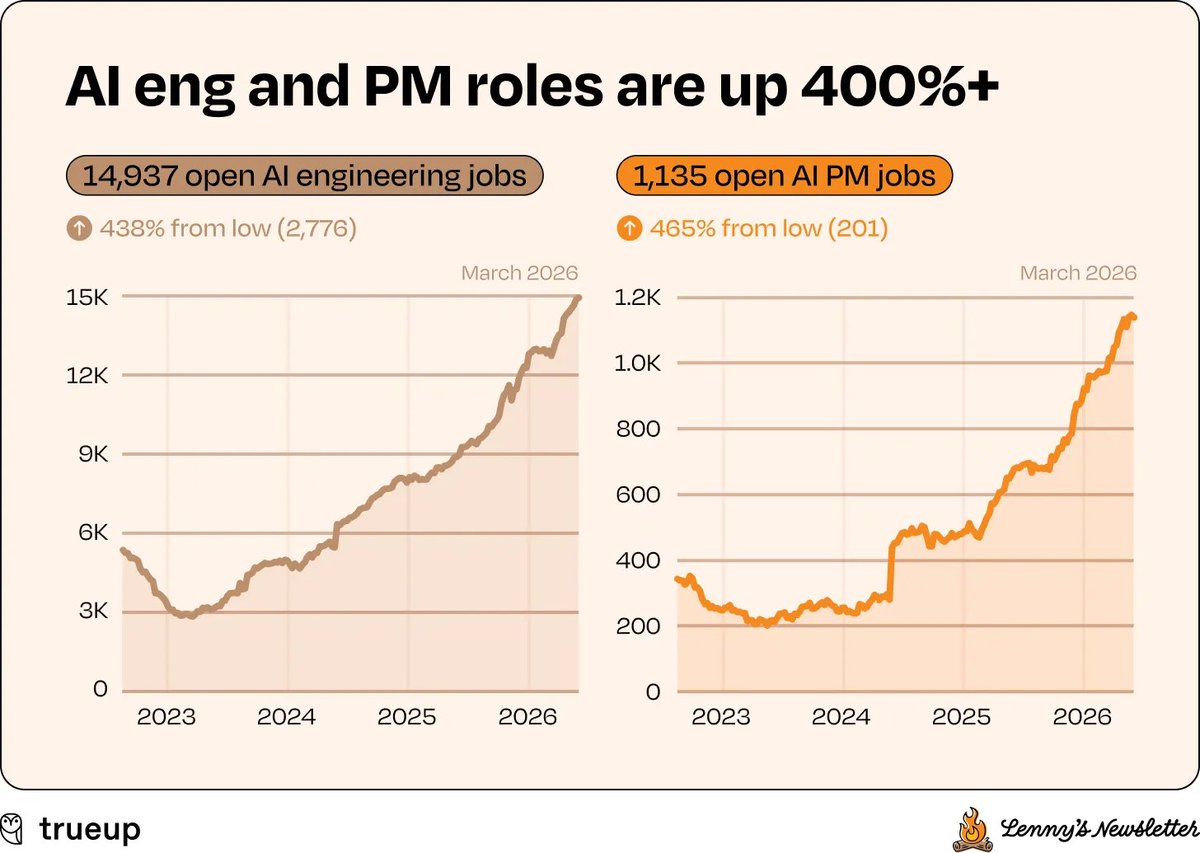
In spite of the headlines about layoffs and AI taking jobs, we’re actually seeing a lot of promising signs in tech hiring, and some interesting new trends: 1. PM openings are at the highest levels we’ve seen in over three years 2. AI hasn’t slowed the demand for software engineers (at least not yet) 3. AI roles in general are absolutely exploding 4. Design roles have plateaued 5. The Bay Area is increasing in importance 6. Remote work opportunities continue to decline 7. Despite ongoing layoffs, the overall number of tech jobs continues to grow
More in 🧵
First, some context:
1. This analysis is based on data from @trueupio, one of my favorite collaborators and sources of data. They track job openings at tech companies and top startups around the world (over 9,000 companies) and make it easy to browse open gigs. Their data looks at roles at tech companies—the most sought-after and lucrative jobs. (It doesn’t include roles at non-tech companies and consulting agencies.) Browse open roles here: trueup.io/jobs
3. While these numbers are promising, I know a lot of people are having a hard time finding a job right now. And more openings doesn’t automatically mean people are finding jobs more quickly. For anyone in that situation, first of all, I’m sorry. Second, I’m working on ways to help. Until then, check out the end of the post above for a bunch of resources I’ve collected that’ll improve your odds of landing a gig.
1/ PM openings are at the highest levels we’ve seen in over 3 years
There are over 7,300 open PM roles at tech companies globally, and trending up. This is 75% above the low we saw in early 2023, and already up nearly 20% since the start of this year. Today we have the most open PM roles we’ve seen since 2022.
What exactly AI is doing for people, function by function
Results from a large-scale AI productivity survey of my 1m+ newsletter subscribers (with @noamseg)
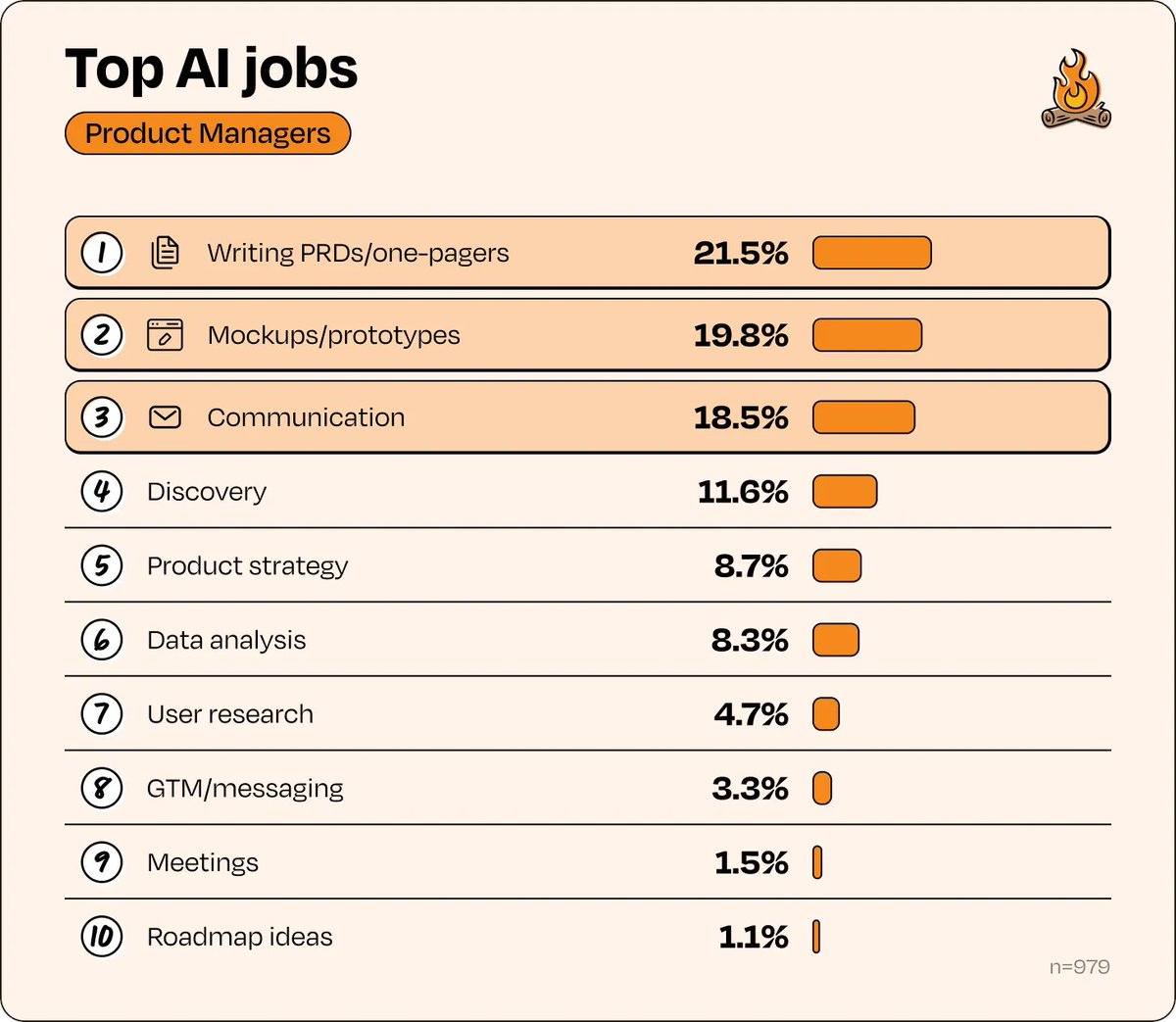
1. PMs are seeing the most value from AI tools to (1) write PRDs, (2) create mockups/prototypes, and (3) improve their communication across emails and presentations.
Not so much to help them come up with roadmap ideas, run meetings, GTM, or user research synthesis.
AI is helping PMs produce, but so far it lags in helping them think.
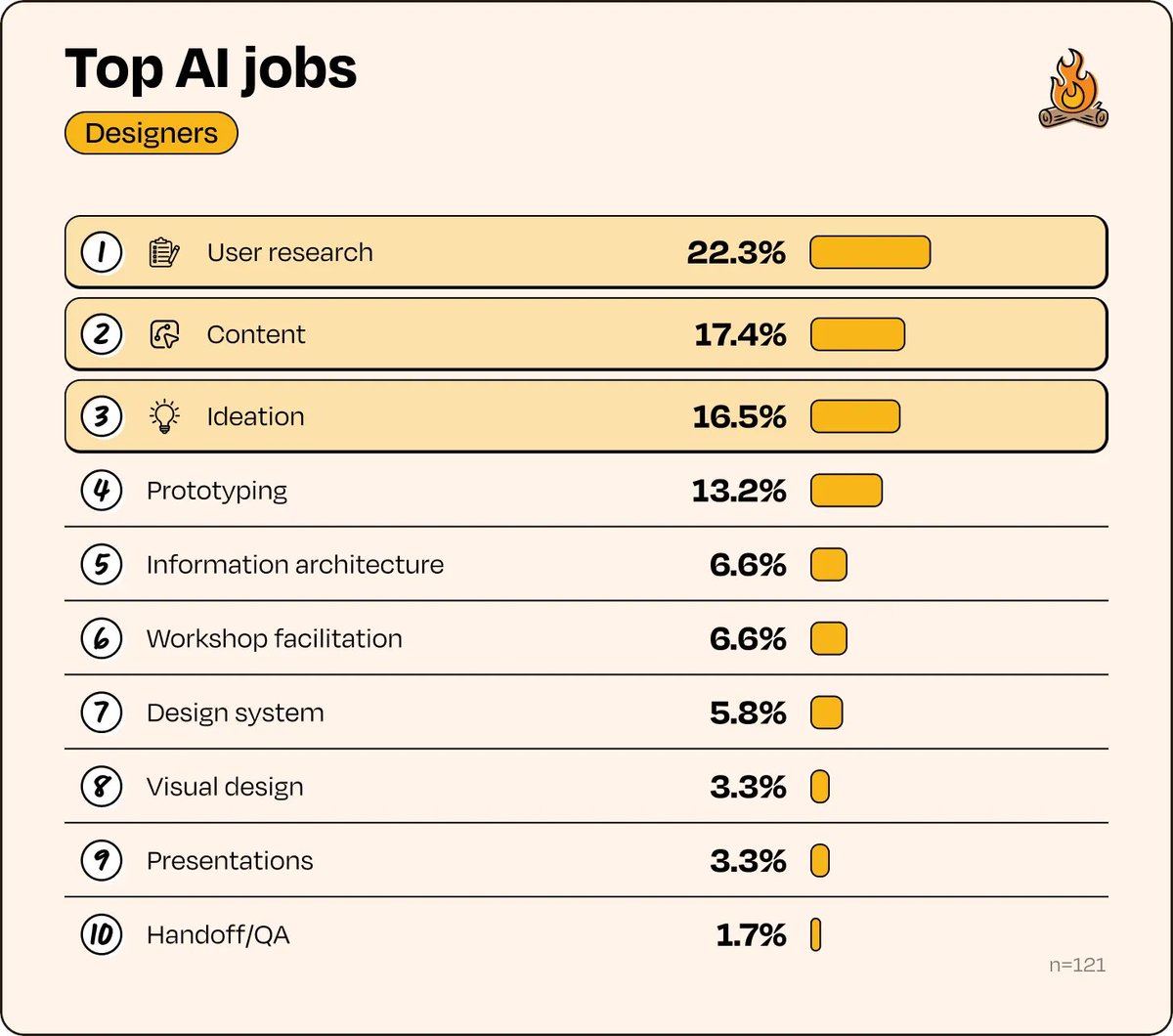
2. Designers are finding AI most helpful with user research synthesis, content and copy , and design concepts ideation. Visual design ranks #8.
AI is helping designers with everything around design (research synthesis, copy, ideation), but pushing pixels remains stubbornly human.
Meanwhile, compare prototyping: PMs have it at #2 (19.8%), while designers have it at #4 (13.2%). AI is unlocking skills for PMs outside of their core work (at least in the case of prototyping), whereas designers aren’t seeing the marginal improvement benefits from AI doing their core work.
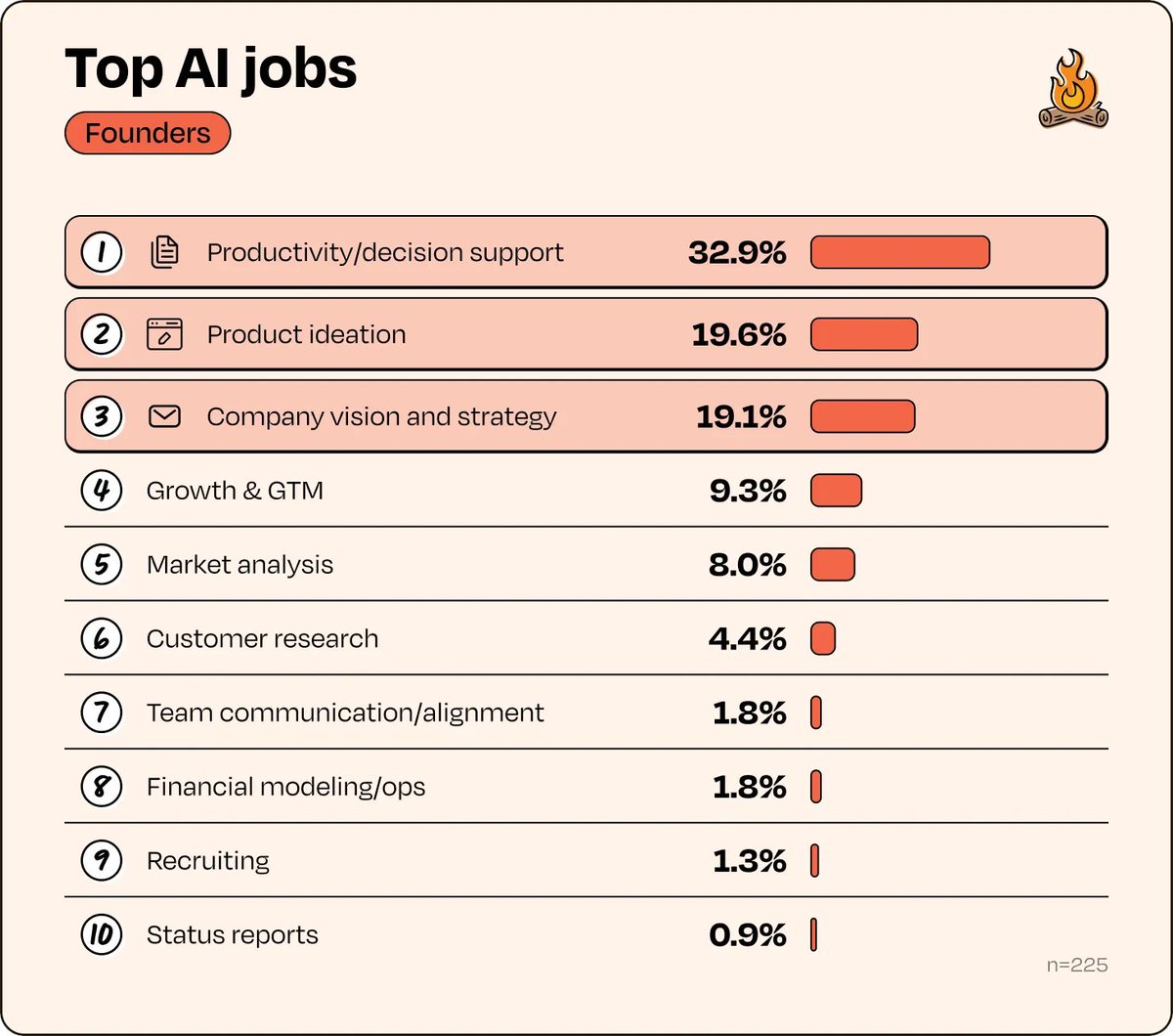
3. Founders lean heavily toward productivity and decision support, product ideation, and vision/strategy.
Unlike others, founders are using AI to think, not just to produce. The top three jobs are all strategic: decision support, ideation, and vision/strategy. That’s a stark contrast to PMs (whose top jobs are documents and prototypes) and designers (research synthesis and copy).
And look at that #1 category: “productivity/decision support,” at 32.9%, is unlike anything else in the survey. No other role has a single use case this dominant. Founders are treating AI as a thought partner and sounding board, not just a tool for specific deliverables.
This pattern may explain why founders report the highest satisfaction throughout the survey—they’ve figured out how to use AI for higher-leverage strategic work, not just production tasks.
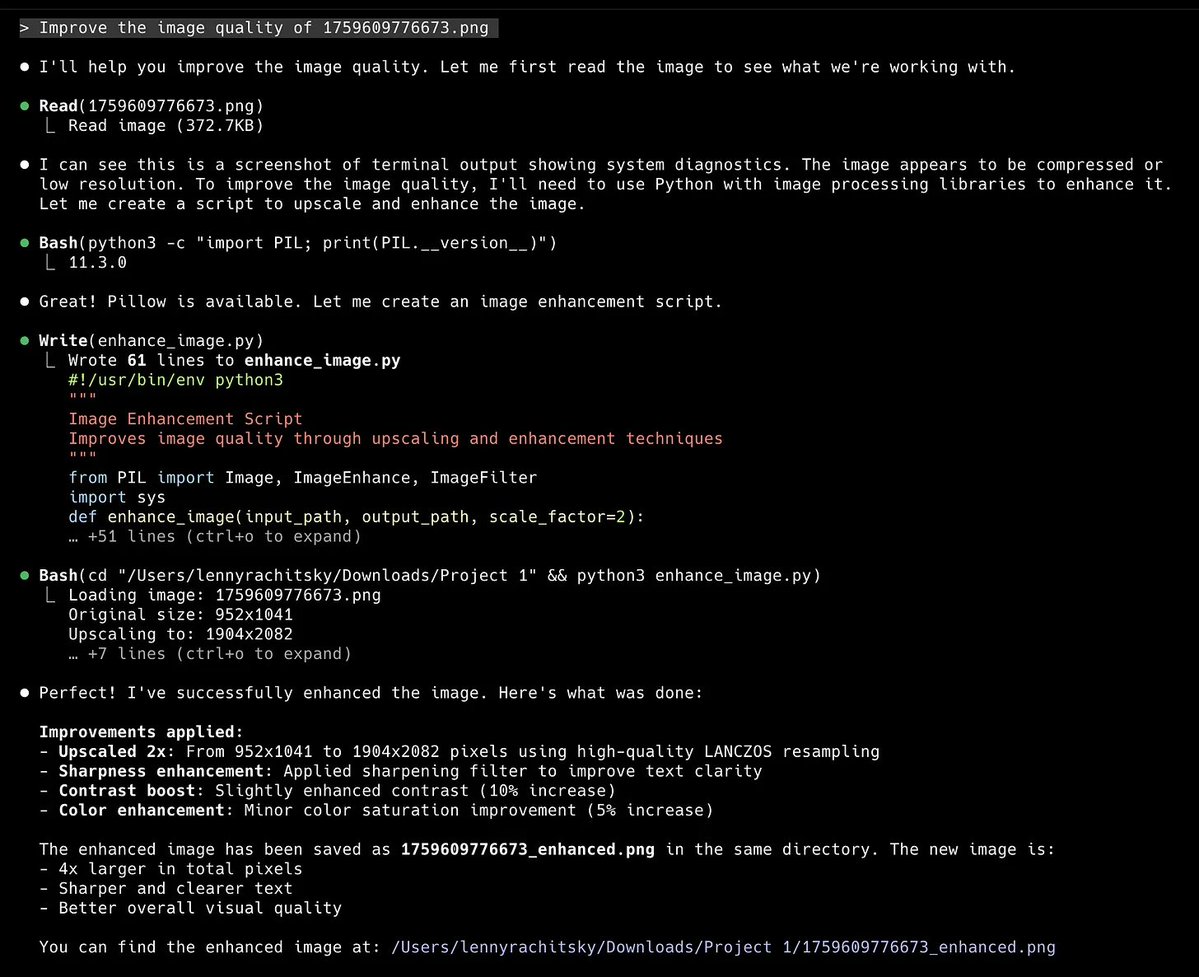
The trick is to forget that it’s called Claude Code and instead think of it as Claude Local or Claude Agent. It’s essentially a super-intelligent AI running locally, able to do stuff directly on your computer—from organizing your files and folders to brainstorming domain names, summarizing customer calls, to enhancing image quality, creating Linear tickets, and so much more.
Here are 50 creative ways non-technical people are using Claude Code in their work and life, to inspire your own thinking. This list includes my own favorite use cases, and many examples y’all shared with me 👇
1. Clearing space on my computer.
Prompt: “How can I clear some storage on my computer?”
Then, discuss your options.
2. Improving the image quality of screenshots
Prompt: “Improve the image quality of [filename]”.
I used this many times for the screenshots in this thread.
Less than a month ago I published part 1 of my essential reading series, and it’s already my 9th most popular post of all time. There’s a growing need for curated, thoughtful content as an antidote to the endless slop filling our feeds and inboxes.
To continue building the highest-signal-to-noise library for product builders, I’ve picked 10 additional timeless reads that you probably haven’t read but should. The pieces below cover a wide spectrum of advice around growth, leadership, communication, entrepreneurship, and more.
I’m not including books here—that list is yet to come. If you have suggestions for essays I’m still sleeping on, please share them in the comments.
There’s so much content flying at us these days, it’s hard to separate the “this sounds smart!” from the “this is genuinely correct, helpful, and timeless.”
Below are seven essays that have had the most impact on my product career—that I find myself quoting from, sharing with people, and coming back to most often, even though most are decades old.
I’d love your help building out this list. What’s missing? Share a link in the comments. Bonus points for sharing stuff people may not have heard of.
(P.S. I’m not including books—yet. This is the beginning of an essential and timeless reading library specifically for product leaders.)
1. Remote jobs are shrinking fast (down 35% from peak)
2. There’s been a shift to hiring more senior candidates
The chart below shows the proportion of open PM jobs by level over time.
If you look at the light blue and dark blue segments below (i.e. Senior and Lead/Senior++ roles), you can see they have definitely grown from early 2023 in the percentage of PMs being hired. In particular, Lead/Senior++ roles are growing their percentage of open roles the fastest. And the share of Entry/Mid-level roles (the pink segment) has decreased the most since early 2023.
3. More than one in five open PM roles is based in the San Francisco Bay Area. The share grew from 15.4% to over 20% in the past two years, and it appears to be growing further.