1/ Buzzwords like “synergy” and “disruption” annoy workers and dominate the professional world, @OlgaKhazan reports. Readers shared other examples of cloying marketing-speak, from “double click” to “bandwidth.” But which ones are the most irritating? theatlantic.com/health/archive…
2/ The Atlantic wants to hear from you. Every day for the next several weeks, new polls will test overused corporate buzzwords against each other until your votes decide the most nauseating of them all.
3/ So before we “close the loop” on this poll, let’s “loop in” as many voters as possible. Which is worse?
4/ Silicon Valley has recast “disruption” as a good thing, @OlgaKhazan writes. But can anyone actually say “disrupt” with a straight face anymore? Is frustration with corporate speak “moving the needle”?
Which phrase do you mock more?
Which phrase do you mock more?
5/ When @OlgaKhazan “unpacked” corporate buzzwords, she realized that the terms people knew best tended to be the ones that irritated them the most. So let’s “debrief”: Which word is more irritating? (Leave a comment if you use it more than the alternative.)
6/ It might be time to “think outside the box” and take a “holistic approach”—if a sentence like that even means anything to you.
Which buzzword is more purposefully—and more annoyingly—vague?
Which buzzword is more purposefully—and more annoyingly—vague?
7/ Are you “at capacity” yet? Do you have the “bandwidth” to vote on which phrase is more maddening?
8/ All employees are “stakeholders” in their organization, but not all are “change agents.” Which description of an invested party bothers you more?
9/ Why is it that you email your grandparents but you “ping” your boss? You can phone your friend, but you must “hop on a call” with a coworker. Which is worse?
10/ Do workers use corporate buzzwords to “lean in” to adulthood? Let’s “double click” into that idea.
Which infuriates you more?
Which infuriates you more?
11/ Buzzwords can provide a PR-friendly gloss on whatever “pain points” you’re trying to cover up—and easily recast criticism as “pushback.”
Which corporate expression of refusing to acknowledge failure irks you more?
Which corporate expression of refusing to acknowledge failure irks you more?
12/ Though the terms “value added” and “value proposition” share the same first word, they mean completely different things. Which expression is more confusing?
13/ If someone disagrees with your work, just call the compromise a "pivot" and press on. Can we “align” on which buzzword is more annoying?
14/ Boycotting corporate buzzwords could be a “win-win,” but only if enough workers “buy in.”
Which word is more of a lose-lose?
Which word is more of a lose-lose?
15/ “Huddles” aren’t just for youth sports fields—they’re also for colleagues to “liaise” with potential business partners.
Which word makes you miss the simplicity of “meet” more?
Which word makes you miss the simplicity of “meet” more?
16/ “Touching base” on this! “Circling back” to see if you’ve had a chance to vote.
So which phrase grates more?
So which phrase grates more?
17/ Thanks for joining us on this “deep dive” into one of the most frustrating parts of office life. Vote below to ensure that our results are “robust.” Which corporate phrase do you wish offices would just ban?
18/ Ultimately, buzzwords are useful when office workers need to dress up their otherwise pointless tasks with fancier phrases—you know, for the “optics,” @OlgaKhazan concludes. So let’s “silo” the first round of voting here.
Which is worse?
Which is worse?
19/ Results are in for the first round of voting. The winners include: “ping,” “silo,” and more.
We’ll start the next matchups on Monday. To participate in more engagement opportunities, follow us on Instagram and Facebook too.
instagram.com/theatlantic/
facebook.com/TheAtlantic/
We’ll start the next matchups on Monday. To participate in more engagement opportunities, follow us on Instagram and Facebook too.
instagram.com/theatlantic/
facebook.com/TheAtlantic/

20/ “Looping in” new voters for our next round of polling! How much of a “disruption” would banning buzzwords create for corporate life?
If you had to choose, which phrase would you ban first?
If you had to choose, which phrase would you ban first?
21/ As we continue this next round, we wanted to “unpack” our “holistic approach” to composing the bracket: Many of these buzzwords were collected from comments on our Instagram account responding to @OlgaKhazan's article. theatlantic.com/health/archive…
Which word annoys you more?
Which word annoys you more?
22/ Any worker could become a “change agent”—but not if they lack the “bandwidth” to innovate.
Which word is more jargony?
Which word is more jargony?
23/ Now that so many of us are working from home, "lean in" to your digital communication and "ping" your colleagues.
Which action word do you dislike more?
Which action word do you dislike more?
24/ Overcome any “pain points” in your business strategy with a comprehensive “value proposition.”
Which expression makes you roll your eyes more?
Which expression makes you roll your eyes more?
25/ If you don’t “buy in” to your boss’s idea, can you “pivot” to a new project?
26/ Polls are a fun way for us to “liaise” with our readers. But let’s “circle back” to the task at hand: Which buzzword gets under your skin more?
27/ Thanks for staying with us for this anti-buzzword “deep dive.” If you haven’t “siloed” yourself off yet, this is the last matchup before we move on to the elite-eight!
Which term do you dislike more?
Which term do you dislike more?
28/ Results are in for the second round. The winners include: “loop in,” “lean in,” and more.
We’ll start the quarter-finals tomorrow. To participate in more engagement opportunities, follow us on Instagram and Facebook too.
instagram.com/theatlantic/
facebook.com/TheAtlantic/
We’ll start the quarter-finals tomorrow. To participate in more engagement opportunities, follow us on Instagram and Facebook too.
instagram.com/theatlantic/
facebook.com/TheAtlantic/
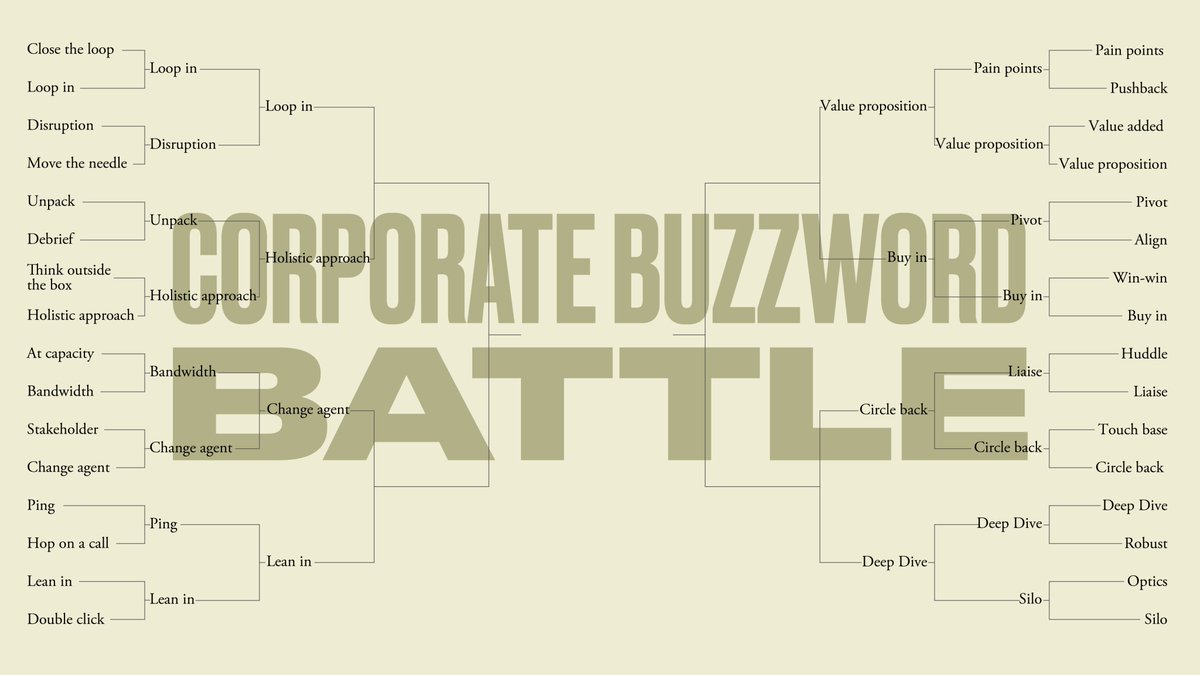
29/ If you haven’t been “looped in” already, we’re asking readers to vote for their least favorite corporate buzzword. Read more about our “holistic approach” in the thread above.
So which term frustrates you more?
So which term frustrates you more?
30/ “Change agents” are sometimes hired to evaluate and improve the overall effectiveness of an organization. “Lean in” to innovation, and you too could become a “change agent.”
Okay, which word do you loathe to hear more?
Okay, which word do you loathe to hear more?
31/ “Value proposition” is just a fancy way for organizations to say they want customer “buy in.”
Which term grinds your gears more?
Which term grinds your gears more?
32/ Has our corporate buzzwords “deep dive” made you hate any buzzwords even more? We’ll “circle back” to that question after we finish the bracket.
Which word makes you cringe when you say it?
Which word makes you cringe when you say it?
33/ Results are in for this round. Winners include “lean in,” “circle back,” and more.
Voting on the final four buzzwords begins tomorrow. To participate in more engagement opportunities, follow us on Instagram and Facebook too.
instagram.com/theatlantic/
facebook.com/TheAtlantic/
Voting on the final four buzzwords begins tomorrow. To participate in more engagement opportunities, follow us on Instagram and Facebook too.
instagram.com/theatlantic/
facebook.com/TheAtlantic/

34/ A “holistic approach” for evaluating employee performance might consider some of the challenges of “leaning in” at the workplace.
Which word vexes you more?
Which word vexes you more?
35/ “Circling back” to the essential idea behind @OlgaKhazan’s article, we have a “value proposition” for you: Ban corporate buzzwords.
Which word makes your skin crawl?
Which word makes your skin crawl?
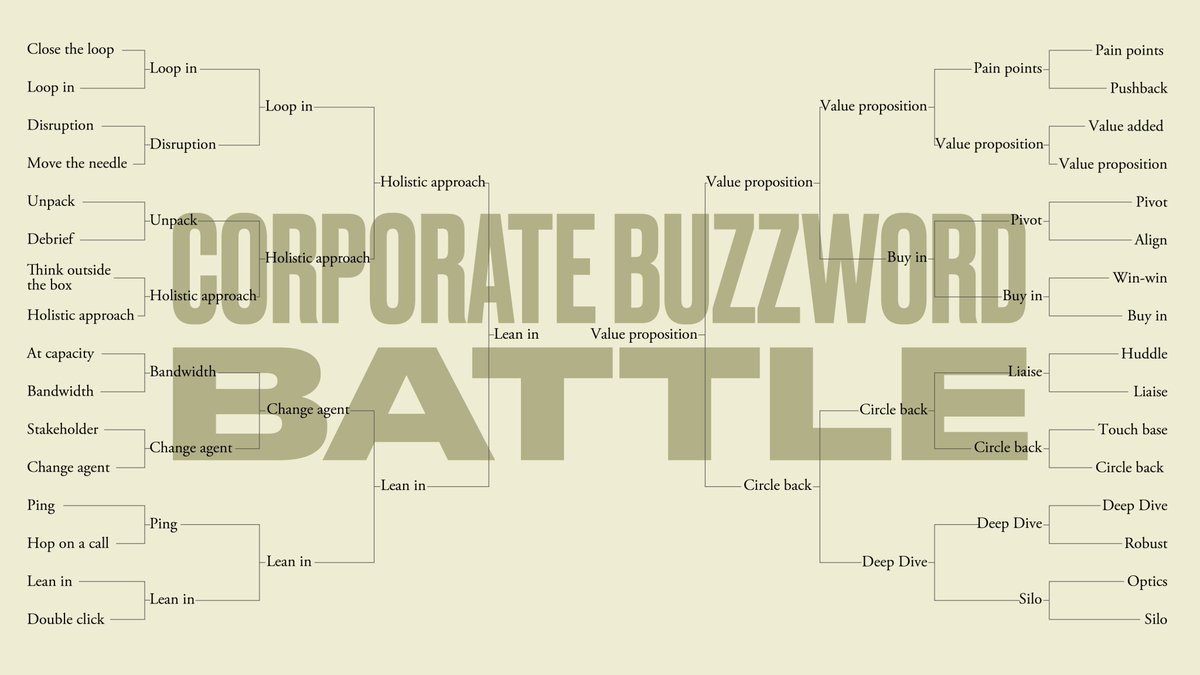
36/ We’ve narrowed down the list of your least favorite corporate buzzwords—including “liaise,” “optics,” and “change agent”—from 32 to two.
Only “lean in” and “value proposition” remain. Vote on Monday to settle this bracket once and for all. May the worst buzzword win.
Only “lean in” and “value proposition” remain. Vote on Monday to settle this bracket once and for all. May the worst buzzword win.
• • •
Missing some Tweet in this thread? You can try to
force a refresh