
A @nytimes story by @apoorva_nyc features last week's German study claiming that viral loads among children and adults are the same. Except that is not what the study results show. A quick thread with some graphs.
nytimes.com/2020/05/05/hea…
nytimes.com/2020/05/05/hea…
I tweeted on the study last week. This weekend I wrote it up as part of a module for my students to illustrate hypothesis tests, statistical power, and selection bias. Here's a quick summary.
The study, involving the now famous virologist @c_drosten, analyzes the viral loads from 3712 positive RT-PCR tests in Berlin. The main conclusion is that the mean viral loads for younger age groups are not significantly different from adults. zoonosen.charite.de/fileadmin/user… 

Problem 1: There are very few children in the sample. Their viral load is on average lower but the mean viral load is imprecisely estimated. This means that you can't always reject the null-hypothesis that there is no difference between younger and older groups.
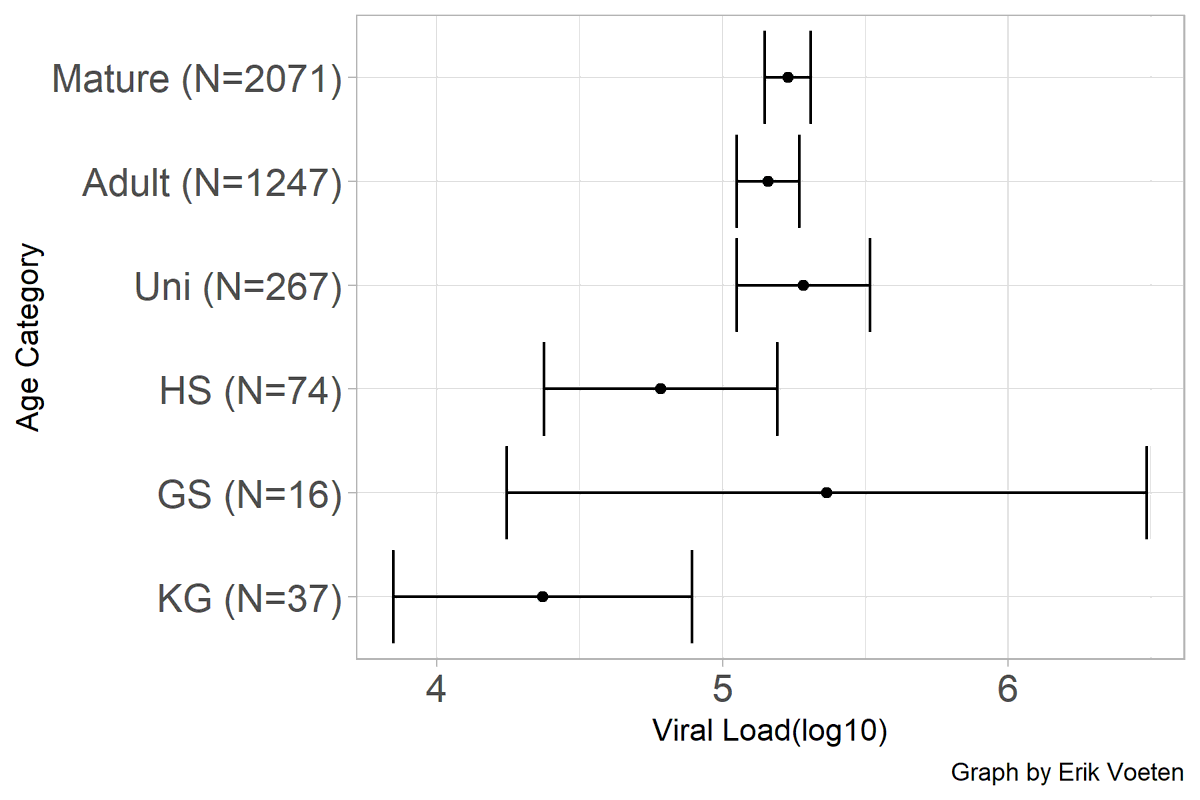
This is a problem of statistical power: you need at least 115 people in each group to have an 80% chance that we can reject the null-hypothesis when there really are differences in the viral loads of children and adults (given these effect sizes).
So why not just combine the youngest and oldest age groups? When you do that, you find a clear significant difference between children and adults. This is the headline comparison in the paper abstract "Children may be as infectious as adults."
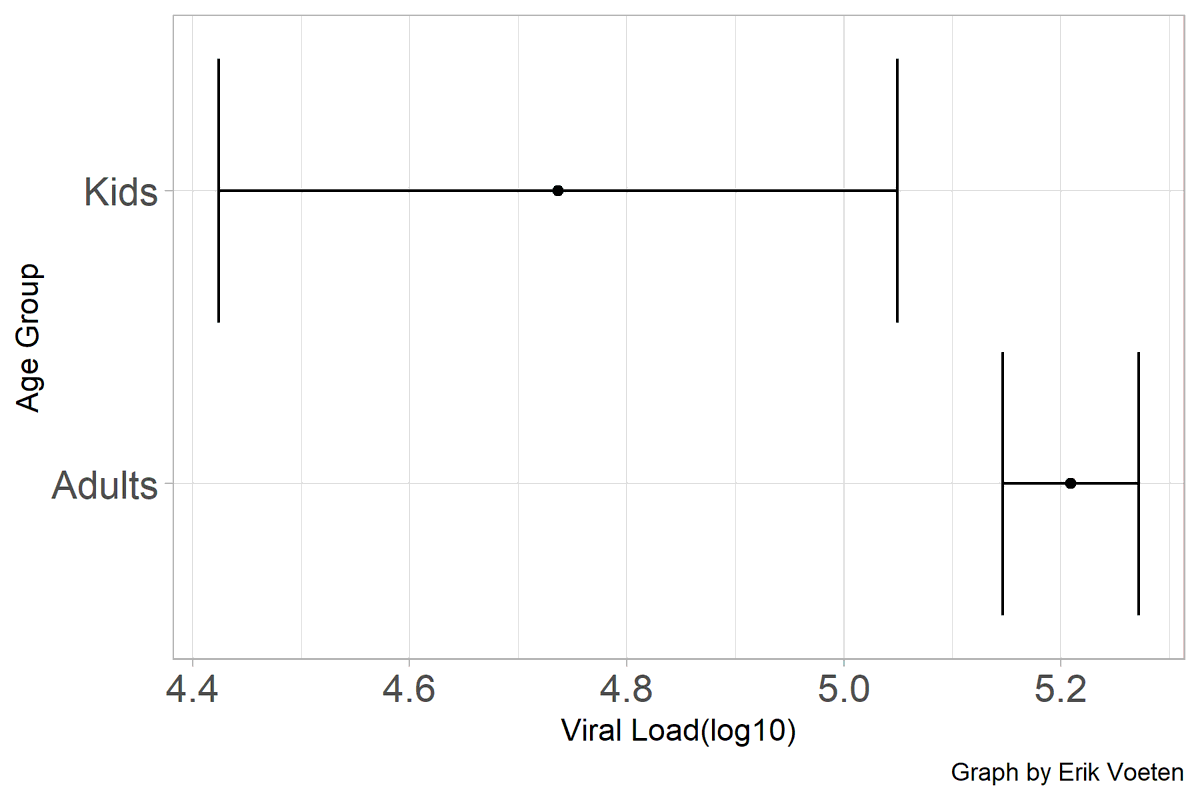
The proper conclusion from this study is that it finds evidence for different mean viral load values for children and adults but that it lacks the statistical power to reliably estimate differences between specific groups of children and adults.
Problem 2: selection. There are two issues. First, only about 4,000 children were tested as opposed to about 55,000 adults. Maybe after school closures, children had fewer contacts but it could also be that children had lower viral loads (and symptoms) and were thus not tested.
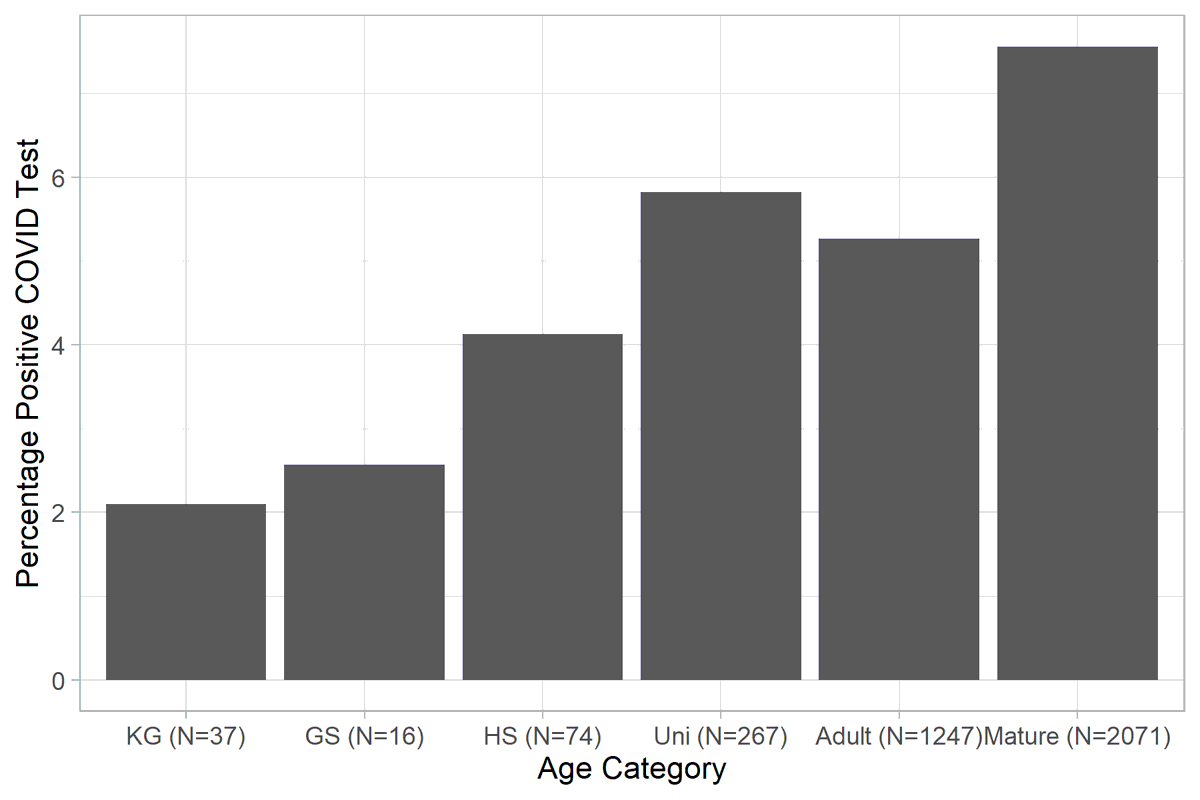
Second, among those tested, children are much less likely to be positive. This is a big problem because these tests are known to have a high percentage of false negatives, especially among people with low viral loads.
Suppose that the true means for kids and adults are 3 and 5. But only those above 4 test positive (the actual data barely have anyone below 4). This leaves only the kids with high viral loads in the sample (the sample mean for kids is above 4 in this illustration).
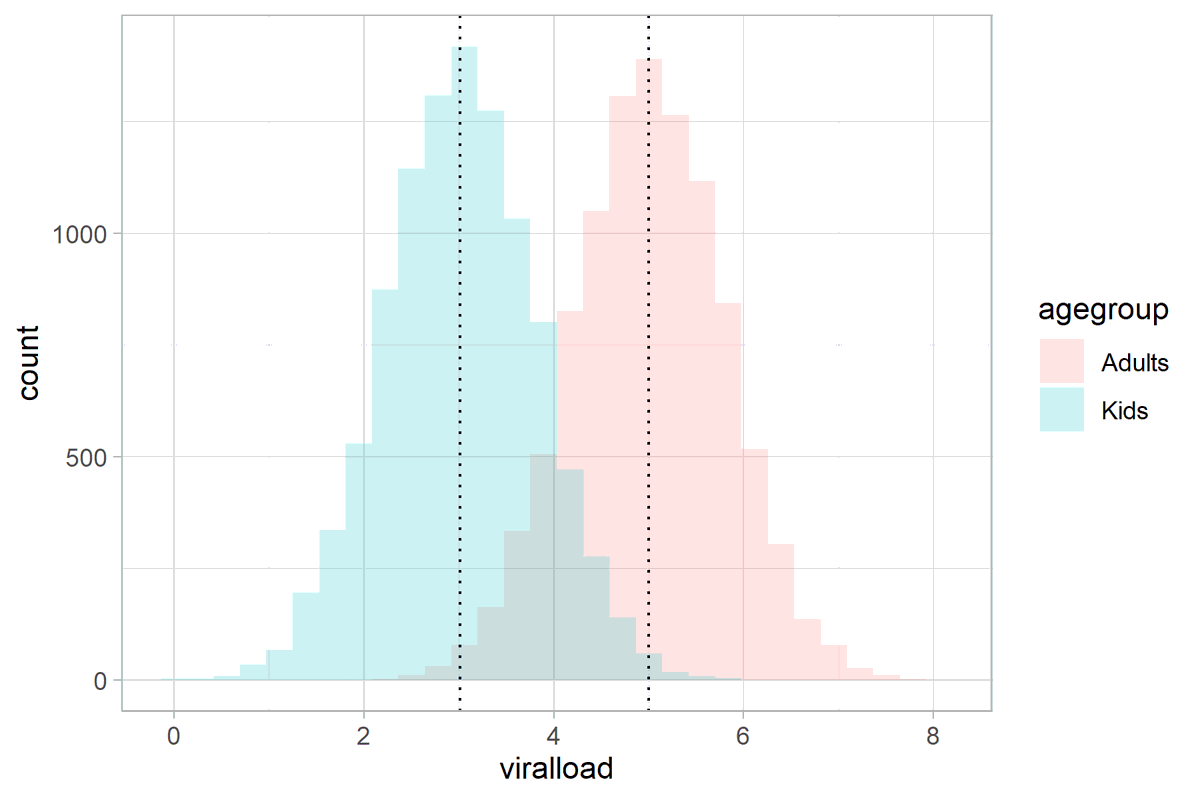
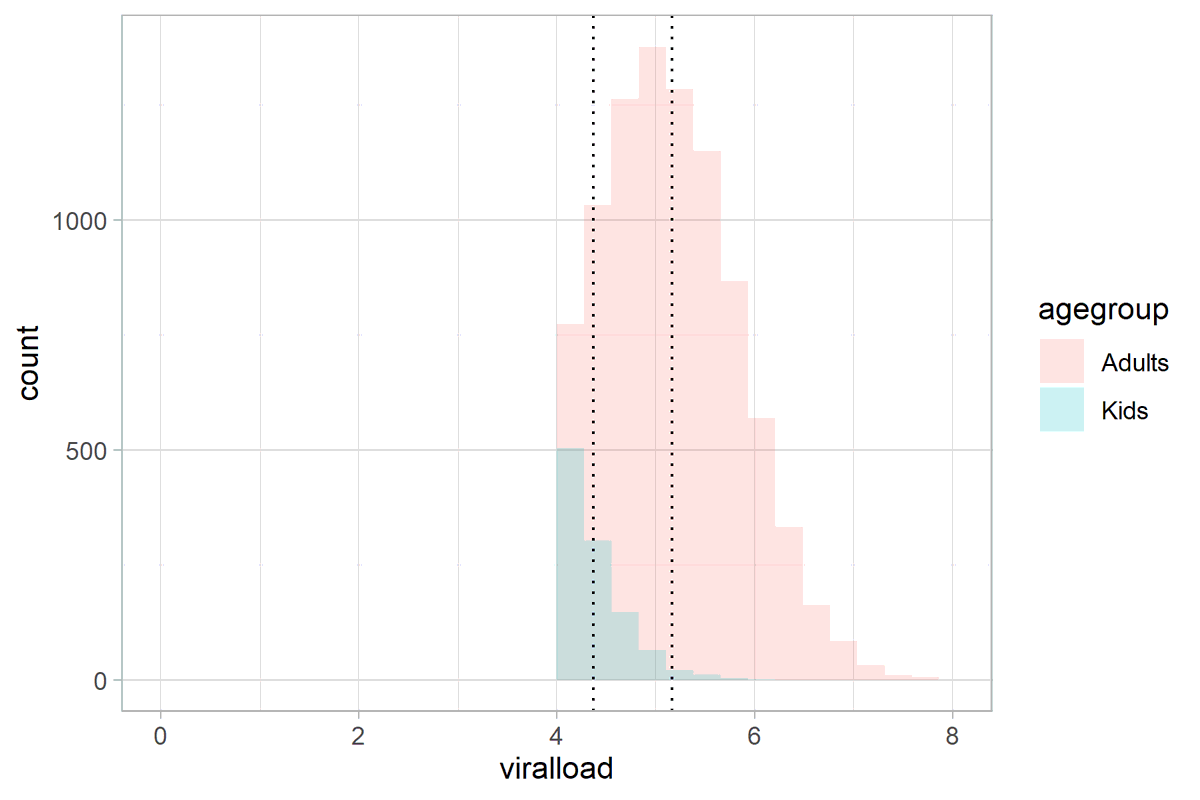
There is no direct evidence that this selection process biased this study in exactly this way. Nevertheless, the histograms in the paper are certainly consistent with this story: the distributions for children tend to be asymmetric and right-tailed.
So what does this mean for policy? Only virologists can tell how important it is that children have somewhat lower viral loads than adults. The viral loads for children are not zero. This suggests that children can be vectors in the spread of the disease.
The Wuhan study, also referenced in the article, does find that children have lower viral loads but (based on simulations) finds that closing schools nonetheless can have large and import effects on slowing down the spread of COVID science.sciencemag.org/content/early/…
That said, the headlines around this study were certainly misleading. The study's findings show that children most likely do have lower viral loads than adults and the results are consistent with the notion that these differences are quite substantial.
But perhaps, with @ProfEmilyOster, I just really want summer camps to be open. emilyoster.substack.com/p/can-kids-tra…