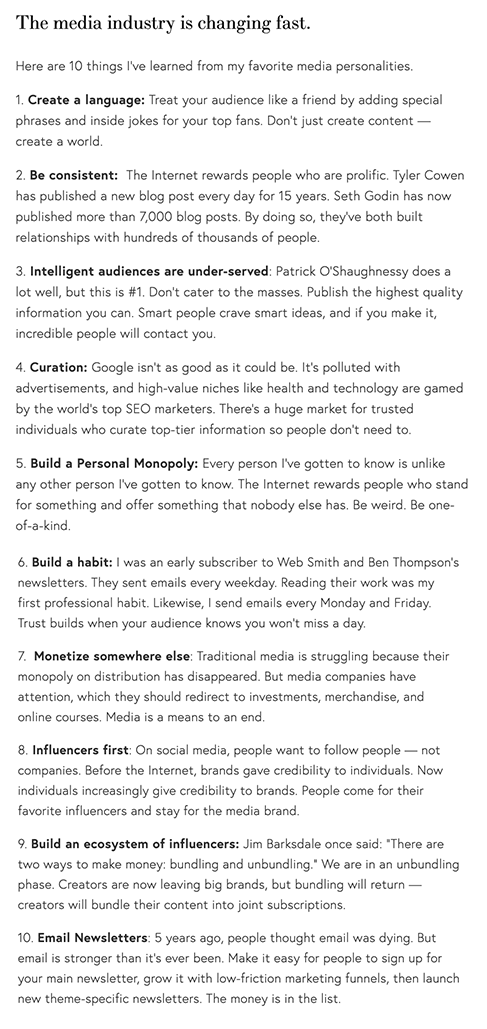
Here are 10 things I’ve learned from my favorite media personalities.
1. Create a language
Treat your audience like a friend by adding special phrases and inside jokes for your top fans. Don't just create content — create a world.
2. Be consistent
The Internet rewards people who are prolific. @tylercowen has published a new blog post every day for 15 years. Seth Godin has now published more than 7,000 blog posts. By doing so, they've both built relationships with hundreds of thousands of people.
3. Intelligent audiences are under-served
Patrick O'Shaughnessy (@patrick_oshag) does a lot well, but this is #1. Don't cater to the masses. Publish the highest quality information you can. Smart people crave smart ideas, and if you make it, incredible people will contact you.
4. Curation
Google isn't as good as it could be. It's polluted with advertisements, and high-value niches like health and technology are gamed by the world's top SEO marketers. There's a huge market for trusted individuals who curate top-tier information so people don't need to.
5. Build a Personal Monopoly
Every person I've gotten to know is unlike any other person I've gotten to know. The Internet rewards people who stand for something and offer something that nobody else has. Be weird. Be one-of-a-kind.
I was one an early subscriber to @web and @benthompson's newsletters. They sent emails every weekday. Reading their work was my first professional habit. Likewise, I send emails every Monday and Friday. Trust builds when your audience knows you won't miss a day.
7. Monetize somewhere else
Traditional media is struggling because their monopoly on distribution has disappeared. But media companies have attention, which they should redirect to investments, merchandise, and online courses. Media is a means to an end.
On social media, people want to follow people — not companies. Before the Internet, brands gave credibility to individuals. Now individuals increasingly give credibility to brands. People come for their favorite influencers and stay for the media brand.
9. Build an ecosystem of influencers
Jim Barksdale once said: "There are two ways to make money: bundling and unbundling." We are in an unbundling phase. Creators are now leaving big brands, but bundling will return — creators will bundle their content into joint subscriptions.
10. Email Newsletters
5 years ago, people thought email was dying. But email is stronger than it's ever been. Make it easy for people to sign up for main newsletter, grow it with low-friction marketing funnels, then launch new theme-specific newsletters. The money is in the list
Here's a screenshot if you want to save the entire thread
When it comes to building an audience, @dollarsanddata is one of my favorite case studies.
On New Year's Day in 2017, he committed to publishing an article every week. Three years later, he's never skipped a week and his career is in a much better place.
"One great detail will do the work of 50 crappy sentences."
Wright Thompson is one of the last great magazine writers in America. He's long been a writer at ESPN, and if you love sports, you've almost definitely read his work. Maybe his profile of Tiger Woods. Or maybe the one about Michael Jordan.
Some highlights:
- "When somebody says something is overwritten, it really just means that the story is underreported."
- Profiles are about figuring out what is a central complication of somebody's life and how, on a daily basis, they go about solving it.
- "All of these stories, the few good ones I've written... I think these stories are like a prayer for empathy, to try to understand each other, to understand another human being a little bit at a time. Then slowly, thread by thread, you understand yourself."
- On writing well: "One of the things that's missing is that nobody wants to hear what I have to say, which is just reps. Zen is a butt in a seat. There's no mystery. It's just reps."
- "I wish someone had told me years ago that if you're going to be a professional writer for decades, writing is not going to be about words, but it's going to be about architecture. Only when you really understand how things fit together and move can you then actually be thinking about the words."
- "All writing is trying to say something new that is true and is both specific and universal and that helps the reader understand something they didn't understand before, preferably about themselves."
And here are the timestamps:
1:50 Writer's vomit vs. writer's block
8:33 The architecture of writing
11:30 What makes for a good story?
15:57 Bringing characters to life
21:11 "The hammer"
26:26 Writing a vivid scene
33:41 How to bring places to life
39:57 Dialogue vs. quotes
45:49 The role of secondary characters
51:44 The problem with "brainstorming"
1:02:13 What makes for a great ending?
I've shared the full conversation with Wright Thompson below.
If you'd rather watch on YouTube, or listen to the full thing on Apple / Spotify, check out the reply tweets.
How I Write costs a small fortune to run, and it's thanks to @mercury that I can record all these interviews in-person.
I'll be honest: I hate Business Stuff, and when I started doing the show, just the thought of dealing with Bank Stuff filled me with dread.
But Mercury makes it easy. Their platform is intuitive while also feeling secure, and they have all kinds of little features that've made running a global team way less painful than I thought it'd be. They're worth looking into if you run a digitally-native business.
Lee Child is the man behind the Jack Reacher series. He's sold more than 200 million books, and two of his books were adapted into movies starring Tom Cruise.
How popular are his books? In the UK, his series has sold more copies than J.K Rowling did with Harry Potter on Amazon. So at this point, you basically can't talk about contemporary crime and thriller books without talking about Lee Child.
This interview is all about how he wrote that Jack Reacher series. To the best of my knowledge, it's the deepest interview he's ever done about his writing process.
Timestamps:
0:30 Writing stories in America
7:26 You don't need an outline
12:50 Writing one book per year
17:57 Why the 60s were so creative
18:56 The business of writing
23:05 The key to page-turner books
38:25 How to write good dialogue
43:15 Where to start / end a book
52:18 Writing a violent scene
56:56 Using clothes to reveal character
1:00:43 Why the UK has so many good writers
I've shared the full conversation below. If you'd rather watch on YouTube, or listen on Apple / Spotify, check out the links in the first reply tweet.
Lee Child: "In my genre, virtually everybody successful is doing it as a second phase career. They've done something prior that often requires an audience like law or journalism.
The key is that they've done a lot of reading. They've internalized the idea that there must be a structure. People are very skeptical when I say I never make a plan. I never make an outline. Every single line is improvised on the spot.
But it's not quite as naked as it sounds because I've read tens of thousands of books. So in fact, I have an enormous internal database of virtually every available plot, character type, cliffhanger, and structure. So actually I have a monster plan and outline."
Kobe Bryant spent 15 years writing every day because he wanted to become the next Walt Disney.
Now, Jimmy Soni is telling that story.
The first part of our conversation is Kobe’s secret obsession with writing. Then we got into why Michael Lewis once wrote under a pen name, why the publishing industry is broken, and why Jimmy loves writing with AI.
Highlights:
1. The world is a conspiracy designed to prevent you from writing.
2. Jimmy sees himself in a battle against that world to find four hours per day to do focused writing.
3. “I’m researching” is often an excuse not to write. People spend decades researching books they never write, and it’s a writers' job to come up with ways to get research done without falling down a black hole.
4. Using AI to write is like using a very sharp knife to cook. The tool might make it easier, but you still have to cook the meal.
5. If you can’t out-write the AI, what are you doing writing in the first-place?
6. Find a Model Book to serve as the "plaster cast" for the book you’re writing and study it obsessively. Jimmy wanted his book, “The Founders” to be like “The Everything Store” by Brad Stone, and read it more than 20 times to understand what made it so good.
7. People think that being a professional writer means going to a lot of cocktail parties. Nope... the reality is that the craft of writing involves showing up to work every day, putting away the distractions, and focusing for many, many hours. You go to bed early, you wake up early, you get your work done. Do it every day for months in a row and you’ll have a book.
8. A problem with traditional publishing is that the entire system is predicated on your book being a hit within the first two weeks. If it’s not, publishers largely give up and move onto something else.
9. What looks like a talent gap is often just a focus gap. Amateur writers severely underestimate just how much time and effort goes into great books.
10. A/B test the cover art for your book. It’s so easy, so cheap, and the saying is true: People judge a book by its cover.
11. Before Michael Lewis was “Michael Lewis,” he wrote under the pen name of Diana Bleecker because he was writing about Wall Street while working on Wall Street, and didn’t want people to know who he was.
12. Michael Lewis was an art history major at Princeton, and once recounted that a lot of Renaissance-era paintings look quite similar. But if you want to see the idiosyncrasies, look at the toenails. That’s where the artists would lose their steam or put in the most individuality, so they’re some of the most distinctive parts of the art. Many fields have an equivalent — a place where you can find hidden answers, if only you know where to look.
13. Ambition is fuel that can burn relatively clean for a little while, only to become dirty later on. Jimmy says: “For the true greats, the sustained motivation needs to come from something deeper. It needs to come from love. That’s the only sustaining force there is.”
14. Kobe built his own publishing company because he didn’t feel like the big publishing houses could deliver the level of quality he demanded.
15. Kobe once spent two weeks redesigning the barcode on one of his books because he wanted it to blend more fluidly with the back cover design (no traditional publisher would do something like this).
I've shared the full conversation with Jimmy Soni below. The first ~25 minutes are about Kobe Bryant. The rest is about a hodgepodge of other topics.
If you'd rather watch the full thing on YouTube or listen on Apple / Spotify, check out the links in the reply tweets.
Kobe Bryant started his own publishing company because he didn't think the traditional ones met his quality bar.
And he was as obsessive about publishing as he was about basketball: he once spent two weeks with his team redesigning the barcode on a book because he wanted it to more fluidly blend in with the rest of the design.
At every part of the process, he'd ask: What's the highest quality thing we can do?
Alain de Botton has written ~17 books and runs the School of Life YouTube channel, which now has almost 10 million subscribers. And this is a rare interview for him.
Some highlights:
1. A clear night sky is a challenge to everything we think we know.
2. If we really took on board what that night sky is telling us, we'd have to lie down and just question absolutely everything.
3. Writer's block is a conflict between shame and the desire for honesty.
4. The effect of mass media is to industrialize and commercialize our thinking, which leaves no room for the free thinker, the honest thinker, and the authentic thinker.
5. You've got to be attentive to your own sensations and thoughts. That's the real work of writing.
6. Every person is an incredible library of sensations but so often, particularly in the academic world, people think: “Let’s ignore ourselves as a source of data and find out what Cicero said, or what Socrates said, or what Michel Foucault said."
7. Writing can be revenge for the silenced person, which is why so many writers are meek in person but fierce on the page.
8. A work of art is the best thing you can do with your dislocation and distress, and sometimes, it’s even an alternative to losing your mind.
9. Emerson said: "In the minds of geniuses, we find our own neglected thoughts."
10. The thoughts of geniuses aren’t fundamentally different from others. It’s just that they’re able to put words to sensations we’ve long felt but couldn’t articulate.
11. Writing prompt: If there were no rules, if you couldn't fail, if no one was going to laugh, if you were going to be dead tomorrow, what would you actually do and say? How would you write, let's say? That's the thing you should write.
I've shared the full conversation with Alain de Botton below. You can watch here or on YouTube, and listen on Apple or Spotify. You'll find the links in the reply tweets.
Watch on YouTube
If we knew the complexity of the world, we'd know that we need hours and hours to process every waking minute.
George Eliot said something like: "If we were truly attentive to the mystery and complexity of things, we would hear the squirrel's heartbeat and would hear the grass grow. And we'd go mad from the multiplicity of things. We'd lose our minds."
Now that's a paraphrase but the point stands. Can you imagine what it'd be like to hear the heartbeats of squirrels? We repress those things. They're in us, but we don't pay attention to them because, if we were alive to all that's going on in the world, we'd lose ourselves.
I grew up in San Francisco, walking with my family by the Golden Gate Bridge. I still remember the thick and iconic chain railing that gave the place a sense of distinctiveness.
Now the chains are gone, and they've been replaced by a soulless metal railing that's colder than a hospital waiting room. I'm sure some bureaucrat somewhere justified it with a tidy spreadsheet, but they stripped away a little piece of San Francisco's soul in the process.
This is how a culture loses its charm: slowly, quietly... one small decision at a time.
Ok, the poet Dana Gioia explained the problem better than I ever could.
This rips: "The failure of the public sector in this nation is embodied in thousands of ugly buildings and public spaces.
These places have been built practically. They are practical and functional in every respect except in practice, since they communicate to the average person that the citizen is just a number in a game of cost efficiency and crowd control.
The experience that Americans have with walking up the steps of the Lincoln Memorial is the experience of beauty, the embodiment of our political vision of the beauty of democracy, expressed in great architecture, great sculpture, great landscaping, and great language, carved calligraphically in the very walls of the memorial.
Just look at a Depression-era post office with marble floors, carved wooden counters, brass fixtures and often an original mural. This was a vision of a beautiful society to which any citizen who entered could participate in.
Today the post office is all vinyl and plexiglass. It offers no vision but expediency. We are not citizens, but customers in a cut rate 99 cent store vision of democracy. No wonder the public doesn't believe in the government. The government seems not to believe in them as alert, intelligent, sensory human beings."
Dean Koontz has published more than 140 novels, 74 works of short fiction, and sold more than 500 million books.
Simply put, he’s one of the most prolific writers alive today. Some highlights from our chat:
1. Dare to love the English language.
2. Characters come alive when they're given free will. Instead of constraining them in an outline, let them go where they want. You know they’re alive once they start surprising you. He says: “I give the characters free will like God gave it to us.”
3. Everything a writer believes about life and death, culture and society, relationships and the self, God and nature will wind up in their books. A writer’s body of work, therefore, reveals the intellectual and emotional progress of its creator, and over time, becomes a map of their soul.
4. To think you understand the world is to be foolish in the extreme. The world is too complex for us to understand it. To see reality clearly is to be utterly enchanted by its staggering complexity.
5. Where should you look? Well, the supernatural enters the world in mundane ways, and rarely the great and glorious flashes of drama.
6. Dean writes his novels page-by-page, and doesn’t move onto the next page until he nails the existing one. There’s no messy first draft. Because of that, he’s basically done with his novels once he finishes the final page.
7. Where does a unique writing voice come from? Three places: style, perspective, and a philosophy of life.
8. Be skeptical of conventional wisdom. There’s an encyclopedia of common wisdom in publishing. All of it is common and none of it is wise. You have to become aware of that, go your own way, and just stick with it because there are so many ways you can be sent wrong based on "that's the way we always do it."
9. The aesthetic plainness of contemporary writing (and culture at large) is crushing our souls.
10. Contemporary fiction is suffering from plainness in particular. It started when writers started imitating Hemingway (who stripped his prose down but kept the mystery and underlying strangeness of the world by implication). But the imitations that came later stripped the prose down while also removing the underlying depth that made Hemingway so great.
11. Koontz Law of Writing #1: Never go inside more than one character's mind in a scene. Each one should come from a singular viewpoint.
12. Koontz Law of Writing #2: Metaphors aren't meant to dazzle readers, but to seduce them into a more intimate relationship with the story.
13. Koontz Law of Writing #3: Metaphors and similes describe a scene more colorfully than a chain of adjectives — while reinforcing the mood. The point is that you can create depth by describing things metaphorically instead of using blunt adjectives. That’s what poetry does: it uses words to say more than the word itself says, which creates a mood.
14. Great prose doesn't come from piling on adjectives. It comes from finding the perfect metaphor that does triple duty: describes the scene, reinforces the mood, and reveals something about the character.
15. The goal is for metaphors not to pop out like showmanship, but to flow into the music of the language.
16. Develop an ear for the musicality of language.
17. A book can succeed with a mediocre plot if the characters are compelling. Character is the center of good fiction. If the characters work, the story works.
18. From the afterword of his book, Watchers: “We have within us the ability to change for the better and to find dignity as individuals rather than as drones in one mass movement or another. We have the ability to love, the need to be loved, and the willingness to put our own lives on the line to protect those we love, and it is in these aspects of ourselves that we can glimpse the face of God; and through the exercise of these qualities, we come closest to a Godlike state.”
I've shared the full conversation with @deankoontz below.
The YouTube video link is in the replies, and so are the links to Apple and Spotify.