I’ve been meaning to do this for some time: starting this week, I will be sharing my syllabus and recommended readings from the “Lies, Damned Lies, and Disinformation” course I taught in the spring semester @Georgetown SSP. I’ll be sharing some highlights from each week’s lesson.
I’ve had some requests for the course syllabus from friends and colleagues and thought this might be a fun way to share it, along with some commentary. I’d love feedback, advice as I plan out next yr’s course. (H/T @LorenRaeDeJ whose sharing throughout the semester inspired me).
First off, here’s a snapshot of the course outline. Each week, for the next 14 weeks, I’ll be share readings from each lesson, and provide some commentary on the discussions we had in class, and more. 

Week 1 of “Lies, Damned Lies, and Disinformation” @Georgetown was getting us on the same page about terms and definitions. I’m a bit pedantic about language so we needed to get this one out of the way. Misinfo, disinfo, info ops, hoaxes, propaganda, influence, bots, trolls, etc.
To get started, I asked students to read @peterpomeranzev’s “Brave New War” @TheAtlantic from 2015, which inspired me to work on these issues. theatlantic.com/international/…. As for resources on terms/ concepts “Lexicon of Lies” @cjack @datasociety is a great one datasociety.net/library/lexico…
Two other foundational guiding documents students read on the many terms, definitions used in this space were “Fake News. It's Complicated,” firstdraftnews.com/fake-news-comp… and the Information Disorder -- Essential Glossary from @cward1e: medium.com/1st-draft/info…
Because @Georgetown SSP, many students come from / focus on traditional defense and security, it was important to highlight how the military uses terms like “information operations” - this article from Chris Paul @RANDCorporation sparked a great discussion
thestrategybridge.org/the-bridge/201…
thestrategybridge.org/the-bridge/201…
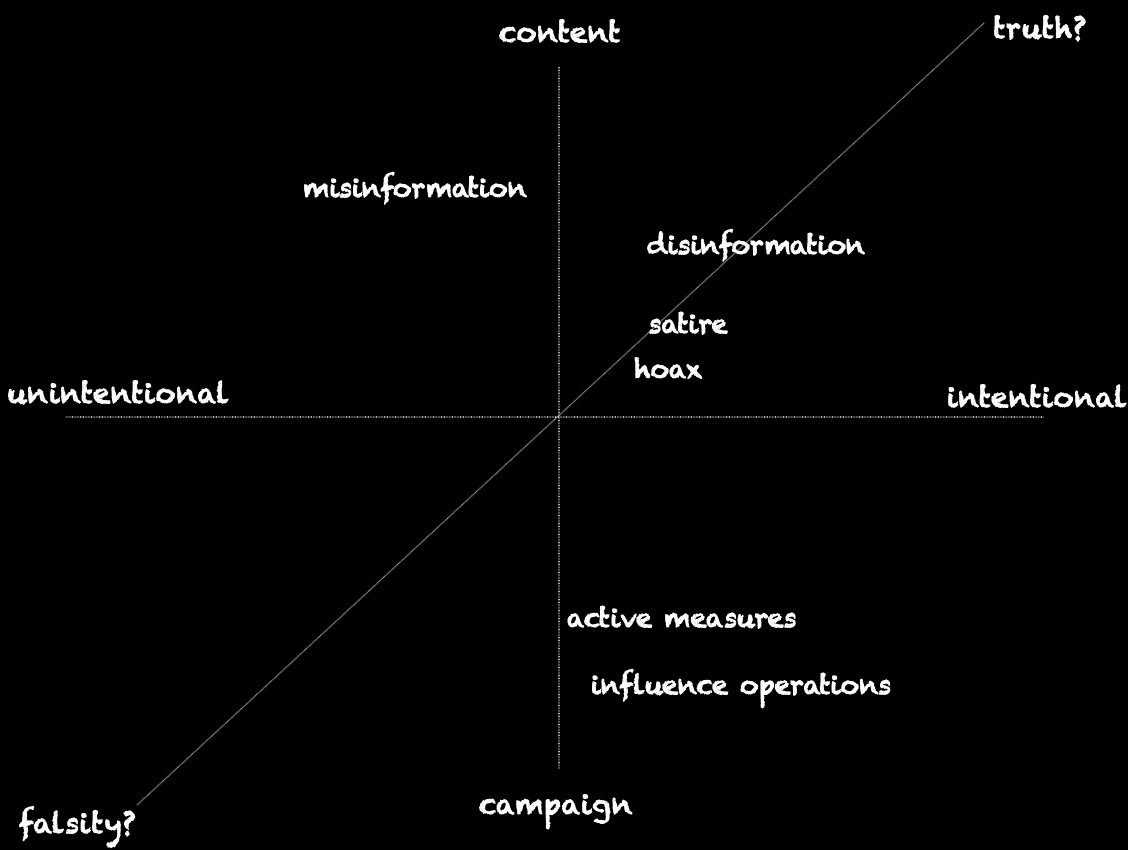
In class, we spent some time trying to think of a useful framework upon which to place all these concepts. Where do we draw the lines? Around intent? Harm? Actor? Truth, falsity? We ended up drawing something the board, only to realize we prob needed 3 or 4 dimensions...
Coincidentally, around the time of our first lesson, @JPamment and @lageneralista at @IOpartnership put out this very useful paper on the subject of defining a problem like influence. Highly recommend it and will be adding it to next year’s syllabus: carnegieendowment.org/2019/12/30/how…
One last, but important note for this week: the credit for the course title goes to the wonderful @ethan_fecht, who helped me brainstorm titles last summer. Sadly, the character cutoff meant that it is forever immortalized on transcripts as "Lies&Disinformation"