What set of reforms would deliver on:
1. The privacy rights of transgender people
2. The need of service providers for clarity in order to treat everyone well
3. Respect for the privacy & freedoms of others (particularly women & girls)
Ideas...
medium.com/@MForstater/wh…
1. The privacy rights of transgender people
2. The need of service providers for clarity in order to treat everyone well
3. Respect for the privacy & freedoms of others (particularly women & girls)
Ideas...
medium.com/@MForstater/wh…
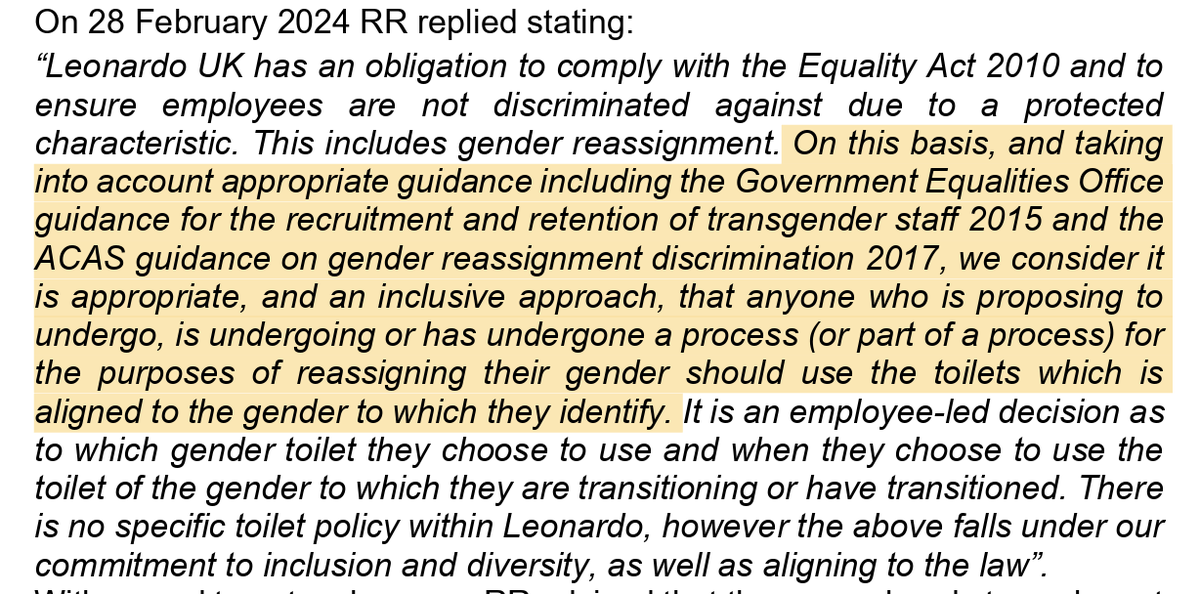
1) @GEOgovuk & @EHRC should urgently review national guidance. They should clarify that the Equality Act does not give individuals the right to use services provided for the privacy or needs of members of the opposite sex
a-question-of-consent.net
a-question-of-consent.net
2) Public bodies should be instructed to withdraw misleading guidance.
All state funded bodies should review existing policies on single sex service services to ensure they are compliant with their duties under the Equality Act.
safeschoolsallianceuk.net/?s=guidance+wi…
All state funded bodies should review existing policies on single sex service services to ensure they are compliant with their duties under the Equality Act.
safeschoolsallianceuk.net/?s=guidance+wi…
Guidance, policies or training suggesting that expecting bodily privacy from the opposite sex is ‘bigotry,’ or encouraging people who identify as trans to believe they are entitled to share spaces which are designated for the privacy of the opposite sex — should not be promoted.
3) Amend the GRA 2004 to exclude any effect of s.9 (which changes a person’s sex “for all purposes”) and the Equality Act 2010,
For the purposes of the 2010 Act, “sex” should mean biological sex.
lawscot.org.uk/members/journa…
For the purposes of the 2010 Act, “sex” should mean biological sex.
lawscot.org.uk/members/journa…
4) Simplify the system for trans people to obtain birth certificate privacy.
Replace medicalised GRCs with a super simple administrative system to enable anyone to obtain a copy of their short-form birth certificate with the ‘sex’ field left blank.
hiyamaya.net/2020/06/20/not…
Replace medicalised GRCs with a super simple administrative system to enable anyone to obtain a copy of their short-form birth certificate with the ‘sex’ field left blank.
hiyamaya.net/2020/06/20/not…
This could also work for passports and other ID.
There should be a right to say "none of your business"/ prefer not to say about your sex in situations where it is no one else's business.
And clarity that when it is other people's business sex means sex.
There should be a right to say "none of your business"/ prefer not to say about your sex in situations where it is no one else's business.
And clarity that when it is other people's business sex means sex.
These are of course just one set of proposals.
We should be able to have a normal policy discussion about practical solutions to protecting everybody's rights.
#itstimetotalk
@Samsmethers @Keir_Starmer @Nancy_M_K @fairplaywomen @Womans_Place_UK @ALLIANCELGB
We should be able to have a normal policy discussion about practical solutions to protecting everybody's rights.
#itstimetotalk
@Samsmethers @Keir_Starmer @Nancy_M_K @fairplaywomen @Womans_Place_UK @ALLIANCELGB
• • •
Missing some Tweet in this thread? You can try to
force a refresh