
Online education is growing fast.
This thread is like an Industry 101 course:
1. It's harder to sell a course than build one: The top online schools are run by people with the largest audiences, not necessarily the best teachers. But building an audience trains you to teach.
This thread is like an Industry 101 course:
1. It's harder to sell a course than build one: The top online schools are run by people with the largest audiences, not necessarily the best teachers. But building an audience trains you to teach.
2. Teaching follows a power law.
Like most of the Internet, there are disproportionate returns to being the best. In public schools, even the best teachers have no more than 100 students at a time. Online, the best teachers can have thousands of students.
Like most of the Internet, there are disproportionate returns to being the best. In public schools, even the best teachers have no more than 100 students at a time. Online, the best teachers can have thousands of students.
3. In online education, there can be increasing returns to scale.
Colleges tout the benefits of small classrooms because big class sizes tend to harm the student experience. In online courses, depending on the subject, class sizes in the 1000s can enhance the student experience.
Colleges tout the benefits of small classrooms because big class sizes tend to harm the student experience. In online courses, depending on the subject, class sizes in the 1000s can enhance the student experience.
4. Come for the course, stay for the community.
Having 1000s of people in a live session at once doesn't hurt the student experience, but accepting non-serious participants does. Community strength — not information — differentiates most high-end schools.
Having 1000s of people in a live session at once doesn't hurt the student experience, but accepting non-serious participants does. Community strength — not information — differentiates most high-end schools.
https://twitter.com/david_perell/status/1281742172119642113?s=20
5. Online education brands are built around courses, not schools.
When people talk about traditional education, they talk about schools like Harvard and Yale. But when they talk about online education, they talk about individual courses like AltMBA and Building a Second Brain.
When people talk about traditional education, they talk about schools like Harvard and Yale. But when they talk about online education, they talk about individual courses like AltMBA and Building a Second Brain.
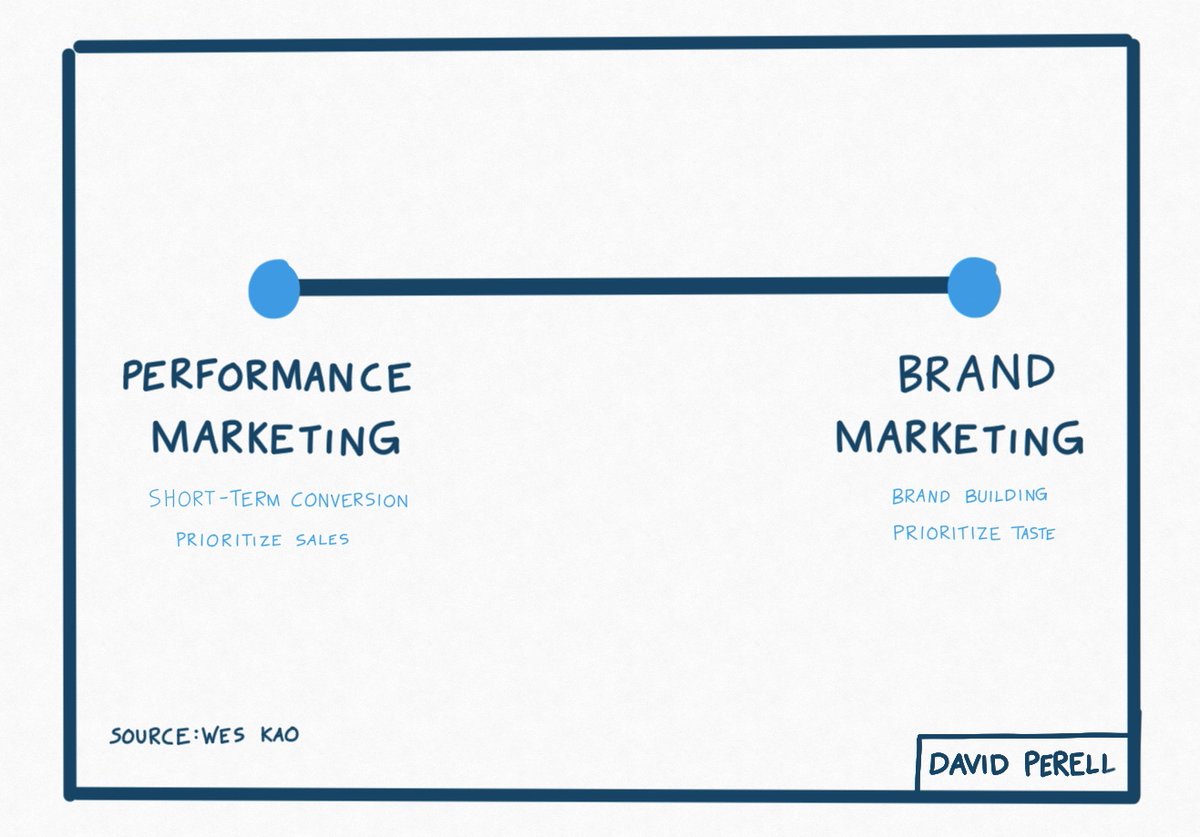
6. Online schools exist on a spectrum between performance marketing and brand marketing.
Every school prioritizes either short-term sales or long-term brand building. The industry's scammy reputation comes from the creators who prioritize performance over brand.
(h/t @wes_kao)
Every school prioritizes either short-term sales or long-term brand building. The industry's scammy reputation comes from the creators who prioritize performance over brand.
(h/t @wes_kao)
7. Learning is active, education is passive
Until now, most online education has been a passive experience with pre-recorded videos and little student-to-student interaction. For active learning schools, community building will become an essential skill.
Until now, most online education has been a passive experience with pre-recorded videos and little student-to-student interaction. For active learning schools, community building will become an essential skill.
https://twitter.com/david_perell/status/1194107362791084039
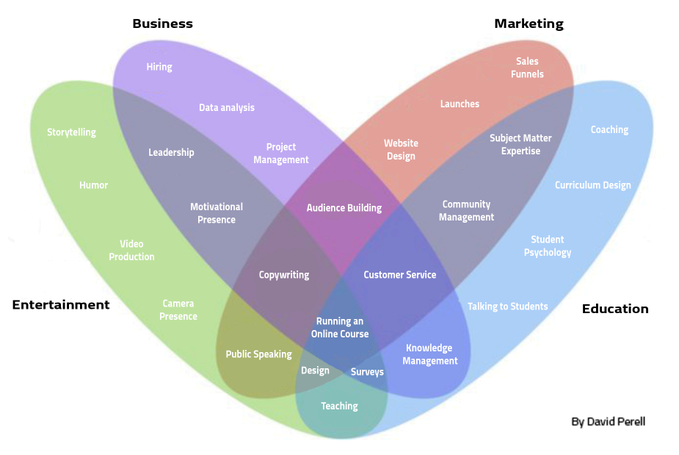
8. Teaching online demands many skills.
None of these skills are hard to learn, but many are inversely correlated with each other so good online teachers are a rare breed. Those skills fall into four buckets: (1) business, (2) marketing, (3) entertainment, and (4) education.
None of these skills are hard to learn, but many are inversely correlated with each other so good online teachers are a rare breed. Those skills fall into four buckets: (1) business, (2) marketing, (3) entertainment, and (4) education.
9. Online learning demands new research.
It's no coincidence that many of the top online teachers have never taught in a real classroom. Teaching online demands a different skillset. Since the experience is so different, traditional pedagogy isn't helpful for online educators.
It's no coincidence that many of the top online teachers have never taught in a real classroom. Teaching online demands a different skillset. Since the experience is so different, traditional pedagogy isn't helpful for online educators.
10. Entertainment and education
If online educators have a core insight, it's that entertainment and education are symbiotic. Most of my teachers saw them as opposites. They made learning a boring and uneventful endeavor. If online teachers do that, they'll go out of business.
If online educators have a core insight, it's that entertainment and education are symbiotic. Most of my teachers saw them as opposites. They made learning a boring and uneventful endeavor. If online teachers do that, they'll go out of business.
11. Learning and daycare
Today, kids spend way too much time sitting down in school. By unbundling learning and daycare, online learning will change that. Kids will benefit by escaping the tyranny of boring lectures. For parents who need supervision, let's expand daycare hours.
Today, kids spend way too much time sitting down in school. By unbundling learning and daycare, online learning will change that. Kids will benefit by escaping the tyranny of boring lectures. For parents who need supervision, let's expand daycare hours.
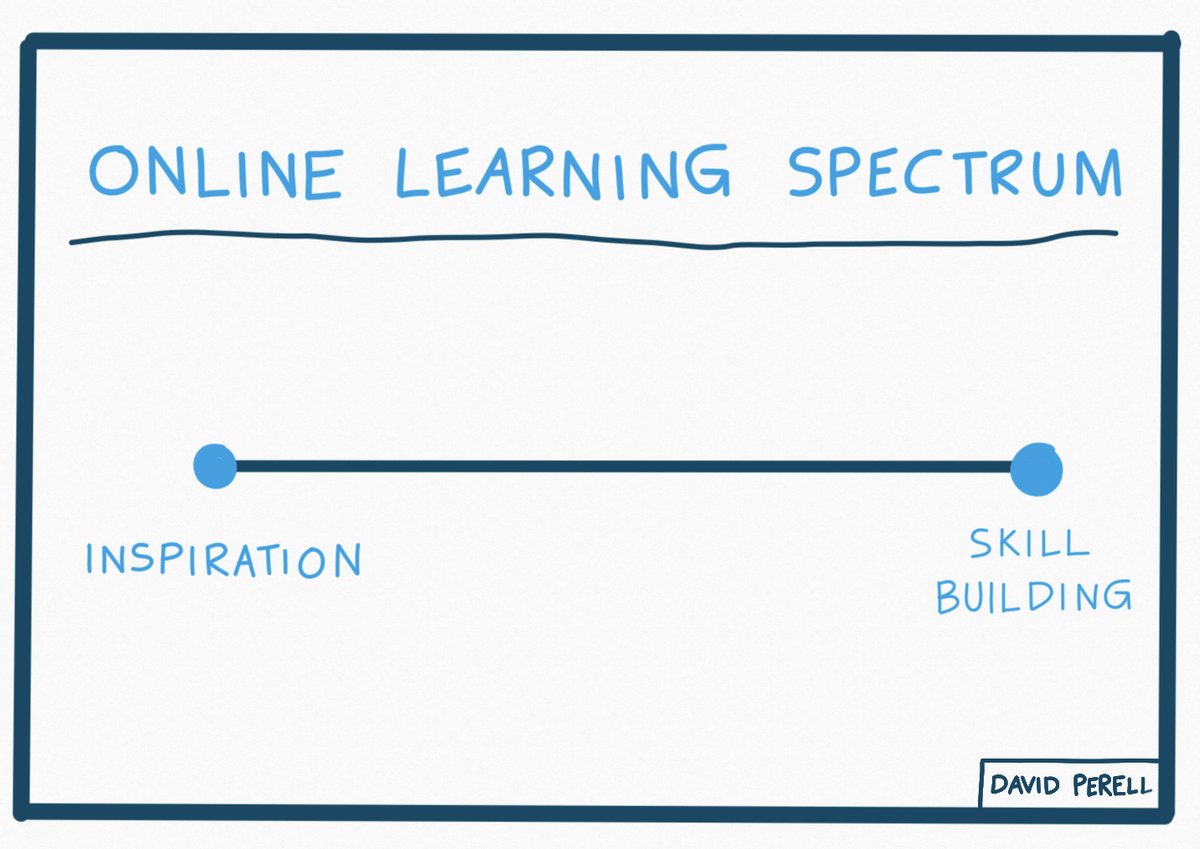
12. Online learning lives on a spectrum between inspiration and skill-building.
On the inspiration side, you have companies like Masterclass and Marie Forleo's B-School. On the skill-building side, you ones like Lambda School who deliver a desired outcome.
(h/t @fortelabs)
On the inspiration side, you have companies like Masterclass and Marie Forleo's B-School. On the skill-building side, you ones like Lambda School who deliver a desired outcome.
(h/t @fortelabs)
13. Global Pricing
Today, the industry has no norms around price discrimination. Schools sometimes offer location-specific pricing. People in countries with weak currencies have legitimate gripes with the high price points of many schools, but discounts may upset other students.
Today, the industry has no norms around price discrimination. Schools sometimes offer location-specific pricing. People in countries with weak currencies have legitimate gripes with the high price points of many schools, but discounts may upset other students.
14. The Evolution of Stakeholders
When a school starts, they can focus on the satisfaction of two groups: students and employees. But as a school grows, they have to develop relationships with alumni, many of whom will become community leaders — just like a traditional college.
When a school starts, they can focus on the satisfaction of two groups: students and employees. But as a school grows, they have to develop relationships with alumni, many of whom will become community leaders — just like a traditional college.
15. Alumni Mentors
Adding an Alumni Mentor program is one of the best decisions we've ever made. Becoming a mentor is like joining the advanced course. By helping students with small hurdles that we can't address in the main curriculum, they make the course much more intimate.
Adding an Alumni Mentor program is one of the best decisions we've ever made. Becoming a mentor is like joining the advanced course. By helping students with small hurdles that we can't address in the main curriculum, they make the course much more intimate.
16. Micro-communities
The best part of my college experience was running multiple student groups. Online courses should replicate those with student-run interest groups. They're a fast-track for helping students teach others, become community leaders and meet like-minded people.
The best part of my college experience was running multiple student groups. Online courses should replicate those with student-run interest groups. They're a fast-track for helping students teach others, become community leaders and meet like-minded people.
17. Launches
Every online course business has two core functions: marketing and teaching.
But like a see-saw, only one is happening at a time which means you need two very different skillsets to run the business. If you run a live course, you don’t teach most of the year.
Every online course business has two core functions: marketing and teaching.
But like a see-saw, only one is happening at a time which means you need two very different skillsets to run the business. If you run a live course, you don’t teach most of the year.
18. The Three Buckets
There’s a saying in the online education industry that every product falls in one of three buckets: health, wealth, or relationships.
There’s a saying in the online education industry that every product falls in one of three buckets: health, wealth, or relationships.
https://twitter.com/david_perell/status/1274420826977169410?s=20
19. Courses need two kinds of leaders
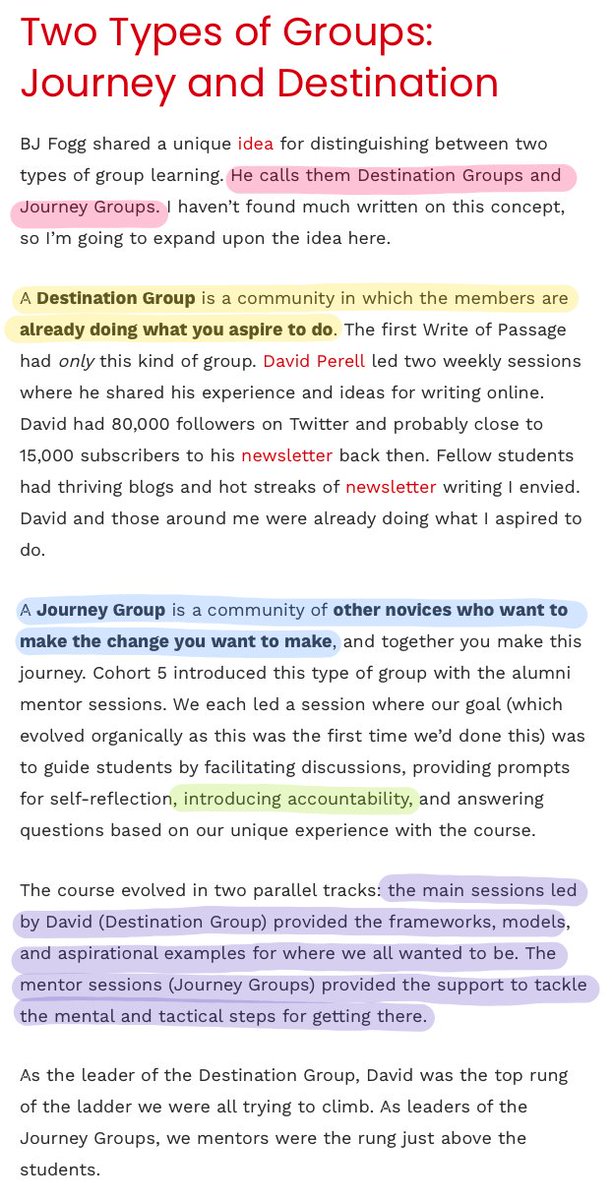
1) Destination Leaders: People at the top of their craft, whose success inspires students and gives them credibility.
2) Journey Leaders: Peer mentors who share the same challenges as students, which makes them relatable.
(h/t @Bazzaruto)
1) Destination Leaders: People at the top of their craft, whose success inspires students and gives them credibility.
2) Journey Leaders: Peer mentors who share the same challenges as students, which makes them relatable.
(h/t @Bazzaruto)

20. Seek buyers, not followers
Once you start selling a course, you’ll realize that you need the right kind of followers to sell a course. Sometimes, those buyers will be on platforms your industry doesn’t use too.
This article from @nateliason explains it well.
Once you start selling a course, you’ll realize that you need the right kind of followers to sell a course. Sometimes, those buyers will be on platforms your industry doesn’t use too.
This article from @nateliason explains it well.

21. Lectures
Until now, online education has followed a “flipped classroom model” where students watch lectures at home and do the work in class. This view is short-sided. Live lectures can be galvanizing if the teachers know how to command the room and make the chat energetic.
Until now, online education has followed a “flipped classroom model” where students watch lectures at home and do the work in class. This view is short-sided. Live lectures can be galvanizing if the teachers know how to command the room and make the chat energetic.
20. The customer journey is simple
If you want to sell online products, start by sharing your best ideas with a wide audience. Then, encourage as many of them to sign up for your email list. Once they opt into your list, they’ll want to hear about your product
(h/t @BillyBroas)
If you want to sell online products, start by sharing your best ideas with a wide audience. Then, encourage as many of them to sign up for your email list. Once they opt into your list, they’ll want to hear about your product
(h/t @BillyBroas)

21. Get future students to cross your “Public to Private Bridge.”
They’ll find you on open platforms like Twitter, which give you free reach. Then make in easy for them to opt-in to private channels like an email list, where you can contact them directly.
Here’s my mini-essay.
They’ll find you on open platforms like Twitter, which give you free reach. Then make in easy for them to opt-in to private channels like an email list, where you can contact them directly.
Here’s my mini-essay.


22. Focus on a fast-changing sector of the economy that’s widely misunderstood.
Courses have small teams, so they can respond to market dynamics by evolving their curriculums faster than any institution possibly could. That’s why I teach online writing.
Courses have small teams, so they can respond to market dynamics by evolving their curriculums faster than any institution possibly could. That’s why I teach online writing.
https://twitter.com/david_perell/status/1259539005097426944?s=20
• • •
Missing some Tweet in this thread? You can try to
force a refresh






