Good morning from New York.
There is a hearing this morning in the lawsuit challenging the Trump admin's attempted exclusion of undocumented immigrants from the census.
I will be covering it live at 9:30 a.m. Eastern Time for @CourthouseNews.
There is a hearing this morning in the lawsuit challenging the Trump admin's attempted exclusion of undocumented immigrants from the census.
I will be covering it live at 9:30 a.m. Eastern Time for @CourthouseNews.
To clarify, the Trump administration's attempted exclusion of undocumented immigrants relates to the numbers used for reapportioning seats in Congress, not the census in general.
The hearing is about to begin in five minutes.
The hearing is about to begin in five minutes.
On the line now:
Assistant U.S. Attorney Jeffrey Oestericher (SDNY)
Elena Goldstein, for NYAG
ACLU's Dale Ho, for New York Immigration Coalition
Assistant U.S. Attorney Jeffrey Oestericher (SDNY)
Elena Goldstein, for NYAG
ACLU's Dale Ho, for New York Immigration Coalition
This morning's hearing was originally slated to happen next week, until @hansilowang broke the news that the Trump admin wanted to cut door-knocking a month short.
The fast-tracked census count led to an expedited hearing.
ICYMI, Hansi's scoop: npr.org/2020/07/30/896…
The fast-tracked census count led to an expedited hearing.
ICYMI, Hansi's scoop: npr.org/2020/07/30/896…

U.S. District Judge Jesse Furman, who previously found the citizenship question illegal, is presiding over this new challenge over the census.
He joins the line and we are about to begin.
He joins the line and we are about to begin.
Also on the line:
* Matthew Colangelo from NYAG.
* Assistant U.S. Attorney Allison Rovner from SDNY
Clarifying earlier tweet:
* Jeffrey Oestericher is SDNY's chief of the civil division, not a line assistant.
* Matthew Colangelo from NYAG.
* Assistant U.S. Attorney Allison Rovner from SDNY
Clarifying earlier tweet:
* Jeffrey Oestericher is SDNY's chief of the civil division, not a line assistant.
Judge Furman says there is a question about whether the record from the first census case (citizenship question) can be adopted for this one (counting undocumented immigrants for apportionment).
"I don't think we have to address that question now," Furman says, deferring the question to a later date.
Matthew Colangelo, for the NYAG, says that he believes the record from the first case might bear on the question of irreparable injury in their injunction request.
Matthew Colangelo, for the NYAG, says that he believes the record from the first case might bear on the question of irreparable injury in their injunction request.
Furman: There is another question as to whether a three-judge panel is required for this case.
It comes down to the interpretation of this statute. law.cornell.edu/uscode/text/28…
It comes down to the interpretation of this statute. law.cornell.edu/uscode/text/28…
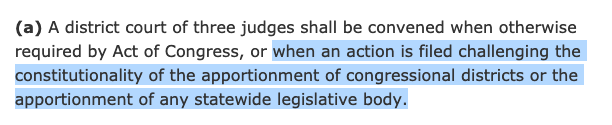
Calling it a "close question," Colangelo agrees that a three-judge panel is necessary.
ACLU's Dale Ho concurs.
AUSA Allison Rovner hedges and wants time to research and submit a letter.
ACLU's Dale Ho concurs.
AUSA Allison Rovner hedges and wants time to research and submit a letter.
Matthew Colangelo from NYAG: "Time is of the essence and delayed review would cause extremely serious harm."
Immediately after the president certifies the census count for reapportionment in January, states are supposed to begin the process of redistricting, Colangelo says.
Immediately after the president certifies the census count for reapportionment in January, states are supposed to begin the process of redistricting, Colangelo says.
There is also a six-week window between when the certified count is transmitted to the states, Colangelo notes.
Redistricting follows the transmission.
Redistricting follows the transmission.
Judge Furman asked about whether the period between this process and the midterm elections would mitigate any harm.
Colangelo noted that armed service members would be receiving absentee ballots well before that election.
Colangelo noted that armed service members would be receiving absentee ballots well before that election.
Judge Furman notes that a "popular misconception" of Trump's memo is that it excludes undocumented immigrants from the *count.*
The memo is about excluding them from apportionment.
The memo is about excluding them from apportionment.
Judge Furman asks how that distinction affects the plaintiffs' theory of harm.
Colangelo responds that the memo is likely to have the affect of chilling undocumented immigrants from participating in the follow-up operations of the census.
Colangelo responds that the memo is likely to have the affect of chilling undocumented immigrants from participating in the follow-up operations of the census.
Colangelo adds that the change has "penetrated immigrant communities," where they have a "high degree of awareness" of Trump's memo.
This change will confirm the immigrants' views that they "cannot trust the federal government," Colangelo argues.
This change will confirm the immigrants' views that they "cannot trust the federal government," Colangelo argues.
Judge Furman presses AUSA Allison Rovner on the position that the "census is almost over."
"Isn't that a problem of the president's own making?" Furman asks, calling it "rich to rely on the fact that he waited" to deny relief to the plaintiffs.
"Isn't that a problem of the president's own making?" Furman asks, calling it "rich to rely on the fact that he waited" to deny relief to the plaintiffs.
Rovner replies that she brought up that the census is almost over to suggest that any relief would be limited.
Judge Furman asks about the states' position of "ongoing, immediate harm" to the count by Trump's memo.
Rovner characterizes that as a new theory. The judge disagrees.
Judge Furman asks about the states' position of "ongoing, immediate harm" to the count by Trump's memo.
Rovner characterizes that as a new theory. The judge disagrees.
Furman tells Rovner that "I'm a little puzzled by" her claim that she did not understand the states' theory, when it is spelled out in the complaint.
Judge Furman says that he will adopt the faster schedule proposed by the plaintiffs.
New complaint by today.
Government opposition by Aug. 17.
Plaintiffs reply by Aug. 24.
New complaint by today.
Government opposition by Aug. 17.
Plaintiffs reply by Aug. 24.
Judge Furman: "I recognize that this schedule may be more welcome to some than others."
But he adds that the president's decision to announce the memo when he did required a fast-track.
"Given the timing of that decision, it is what is," Furman says.
Adjourned. #ItIsWhatItIs
But he adds that the president's decision to announce the memo when he did required a fast-track.
"Given the timing of that decision, it is what is," Furman says.
Adjourned. #ItIsWhatItIs
• • •
Missing some Tweet in this thread? You can try to
force a refresh