
Below is a joint statement by women journalists and commentators in Pakistan against online abuse and trolling by government officials and Twitter accounts which declare their affiliation to the ruling Pakistan Tehreek-e-Insaf. #AttacksWontSilenceUs
docs.google.com/document/d/1DD…
docs.google.com/document/d/1DD…
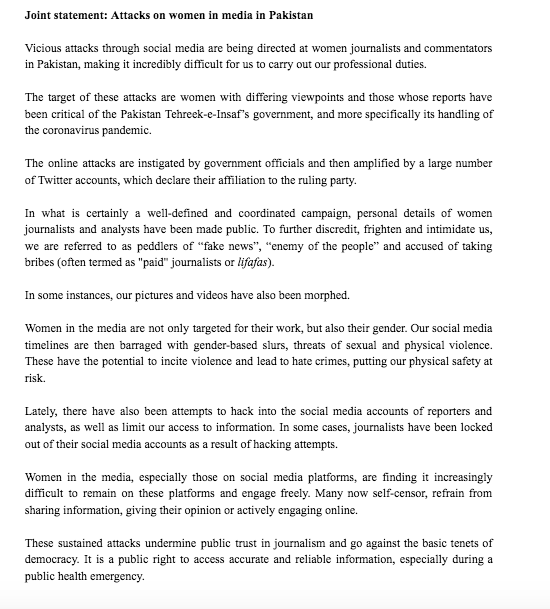
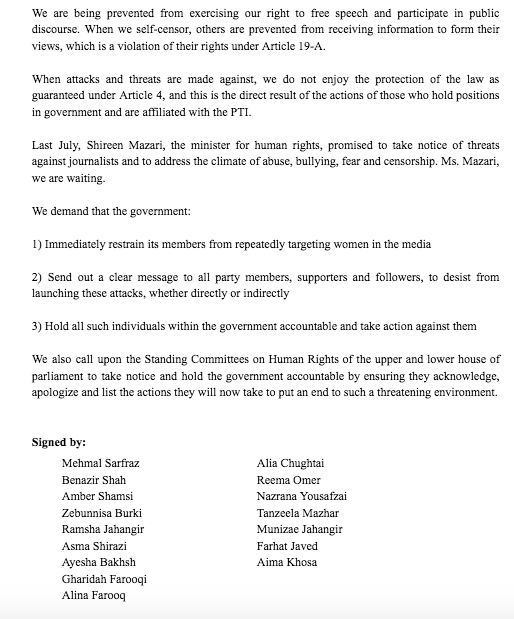
Last July, Shireen Mazari, the minister for human rights, promised to take notice of threats against journalists and to address the climate of abuse, bullying, fear and censorship.
We are waiting.
#AttacksWontSilenceUs
We are waiting.
#AttacksWontSilenceUs
In what is certainly a well-defined and coordinated campaign, personal details of women journalists and analysts have been made public.
To further discredit, frighten and intimidate us, we are referred to as peddlers of “fake news”, “enemy of the people”. #AttacksWontSilenceUs
To further discredit, frighten and intimidate us, we are referred to as peddlers of “fake news”, “enemy of the people”. #AttacksWontSilenceUs
We also call upon the Standing Committees on Human Rights of the upper and lower house to take notice and hold the government accountable by ensuring they acknowledge and list the actions they will now take to put an end to the threatening environment. #AttacksWontSilenceUs
The target of online attacks are women with differing viewpoints and those whose reports have been critical of the PTI government, and more specifically its handling of the coronavirus pandemic.
#AttacksWontSilenceUs
#AttacksWontSilenceUs
When attacks and threats are made against us, we do not enjoy the protection of the law as guaranteed under Article 4, and this is the direct result of the actions of those who hold positions in government and are affiliated with the PTI.
#AttacksWontSilenceUs
#AttacksWontSilenceUs
• • •
Missing some Tweet in this thread? You can try to
force a refresh




