1/ I'm teaching my Game Theory course (for kids age 11-16), as a weekend course starting this Saturday.
In the run-up to it, I thought I'll write-up the experiences of teaching it to 2 batches of kids this summer: genwise.in/single-post/20…
Thread with highlights.
2/n Playing games is usually viewed as a waste of time. By parents, and also by students—the only difference being that the students actually like "wasting" time.
Not surprising then that a lot of student feedback indicated they would have liked to play more games. But...
3/ It turns out that much learning can happen while they are playing. "I did not expect it to be this informative." Or "I have learnt and evolved from what i was a week ago," or "I learnt so much in the past few days and i could finally spend some part of quarantine productively"
4/ Not just that, but there is homework, and the students appear to love it and ask for more.
5/ Why study game theory. Because analyzing simple games gives us strategies that work in a lot of messy, complex real-life situations.
Consider this clip from the movie Footloose, of the game of chicken:
6/ The Game of Chicken, while very simple, has been extensively studied by economists, and helps determine strategies in fields as diverse and important as terrorist negotiations, workers' strikes, and nuclear weapons deterrents.
Here's @amitvarma pointing out how another game from game theory is playing out in the @INCIndia right now:
8/ And consider this life-philosophy by Sam Altman (CEO of OpenAI, and ex president of Y-Combinator). This is one of the things the students learn in the course. And they understand it intimately because they use it in the games played during the course.
9/ See genwise.in/events-3/intro… for details of the course and to register. This is probably my last course for kids this year (as they will get busy with normal school after this)
Sorry, quoted the wrong @amitvarma tweet here. Should have been:
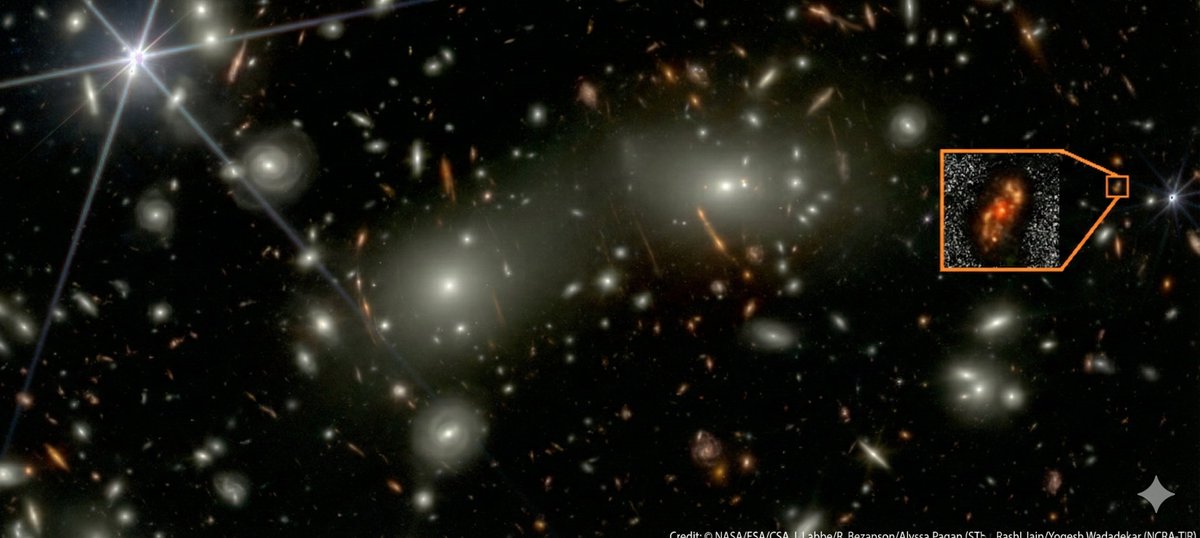
Scientists from NCRA Pune have made a discovery with the potential to shake up science's understanding of how early galaxies were formed after the Big Bang
They have discovered a galaxy which they've named Alaknanda. It is a fairly basic galaxy, so why is it such a big deal? 🧵
Alaknanda is a tiny dot on the images taken by the James Webb Space Telescope. If you zoom in, it looks rather unremarkable: a basic spiral galaxy with a thin central disk and two arms. There are billions of galaxies like this, and nothing about its shape or size is special 🧵
What makes Alaknanda special is that it has a redshift of 4. This means that the light from Alaknanda that we are seeing just now was emitted over 12 billion years ago.
How do we know this? (Skip to the next tweet if you don't want to know the details of how we know it is 12 billion years old.) You’ll be surprised by how much we can tell by looking closely at the light. Consider this oversimplified explanation: suppose we pass the light from Alaknanda through a very fancy prism. It splits into the rainbow colours, as you would remember from your high-school physics. If you zoom into this spectrum, you notice a lot of thin bright vertical lines—meaning some specific colours are brighter than the others. These correspond to colours ("wavelengths") emitted by a gas like Hydrogen, which is the most common element in a galaxy. It turns out that one of the bright lines corresponding to Hydrogen is not in the correct place, but is located much further to the right (longer wavelength) than what we expected. This is called ‘redshift’. (This is not literally what was done. This is an oversimplified explanation. NCRA didn’t have access to an appropriate spectrograph, but used advanced data manipulation on the existing data with 21 different filters to get a similar effect. But the basic science principles are the same.)
What causes the redshift? According to Einstein's theory of relativity, the universe is expanding, and this causes the redshift. Imagine a short line drawn on the surface of the balloon. If the balloon is blown up further, the fabric stretches, and the length of the line increases. The same thing happens when light is travelling in expanding space: the wavelength gets stretched and hence increases.
We know how much the universe is expanding and since when, so by looking at the amount of redshift of Alaknanda's light, we can calculate how long it has been travelling through the universe to reach us.
What the hell?! This is the most insane science I've heard of.
In this procedure, surgeons remove a patient's tooth+bone, drill a hole in it and put a lens, and then they IMPLANT THE TOOTH IN THE PATIENT'S CORNEA!?
What?!
The more I looked into this, the more insane it is. 🧵
Is this some bizarre evil scientist Nazi experiment? Nope. It's a procedure invented in the 1960s and is performed every year in several locations around the world.
Including Sankara Nethralaya in India. 🧵
Why the hell are they putting a tooth in someone's eye?!
There are patients where normal corneal transplants fail (repeatedly) because the patient's immune system rejects the transplanted cornea.
This is rare, but in such cases, a tooth is the only thing that works well. 🧵
Tall Quantum Claims: Microsoft has a breathless (but difficult to understand) press release about a new quantum computing chip which makes it appear as though they've solved Quantum Computing. This isn't true, but the science of the claims is fascinating 🧵
We don't know for sure if Microsoft have (so far) invented a new type of material (topoconductor) which allows a new type of qubit (Majorana zero modes) that could revolutionize QC. But let me give a high-level explanation of what's being claimed and why it could be a big deal 🧵
This is a rather complex topic: I'll have to explain bits, qubits, why error correction is so important in qubits, Majorana particles and how qubits based on them help with the error correction problem 🧵
I recently found out that Akbar's wife, popularly (but mistakenly) known as Jodhabai, was an accomplished international trader and her business problems possibly resulted in changing the fate of India: ensuring the British colonized India instead of Portugal 1/36
So, this is the story of how a Hindu queen's Muslim ship, carrying Hajj pilgrims in Christian waters patrolled by the Portuguese armada resulted in changing the course of Indian History. (Sorry can't find the original source of for this wonderful sentence) 2/36
But first, what do I mean by "mistakenly known as Jodhabai"?
The name of Akbar's wife, mother of Salim (aka Jahangir), was not Jodhabai. Women of the Mughal harem were referred to by their birth place (or place where they were "first viewed with affection by the Emperor") 3/36
Who are Indians descended from? Aryans from Europe? Dravidians who've been "here" forever? The Indus valley civilization?
A controversial question for 150+ years, but now we have DNA evidence that answers these questions with a high degree of certainty.
🧵
The controversy originated with the (now discredited) "Aryan Invasion Theory" which began as a respectable theory of how Indian, European, and Persian languages all have a common ancestry: but was quickly adopted by racist white Europeans
It started in late 17xx when William Jones, a linguistic scholar, was appointed a judge of the Bengal Supreme Court. He came to India and noticed striking the similarities between Sanskrit, Persian, Gothic, Greek, Latin.
Devanagari is an extremely elegant script. But this was never explained to us in school.
A thread on the awesomeness that is devanagari.
Let's start with the things that my teachers did *not* teach me in school:
Why do both श and ष exist? (The difference in pronunciation was never explained) Why do ङ and ञ exist?
What is ऋ? Is it pronounced “ri” or “ru”, and in any case, why does it even exist if री and रु exist?
Much later in life, when I understood the meaning of the rows and columns in Devanagari, everything fell into place and I saw the beauty and elegance of it all.