
Do eggs raise our cholesterol? How can we make sense of the confusing contradictory messages?
(Short thread)
Full video here:
(Short thread)
Full video here:
I thought this was pretty clear to most but I kept getting this Q so I made a short video going over the evidence. Here's the gist.
College students were given 1 large egg/day vs. a comparable diet without the egg
after 3 weeks both LDL-cholesterol and ApoB significantly increased in the egg group
sciencedirect.com/science/articl…
after 3 weeks both LDL-cholesterol and ApoB significantly increased in the egg group
sciencedirect.com/science/articl…
ok, that's just 1 study. who cares. maybe there was something weird about those students...
RCT fed people egg or egg substitute. they were able to do it double-blind: neither the volunteers (similar taste) nor the experimenters knew who was on eggs
academic.oup.com/ajcn/article-a…
RCT fed people egg or egg substitute. they were able to do it double-blind: neither the volunteers (similar taste) nor the experimenters knew who was on eggs
academic.oup.com/ajcn/article-a…
indeed cholesterol rose from baseline when people were on eggs
here's the genius part. they switched the groups mid-way (cross-over study)
adding egg bumps cholesterol ~20points, removing them makes it drop again. on and off like a rollercoaster
here's the genius part. they switched the groups mid-way (cross-over study)
adding egg bumps cholesterol ~20points, removing them makes it drop again. on and off like a rollercoaster
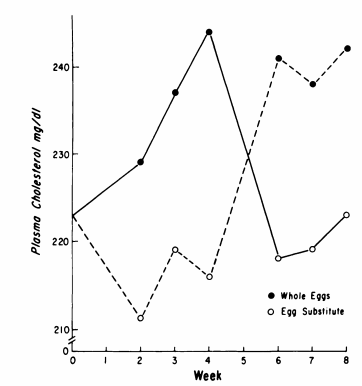
ok but those were free-living subjects. who knows. maybe they changed their diet and it confounded the results
we need to keep the volunteers at the research center for the whole study and control every bite of food they take
lucky for us, that's been done dozens of times
we need to keep the volunteers at the research center for the whole study and control every bite of food they take
lucky for us, that's been done dozens of times
meta-analysis of >70 metabolic ward studies on effect of dietary cholesterol and saturated fat on blood lipids
tl,dr: swapping 10% cals from sat fat with whole carbs drops cholesterol by 20 pts; cutting 200mgs cholest (~1 egg) drops another 5 pts
ncbi.nlm.nih.gov/pmc/articles/P…
tl,dr: swapping 10% cals from sat fat with whole carbs drops cholesterol by 20 pts; cutting 200mgs cholest (~1 egg) drops another 5 pts
ncbi.nlm.nih.gov/pmc/articles/P…
in fact the effect of saturated fat (and secondarily, dietary cholesterol) on blood lipids is one of the most reliable observations in nutrition science
you know something is reproducible when there's a mathematical equation for it
en.wikipedia.org/wiki/D._Mark_H….
you know something is reproducible when there's a mathematical equation for it
en.wikipedia.org/wiki/D._Mark_H….
ok so we have a very specific question, experimentally very tractable (so much so people can do the experiment themselves) and has been addressed ad nauseam in the literature
then why does this appear so controversial??!!?
then why does this appear so controversial??!!?
it helps to understand the full breadth of the effect
the effect of food on blood lipids is dependent on context (more specifically, your baseline)
i.e. the higher your blood levels, the smaller the effect of a dietary increase in sat fat/cholest
citeseerx.ist.psu.edu/viewdoc/downlo…
the effect of food on blood lipids is dependent on context (more specifically, your baseline)
i.e. the higher your blood levels, the smaller the effect of a dietary increase in sat fat/cholest
citeseerx.ist.psu.edu/viewdoc/downlo…
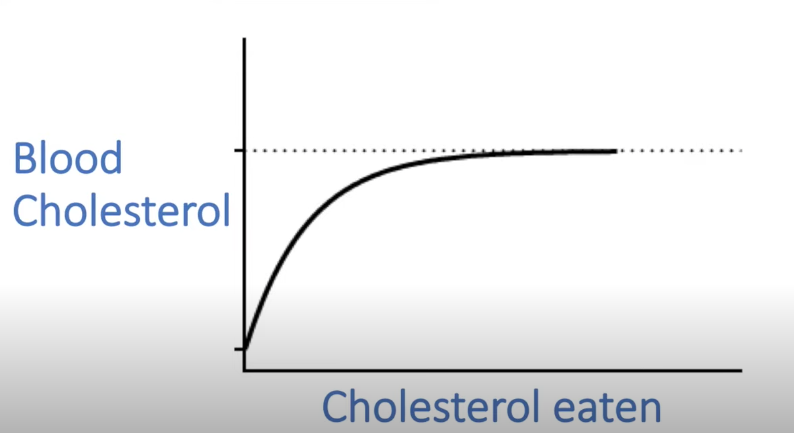
this is not specific to cholesterol. many parameters work like that
that dynamic means that specific values will vary depending on baseline
that dynamic means that specific values will vary depending on baseline
so if we take hypercholesterolemic individuals (typical western diet, high sat fat/cholest) and add a bit more (e.g. 1 extra egg), a small or no difference is expected
this is routinely done in egg industry-funded studies
this is routinely done in egg industry-funded studies
the problem is not the experiment, it's the interpretation
seeing no sig. change means an extra egg makes no difference *in that specific context*. not that "eggs don't affect serum cholesterol". yet this is often what you'll see implied in the paper and esp. in the media blurbs
seeing no sig. change means an extra egg makes no difference *in that specific context*. not that "eggs don't affect serum cholesterol". yet this is often what you'll see implied in the paper and esp. in the media blurbs
the (predictable and, indeed, desired) result is confusion
other ways to manipulate experimental design and thereby confuse include
1) the choice of comparison foods (compare eggs to butter and they look pretty good)
other ways to manipulate experimental design and thereby confuse include
1) the choice of comparison foods (compare eggs to butter and they look pretty good)
2) a more sophisticated approach: acknowledge eggs raise LDL-c but argue that's fine bc some other parameter "makes up for it" (HDL-C, particle size etc)
(preponderance of evidence indicates neither is likely to do much to offset a LDL-c/apoB rise)
mdpi.com/2072-6643/9/2/…
(preponderance of evidence indicates neither is likely to do much to offset a LDL-c/apoB rise)
mdpi.com/2072-6643/9/2/…
ok so are eggs good or bad?
neither. they have substantial SFA and cholest but overall dietary pattern >>>> individual foods
this means a dietary pattern can include some eggs AND be healthy (or unhealthy)
and vice versa
neither. they have substantial SFA and cholest but overall dietary pattern >>>> individual foods
this means a dietary pattern can include some eggs AND be healthy (or unhealthy)
and vice versa
so how much can we get away with? depends (on your lipids, overall health, family history etc etc etc). some people can handle more than others. that's life
e.g. if your lipids are stellar, chances are you have more leeway. if they're iffy, you have less room to play
e.g. if your lipids are stellar, chances are you have more leeway. if they're iffy, you have less room to play
PS. some will say 'sure, dietary cholesterol/SFA raises LDL-C/apoB, that's established. but do those markers translate to higher risk of CVD? that's the question'
and yes, preponderance of evidence overwhelmingly says they do. covered it here:
and yes, preponderance of evidence overwhelmingly says they do. covered it here:
• • •
Missing some Tweet in this thread? You can try to
force a refresh




