An example of what I mean. Inclusive college admission looks inclusive only to a population who went to college.
Many of those who cannot go to college want to find good jobs without having to travel to a college the other side of the country leaving their parents alone.
Of course, inclusive college admission is better than non-inclusive one. But it’s still pretty non-inclusive, to everyone for whom college is not a viable option, and to all towns and families for whom having their young go away is not a viable option.
Decentralization would probably be more inclusive than any form of inclusive centralization.
Inclusivity, as a gatekeeper, doesn’t mean to ensure that the population you let through is diverse.
It means getting out of the way as much as possible, and only gate when strictly necessary.
Colleges, I’m looking at you.
• • •
Missing some Tweet in this thread? You can try to
force a refresh

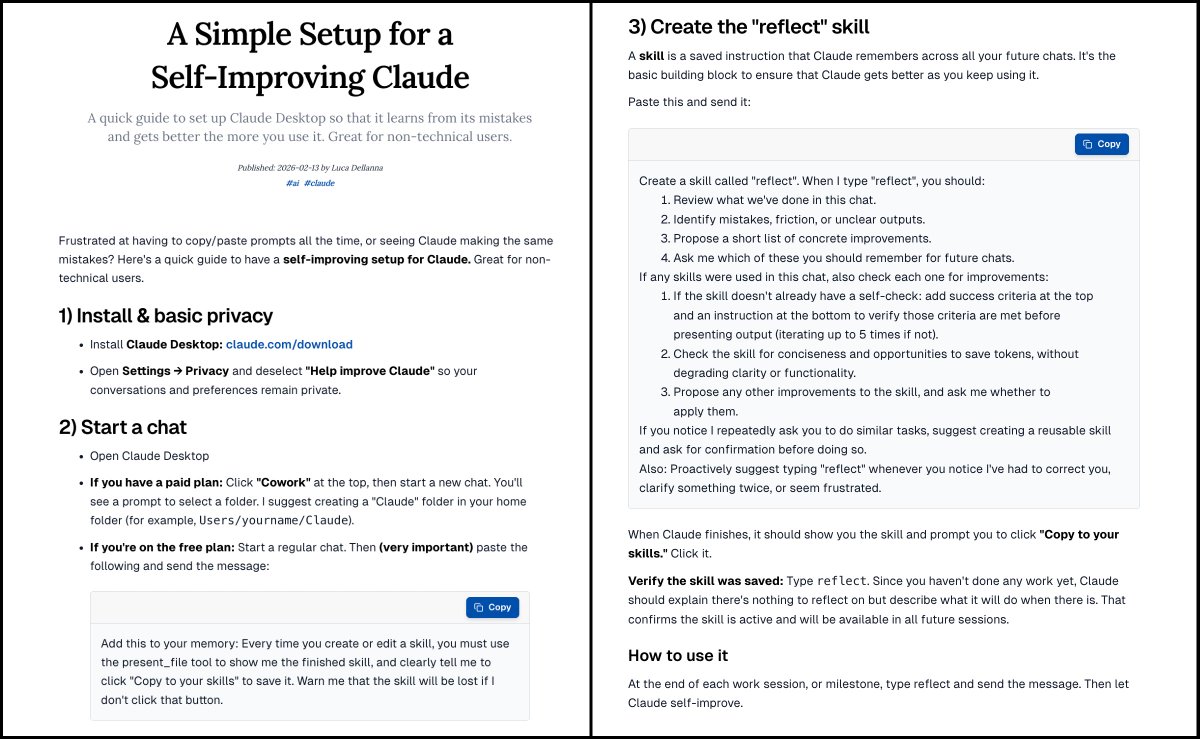
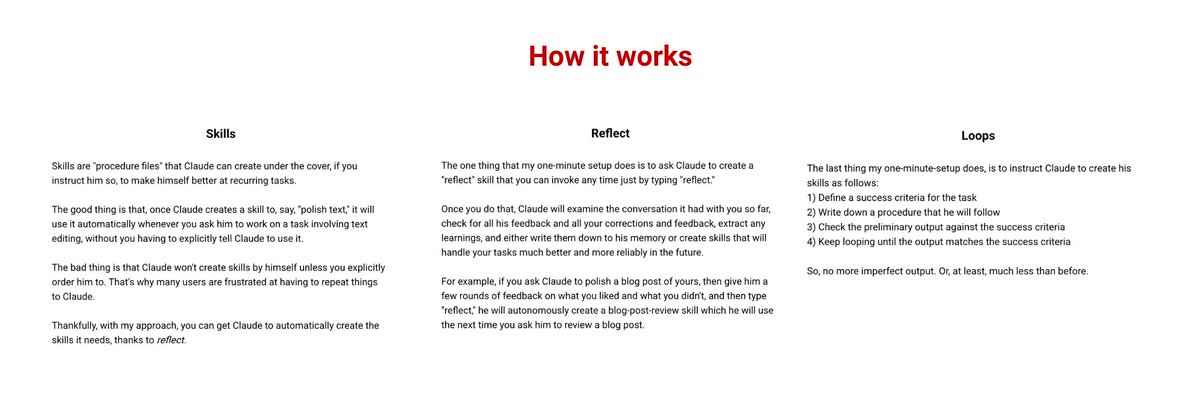
“Create a UserPromptSubmit hook (global settings). Script echoes: If 8+ tool calls, append one optimization hint (reusable skill, memory pattern, or workflow fix). One sentence. Skip if exploratory.”"
2) Skills audit
"Create a skill that lists all my installed skills (project & global level) with their line counts. Then ask the user which to review for improvement opportunities (conciseness, clarity, overlapping scopes, token efficiency).”
3) Claude audit
“Create a skill that reads all CLAUDE .md files and checks for: redundant instructions, verbose phrasing, and content that could move to memory. Present findings and ask if the user wants to implement them.”
Highlights from today’s Jeff Bezos’ talk in Turin 🇮🇹:
“Advice to young people: go work to a company where you can learn best practices”
I fully agree: it should also apply to politicians, educators, and other high-leverage roles.
1/N
“You can be an entrepreneur within a company; good companies don’t eject mavericks but empower them.”
I add: it’s so important to select a great first job and first boss; it’s sad it’s mostly left to chance, esp. comparing how much time is spent studying and how little interviewing.
2/N
We interviewed @linaashar, founder of Dreamtime Learning, who has very interesting thoughts about education.
Some of my favorite quotes:
“I keep teaching kids about their brains and their behavior in every session. Because if kids can master their brains, their thoughts, their actions, and therefore their behaviors, they're going to be successful. That's a given. But if they master only what is calculus, or what this is and what that is, even though they may get an A+, success is not a given. Because you can master content, but if you have to master yourself, you're lost.”
(link at the bottom; 1/7)
“We do not [as society] design the education system or the learning sessions in the way their brain actually works.”
2/7
“If their whole school time is spent on learning the core curriculum, where is the time for kids to specialize? Where do they get those 10,000 hours that they need to become a specialist? So you have to free up time in the child's day for them to become highly specialized.”
3/7
I recently got a small grant (courtesy of Kanro, Vitalik Buterin's foundation) to produce some educational materials regarding the pandemic response.
These 10 one-pagers are the first batch of educational materials.
Any feedback?
1/10
Some more background about the one-pagers. They are meant for people who are already onboard with the need to properly react to an eventual future pandemic but don't have the vocabulary or examples to explain to others what they can do and why.
2/10
A simple model to understand indoor infection risk