Regarding CHN "stealing" of technology, it is useful to keep several things in mind: 1. Most of the "stealing" is trading of access to the Chinese market for transfer of technology. So the issue is whether China has the right to use its huge market as a leverage in negotiations.
2. All of today's developed countries (as described by Ha Joon Chang in "Bad Samaritans") routinely "stole" foreign technologies to get ahead. They, incl. the US, generally refused to accept foreigners' patent rights (see Chang's chapter 6).
3. International devt organizations for decades lamented insufficient transfer of technology from rich to poor countries. Does it make sense now, when such transfers seem to work (other countries' using the same tactics as CHN), to reverse that position?
4. A very strict approach to IPRs and technology transfers is likely to slow the development of poorer countries and to increase poverty over what it would have been without such protection.
Both history and the present seem to argue for a much more nuanced view than "stealing".
• • •
Missing some Tweet in this thread? You can try to
force a refresh

It is Weekend No. 7 and (as I have been doing for the past six weeks), I will now review Chapter 7 of "Visions of Inequality". It has become the most controversial part of the book b/c of its strong critique of lack of concern of neoclassical economics with income distribution.
It asks the Q: why were neoclassicists uninterested in income distribution? It provides three reasons: endogenous evolution of economics away from class structure to individual "agents" (that are all fundamentally identical); political reasons (the Cold War) and funding of the research by the rich.
It is important to realize (and very few people have) that the chapter opens up with a review of inequality studies in systems of state ownership of the means of production and makes an analogy between the denial of class structure in these societies and under capitalism; and thus why both were uninterested in studying income distribution.
No concern with class => no concern with inequality.
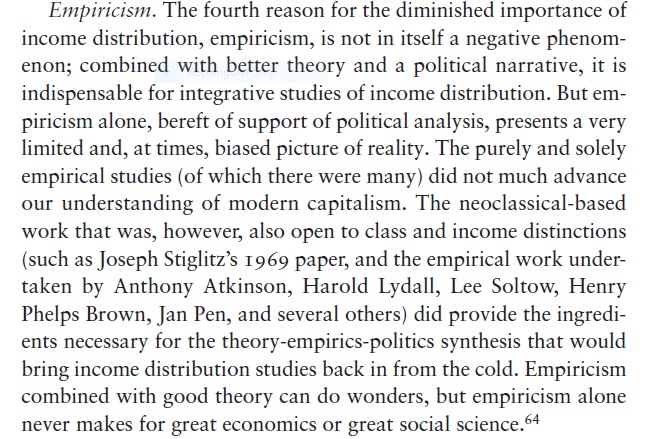
The most that neoclassical economics ever did in inequality studies was mere empiricism. Nothing else. No integrative study of inequality, no theories of how inequality is determined nor how it would evolve. It was in true sense what Marx called "vulgar political economy". One such example is Alan Blinder's "Theories of income distribution".
The list (in no particular order) of the books that I liked the most and read in 2025, with their reviews:
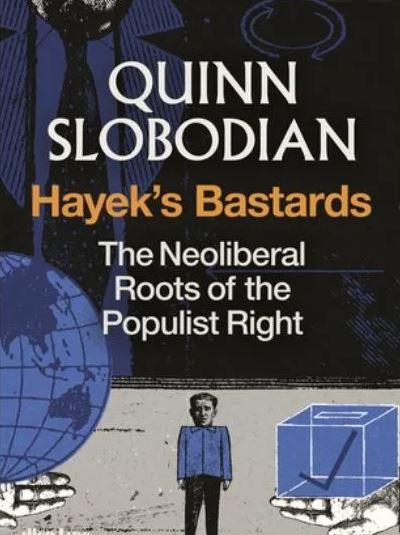
Quinn Slobodian, Hayek's Bastards
Gold, volk and IQs branko2f7.substack.com/p/gold-volk-an…
In Chapter II of "The Great Global Transformation" I discuss opinions of key authors on whether trade (and thus globalization) lead to peace or war. I begin with Montesquieu who is famous for his doux commerce. Then continue with Smith whose views are much more complex and definitely worth reading. Then Schumpeter who in his early work believed that capitalism and trade generate peace in order to change later
when he saw monopoly capitalism with its predatory behavior and struggle for markets as a more efficient, "normal", capitalism. And I end with Hobson, Rosa Luxembourg and Lenin who regarded competition for foreign markets & raw materias as leading to wars.
So we have an entire gamut of theories, from those who see trade as promoting peace among nations to the opposite.
It is in that context that World War I becomes important. It happened in the midst of the greatest trade and capital interdependence ever (up to that date) which, according to the pro-peace view of trade, was the least war-enabling condition possible.
Hence, a very fundamental problem for pro-peace view of trade.
I mentioned most of this (informally) at a Europa conference in Madrid several days ago.
Europe should stop living in the 1990s. There is no End of History anymore. Things have changed.
EU's economy is declining but it continues to dispense gratuitous lessons to the world. Latvia teaches China--a country that has performed the greatest economic miracle in history--what it should do.
In foreign affairs, EU results are negative to disastrous.
It started the war in Libya and left the country in permanent ruin & civil war.
Most of EU members participated in the illegal war on Iraq which, like the Russan war against Ukraine, was in clear violation of the UN charter. It is bizarre that they now complain.
EU has produced no plans or blueprint to end the war in Ukraine. It simply criticizes Trump's.
It has willfully ignored the war in Gaza and de facto supported mass ethnic cleansing and worse (the G word).
It has done nothing to reduce conflicts in Africa, a continent to which it is the closest.
It has gratuitously, through its propaganda, made relations with China worse.
Every couple of years, a fundamental misunderstanding between the East and the West of Europe reappears re. the WW2. In the occupied Western parts, life went on as before. Sartre continued writing & his plays were shown in theaters. Simone kept on sipping coffee at Les deux magots. Literary soirees were celebrated. People went to their jobs. Some food items became unavailable, and people listened to Radio London. Life in Paris, Brussels, Copenhagen, Amsterdam went on as before except for occasional raids on Jewish people.
In countries that were Nazi allies, things were even better: Italy, Austria (Anschluss), Finland, Croatia, Hungary, Bulgaria, Slovakia, Vichy France: things were broadly normal. Many more joined Nazi militia and Waffen SS than resistance.
In countries, that were neutral but in realty pro-Nazi (Sweden, Switzerland, Spain) life went on normally too. In a really neutral Portugal, even more so. My favorites are restaurants in Barcelona that opened up in 1943.
So that was the war in the West.
In the East, it was entirely different. It was a war of extermination. Not only because of the Holocaust (esp. in Poland & USSR), but also because of 3 million Soviet POW who were starved to death in iron cages...
A strange disease has taken hold of the left: to bemoan loss of wealth of billionaires, The billionaires' commander-in-chief has decided to cut to size other billionaires. He has driven the stock market down. It is understandable that other billionaire and their think-tanks decry such a policy. But why should the left do the it?
Esp. if you know that in the US and other advanced economies 60% of households have 0 or trivial amount of income from financial wealth. Moreover, financial income for the other 40% is so heavily concentrated that the losers are only 3-4% of the population--the richest ones. The measure is clearly super progressive.
(My next Substack on this theme.)
Percentage of country’s population that has zero or negligible annual income from capital ownership