
1/I haven't yet read @mattyglesias' book, "One Billion Americans". But this book review, by @jakebackpack, contains what I think are a number of conceptual mistakes, so I thought it would be useful to go through some of these.
newrepublic.com/article/159306…
newrepublic.com/article/159306…
2/Bacharach faults Yglesias for not presenting a "theory of political power or change" -- a road map for turning his vision into political reality.
But that seems like it's far too much to expect of any book about policy.
But that seems like it's far too much to expect of any book about policy.
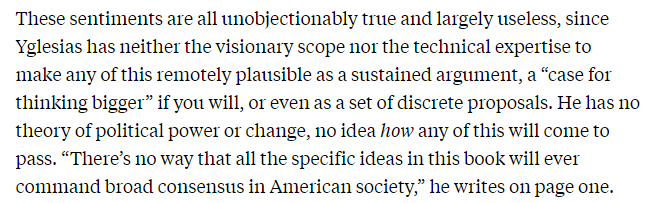
3/First of all, policy thinkers may not understand politics well. And the people who are good at turning ideas into reality may not be the best at coming up with ideas in the first place.
It's OK to have a division of labor between policy people and politics people!
It's OK to have a division of labor between policy people and politics people!
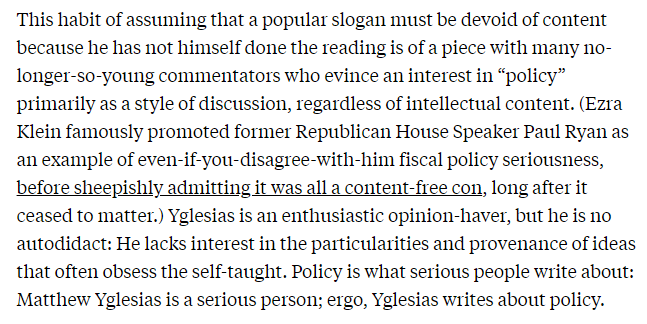
4/Much of the review is a personal criticism of Yglesias. But when Bacharach does level a specific criticism of Yglesias' acumen, it turns out to be something that EZRA KLEIN, not Yglesias, got wrong!
How does that make sense? Ezra Klein is not Matt Yglesias!
How does that make sense? Ezra Klein is not Matt Yglesias!
5/When addressing the substance of the book, Bacharach asserts that Yglesias' idea to upgrade 2nd-tier research universities with federal funding (something I've long argued for) won't help the surrounding regions. But no actual evidence is presented!

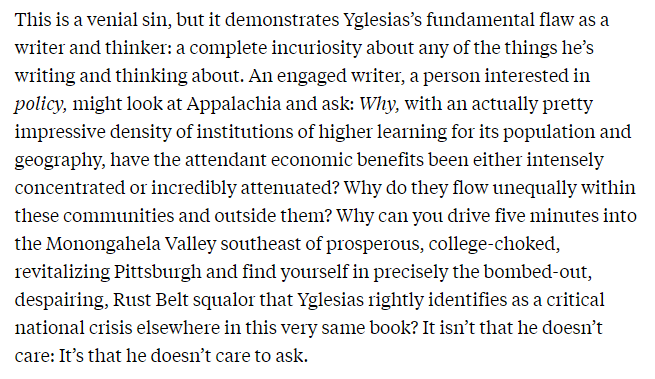
6/Bacharach has anecdotes for regions that (supposedly) have not been revitalized by the nearby presence of universities.
And yet it's easy to find examples of regions that *have* been revitalized, even by small low-ranked universities.
medium.com/migration-issu….
And yet it's easy to find examples of regions that *have* been revitalized, even by small low-ranked universities.
medium.com/migration-issu….
7/There's plenty of research about the beneficial effect that universities have on the economies of the surrounding regions.
For example, this paper:
sciencedirect.com/science/articl…
But Bacharach does not engage with this evidence at all.
For example, this paper:
sciencedirect.com/science/articl…
But Bacharach does not engage with this evidence at all.
8/Bacharach's dismissal of YIMBYism is similarly vague and reliant on anecdotes.
Pittsburgh has built some housing and yet rents have gone up there. So? How much would rents have gone up if the housing hadn't been built?
Bacharach doesn't even ask this question.
Pittsburgh has built some housing and yet rents have gone up there. So? How much would rents have gone up if the housing hadn't been built?
Bacharach doesn't even ask this question.
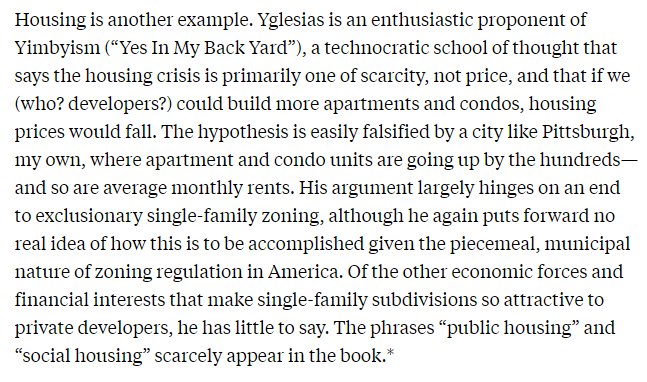
9/Bacharach claims that there's no political way to end single-family zoning, because zoning is done locally.
But he's wrong! Oregon just banned single-family zoning statewide!
npr.org/2019/07/01/737…
But he's wrong! Oregon just banned single-family zoning statewide!
npr.org/2019/07/01/737…
10/In other words, something that Bacharach assumes is politically impossible is not only possible, but JUST HAPPENED. (It also came close to happening in California but failed.)
11/Finally, I would like to note that when writing a book review, before I assert that a phrase does not appear in the book, I make sure to do a word search.
If I have a physical copy, I avoid making strong claims about what does not appear. ;-)
If I have a physical copy, I avoid making strong claims about what does not appear. ;-)

12/To sum up, this review:
1. is an impressionistic personal broadside against Yglesias,
2. stumbles badly when discussing specific policy issues, and
3. demands a "theory of change" yet ignores the reality of actual change now taking place.
newrepublic.com/article/159306…
1. is an impressionistic personal broadside against Yglesias,
2. stumbles badly when discussing specific policy issues, and
3. demands a "theory of change" yet ignores the reality of actual change now taking place.
newrepublic.com/article/159306…
13/I am looking forward to reading @mattyglesias' book, and I hope to write a review that avoids these pitfalls.
(end)
(end)
• • •
Missing some Tweet in this thread? You can try to
force a refresh






