First of all, @Mike_Page is right that electric motors are actually more efficient at turning calories into motion than humans. So if we would replace heavy electric trucks with an army of cyclists, this would indeed not be good for the climate and require too much food.
Second of all, I think it's probably true when you compare an electric bike to a car but the 30g/km for a vegan like me is clearly less than for an electric car (~50g/km for manufacturing plus ~40g/km for driving in the EU) and you have to add my CO2 emissions as car driver.
Finally I'm pretty sure the avoided healthcare costs and other societal costs that result from switching from car to bike outweigh the CO2 emissions from biking, both in terms of costs and CO2.
The only thing you could say is that biking is healthy and if that means you live longer, your total CO2 emissions rise. But if you say a person should not bike for that reason I consider you to be 'off the reservation' as they say.
• • •
Missing some Tweet in this thread? You can try to
force a refresh

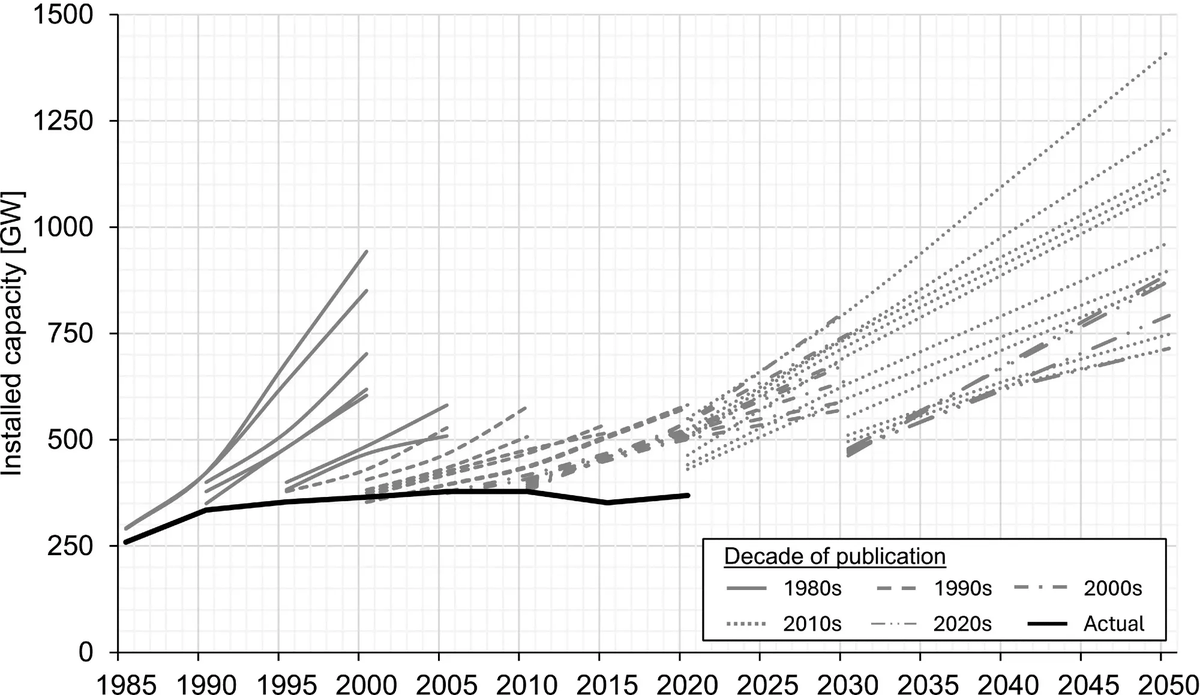
Interesting new paper documents clearly how the IAEA has been overestimating the growth of nuclear time and time again. It's the inverse of what I've documented for solar and batteries. doi.org/10.1016/j.erss…
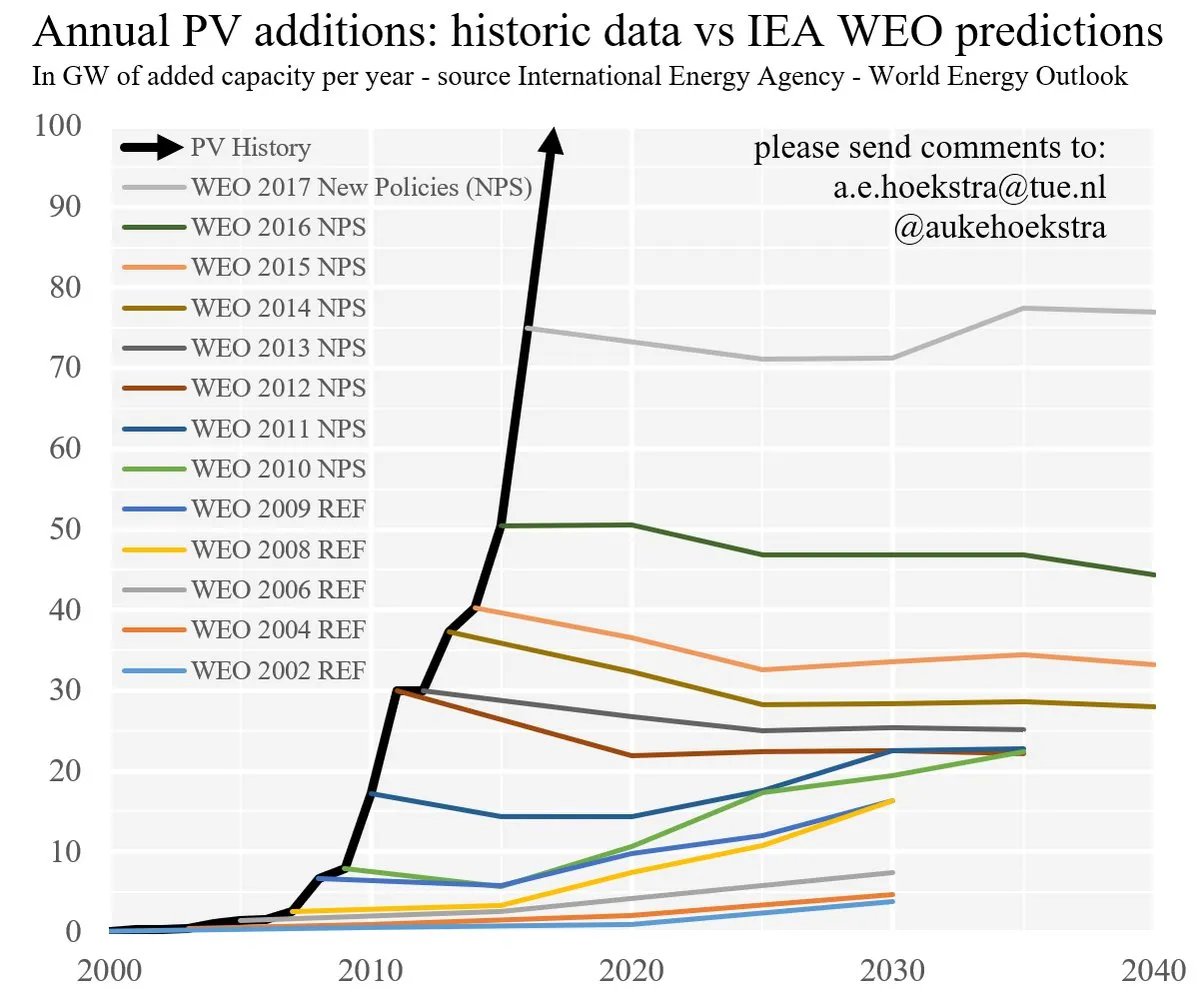
For PV you may know my graph (that was updated by - among others - carbon brief, the economist and Al Gore).
It shows reality (yearly PV sales) quickly increasing while IEA predictions keep denying it.
The nuclear graph is the inverse: predictions keep skyrocketing and reality doesn't budge.
It's similar to a recent paper I wrote on how battery price developments are continuously underestimated by experts. The left graph shows how expert predictions for prices in 2030 get lower as time goes on. nature.com/articles/s4433…
The final report on the Iberia Peninsula (Spain and Portugal) blackout is out.
A lot of people will be blaming renewables and talk about inertia. But the cause was bad voltage control and that's surprisingly easy to fix. Let me explain. entsoe.eu/publications/b…
The chair of the ENTSO-E (European grid operators) board Damián Cortinas stated at the press conference: "The problem is not renewable energy, but voltage control, regardless of the type of generation." sciencemediacentre.es/en/final-black…
You have to understand that traditionally, grids were managed largely through frequency control. If the frequency went down that meant more demand than supply. So you quickly burned more fossil fuels. If the frequency went up you burned less. Simple.
Bjoern talks about "spinning masses" to keep frequency constant, as if that's super important.
And in the old grid it is.
That's why I compare the old grid to a record player.
Here's a longer thread with details.
It has a sub-thread on Spain.
But the new grid has what I call digital power transformers (DPTs).
Basically a computer chip is driving a couple of power transistors. It works like a digital amplifier or your new and light laptop charger. energy-storage.news/demystifying-s…
Renewables also had a role: "tension was very high and sustained, causing the disconnection of generators".
An inside source tells me the voltage went above 110% in many places and solar was required to switch off, which meant 8GW was lost all at once.elpais.com/economia/2025-…
Let's start with some quantifiable facts. (Things this conservative armchair energy philosopher is allergic to.)
First thing we notice is that solar and wind are clearly surpassing nuclear (though the new leadership of the department of energy denies it).