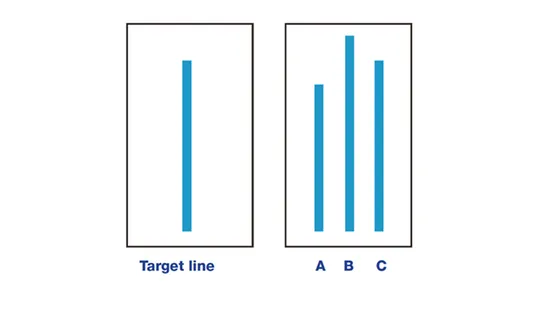
1/ Social psychologists long ago proved something utterly terrifying: *People will literally DISREGARD WHAT THEY SEE WITH THEIR OWN EYES to conform to what others around them say.* In classic 1951 experiment by Solomon Asch, people looked at picture of 3 lines & asked to choose
2/ which one was same length as "target" line—which was also right in front of them. Correct choice was OBVIOUS. Person after person gave wrong answer OUT LOUD when others before picked wrong line. WHEN THE TRUTH WAS RIGHT IN FRONT OF THEIR FACES. Watch
3/ video, see for yourself. This happened even when the truth was visibly obvious. If person after person will say something blatantly false to conform with group of strangers, imagine what happens when things are even slightly more ambiguous as with social, cultural, political,
4/ & ideological issues. But we don't have to imagine, it's happening all around us. Otherwise sane people say out loud things that are batshit crazy. Given pressure of social conformity, people will literally say the truth is a lie & a lie is the truth, right is wrong &
5/ wrong is right, violence is peaceful and peaceful is violence. And huge numbers just jump on bandwagon.
But here's where it gets interesting.
In famous line experiment, people who gave wrong answer fell into three groups:
1. People who saw the truth and knowingly
6/ said something they didn't believe just to go along.
2. People who saw the truth but thought the others must be right and they must be mistaken about what they were looking at.
3. People who, after hearing others say wrong thing, LITERALLY COULD NOT CORRECTLY SEE what was in
7/ front of them and literally saw the longer line as short and the shorter line as long. Their actual ability to perceive reality was altered.
And of course (although not an option in this particular experiment) there are the people who see reality accurately but REMAIN SILENT
8/ when the people around them start saying things that are batshit crazy.
Which group are YOU in?
• • •
Missing some Tweet in this thread? You can try to
force a refresh

1/ Highlights from this crucially important paper:
About 7 out of 10 patients who get “evidence-based therapy” for depression are still depressed after treatment
Of the 3 that get well, about half would have gotten well without treatment
No significant differences between types of therapy (the “dodo bird verdict”)
“Third wave” therapies (eg, ACT) no better than plain old CBT, or any other form of treatment
From the paper: “Most patients do not respond or remit after therapy, and more effective treatments are clearly needed”
So… can someone please explain to me again why these treatments are routinely called “evidence-based therapy?”
2/ When the benchmark is “getting better”—not just doing better than a control group—this is what research shows
Most patients get little or no benefit from brief therapy. This is what research has has shown for 40-50 years. The findings have been consistent for half a century
3/ Someone here offered and analogy:🙏
Imagine if the benchmark for evaluating a plumber was not doing the job right, but how they compared to not trying to do the job at all? Pipes could be leaking everywhere, the pluming fixtures could be falling off—and researchers would be
1/ This quotation needs more psychological nuance. In fact, it’s in our human nature to take pleasure in others’ downfall, for many reasons—often unconscious
It’s not so much that we “make monsters of ourselves,” because the monster is already within. In the words of Aleksandr
2/ Solzhenitsyn, “The line dividing good and evil cuts through the heart of every human being”
It is that *acting* on these impulses—publicly reveling in sadistic glee, joining in the pile-on, inciting others to pile on—feeds that inner monster. It grows larger and uglier, and
3/ the rest of us is diminished. In time, we become an empty husk of the person we could have become
We can’t reason away our feelings and impulses (sorry, cognitive therapists). We may feel that twinge of pleasure in another’s ruination, we may feel feel that inner impulse to
2/ In historic usage, it referred to taking a position (as a matter of *technique,* aimed at self-knowledge) equidistant from id, ego, & superego—terms that no longer hold currency in contemporary psychoanalytic theory, and that are now meaningless to most
So here’s an update:
3/ The term is a recognition that we humans are of many minds about many things, there is inner contradiction, and the contradictions can be at any level of conscious awareness
“Neutrality” means helping the person become aware of all of the inner facets and contraductions,
1/ Depressive Personality Style
“Despite its omission from the DSM, depressive personality is the most common personality syndrome seen in clinical practice. It is a personality syndrome in every sense of the term: an enduring pattern of psychological functioning evident by
2/ adolescence and encompassing the full spectrum of personality processes.
People with depressive personalities are chronically vulnerable to painful affect, especially feelings of inadequacy, sadness, guilt, and shame. They have difficulty recognizing their needs, and when
3/ they do recognize them, they have difficulty expressing them. They are often conflicted about allowing themselves pleasure. They may seem driven by an unconscious wish to punish themselves, either by getting into situations destined to cause pain or depriving themselves of
1/6 The goal of psychotherapy is to insert spaces for noticing and reflecting where space has not previously existed—and thereby create opportunities to know ourselves more fully, connect with others more deeply, and live our lives more congruently
2/6 Psychotherapy is about slowing things down—so we can begin to see and understand patterns and responses that otherwise happen quickly, automatically, without awareness or understanding
3/6 Talk about “optimizing” psychotherapy or making it more “efficient” betrays a fundamental misunderstanding
We find ourselves in difficulties specifically because we *cannot* slow down to notice and reflect. The rush to optimize every facet of life is the disease—not the cure