The 33rd Sessions Court today heard the arguments on behalf of the Petitioner by Advocate. Special Public Prosecutor has filed objections in the matter. SPP prays for additional time to address arguments in the plea.
Supreme Court hears plea against the use of Pellet guns on protesting students at Jantar Mantar and other areas
Adv Vrinda Grover: It has a kinetic metallic projectile
Justice Joymalya Bagchi: But police rules allows the use in exceptional circumstances unless you challenge the rules itself.. one of the steps of graded approach is use of pellet guns
Grover: Give me 2 minutes. there can be rubber, plastic and metallic pellets. These were metallic and recovered from the bodies. Nature of the crowd will determine use of this as well. Was it a violent mob? No. These metallic pellets were fired.
@CPDelhi @Cockroachisback #SupremeCourt
Justice Bagchi: We are not averse to examine use of pellets in an individual use. you have to show us if graded response use of pellets can be allowed when even bullets are used in some situations. If your convict uses a bullet...
CJI: in light of alleged excessive use.. your prayer should be that court lays down a protocol regarding the use
Grover: Yes only metallic pellets
Justice Bagchi: In Calcutta HC there was a rule that bullets should be fired at the chest to preserve amunition and not any other body area
SG: must be some colonial era..
Justice Bagchi: that rule was struck down. So you have to show us rules where use of pellets is arbitrary, etc.
Adv Grover: Even the DPRD document which I have was accessed by a RTI.
Justice Bagchi: must be there the archive. If not, then that is not done. It has to be there..
#SupremeCourt begins hearing the batch of petitions challenging the reinstatement of the three-year minimum practice requirement for recruitment to the post of Civil Judge (Junior Division)
Senior Advocate Pinky Anand: if this happens then good people will not enter the profession. Women will not come.
We have suggestions... Selected candidates undergoing training for the post of Civil Judge may be attached, for a specified period, to designated Senior Advocates, Government Pleaders, Advocates General, Standing Counsel, and Assistant Legal Aid Defence Counsel under the Legal Aid Defence Counsel (LADC) Scheme, 2022.
A similar system has been adopted in Germany, where a candidate aspiring to judicial office must complete a university law degree followed by preparatory training under Section 5b of the German Judiciary Act, 1932. The training lasts for two years and includes placements in civil courts, criminal courts, public prosecution offices and other legal institutions.
At present, State Judicial Academies follow different induction and training systems. There is a need for a uniform national training framework, either through the National Judicial Academy or a permanent committee headed by the Chief Justice of India as ex officio Chairperson, to continuously develop and standardise training modalities for the subordinate judiciary.
We have also suggested reforms in legal education, including:
Optional, structured six-month practice modules during the three-year and five-year law degree programmes;
Specialised degree courses for judicial aspirants to identify, train and expose them to high-quality judicial education from the university stage itself. One such example is the BA LL.B. (Adjudication and Justicing) programme offered by an MNLU.
It is imperative that this issue is flagged. Ultimately, the merit, competence and ability of a Civil Judge are of concern to both the Bar and the Bench.
Accordingly, it is suggested that Civil Judges (Junior Division) be provided scholarships, administrative leave for higher legal education and specialisation, both in India and abroad, as well as opportunities for exchange programmes, placements and deputation.
Sr Adv Anand: We have to bring the judges at the correct age.
Sr Adv Colin Gonsalves: Our compilation demonstrates that the three-year practice requirement is not necessary. I also deal with the expansion of judicial academies. By 2026, almost every State, barring a few smaller ones, has a full-fledged State Judicial Academy. The time is therefore ripe to train judges after they graduate from law schools. Instead, we are sending fresh graduates back into litigation for three years.
Then there is an an article by a former Director of the National Judicial Academy. In paragraph 13, he recommends replacing the three-year practice requirement with a mandatory, intensive induction training programme.
The compilation also addresses judicial education in collaboration with universities. It refers to the University of Virginia model and, subsequently, the French model, both of which emphasise collaboration between judicial academies and universities.
Another suggestion is to adopt experiential learning from the very beginning through legal aid work, clerkships and internships, coupled with continuous evaluation, accountability mechanisms and holistic judicial training.
The compilation also sets out the views of the National Law Universities. I believe the learned Amicus' presentation may not have fully reflected them. ...National Law Universities and leading law schools across the country consistently recommend against retaining the three-year practice rule.
Now on deal with judicial vacancies. Higher Judicial Service examinations continue to witness a significant number of vacancies across the country. The data also shows that only around 20% of graduates from National Law Universities enter litigation. The experience of the NLUs is that retaining the three-year practice requirement discourages graduates from leading law schools from opting for judicial service.
The compilation also refers to a speech by former Chief Justice N.V. Ramana, where he observed that very few graduates from National Law Schools are interested in joining litigation.
Delhi High Court refuses to entertain a petition seeking withdrawal of a pending enquiry from the administrative control and supervision of police officer Sandeep Lamba, who was seen slapping a woman during the Cockroach Janta Party (CJP) protest.
The matter was listed before Justice Girish Kathpalia
The petition was filed by a 68 year old woman in a 2025 incident, where she complained of enquiry into illegally detention by police the entire night without any formal warrant or notice.
The petitioner is seeking to withdraw the pending enquiry from Additional DCP Sandeep Lamba.
The Counsel submitted: He was violating a woman, which has been widely reported in the media wherein he is seen slapping a woman in broad daylight while in uniform, and subsequently administrative action has been taken.
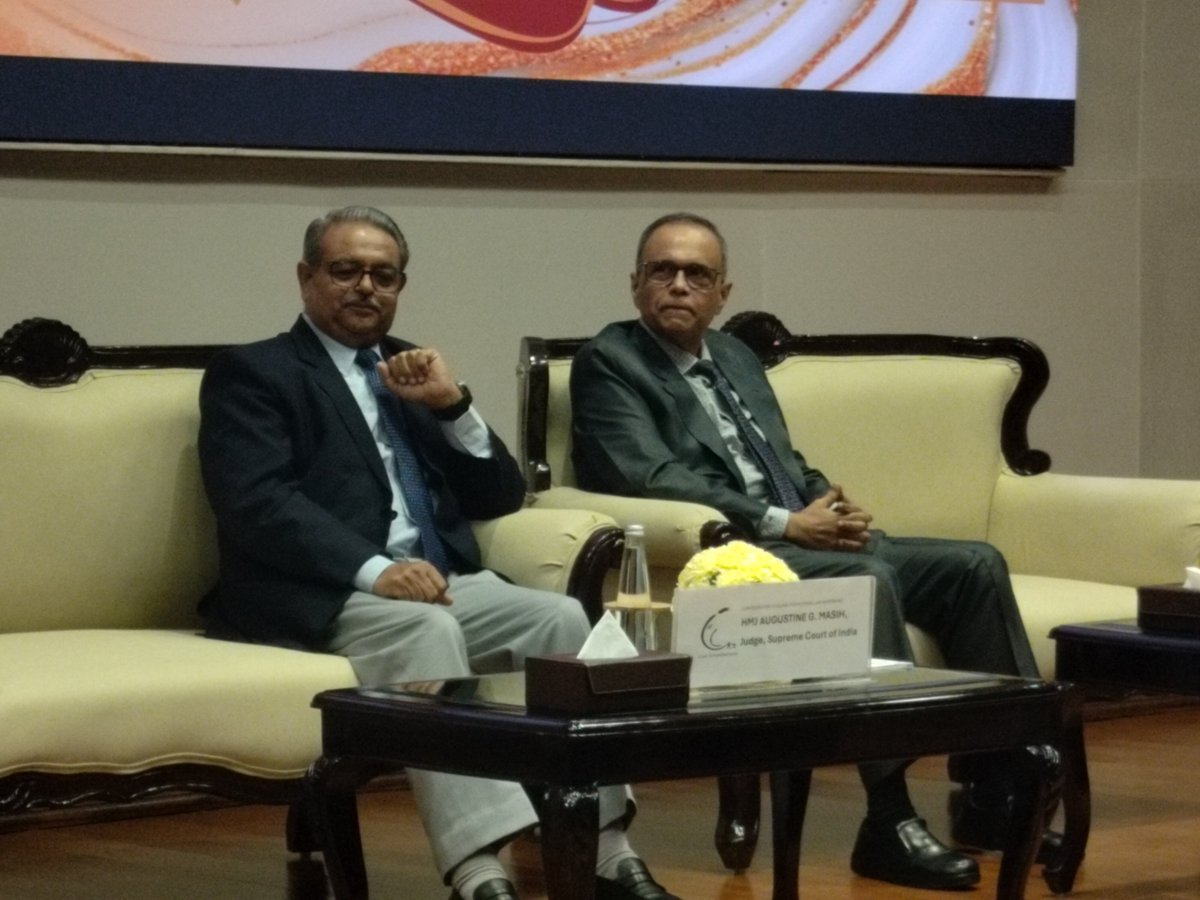
Supreme Court judge Justice Ujjal Bhuyan in his key note address at the Justice G.P. Singh 4th Memorial Lecture at the National Law University at Bhopal said:
Though I am a part of the Supreme Court, I am an insider. I am critical of the functioning of the Supreme Court to a great extent, and I don't mince my words. Perhaps for this reason, some are not happy, but leave it at that.
#JusticeUjjalBhuyan #SupremeCourt
Justice Bhuyan: In a span of over 25 years, this university has established itself as a center of learning and excellence. It has done commendably well, for which the faculty and the students deserve all the praise. But one word I would like to put in: This university has done exceptionally well, there are many universities which are doing well. The question is, where do Indian universities stand today on a global comparison? Why is it that people with means, the first thing they do is to send their students, to send their children abroad? Why? We need to ask this.
#JusticeUjjalBhuyan #SupremeCourt
Justice Bhuyan: The other day I was invited by another National Law University for the induction program of the new batch of students. I requested the university that "Allow the students to be themselves, encourage their inquisitiveness."
Students should be encouraged to question. Unless we question, unless students question, they will only be parroting the texts, and they will become like a captive audience.
Captive audience, I say, when a high court judge speaks, the district judges are there, the district judiciary, the judges of the tribal judiciary are there and they are not questioned. Everything is being asked or everything being said is being lapped up. So our students need to be critical, need to question, including the judiciary.
Sonam Raghuvanshi case: Supreme Court to shortly resume hearing the State of Meghalaya’s plea seeking cancellation of the bail granted to Sonam by the High Court.
Bench: Justices MM Sundresh and PB Varale
Sonam is accused for the murder of her husband Raja Raghuvanshi during their honeymoon last year. She was granted bail by a trial court, which was upheld by the High Court.
Delhi High Court to hear the appeal filed by Gitanjali Angmo, wife of activist Sonam Wangchuk, challenging a single judge order rejecting her plea to discharge Wangchuk from Safdarjung Hospital and transfer to Medanta Hospital.
The matter is listed before Chief Justice DK Upadhyaya and Justice Tejas Karia.
From the government's side, Solicitor General of India Tushar Mehta, ASG Chetan Sharma and standing counsel Ashish Dixit will appear.
Senior advocate Akhil Sibal is likely to appear on behalf of Angmo.