Been meaning to make this recommendation for some time, & as with "Range," I am several months late. I really, really loved "How Innovation Works" from @mattwridley It is a very elegant follow up to "The Rational Optimist" - read both if you can. (more) amazon.com/How-Innovation…
One of the most amazing things about both books is Matt's ability to connect the dots across very long time horizons. Very few can. He also has the ability to combine thinking from many fields - most notably science, technology, psychology, & a heavy dose of microeconomics.
Relative to our world in Silicon Valley, Matt shows how "what we do" is not new, but a very old (and critically important) process. He refers to idea generation as "invention," & notes that successful "go to market" (which he calls innovation) is far more important. Agree 10x!
He recognizes how critical innovation is to our world. It is central to such things as solving poverty, curing disease/health, & raising the welfare/standard of living for most humans. Most problems created by the scaling of our globe need innovations as the key solution.
Governments (around globe & across time) either play a supporting role in encouraging innovation or destructive role in discouraging it. Europe is lagging in such support. The U.S. has been a leader but is showing signs of calcification. China is clearly in the driver's seat.
Why would anyone choose to be anti-innovation? They might not know that they are. They are merely trying to protect old hierarchies, maintain the status quo, or keep an industry as it was in the past. However, this Ludicious protectionism has very real long-term consequences.
• • •
Missing some Tweet in this thread? You can try to
force a refresh

The point @sundeep is making about be combinatorial effect of having many (now 7?) Chinese open AI models is very powerful, and I mis-appreciated by many. Each model can improve each other model. And new models are much easier to launch. 🧵
@mattwridley’s book The Rational Optimist: How Prosperity Evolves (2010) persuasively argues that human progress and innovation are largely driven by the exchange and combination of ideas—much like genetic recombination in biology. He calls this phenomenon “ideas having sex.”
If normal sharing or technological innovation is “ideas having sex” this plethora of simultaneous open AI models (with published weights and papers about technique) is an “idea orgy.” The collective innovation should easily soar pass anything one company can do alone.
As a 3rd-party, curious observer, I have several naive, unanswered questions about the Stargate project. Obviously understand that they have no obligation to disclose. Here is list with responses wide open. I would love to be able to aggregate the best answers at some point.
1. Corporate Structure
The OpenA press release says that Stargate is "a new company." Is Stargate established as a standard C-corp, LLC, a joint venture, or something else entirely?
2. CEO Leadership
Will Stargate have an independent CEO? Who will lead Stargate on a daily basis, and how is that person chosen? Will they be as operationally intense as the XAI team that launched Memphis?
You can frequently read articles referencing VC "dry powder" and inferring that these large dollar amounts are "burning a hole" in someone's pocket & will imminently find their way to the market. I totally understand the assumption, but things don't really work this way. [cont]
First and foremost, undrawn VC dollars are not on the IRR clock. There is no urgency to draw them down. The money isn't actually at the VC firm, they are still sitting in the coffers at the LPs. No VC firm I have ever been exposed to feels "pressure" to "get dollars to work."
On the back of a market reset, & w/ portfolio valuations being slashed, GPs are mostly sharing bad news w/ LPs. No GP wants to look aggressive/carefree. Imagine being a teenager with two speeding tickets & a fender-bender insisting on taking the new family car out Saturday night.
Some (below) are arguing US capitalism would be better off if SVB had completely failed (also wiping out depositors). History suggests that out gov't treated big banks (2008) & big airlines (2020) FAR BETTER than SVB - in both cases fully protecting EQUITY shareholders. (cont)
In 2008, during the GFC, our gov't bailed out most of the major money center banks. Equity shareholders & bondholders kept whole. GS received help AFTER they received a preferred investment from Warren Buffet. Here is the real kicker (cont). investopedia.com/insights/too-b…
The GFC was the result of a specific flawed financial product that was an "offering" of these same banks. So far, the identified SVB failure was a bad risk management process. In the GFC case, the "bailed-out" players directly benefited from the flawed product.
As people come to terms with the weight of our new environment, they are slowly beginning to realize how radically things have changed. One area in particular that has changed - the required level of "corporate performance" needed to simply survive (let alone thrive). 🧵
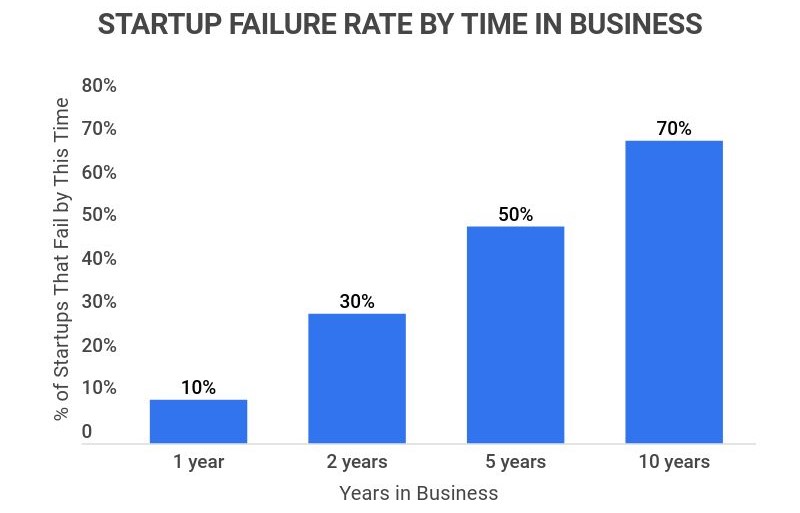
2/ Building startups WAS a historically difficult endeavor (see chart). The past 5 years things have been "much, much easier." Cash was easy to come by (round frequency unprecedented), & no one was held to any profit goals, yet many companies still received high valuations.
3/ Cash is now hard to come by; investors are expecting solid unit economics & earlier profitability. Everything is immediately 5-10X harder. As such, survival is now depedent on hard-core, disciplined, top decile business execution, which no one learned in the past 5 years.