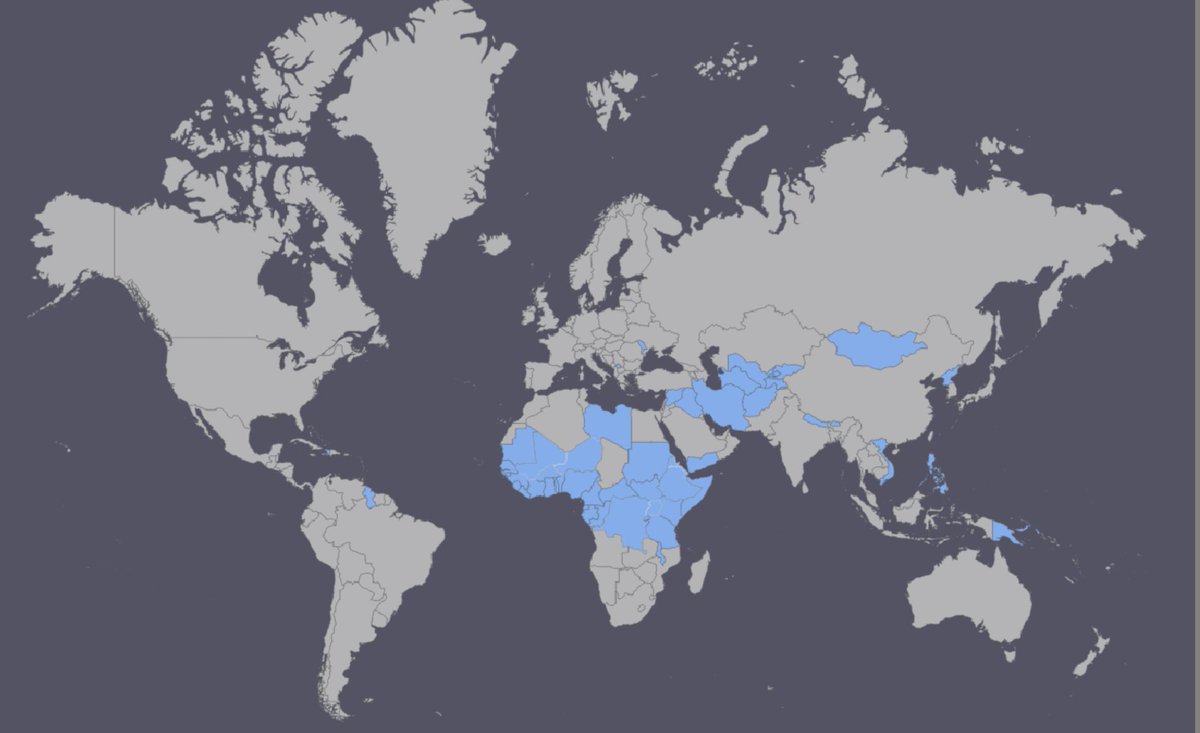
Under DHS's new proposed rule, if you were born in, or are a citizen of, one of the countries on this map, you would be banned from getting a four-year degree in the United States, with a student visa limited to two years maximum.
The thread has all the countries.
The thread has all the countries.
https://twitter.com/ReichlinMelnick/status/1309141303826014209
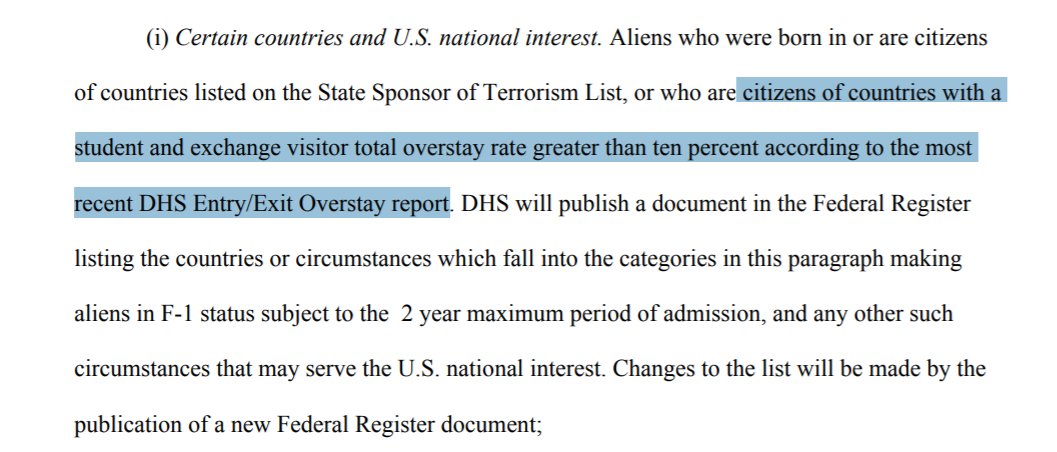
Rather than have people dig through the threads to get to the original rationale, here's the relevant provision I built this map off of.
The vast majority of these countries would be banned from 4-year-degrees based on this overstay provision.
It's collective punishment.
The vast majority of these countries would be banned from 4-year-degrees based on this overstay provision.
It's collective punishment.
Here's a thread I did on some of the other changes made by the rule, which was published this morning.
People who want to oppose the rule will be able to provide comments in opposition to the rule, starting tomorrow and lasting through 10/25/2020.
People who want to oppose the rule will be able to provide comments in opposition to the rule, starting tomorrow and lasting through 10/25/2020.
https://twitter.com/ReichlinMelnick/status/1309123093718278146
Here's the best example I can give for why collective punishment based on visa overstay rates is arbitrary and cruel.
In 2019, six students from Tuvalu were supposed to leave the US. One didn't.
As a result, the visa overstay rate was 17%—meaning all Tuvalans would be punished.
In 2019, six students from Tuvalu were supposed to leave the US. One didn't.
As a result, the visa overstay rate was 17%—meaning all Tuvalans would be punished.
Also, whoops, just realizing I forgot to add Chad to the map. Chad would also be subject to the ban, because they had a student visa/exchange visitor overstay rate over 10% in FY2019.
That completes the band across the middle of Africa.
That completes the band across the middle of Africa.

One final thing to add to this thread; that things are not totally lost if the rule goes into effect.
Students in those situation would be able to ask DHS for an extension of their visas past two years. So that means it's not a total ban.
But those extensions aren't guaranteed.
Students in those situation would be able to ask DHS for an extension of their visas past two years. So that means it's not a total ban.
But those extensions aren't guaranteed.
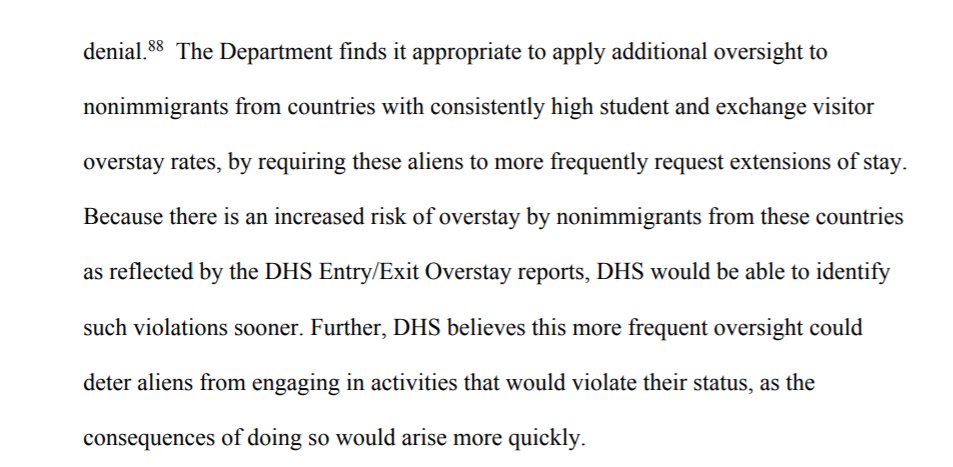
Putting this here: I maybe should not have used the word "ban." Some people would still be able to get a four-year degree, but would be required to apply to extend their visas repeatedly through their time in college—extensions which aren't guaranteed.
https://twitter.com/ReichlinMelnick/status/1309153179926441990
Starting tomorrow morning, people will be able to leave a comment in opposition to this rule at this link. federalregister.gov/documents/2020…
DHS says it's fixing a major problem. But DHS data says just 32,023 people are suspected of overstaying a student/exchange visa in 2019.
And because the rule is based on PERCENT, the countries with the highest NUMBER of overstays (China, India, Brazil, Canada) aren't affected.
And because the rule is based on PERCENT, the countries with the highest NUMBER of overstays (China, India, Brazil, Canada) aren't affected.
Here's why a % threshold is so stupid:
China: 11,030 student/exchange overstays (unaffected by rule)
India: 5,304 (unaffected)
Brazil: 3,177 (unaffected)
Saudi Arabia: 2,983 (unaffected)
South Korea: 2,492 (unaffected)
Japan: 1,418 (unaffected)
...
Tuvalu: 1 (restricted)
China: 11,030 student/exchange overstays (unaffected by rule)
India: 5,304 (unaffected)
Brazil: 3,177 (unaffected)
Saudi Arabia: 2,983 (unaffected)
South Korea: 2,492 (unaffected)
Japan: 1,418 (unaffected)
...
Tuvalu: 1 (restricted)
• • •
Missing some Tweet in this thread? You can try to
force a refresh