🚨 New! A.G. Barr takes ANOTHER whack at the asylum process, issuing a new precedential decision in Matter of A-C-A-A-, 28 I&N Dec. 84 (A.G. 2020) and giving both immigration judges and the BIA more leeway to deny asylum claims.
Before I go through this latest attack on the asylum process, please enjoy a picture of Petra, who is a Very Good Cat. I hope this softens the blow a tiny bit.
A.G. Barr begins his decision (issued under authority to set precedent in immigration court) by basically saying that the Board of Immigration Appeals hasn't been digging deeply enough in every single case to find ways to deny people asylum. It's hard to read it otherwise.
In the underlying decision, the respondent was found to be credible and to have suffered past persecution on the basis of membership in a particular social group. Because of changed circumstances, the judge found no well-founded fear, but granted humanitarian asylum.
Notably, DHS did NOT appeal the grant of humanitarian asylum. Instead, they only appealed the IJ's finding that the respondent was credible and that the IJ shouldn't have found past persecution.
The BIA affirmed the IJ's decision in a very brief order.
Despite the fact that DHS did NOT appeal the grant of humanitarian asylum, A.G. Barr believes that the BIA should have evaluated whether or not the IJ should have granted humanitarian asylum anyway.
A.G. Barr lays out here the role he sees the BIA as playing in asylum cases under what he articulate as "de novo review."
Basically, question everything, dig through the record, and find ways to deny applicants.
In the decision, Barr basically tells the BIA to utterly ignore all normal rules of appellate procedure. Who cares if the government didn't raise an issue—or even stipulated to an issue! The BIA should ignore all of that and go digging through the record.
This decision makes even more clear that the immigration courts are fully broken. They have been politicized to death and are now fundamentally incompatible with due process.
• • •
Missing some Tweet in this thread? You can try to
force a refresh

Today the Supreme Court hears a case that will decide the fate of over 350,000 people currently living legally in the United States — and impact thousands more who are still in limbo.
So what is Temporary Protected Status and what is the case about? NEW 🧵 on the issue.
Temporary Protected Status was created to deal with the fact that sometimes, due to an outbreak of war, political crisis, or natural disaster, deportation becomes inhumane.
Without a law to address this, presidents responded on an ad hoc basis using inherent executive authority.
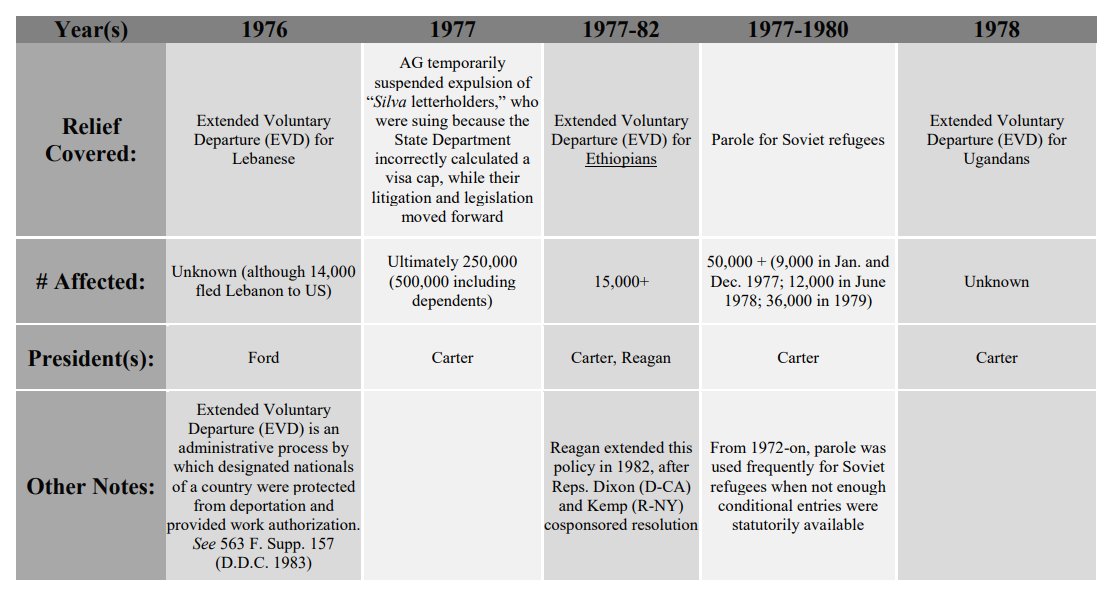
Before TPS, Presidents used a thing called "extended voluntary departure" to address these crisis. For example:
- Ford gave EVD to Lebanese in 1976 due to civil war
- Carter gave EVD to Ugandans in 1978 due to civil war
- Reagan gave EVD to Poles in 1981 due to Soviet crackdowns
From FY 2021 through FY 2024, roughly 3.5 million people became U.S. citizens through naturalization. The idea that Biden is somehow personally responsible if any of them later went on to commit crimes is beyond stupid; it's willfully ignorant and deliberately inflammatory.
Neither @nypost or @DHSgov has EVER blamed Trump for any crimes committed by an immigrant who entered the country or got status under Trump. Not once.
It's because they KNOW it's not a good faith argument.
Wait, sorry, so now the Trump admin is attempting to strip green cards from people just because of who their families are?! And people are cheering this on?
People with DACA came here as children. Every one of them has been here for a minimum 19 years. They grew up here. They went to school here. Many speak English with no accent. They are working legally, paying taxes, doing everything right.
Because that's not something a President can do. Only Congress can provide a path to permanent legal status for most DACA recipients. And Congress has sat on its ass for years, even though huge majorities of the American public supports the DREAM Act.
In 2018, the Supreme Court said DACA might be legal if it only protected against deportation, not provided work permits. The 5th Circuit, the most conservative in the country, upheld that version and limited their ruling only to Texas (the plaintiff).
Here I was thinking that what mattered was every single judge who has ruled on the issue, 125+ years of accepted understanding of the 14th, and centuries of common law on the contours of jus soli. But if you have SEVEN law professors, man, WOW.
Less sarcastically, this article has a GLARING flaw: dual citizenship. Many children of U.S. citizens acquire foreign citizenship at birth under jus sanguinis and so would not have an "exclusive" allegiance to the US under this theory. That can't be right.
If "exclusive allegiance" is required, then how could that cover Wong Kim Ark himself, who was a dual national?
Hamburger's answer is that U.S. law at the time did not recognize dual nationality. That's a bizarre answer that raises more questions than it answers.
The overwhelming majority of Americans (polls show over 80%) oppose the deportation of people like this woman. In every previous administration, including Trump's first, this woman would not have been a priority for enforcement.
You can't get a fiancé visa from inside the country, and thanks to failed laws Congress passed 30 years ago, getting a green card through her husband could be either near-impossible or could take 3-5 years minimum. It's not as simple as most people think.
In 1996, Congress said that people wanting to get a green card through a US citizen spouse, who had originally entered illegally, had to leave the US and get a visa, which triggers a 10-year ban on reentry.