It's an open secret that many of America's largest banks are "zombies" - institutions that are able to carry on despite having a negative net worth, thanks to "a combination of implicit and explicit government credit support."
1/
"Masters of Illusion: Bank and Regulatory Accounting for Losses in Distressed Banks," is a new @INETeconomics paper by Boston College finance prof Edward J Kane, revealing collusion between bank accountants and financial regulators to conceal losses.
Bank accountants want to help their employers stay solvent, while regulators don't want the public to spook and stampede, which would cause a run on the bank. All this is laid out in a layperson-friendly article accompanying the paper
Taken together, accountants and regulators have a "disposition toward supervisory informational deception and regulatory forbearance" and during crises, this comes to the fore, allowing zombie banks to borrow even more money under the expectation that they will be bailed out.
4/
The degree to which banks are guaranteed to be solvent regardless of recklessness and deception means that any time you see an insider running away from a bank, you should assume that things are REALLY bad.
5/
Kane: "The processes through which bankers extract benefits from the safety net closely resemble those of embezzlement and the rewards bankers garner usually rise to the level of grand larceny...
6/
"The difference between street crime and safety-net abuse lies mainly in the class and clout of the criminal and the subtlety of the crime."
7/
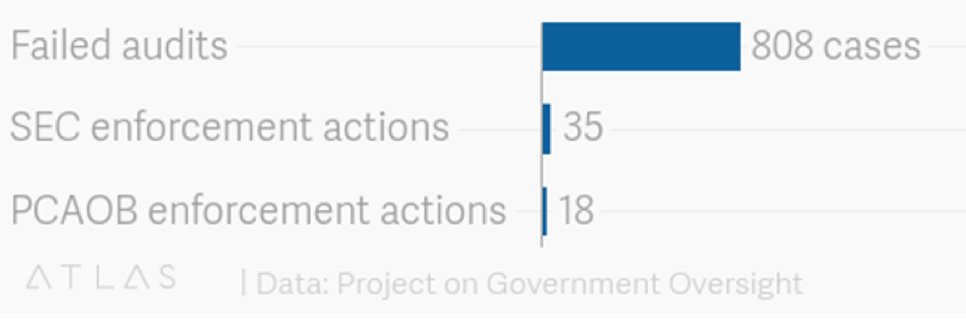
And as ever, a chart tells quite a story: the Big Four accounting firms failed 808 audits between 2009-17, and faced only 53 enforcement actions.
It's hard to talk about the Epstein class without thinking about "The Economy" (in the sense of a mystical, free-floating entity whose health or sickness determines the outcomes for all of us, whom we must make sacrifices to if we are to prosper).
1/
If you'd like an essay-formatted version of this thread to read or share, here's a link to it on pluralistic.net, my surveillance-free, ad-free, tracker-free blog:
As nebulous as "The Economy" is as an entity, there's an economic priesthood that claims it can measure and even alter the course of the economy using complex mathematics. We probably won't ever understand their methods, but we can at least follow an indicator or two.
3/
The best summary of Trump's trade "philosophy" comes from Trashfuture's November Kelly, who said that Trump is flipping over the table in a poker game that's rigged in his favor because he resents having to pretend to play the game at all.
1/
If you'd like an essay-formatted version of this thread to read or share, here's a link to it on pluralistic.net, my surveillance-free, ad-free, tracker-free blog:
Ireland is a tax haven. In the 1970s and 1980s, life in the civil-war wracked country was hard - between poverty, scarce employment and civil unrest, the country hemorrhaged its best and brightest. As the saying went, "Ireland's top export is the Irish."
1/
If you'd like an essay-formatted version of this thread to read or share, here's a link to it on pluralistic.net, my surveillance-free, ad-free, tracker-free blog:
Code is a liability (not an asset). Tech bosses don't understand this. They think AI is great because it produces 10,000 times more code than a programmer, but that just means it's producing 10,000 times more liabilities.
1/
If you'd like an essay-formatted version of this thread to read or share, here's a link to it on pluralistic.net, my surveillance-free, ad-free, tracker-free blog:
We are about to get a "post-American internet," because we are entering a post-American *era* and a post-American *world*. Some of that is Trump's doing, and some of that is down to his predecessors.
1/
If you'd like an essay-formatted version of this thread to read or share, here's a link to it on pluralistic.net, my surveillance-free, ad-free, tracker-free blog:
Look, I'm not trying to say that new technologies *never* raise gnarly new legal questions. But what I *am* saying is that a lot of the time, the "new legal challenges" raised by technology are somewhere between 95-100% bullshit.
1/
If you'd like an essay-formatted version of this thread to read or share, here's a link to it on pluralistic.net, my surveillance-free, ad-free, tracker-free blog:
It's ginned up by none-too-bright tech bros and their investors, and then swallowed by regulators and lawmakers who are either so credulous they'd lose a game of peek-a-boo, or (likely) in on the scam.
3/