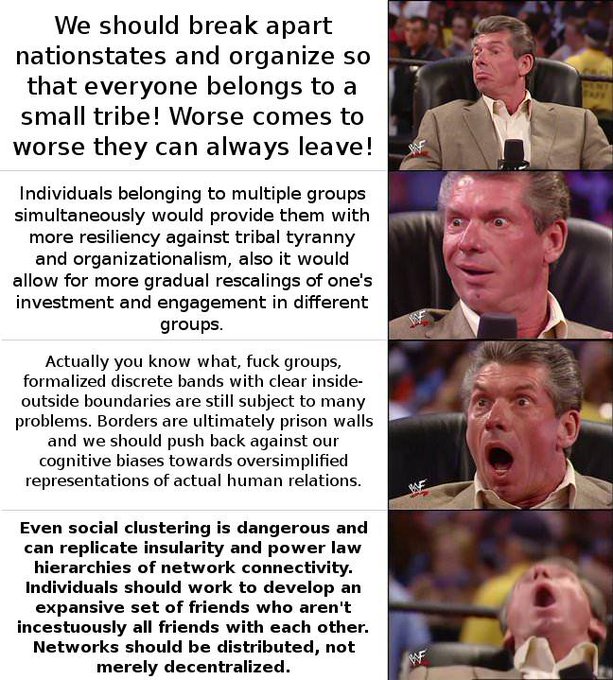
Being "free" to associate as one wishes avoids the question of one's inclinations or unexamined instincts, and those inclinations CAN have a huge impact on the success or failure of projects and broader movements, cultures, even societies.
One of the biggest failure modes in contemporary anarchist organizing is thinking in terms of The Organization and being disinclined or unprepared for fluid disassociation by individuals. This leads people chained in dysfunctional projects without good/smooth exit opportunities.
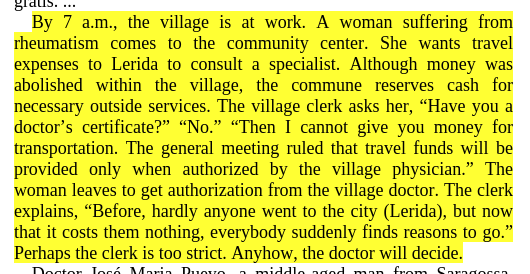
Consider also the all-or-nothing Communes handwavingly described by Kropotkin and implemented in Aragon. Every individual had the Right of exit, but in practical reality / structure there was pretty much no option besides joining what were often essentially Company Towns.
CNT officials *bragged* about the monopsony power that rural collectives wielded, such that while individuals *could* opt out of their village's collective, they were basically completely fucked if they did, with no options, no one else they could exchange with.
Suffice to say that merely having "the right of exit" is not structuring your entire society to center individual agency and resist the emergence of collectivist cancers.
Because The Commune or The Organization can quickly gain state like powers and tyranny:
• • •
Missing some Tweet in this thread? You can try to
force a refresh

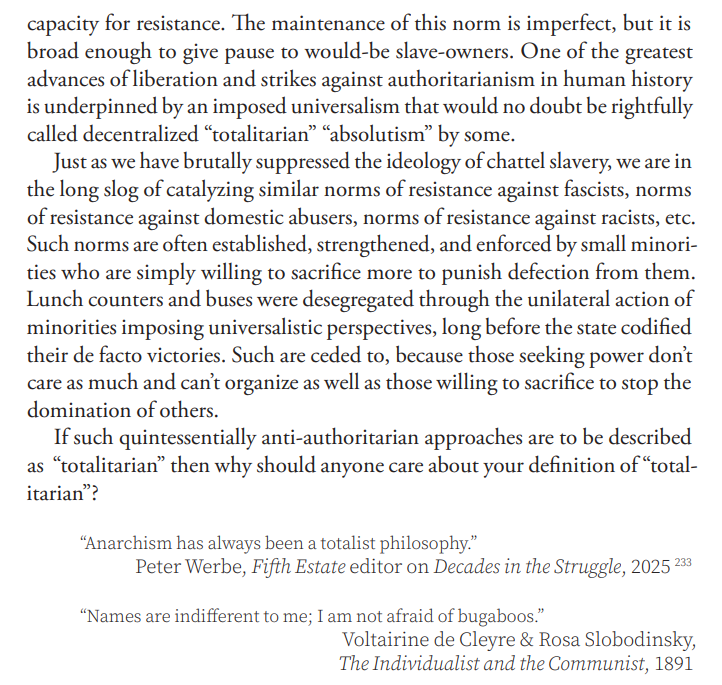
Anarchism is unavoidably a "totalizing" ideology because we're not pluralistic "panarchists" who would happily accept there being a patriarchal state in the next town over.
Core to the Beautiful Idea is the notion that our freedom is entangled with EVERYONE's freedom.
The entire anarchist movement had a decade long fight over the 00s about "national anarchism" and whether we were perfect pluralists who would tolerate any contortion and redefinition of anarchism, any local tyranny, or whether there were limits and thus universals we defend.
The fascist "national anarchists" and their "panarchist" defenders were resoundingly defeated and forever banished, sometimes at great cost and after much fighting.
Importantly, we excluded them from the bottom-up without ratifying and imposing some platformist party line.
hilariously sloppy and cartoonish reduction of the complex actual intellectual lineage at play, but also amusingly kinda right despite the wildness of grabbing Weil to represent left ascetism
after ww2, with the bomb and technocracy, the humanities and sciences reversed political associations, and this led to the aristocratic values of the classics department getting hybridized with young leftist students into a mutual hostility to modernity
left ascetism has *always* existed -- it's a fairly natural stance to prop up anticapitalism by going "i guess wanting things is bad" -- and this intersected with a pop reduction of Reich and Kropotkin into "human nature is good; machines/society make it bad"
Okay, look team. We can't be out here just making shit up. Yes, anarchists are smart, but it was decentralization and informality that made us hard to infiltrate. The AVERAGE anarchist in 06 was an activist who didn't read theory.
I'm not saying the *average* anarchist was a crustie oogle busy breaking beer bottles, but like, "average" over ANY very large movement has never been the intellectual book club nerds. It's activists who go to documentary nights and talk with people, but are like ehhh about books
If you're constraining "anarchist" to folks who have been organizing consistently in the movement for over a decade, then yeah, the average of those folks is super well read and can wipe the floor with leninist dorks but when we were hegemonic in activism the average was not that
Much of my youth revolved around the website ZineLibrary. It went down around Occupy in a massive loss for a movement whose ideas and knowledge mostly doesn't circulate online but in person.
Anyway I've put it back online with a *thousand* zines: zinelibrary.org
There's tons I've no doubt missed but, while I've tried to make it representative of every branch, I did have some broad limiting filters:
1) PDFs must be imposed. 2) PDFs must not be ugly.
Which largely excludes bad scans and lazy layouts. But some exceptions were made.
Any honest attempt at a comprehensive library representative of the whole movement requires toleration, so @ ing me about how X is problematic probably won't prompt a removal. But there ARE of course boundaries, eg no Ted K, ITS, national-anarchists, etc
This is the most productive public debate between an ancom and an ancap in all of human history so far.
But of course I have to interject that I already solved property a decade ago, and they're both clearly just groping towards my evaluation.
I dunk on Huemer a lot but he gets points for turning to rule utilitarianism (and endorsement of theft in extreme cases), yet it's a pretty severe backdoor for egalitarian considerations... including my insane "there are no objective titles, disagreement is necessary" stuff.
Anyway, property needs to be understood as a collapse of many dynamics around 1) autonomy, 2) agency, 3) utility re conflict, 4) utility re net capacity 5) utility re checks on power, as evaluated A) individually, and B) thru emergent social pressures.
Borders were basically invented in the late 1800s as an imperial managerial tool -- polities had previously desired and competed for in-migration, but empires wanted to control internal labor flows. The whole idea of passports/visas was wildly denounced as insane authoritarianism
The US then bought into this new scheme by the British, Spanish, etc empires, in part because of authoritarian progressivism where low-skilled racist white workers backed vast expansions of state power and the police state here to expel and deport chinese-americans.
The Palmer raids against anarchists, "operation wetback", etc then massively expanded the US police state further and chucked previously basic constitutional liberties. Crude KKK populism driven by the most inane and worthless racist trash who should never be allowed in society.