A que no sabían que el primer país americano en buscar romper diplomáticamente con Alemania durante la Segunda Guerra fue Argentina? Y quien se opuso fue, 1ro Gran Bretaña y, dps, EEUU. Ahh… pero claro, supuestamente Argentina fue "pro-Eje". Transcribo Escudé (2006)
In 12/1939, partly as a consequence of the Battle of the River Plate, the Argentine govt concluded that neutral rights were a fiction, and that the dev't of the war would not allow true neutrality. Thus, Argentine Foreign Minister José María Cantilo suggested to...
British Ambassador Sir Esmond Ovey that Argentina might abandon neutrality and side with the Allies. The British govt considered the proposal embarrassing bc although Britain would profit from the use of Argentine naval facilities,...
she was already benefiting from Argentina’s major contribution, supplies, without the need for Argentine active belligerence, & there was a danger that Argentine unilateral action in this respect might annoy the USA and prejudice UK-US relations….
The Brits, therefore, did not respond to the proposal. The ARG govt then turned to the USA.
In 04/1940 Cantilo called on US Ambassador Norman Armour, and on behalf of President Ortiz made a highly confidential proposal for the consideration of Hull and Roosevelt...
In 04/1940 Cantilo called on US Ambassador Norman Armour, and on behalf of President Ortiz made a highly confidential proposal for the consideration of Hull and Roosevelt...
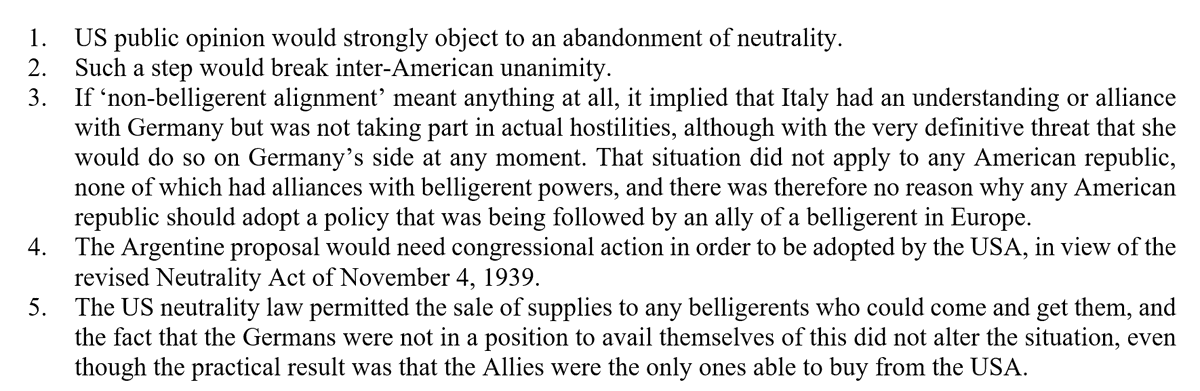
to the effect that ARG & USA -&possibly other American republics – abandon neutrality to side with the Allies without actually becoming belligerents, much in the same way as Italy sided with Germany but did not yet participate in the war. The US reply consisted of five points:
. 
Deplorable developments were to follow. On May 10 it was known that the ARG proposal had been leaked to the press. Though efforts were made in Washington & BA to avoid publication, by May 12 an article marked ‘special’ from Washington bearing the news was published in La Nación.
The ARG govt attributed responsibility for the leak to Washington. By May 13 the ARG govt felt a press statement had to be issued acknowledging the ARG initiative on the subject.
The leak had catastrophic consequences within ARG. To some Argentines, the abandonment of neutrality
The leak had catastrophic consequences within ARG. To some Argentines, the abandonment of neutrality
would have been a betrayal of the principles and traditions of ARG foreign policy. Nationalist elements issued posters demanding Cantilo’s resignation. On May18 President Ortiz issued a press statement saying that ARG maintained ‘the strictest impartiality’ in the continuing war
Ortiz and Cantilo began to lose power, a process that was made more acute when President Roosevelt made a speech in 06/1940 at Charlottesville, Virginia, stating that the extension of material resources to Britain and France was a prime US objective.
This was no less & no more than the ‘non-belligerence’ ARG had suggested, yet not only had ARG been previously rebuffed, but Roosevelt had actually set forth publicly non-belligerence as the official policy of US, without an act of Congress, and w/o even a passing reference...
to the ARG initiative. Roosevelt’s attitude was not only an unintentional blow to ARG foreign policy generally, but also to Ortiz&Cantilo personally & the ideals for which they stood, making an ARG rupture with the Axis due to US pressures after the US entry into the war close..
to politically impossible, considering the importance that an independent foreign policy had in ARG’s political culture. Naturally, it would be naive to suggest that the US should have followed ARG’s lead on such an important issue.
I only point to the fact that given the characteristics of ARG’s political culture, it was not likely that she would follow the USA lead after this rebuff.
After Pearl Harbor, US rhetoric would abound with references to the Fascist Menace from Argentina.
After Pearl Harbor, US rhetoric would abound with references to the Fascist Menace from Argentina.
These views of ARG coincide with neither the British, German, nor Italian views. Nevertheless, they molded US policy, which embarked on an unrelenting and forceful public and private political bombardment of ARG’s constitutional govt….
Internally, US policy was justified with claims as far fetched as the pretension that if left alone, ARG would produce the 3rd World War: this extravagant assertion was made by Secretary of State Hull, Vice-President Wallace, Secretary of the Treasury Morgenthau &, later, Braden
@guarlors @ponto_esteban @ecres70 @conurbanensis @MartinSchapiro_ @marmuniz07 @manolo_gonzalo
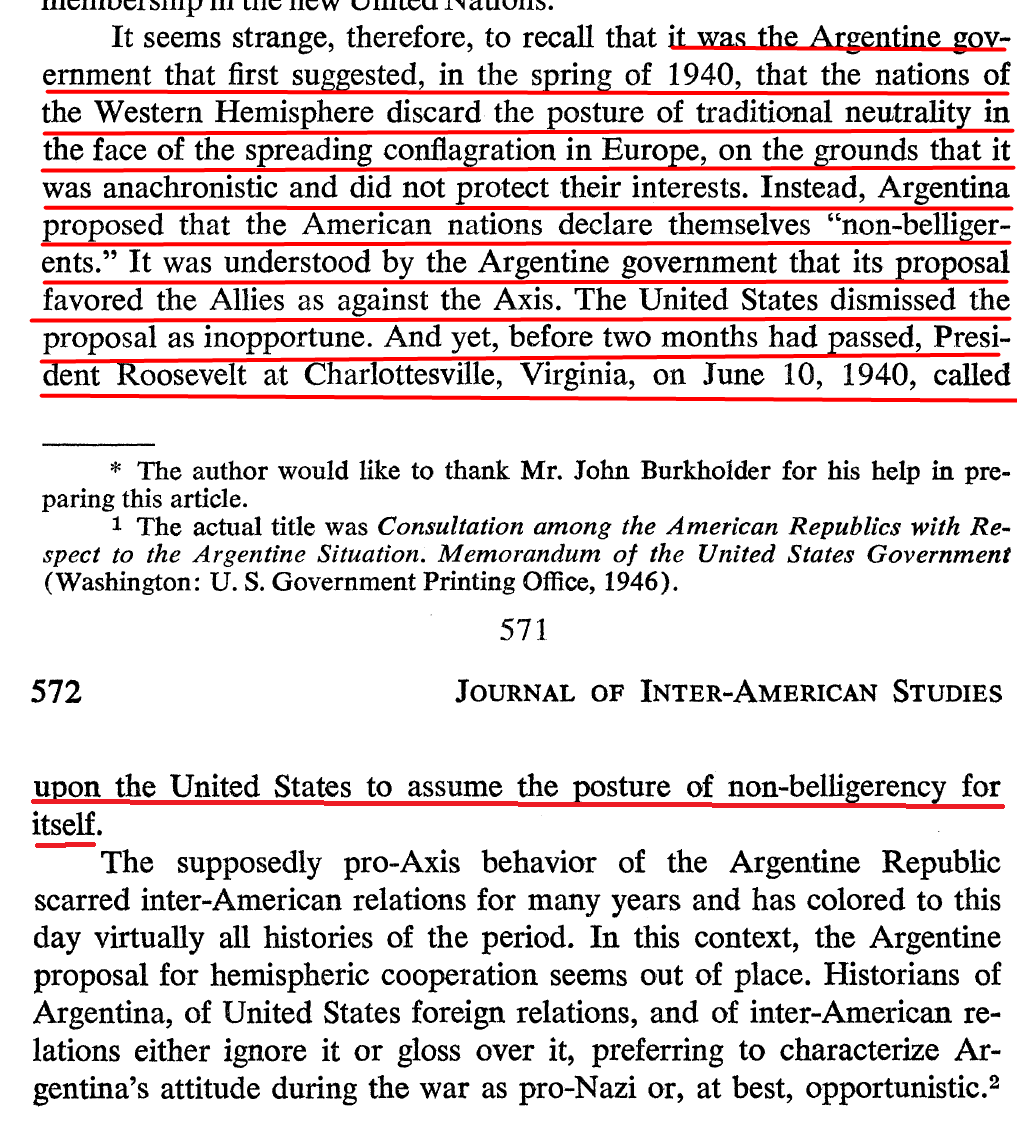
Acá un paper de 1969:
Tulchin, Joseph - The Argentine 'non-belligerent' proposal of 1940
Tulchin, Joseph - The Argentine 'non-belligerent' proposal of 1940
De yapa. Un hilo con las opiniones del embajador británico de la época:
https://x.com/edgardochacal/status/1759537990202687836?s=20
@threadreaderapp compile
@threadreaderapp compile
• • •
Missing some Tweet in this thread? You can try to
force a refresh