Ethereum 101 —
I’ve been exploring Ethereum (and buying, for full disclosure).
This is a plain-english recap of the very basics, to test my learning! (and maybe a frustrating oversimplification for the experts)
I’ve been exploring Ethereum (and buying, for full disclosure).
This is a plain-english recap of the very basics, to test my learning! (and maybe a frustrating oversimplification for the experts)
Bitcoin was the first blockchain. Every blockchain has a cryptocurrency. Bitcoin’s cryptocurrency is named bitcoin. (Lowercase) or $BTC
Bitcoin showed us what blockchains could do, so people started creating new blockchains, separate from Bitcoin.
Ethereum is one of those new blockchains. It has a cryptocurrency called Ether or $ETH
Ethereum is one of those new blockchains. It has a cryptocurrency called Ether or $ETH
Unlike Bitcoin, Ethereum has a complete programming language inside it, so programmers can write code and make apps on Ethereum.
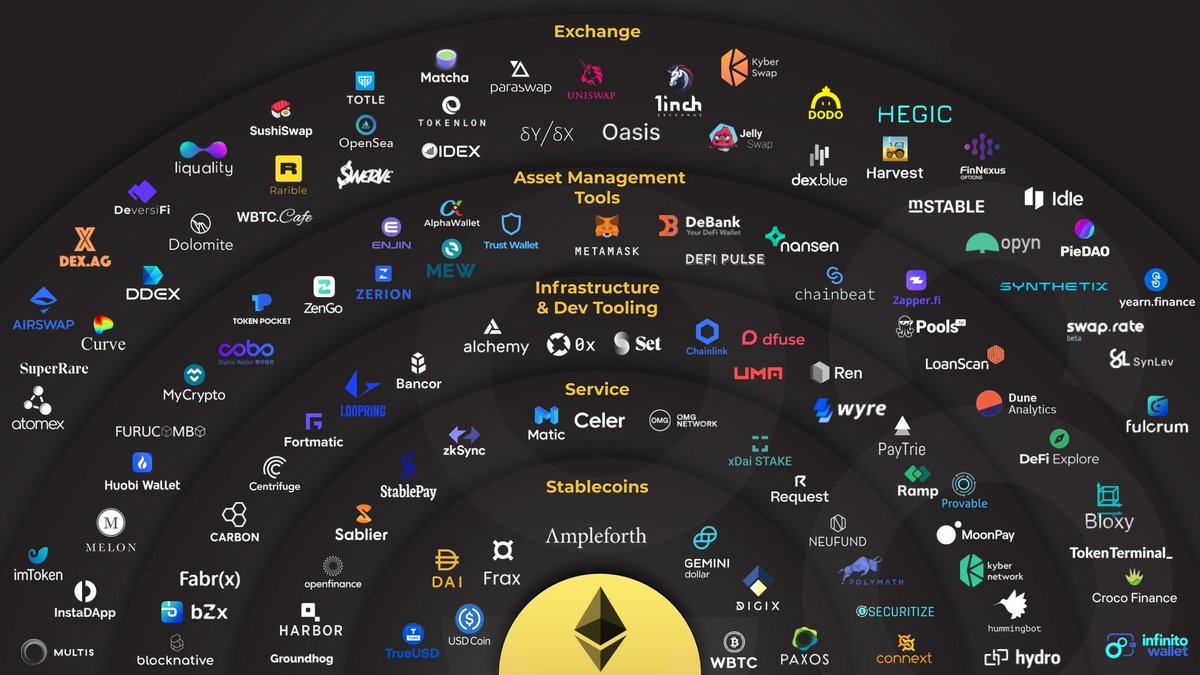
Ethereum is like a giant distributed computer. Rather than running an app on Amazon Web Services’s servers, developers can use Ethereum.
(Image via @draecomino)
(Image via @draecomino)

Apps run on Ethereum are secure from hackers, because the blockchain ensures data stored in the app cannot be changed.
The combination of perfect security with executable code has created “Smart Contracts” and lead to many new kinds of apps.
“Smart Contracts” are like having a robot lawyer live in a computer. This robot lawyer can observe, validate, and execute agreements between total strangers perfectly, cheaply, millions of times per day.
With Ethereum, for the first time, you can trade with someone you don’t know or trust — IF you both agree to the code (Smart Contract) that determines your agreement.
If this isn’t an “oh shit!” moment, think about how much time, energy, and money we spend on preventing fraud, protecting ourselves, achieving trust, or recouping losses.
Examples of trust as a primary value driver:
- Lawyers
- Car Titles
- Property Titles
- Insurance
- Banks
- Credit Cards
and, trust is the foundation of the value of many Brands.
- Lawyers
- Car Titles
- Property Titles
- Insurance
- Banks
- Credit Cards
and, trust is the foundation of the value of many Brands.
Want to buy art, insurance, domain names, stock, tickets, music rights, cars, digital files… without worrying about getting scammed?
It’ll happen on Ethereum.
It’ll happen on Ethereum.
The code for Ethereum is written by a self-organizing group of volunteers, who openly share the ideas, the rules, and the code so the community can verify and validate.
The radical vision is that much of the trust we currently place in Governments and Banks would be better-placed in visible code created by this open community.
Anyone can be a part of the Ethereum movement by owning Eth, contributing to Ethereum, or building and using decentralized apps.
Ways to dive deeper:
- Start reading from the @BanklessHQ intro: newsletter.banklesshq.com/p/-guide-1-sta…
- Buy ETH on Coinbase: coinbase.com/join/jorgen_1q
- Read/Contribute to Developer conversations on GH: github.com/ethereum/EIPs/…
- Read the Whitepaper: ethereum.org/en/whitepaper/
- Start reading from the @BanklessHQ intro: newsletter.banklesshq.com/p/-guide-1-sta…
- Buy ETH on Coinbase: coinbase.com/join/jorgen_1q
- Read/Contribute to Developer conversations on GH: github.com/ethereum/EIPs/…
- Read the Whitepaper: ethereum.org/en/whitepaper/
Learn more about Cryptocurrencies and Blockchain generally from my edit of @naval’s best blockchain explanations: navalmanack.com/secret-section…
(This is where I got my first deep-dive!)
(This is where I got my first deep-dive!)
To build deep fluency, start with an online course about blockchain...
We pulled the top 100 blockchain courses for beginners from @udemy and sorted them by best-reviewed:
coursecorrectly.com/100-highest-ra…
We pulled the top 100 blockchain courses for beginners from @udemy and sorted them by best-reviewed:
coursecorrectly.com/100-highest-ra…
For posterity, google, and the non-twitter people in your life I put this thread into a blog post on my site:
ejorgenson.com/blog/ethereum-…
ejorgenson.com/blog/ethereum-…
Took a closer look at top blockchain development courses with @jesse_l_powers and we picked out the 5 most promising. Shown here including Table of Contents, instructor background, length, and pricing:
coursecorrectly.com/the-three-best…
Feat. @dkcodehelper @ste_grider and more!
coursecorrectly.com/the-three-best…
Feat. @dkcodehelper @ste_grider and more!
• • •
Missing some Tweet in this thread? You can try to
force a refresh