
Planning your geography KS3 curriculum? I’ve made a thread of the decisions we made and why we made them. I hope it helps!
The first stage was to evaluate what we already had and work out what the limitations were: perhaps we already had the perfect curriculum?! #geogchat
The first stage was to evaluate what we already had and work out what the limitations were: perhaps we already had the perfect curriculum?! #geogchat
Previously we had three overall themes: My World, Watery World and Threatened World in each of Years 7, 8 and 9. This developed an idea so we could make links from one year to the next e.g., Watery World: Rivers; Coasts then Cold Environments.
Issues: 1 Students didn’t revisit Rivers after Yr 7 -could remember little in GCSE and needed to be re-taught. 2 Students new to the school in Yr 8 may NEVER learn about rivers. 3 Each unit became a mini GCSE topic–processes, landforms, case studies: students weren’t making links
We have taken a continent-by-continent approach to teaching – with 4 main Qs: 1) What geography MUST students learn? 2) What geog do they learn if they ONLY arrive in Year 9? 3) How do we build up knowledge, understanding + skills? 4) How could we make links to be truly synoptic?
The continents naturally fell in order in terms of the main themes we could explore: Europe – about the local context; Africa – allowing an introduction to population, development, ecosystems should come in Year 7. Through to Year 9: Asia – focusing on development and geopolitics
In the summer term, we decided to focus on the local area to be able to compare to what they had learnt about the continents, but with a different theme each year: Local Area Change; Local Area Risks; Local Area Compared.
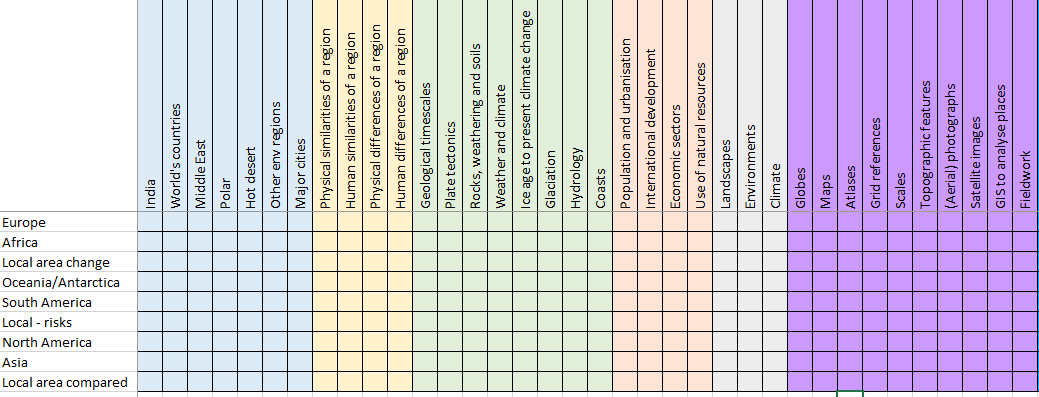
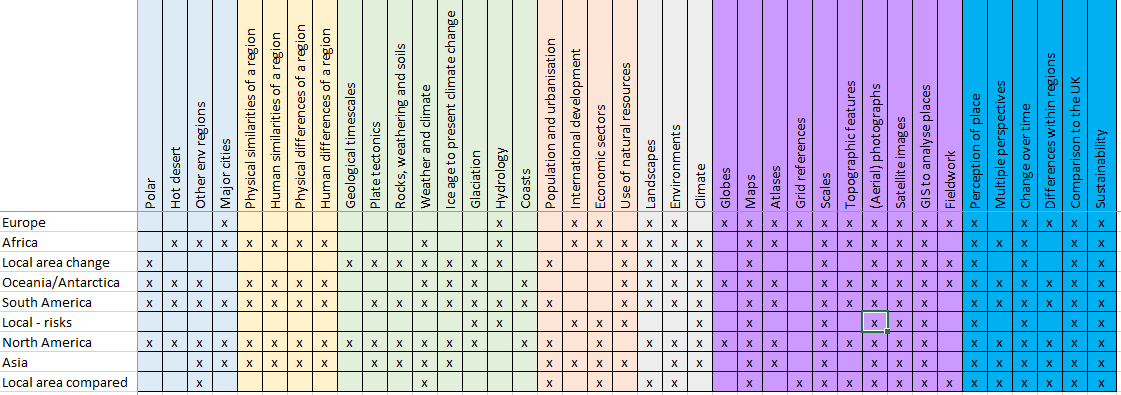
The National Curriculum was our starting point – how could we make sure that we were covering all of the elements for KS3 geography – was there obvious essential Geog that should be taught? Some fell into place (e.g., Oceania+coasts; North America+plate tectonics) straight away. 
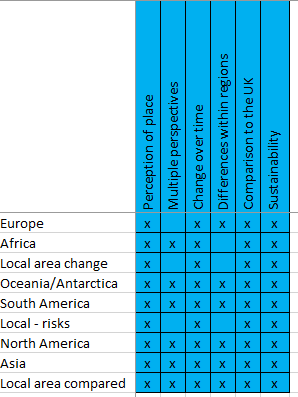
We felt that some elements were missing from the National Curriculum in terms of what we felt was essential geography: perception of places; multiple perspectives; changes over time; differences between regions; comparison to the UK; sustainability – so these were also added.
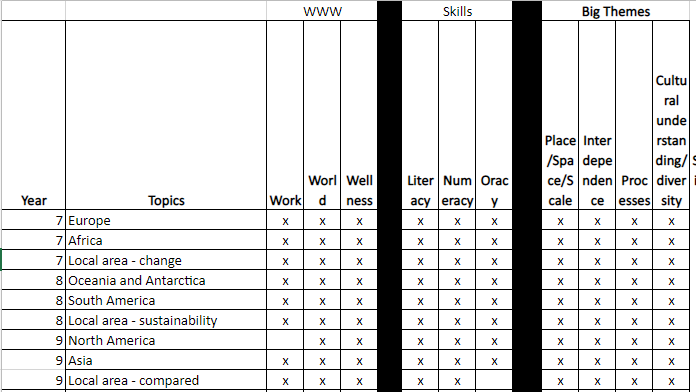
We also mapped our content to the concepts of place; space; scale; physical and human processes; environmental interactions and sustainability; cultural understanding and diversity – all schemes of work should have these elements to them.
It was crucial that students know that they are on a continuous journey through KS3. We re-branded all Powerpoints and resources (which continues through into A level geography) for consistency. Exercise books roll over into the following year (which also saves a LOT of money!)
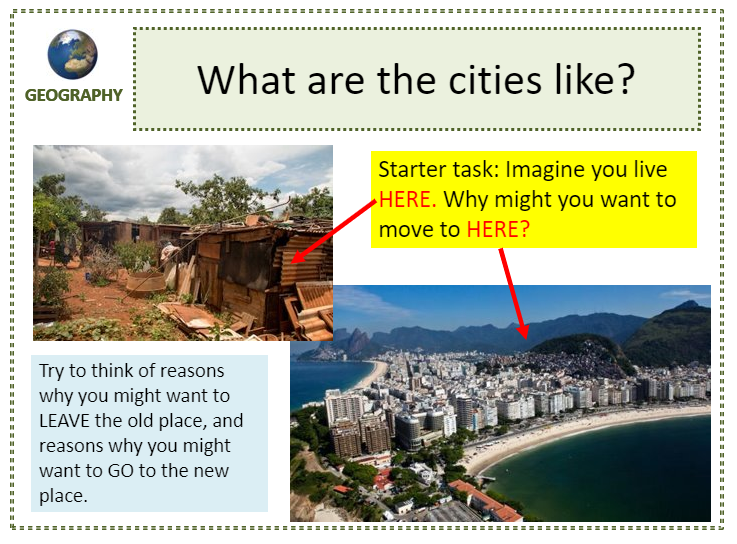
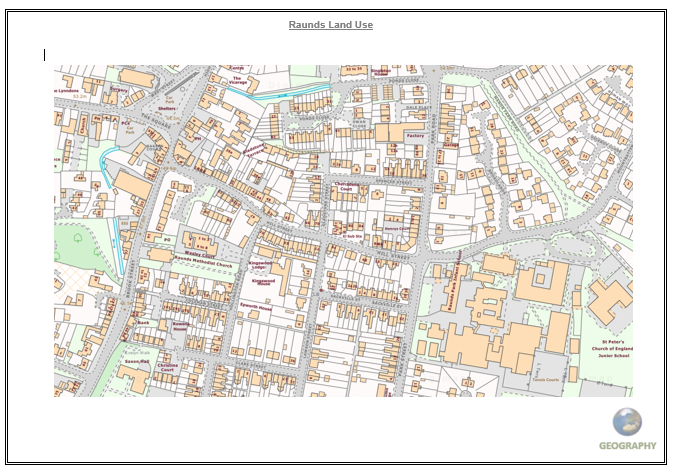
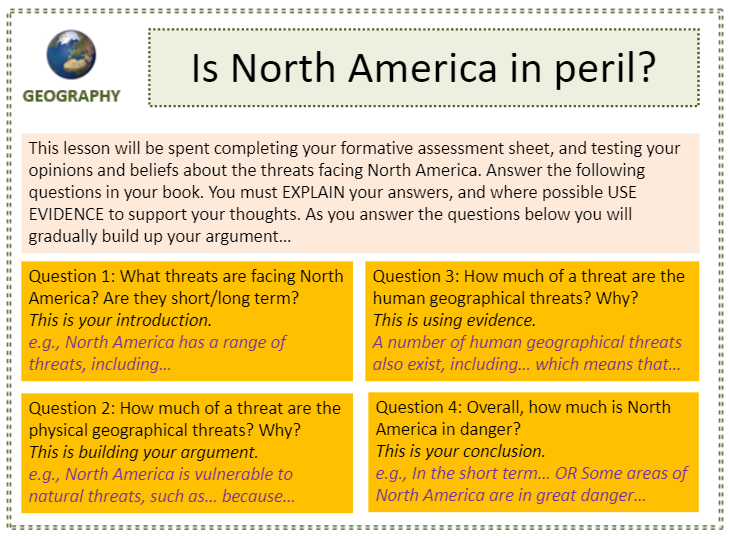
Each continent has an over-arching question which we keep re-visiting throughout the scheme of work. E.g., North America: Is this a continent in peril? Asia: Is this the continent of the future? This has helped students realise the purpose of the lessons
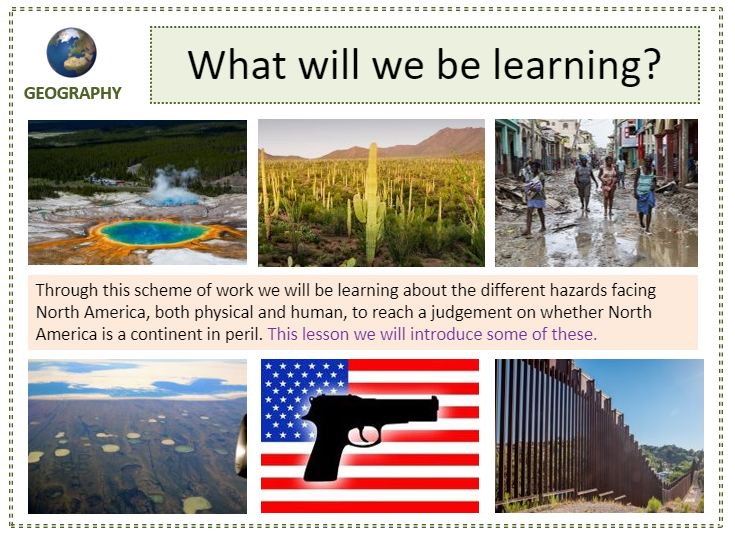
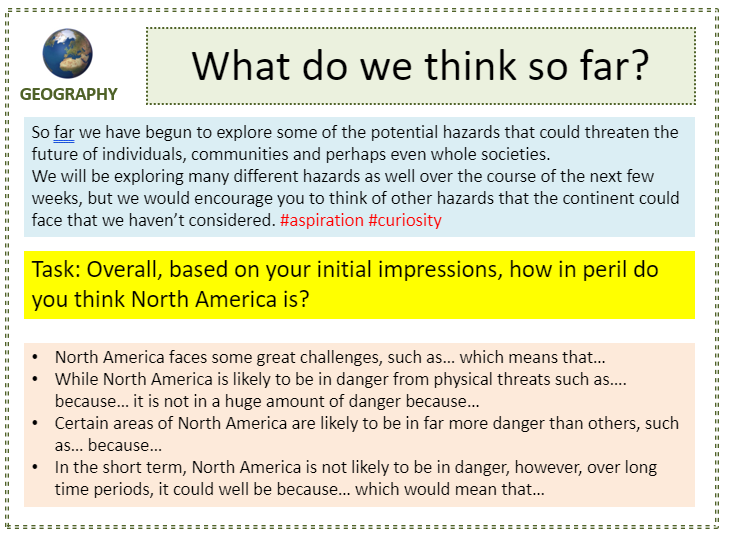
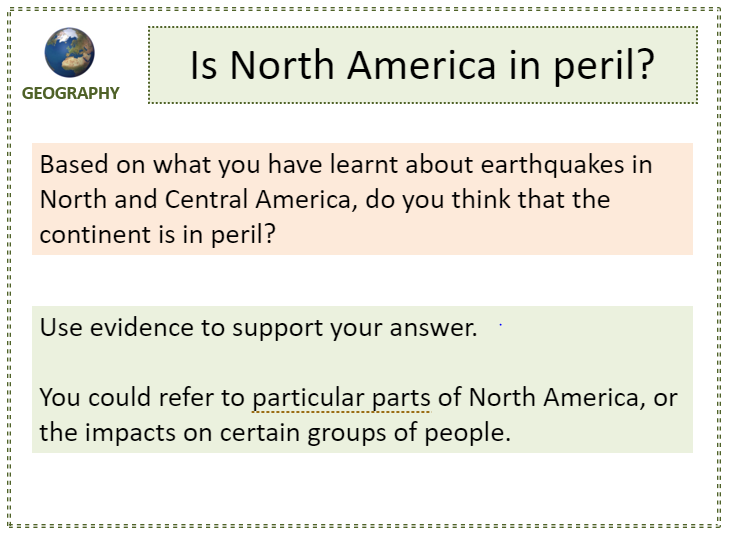
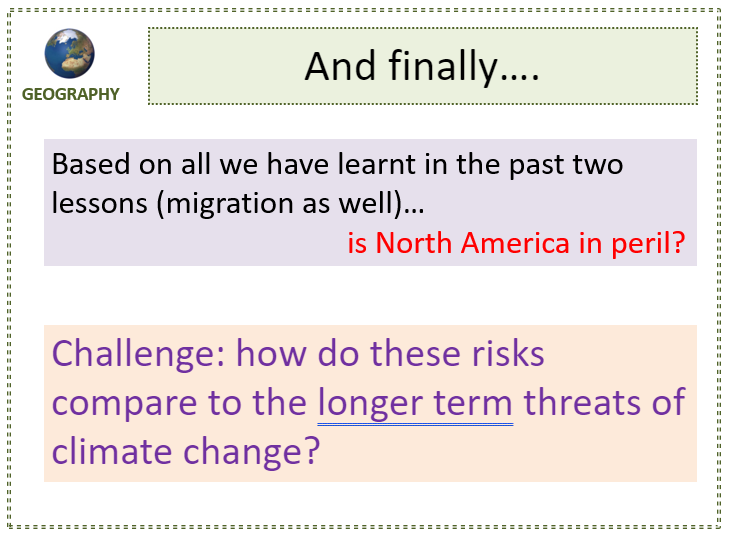
Every lesson starts with an over-arching question, and one challenging objective, and shows how learning is built into previous and future learning.
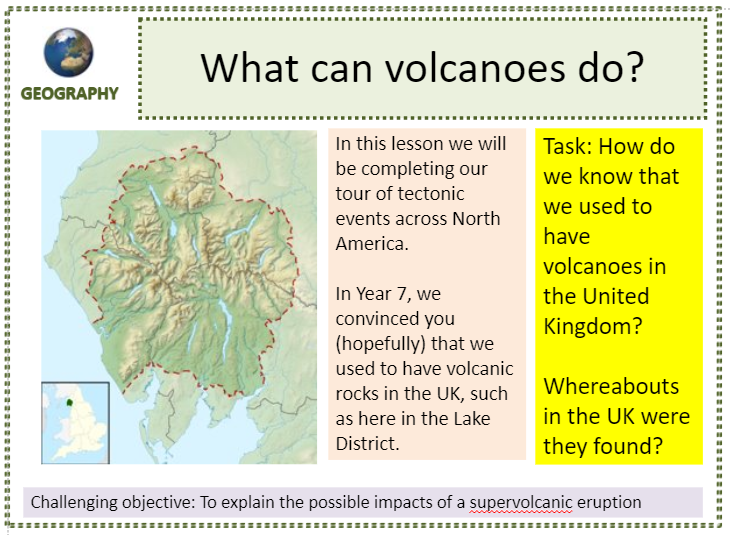
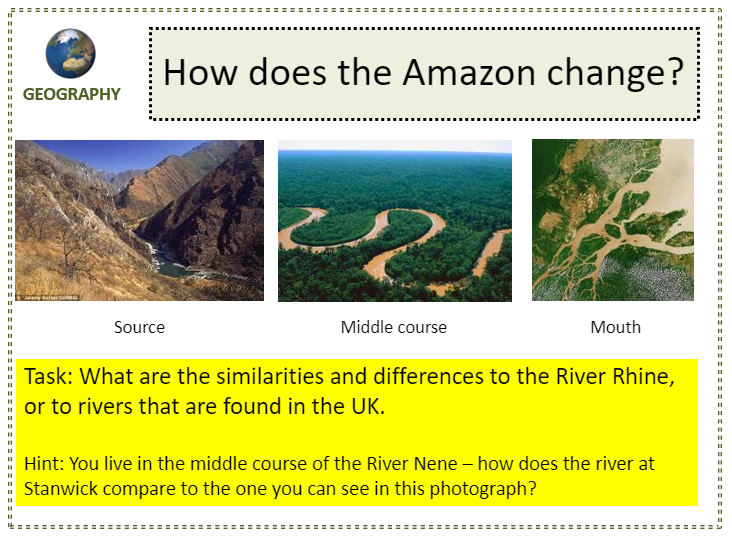
Using Making Every Geography Lesson Count we have focused on ensuring that Challenge, Questioning, Explanation, Modelling and Deliberate Practice are explicit in the resources and SoW. E.g., Deliberate Practice is ALWAYS in a yellow box. Modelling is on Word documents/PPTs.
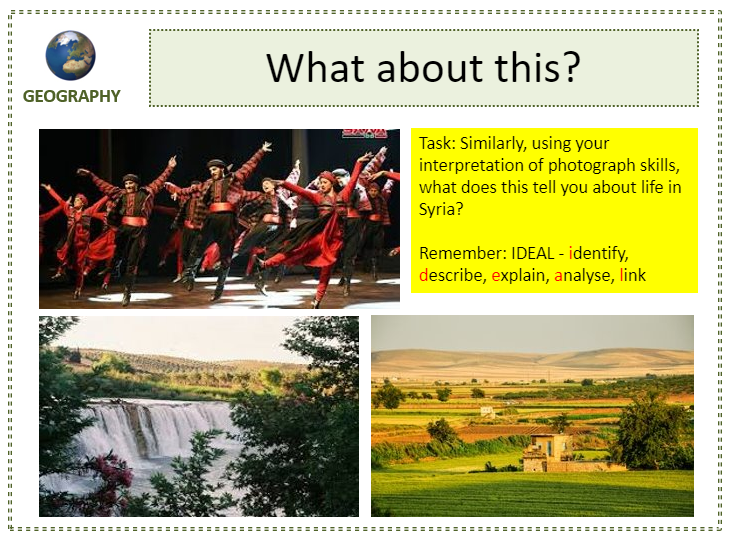
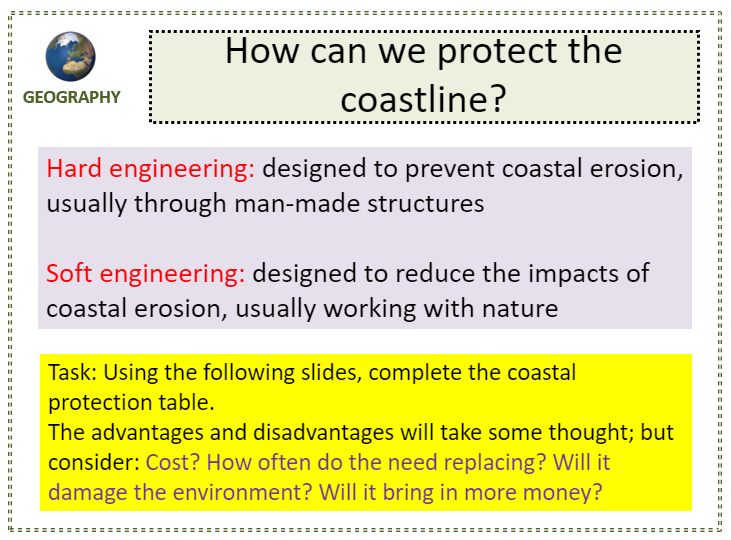
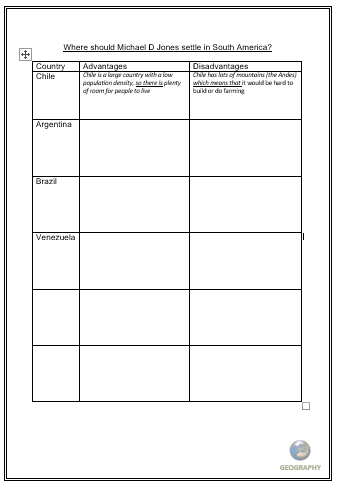
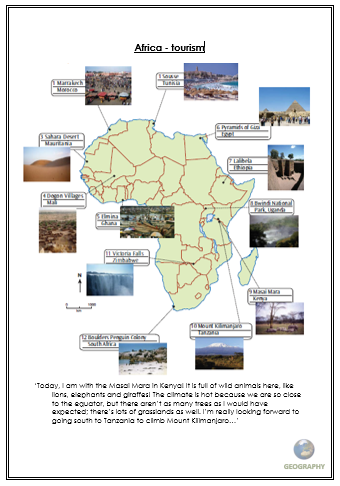
Feedback/Assessment: Each year we have two 25-mark assessments. They are designed to become more challenging from Year 7 to Year 9. They also test knowledge and understanding from previous years: it’s a 3 year geography course; not separate years where students forget content.
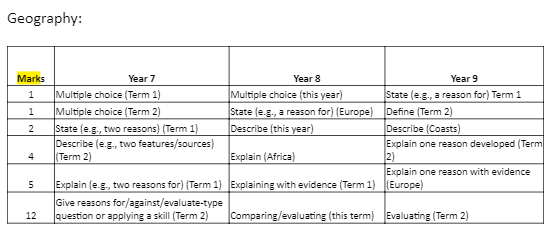
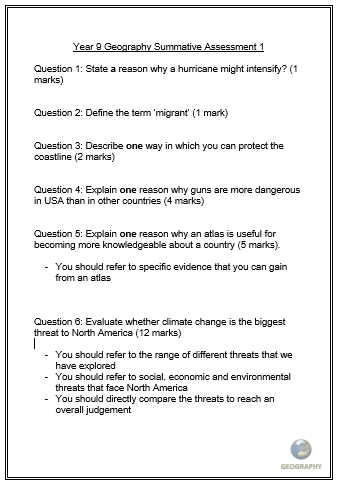
These two assessments are the ONLY physical written marking of work that we do. Workload-wise this has been revolutionary and has given us the time and space to focus on planning lessons and improving resources.
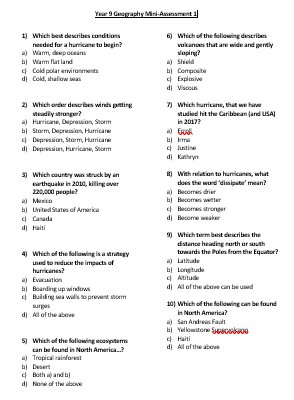
Elsewhere, students complete a self-marked 10 mark quiz within a unit of work. This is low-stakes and used as strategy to help us identify gaps in knowledge and understanding. Students can also recognise where they need to improve.
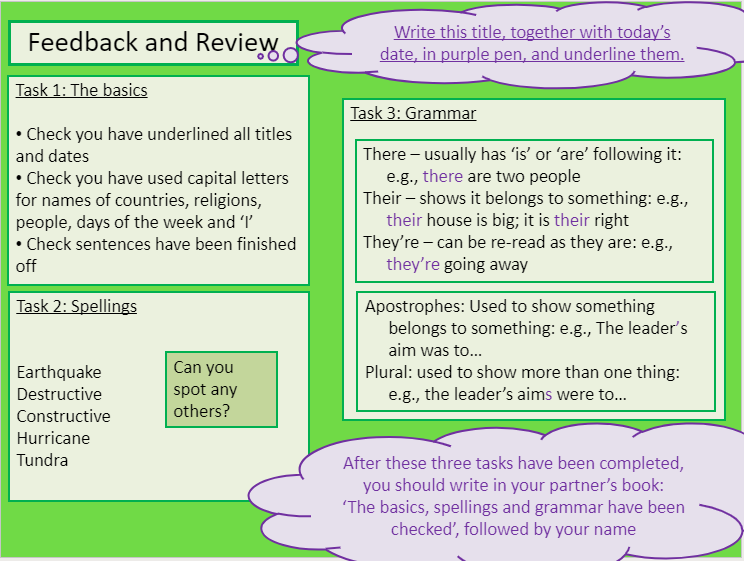
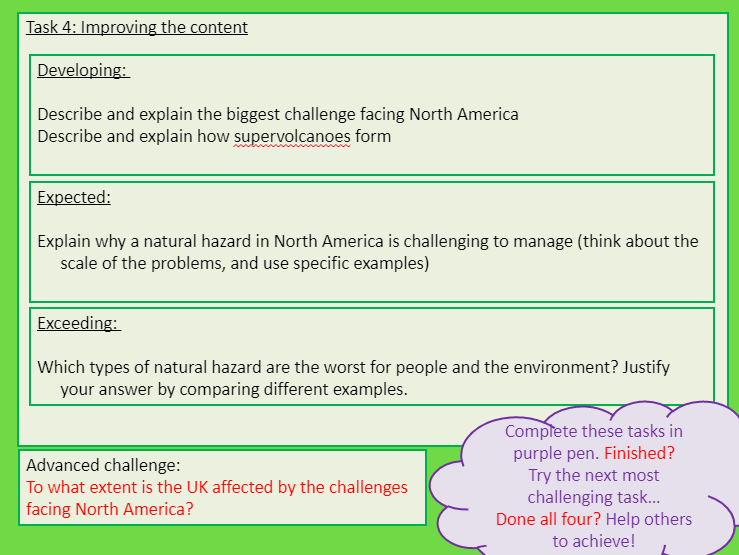
Within schemes of work, students improve their own work independently, using tasks based on common issues found within the class, tailored to that particular class. Students now have far more ownership of their work, and not reliant on us identifying each and every mistake.
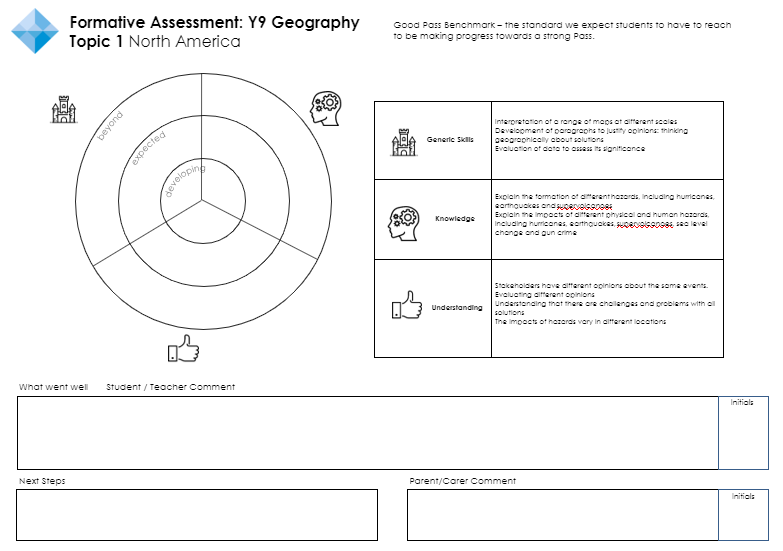
Formative sheets are completed after each unit of work (the radar completed by the teacher); the comments by the student, and checked by the teacher within a lesson. Tasks are set during this lesson to focus on extended writing to allow time for this, and to help individuals
Where are we now? 1) Staff and students are clear on how knowledge builds through the years. 2) Knowledge is much more purposeful, targeted to places and ‘real’ rather than theoretical examples. 3) Students ask far more interested in what they are learning.
Other things: For our school, #workworldwellness underpins our curriculum – where there are clear and obvious links to these areas, they are identified and made explicit to students: it’s about students being employable, have a positive view of the world, happy and healthy.
Next steps: 1) Reviewing the SoW to identify where we feel there are gaps in knowledge, understanding and skills within the geography schemes of work. 2) Excitingly, developing links between subjects to develop schema is the next big phase for the school and deepen understanding.
Anyway, that’s a brief intro to what we have done and where we are going. Any questions, feel free to DM/e-mail me at jandrews@manor.school. I have seen others with similar approaches – if you’ve had fantastic ideas that have worked for your school, please let me know!
As is the way... meant to add in the completed NC grid - there are still some areas that I think need developing (e.g., grid references is too weak).
Plus, the other Q we asked was about what knowledge from A level/beyond could we 'bring down' to KS3
Plus, the other Q we asked was about what knowledge from A level/beyond could we 'bring down' to KS3
• • •
Missing some Tweet in this thread? You can try to
force a refresh




