New details of the Czech arms depot explosion in 2014 from Bellingcat, including details of a senior GRU leader's direct involvement, and details of other team members involved bellingcat.com/uncategorized/…
Bellingcat has established that the GRU operation which Czech authorities have linked to the explosion of the munition depot in Vrbetice on 16 October 2014, involved at least six operatives from GRU’s Unit 29155.
It was supervised personally by its commander, Col. Gen. Andrey Averyanov, a senior deputy to the head of the GRU, who traveled undercover to Central Europe at the exact time of the operation and left back to Moscow mere hours after the explosion.
This was one of only two known clandestine operations for which Gen. Averyanov has personally traveled abroad, indicating the significance of this subversive mission for the Russian government.
Gen. Andrey Averyanov is a high ranking military official who, based on telephone call records reviewed by Bellingcat, has a direct line of communication to both the chief of the GRU chief and to the Kremlin.
The operation also involved at least two GRU officers who traveled under diplomatic cover to Budapest, a roughly five hour drive from the munitions depot, shortly before the explosions.
Notably, at least one of the same diplomats traveled to a region within a similar range of Bulgaria’s capital several months later, during the days that Emilian Gebrev (pictured below) was poisoned with a chemical weapon by the members of the same GRU unit.
Travel data discovered by Bellingcat also points to the fact that the operation was initially likely planned for an earlier date, but was postponed by about one week due to unknown circumstances.
The operation appears to have involved several coordinated trips of members of unit 29155 to Czechia via neighbouring countries, as well as a preparation mission in Switzerland. More details to come later this week.
• • •
Missing some Tweet in this thread? You can try to
force a refresh

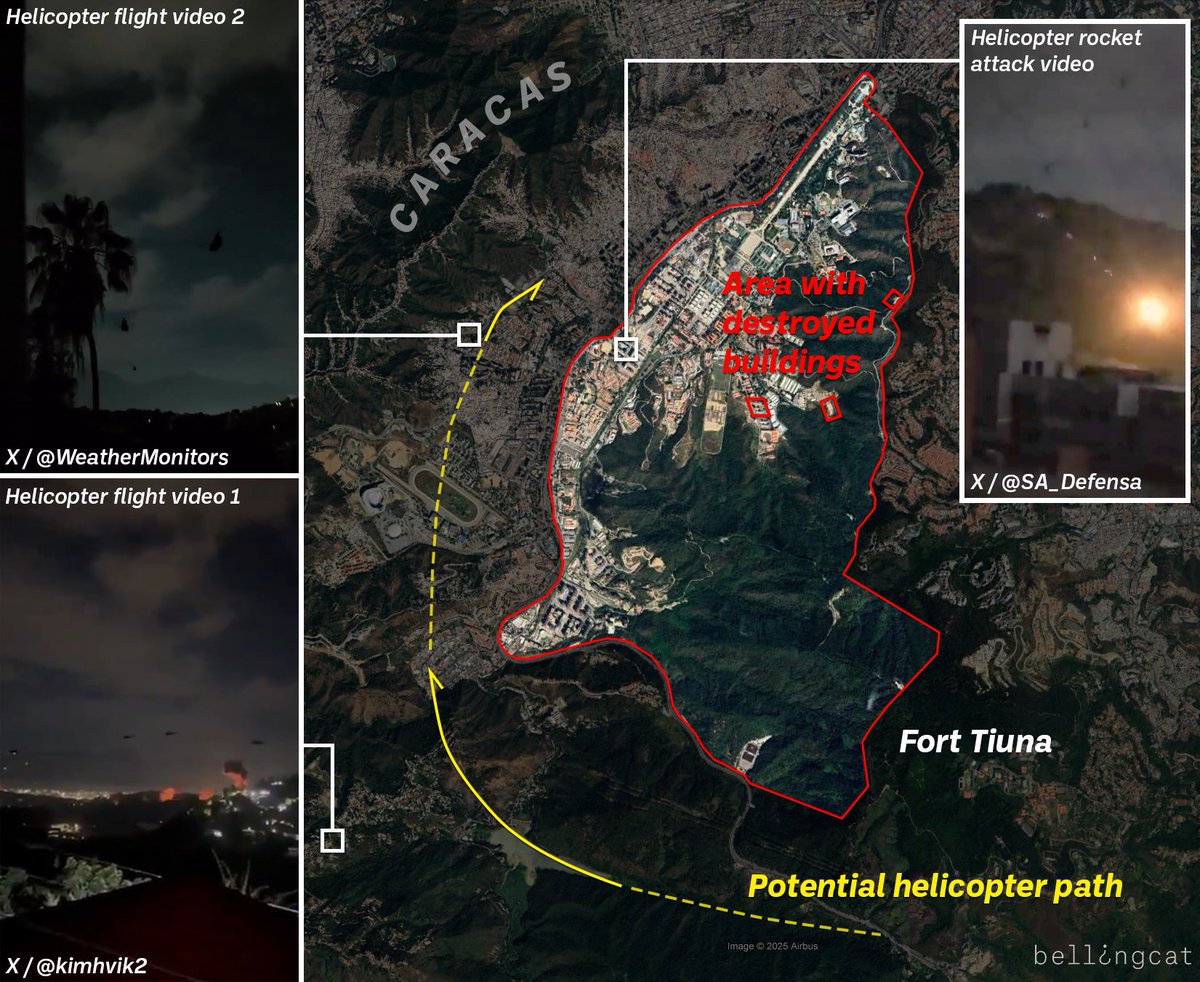
The US military conducted an operation on Jan 3 to capture President Nicolás Maduro of Venezuela. Bellingcat geolocated videos of helicopters involved in the raid, piecing together potential movements of the assault force
The operation included air strikes targeting military sites, and a raid at Maduro’s residence inside Fort Tiuna in Caracas. In addition to armed helicopters, jets and drones provided cover for the assault force, according to the US military.
One video shows what appears to be 9 helicopters, including 7 Blackhawks and 2 Chinooks, flying in formation in the Fort Tiuna area as explosions occur. tiktok.com/@ceciarmy/vide…
Bellingcat’s work in 2025 verified war crimes, exposed deepfake abuse, and challenged disinformation. We want to uncover wrongdoing. We can with your support:
This is how we cut through the digital noise to tell stories that matter. bellingcat.com/donate
We've reported on conflicts around the world — from Myanmar to Gaza, Sudan to the DR Congo, Ukraine and beyond — verifying footage of war crimes, human-rights abuses and attacks on civilians. Read our latest on the reconstruction of Mariupol: bellingcat.com/news/europe/20…
In May we identified the person behind MrDeepfakes — one of the largest providers of non-consensual deepfake pornography. The platform was shut down after the investigation, and politicians from two European countries called for the extradition of its owner. bellingcat.com/news/2025/05/0…
An investigation by Bellingcat and @LloydsList found that Saudi Arabia joined the countries importing grain directly from a sanctioned port in occupied Crimea. Meanwhile Russia attempts to secure recognition of the Ukrainian territory via a US-led peace plan. bellingcat.com/news/2025/12/1…
Using Satellite imagery and Automated Identification System (AIS) data from Lloyd’s List Intelligence we show that a Russian owned bulk carrier sailed from Sevastopol to Saudi Arabia twice in recent months.
On both journeys, the ship turned off its AIS location data, hiding its presence in the port of Sevastopol. But satellite imagery confirms the ship was present at the port’s grain terminal. Satellite imagery: @vantortech
Russian state media are today alleging that a Bellingcat reporter was involved in an attempt to hijack a Russian fighter plane.
We would like to make clear that Bellingcat had absolutely no involvement in the alleged activities and the accusations towards us are entirely false.
The individual detailed in Russian media as a Bellingcat reporter has never worked for us in any capacity and we do not know who they are.
The picture and name in the press pass published in RU media does not depict any of our staff members or contributors. If they exist, we are unaware of them ever engaging with us.
The press pass is also not remotely like any Bellingcat ID or documentation.
The largest aid flotilla in history has been attacked twice in two days whilst in port in Tunisia. Open source analysis suggests an incendiary munition is to blame, contradicting official statements. bellingcat.com/news/2025/09/1…
On September 8 the main vessel in the flotilla, known as ‘the Family’ was struck by what witnesses claimed was a drone. Caught on another boat's camera, a flaming object had fallen onto the Family Boat from above.
Tunisian officials stated that there was “no evidence of any hostile act or external targeting”, claiming the resulting fire was due to “a lighter or cigarette butt”.
A new report by Bellingcat’s Justice & Accountability (J&A) Unit and @GLAN_LAW detailing the use of cluster munitions in civilian areas in Kharkiv at the beginning of the full-scale Russian invasion of Ukraine is published today. j-and-a.glanlaw.org/kharkiv
The report is based on 32 in-depth investigations of separate incidents that took place between February and April 2022. It offers one of the most detailed looks yet at the use of cluster munitions against civilian areas in the early stages of Russia’s full scale invasion.
Bellingcat’s J&A Unit worked on this report as a self-contained entity separated (‘firewalled’) from the rest of Bellingcat, ensuring that accountability work was conducted independently from other investigations, preventing possible bias.