1. The "no-vaxxers" never thought the pandemic was a serious threat to them, and they resent the idea that they need a pharmaceutical intervention to get back to a normal life that they never wanted to stop living.
2. Many people I spoke to said they had already tested positive for COVID and felt confident in their natural immunity.
(Since this group took fewer precautions last year, it would make sense that a higher-than-avg share of them would have antibodies.)
3. As they don't perceive a high risk from the pandemic, they regularly emphasize the downsides of the vaccines. They'll say the shots were rushed by corporate firms they don't trust, and that they're "authorized for an emergency" that is overblown.
4. They've come to really, really hate the Democratic-liberal-public-health nexus and have decided that they're better off doing the opposite of whatever that group says.
In a nutshell, I'd say this is the "deep story" of American vaccine refusal:
"I trust my own cells over a Big Pharma experiment. I trust my mind over liberal elites."
That position correlates with politics (see graph); but it's not explicitly a political position.
So, how do we persuade the no-vaxxers? Here are three ideas.
1. Make it suck more to not be vaccinated.
Some states (eg, MI) are linking re-openings to vaccine thresholds. This sort of soft bribery might work, but it's highly flammable cultural war kindling.
2. What if: DoorDash for vaccines?
It's pretty easy and great to get vaccinated. But we could make it even easier and greater. Some vax hesitancy might dissipate if state health depts offered rewards, or a free-delivery vaccine service to ppl's homes.
3. Consider the lives of strangers.
The most effective line in my conversations with no-vaxxers was something like: "Your immune system might be good enough for you; but in a world of variants, the vaccines are better at protecting others."
Shaming the no-vaxxers won't change anybody's mind. Our focus should instead be on making vaccinations even easier and on broadening the no-vaxxers' circles of care: "Your cells might be good enough for you; the shots are better for others."
New newsletter: MODERN FATHERHOOD WOULD BE UNRECOGNIZABLE TO A 1950'S DAD
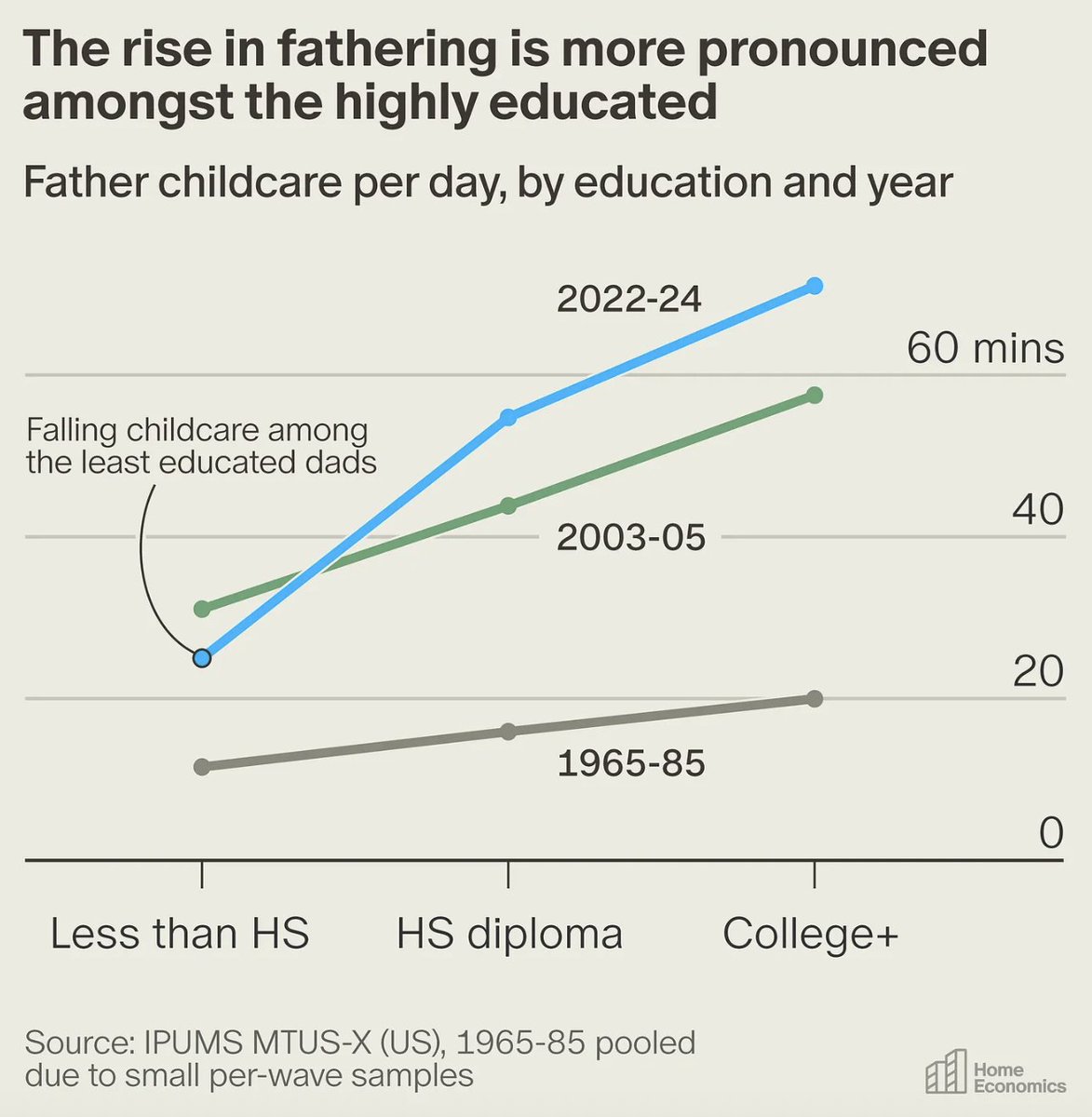
Compared to their Boomer parents, childcare time among Millennial dads has more than doubled.
Compared to their Silent Generation grandparents, it’s nearly quadrupled.
You will be hard-pressed to find any part of day-to-day modern life that has changed more in the last half-century than the way today’s parents—and fathers, in particular—spend their time.
The new American dad is more present and more exhausted—but also, more satisfied with life. What's behind this half-century transformation? Today's piece combines history, economic analysis, and gorgeous charts galore from @AzizSunderji
I think this chart might be my favorite, because it reveals at least two telling things about modern parenthood.
1. One reason father childcare time has increased so much in the last half century is that after the rise of the dual-earner household post-1960, many dads who took on more childcare realized that ... it was kinda nice? That they even ... liked their kids!?
2. But this fact is inseparable from another fact, which is that mothers' childcare time has also increased significantly, and moms consistently take on less fun parenting tasks, like planning, coordinating, and solo parenting.
As a result, there is now a rather linear relationship between the fun-ness of a parenting task and the likelihood that dad does more of it.
Full story here
Oh, and before you scream at me that I missed something, just please do me the favor of clicking on the article to control-F search whatever term you want to fight about, just to make sure I didn't already say the thing :)derekthompson.org/p/why-do-riche…
Given the reception to yesterday's podcast and post, I’m publishing the transcript of my 37-minute weekend conversation with Zohran Mamdani.
What I liked: He’s a charismatic person who handles criticism well and insists that, in his words, “I care most about outcomes,” not ideology—which demonstrates, if nothing else, exquisitely well-targeted political rhetoric.
What I didn’t quite like: Mamdani’s views on housing and policing have moderated in the last few years, but I think his policy instinct to solve every problem with costly state price regulation (rent freezes, $60 million public grocery stores) is a bad fit for a high-tax city that already spends more per capita than anywhere else in America
What I don’t know: Is he a good executive? Can he manage people and systems? Will he surround himself with smart ppl who check his worst instincts (every problem —> price regulation, costly new state initiative) and feed his best ones (charisma, curiosity, commitment to public excellence)?
The share of elite MBA grads still looking for work 3+ months after graduation is up sharply at practically every high-ranking school.
The traditional elite-MBA absorption process—1) Get degree; 2) Glide path to Big Tech/Consulting—seems disrupted.
This is such a narrow and specific statistic that I don't think it's wise to draw confident big-picture conclusions from it, but ...
My not-so-confident big-picture conclusion is that the combination of GenAI (both its absurd capex costs and its facility with amplifying white-collar work) and a wildly uncertain policy environment heading into Trump Era 2.0 is pinching hiring at big white-collar firms mindful of their profit margins
Plus: The overall hiring rate has been steadily declining now for like three years
I wrote the cover story of the February issue of The Atlantic. It builds on a lot of reporting I did throughout 2024, and I'm really proud of it.
It’s called: THE ANTI-SOCIAL CENTURY
The thesis: Rising solitude is the most important social fact in American life today. The historic amounts of time that Americans spend alone and in their homes is reshaping the consumer economy—from dining to entertainment to delivery—warping our politics, alienating us from the realities of our neighbors and villages, and changing our very personalities.
Here are the basic facts:
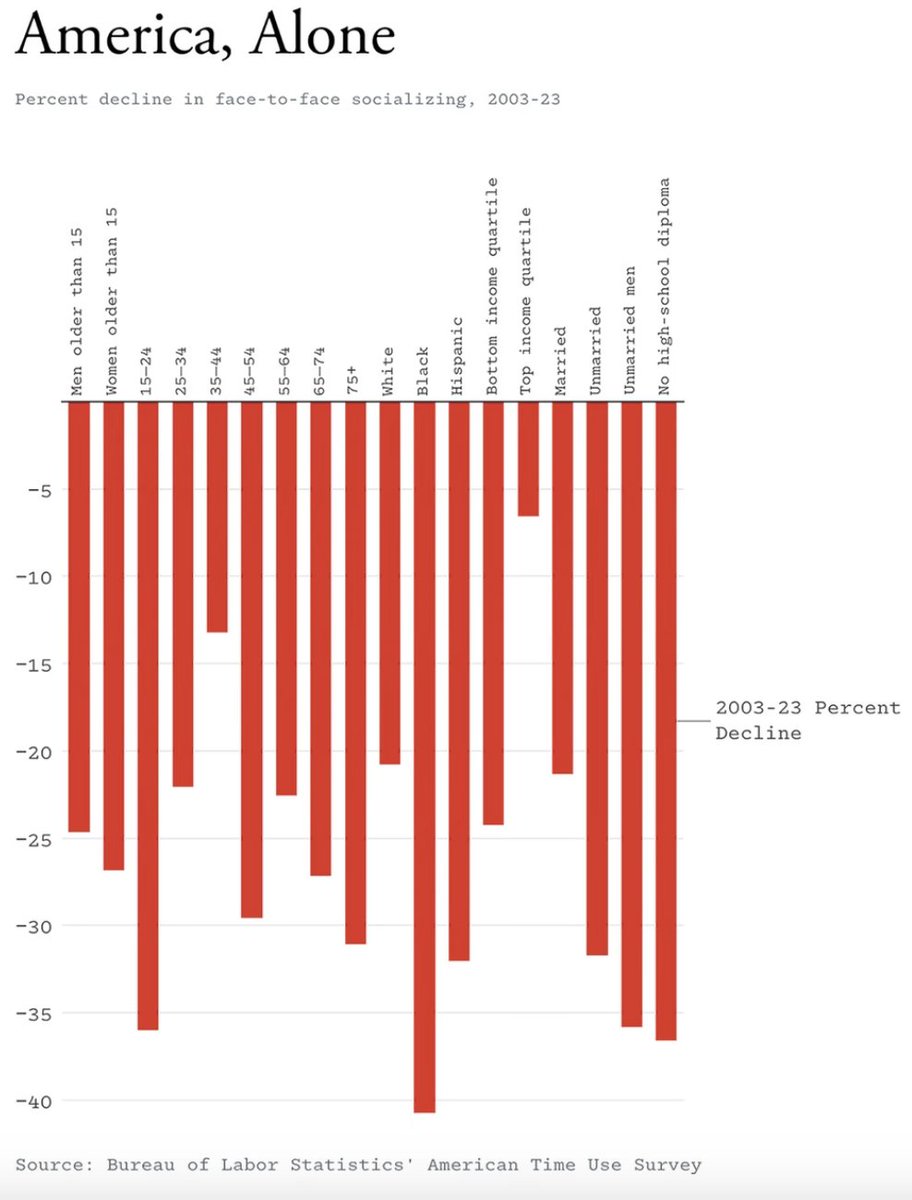
1. In the last few years, in-person socialization has declined, for every demographic group, to its lowest point on record
2. The typical American is now alone more than in any period where we have decent data, going back to at least 1965
3. Americans now spend an extra 99 minutes in their homes compared to 2003—a trend that crept up slowly before the pandemic, before exploding and remaining at a seriously elevated level. As Princeton’s Patrick Sharkey wrote in a 2024 paper, the homebound trend isn't just about remote work. Homebound life has “risen for every subset of the population and for virtually all activities” from eating to praying.
4. America's social depression is far-reaching. The share of adults having dinner or drinks with friends on any given night has declined by more than 30% in the past 20 years. The share of boys and girls who say they meet up with friends almost daily outside school hours has declined by nearly 50%.
I don’t think these trends are simple. In many cases, they’re not even simply bad. (Ordering delivery: totally fine! Eating more meals alone, year after year after year: not so great!) But to see these trends—and their effects on American society—more clearly, I thought this phenomenon needed an anchoring, a naming, a media artifact for people to talk about, even if only to point out that I’m wrong. So, I wrote this.
And here is “The Anti-Social Century,” in full. Gift link! Read and share (and go outside!).
Great question. I think it might be one of the most important pieces of the essay, and it's also very easily misunderstood, so I want to put it plainly here.
Loneliness is so hot right now. Vivek Murthy, the surgeon general of the US, published an 81-page warning on it being an “epidemic” with negative health effects on par with tobacco use. The U.K. has established a minister for loneliness. So has Japan.
But loneliness is complicated. In doses, it's very good. "It is actually a very healthy emotional response to feel some loneliness," the NYU sociologist @EricKlinenberg told me. "That cue is the thing that pushes you off the couch and into face-to-face interaction."
Healthy, lonely people respond to their social isolation by reaching out to friends. What’s happening in this country seems worryingly different. Each year, we seem to be responding to rising aloneness by … spending more time alone. It’s as if our natural instinct to seek the company of others has been short-circuited by a convenience economy that makes it more comfortable and entertaining to spend more (and more and more) time by ourselves.
I’ll leave you with a provocation. If healthy loneliness is the instinct to surround oneself with more people, then America’s problem is not loneliness.
In a strange way, our problem is ... THE OPPOSITE OF LONELINESS.
I wrote about the rise of ANTI-ELITE ELITISM and how Trump 2.0 represents a coalition of power, wealth, and fame that has successfully framed its political movement as a populist rebellion
"Populism"—the rhetoric vibe that says the people are good and the elites are bad—is not a set of ideas so much as a costume that any ideology can wear.
And I am very interested in the way that folks like RFK Jr, Musk, Ackman, and Trump—some of the richest and most famous ppl in America, or the world—have demonstrarted the effectiveness of anti-elite frames, even when the speakers themselves are highly elite themselves.
More broadly, I think RFK Jr is just an absolutely fascinating Rosetta Stone for the most important trends in American politics.
1. His vaccine views perfectly represent the fusion of hippie naturalism and anti-govt attitudes that have pushed vaccine skepticism to the right after COVID
2. His long-standing conspiratorial views about institutions perfectly encapsulate the modern GOP, which has become America's anti-institution party.
As @EricLevitz has written, the parties are not only polarized by education. They are starkly dividied by the degree to which they trust established or legacy organizations to do just about anything