I took a long walk around downtown Portland today to check out the post apocalyptic landscape. I don't want to just point the camera at boarded up buildings -- here you can see non-boarded-up businesses across the street from boarded up ones.
It's hard to say which is worse, the pandemic lockdowns or the constant riots breaking windows, but large parts are taking it hard.
Some of the boarded up buildings are proactive to prevent damage, others are boarded up because their windows got smashed, such as this Starbucks, with boards replacing broken windows, but other windows uncovered.
The most famous part of the riots were when Trump sent in troops to protect the Mark O. Hatfield federal building in downtown. You can see how it's boarded up and fenced off now. In front of the building there is a park...
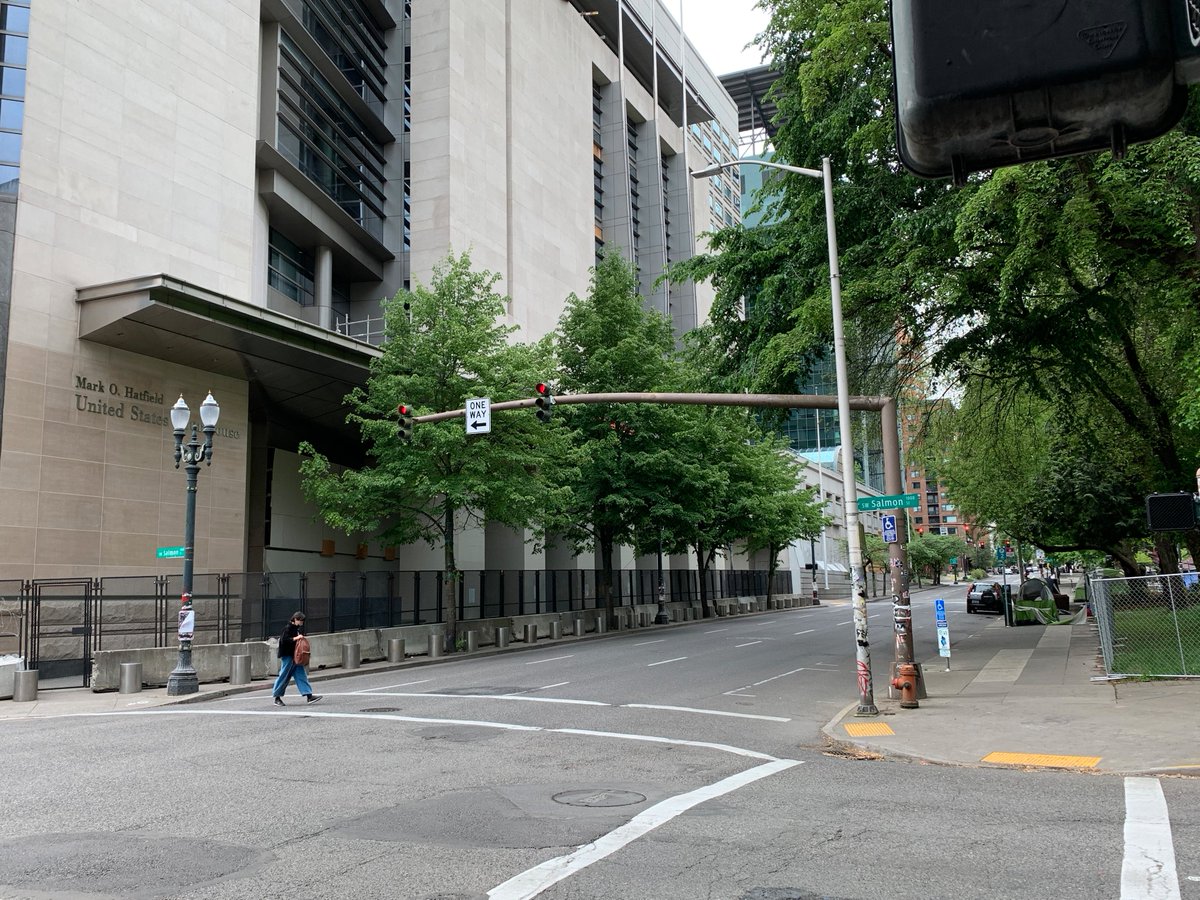
Here's another view of the building through the park. The park has been trashed, the fountain destroyed, and a famous statue of an elk removed for self keeping. It's now an encampment.
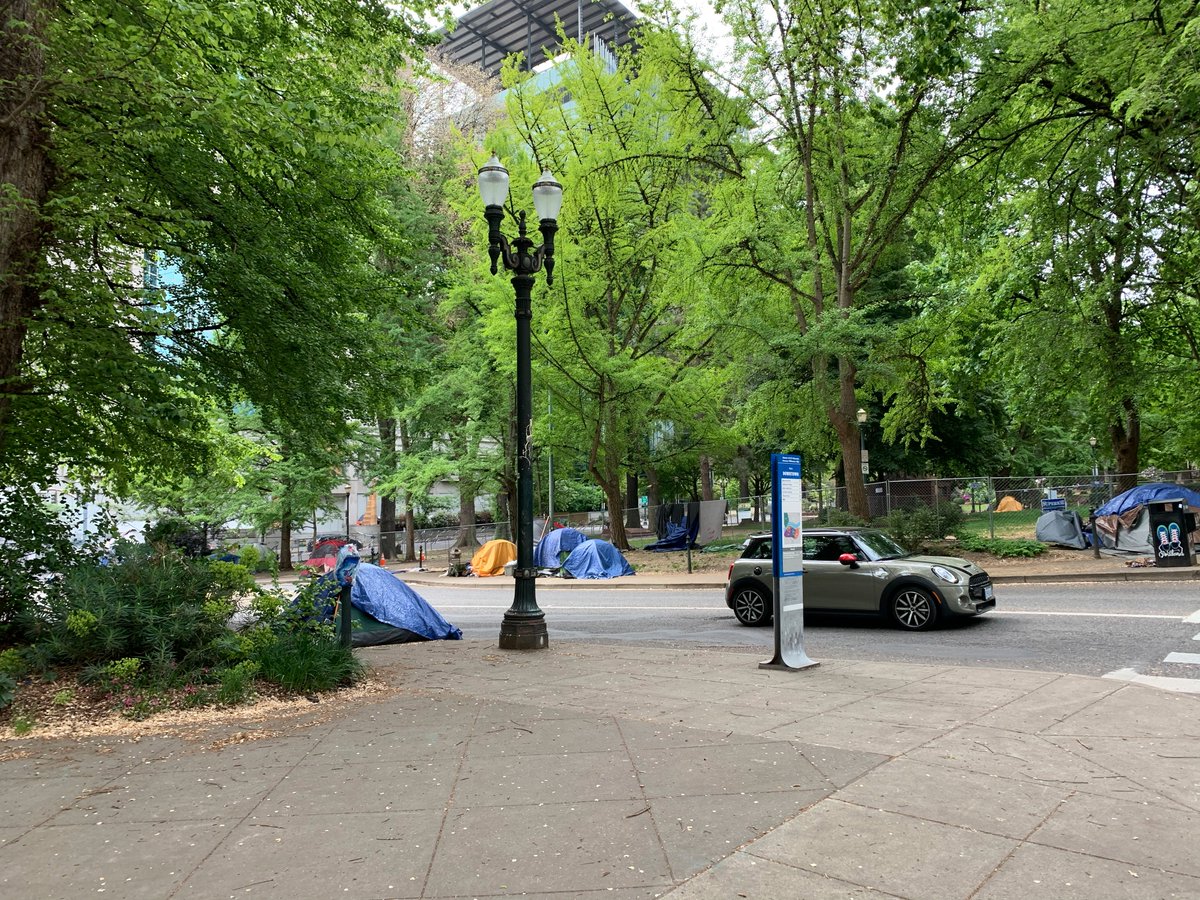
Much of Portland is now an encampment. There's random tents everywhere throughout the city. Some are homeless who have always live there, some are from out of town coming for the nightly "protests".

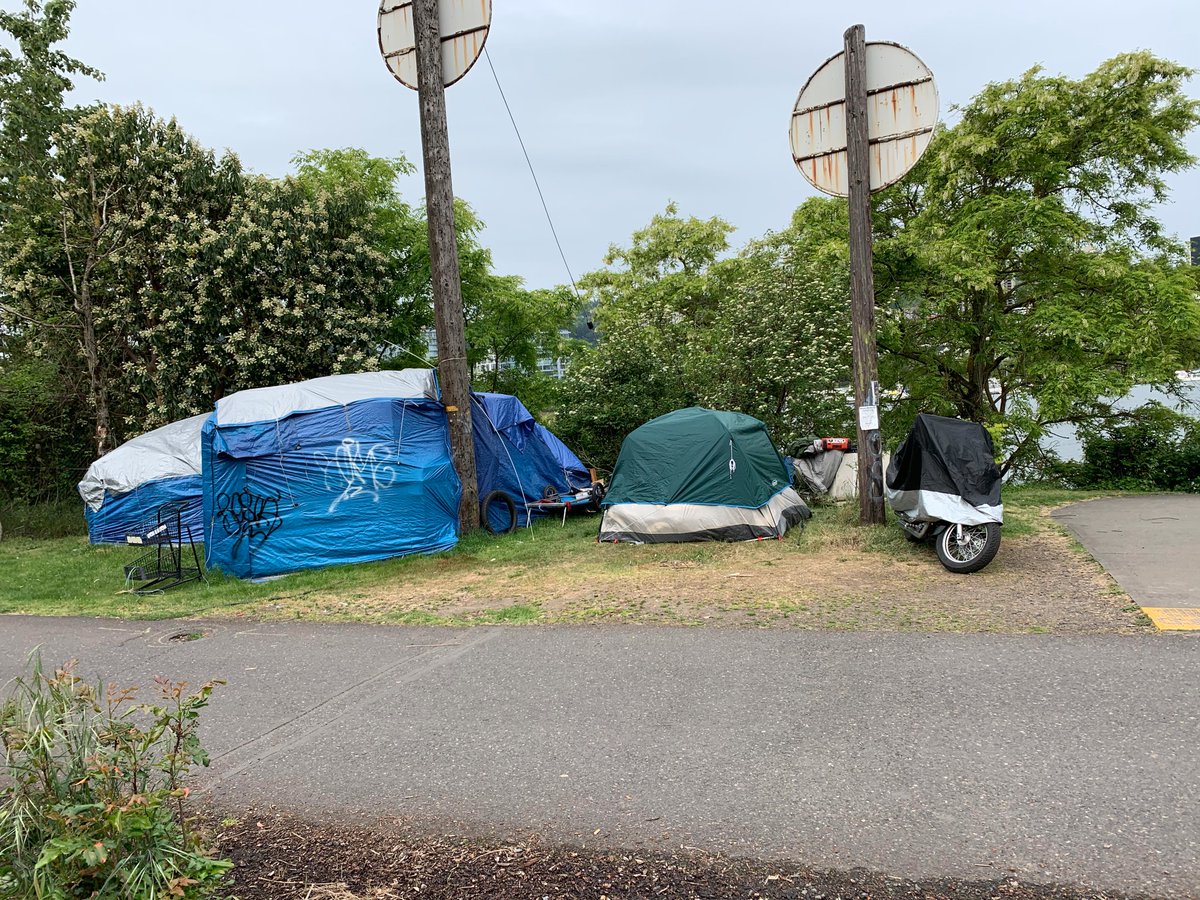
Some seem more deliberate "camping" rather than "homeless camps", especially out of downtown on the other side of the river in more pleasant spaces to setup.
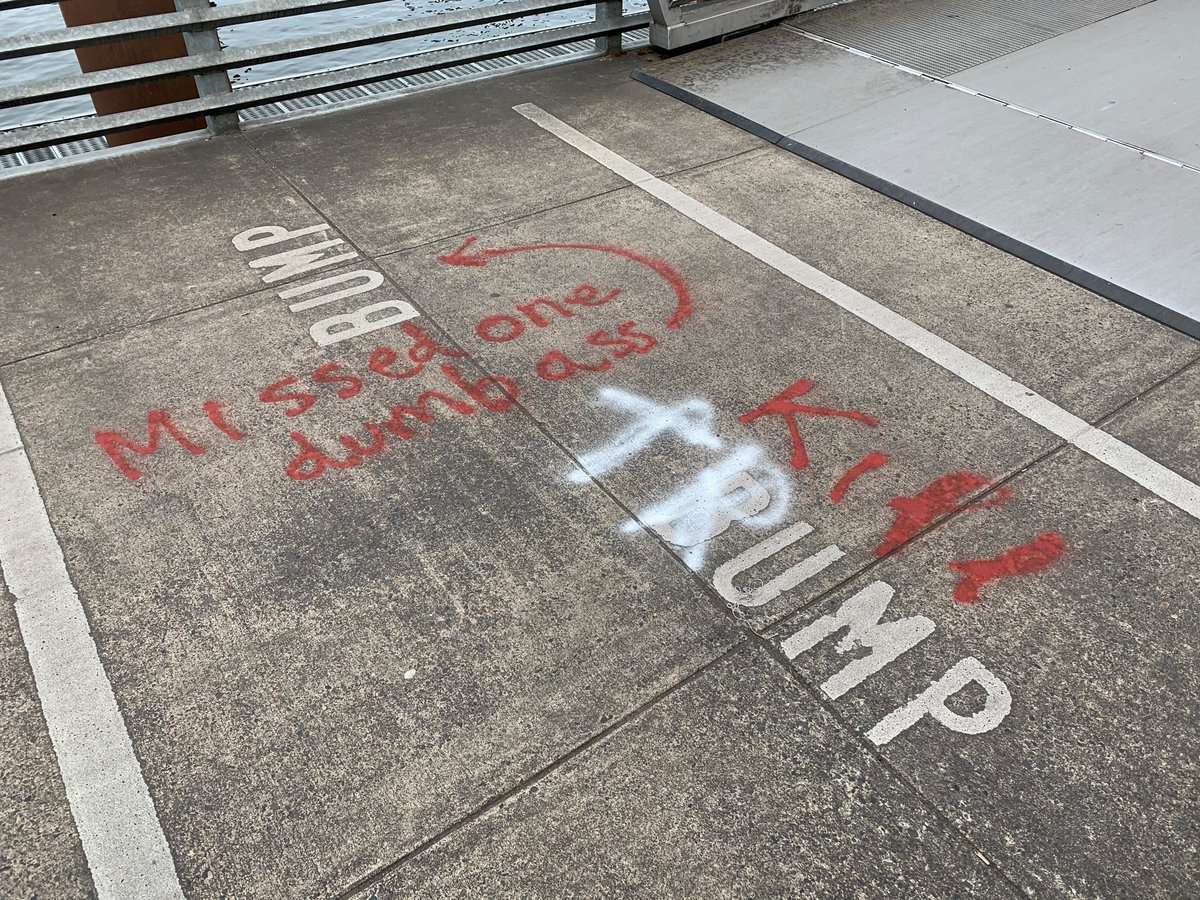
This route near the river water has a lot of "BUMP" warnings that have been converted to "KILL TRUMP" messages -- except one escaped the original graffitist's attention, which was addressed by a later graffitist.
Besides the broken windows in businesses, there's a lot of trash everywhere. I saw a lady in a city uniform doing the normal street cleaning, picking up trash in the street, while ignoring the piles on the sidewalk near the tents.

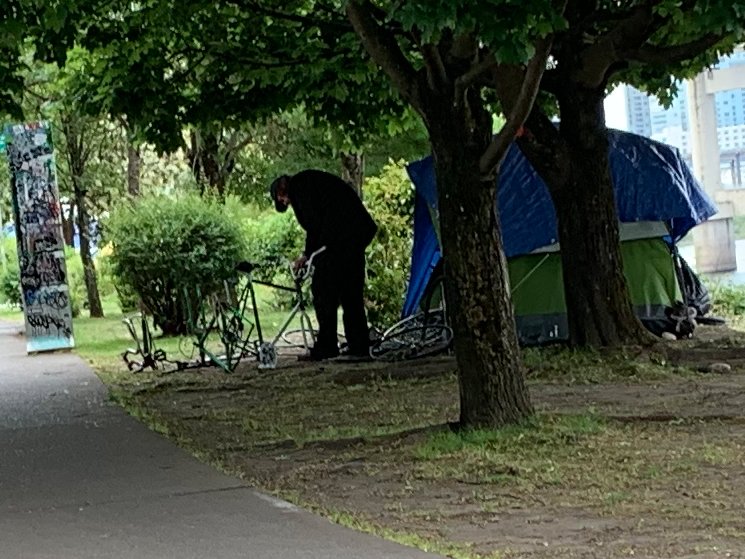
This guy seems to have a thriving business repairing bicycles.
I do a disservice pointing the camera only at bad things. What you don't see is how on this Saturday morning, the promenades and bridges on the waterfront are full of people out exercising

There's a steady stream of people up and down both sides of the river and across the bridges. So it's not as if the city has shut down -- at least, not during the day. I'm told people avoid the roving gangs of "protesters" at night.

• • •
Missing some Tweet in this thread? You can try to
force a refresh

Hi. Professional C/C++ programmer here. The open-source code I can find written by Adam Back and Satoshi Nakamoto don't look remotely similar.
Back's code looks typical of academic Unix programmers who also hack their code to run on Windows.
Satoshi code was written by a professional Windows programmer who also wrote for Unix.
Stylistically, they look nothing alike. There's not enough time between 2005 when I can find the newest Adam Back and January 2009 when Satoshi published Bitcoin/0.1 to account for the change. Both are perfectly competent programmers, but stylistically, they are completely different.
The NYTimes tried to compare their English language in posts/emails. I'm compare their C/C++ language in their open-source code. The NYTimes merely points out they both use C++ as if that's another corroborating detail, when the actual code seems to disqualify Adam Back.
I was a professional Windows C/C++ programmer throughout the 1990s that had to also make code work on Unix. Satoshi's code speaks to me -- that's exactly the sort of code I wrote, down to using 'printf' instead of 'cout'.
What I mean to say is that he's gotten rid of all the C++ class hierarchy nonsense and is primarily using C++ as a smarter C with lightweight objects.
It's a VERY distinctive choice. Conversely, the "style" (where he puts spaces and braces) is non-distinctive, looks like all other code.
Okay, here's how this lie works: 1. everyone agreed that Russians did not hack election infrastructure 2. everyone agreed Russia meddled with the election in other ways, such as hacking the DNC and releasing emails from Podesta et al
She correctly notes that the intelligence community concluded that Russia '"did not impact recent U.S. election results" by conducting cyber attacks on infrastructure'.
🧵So let's talk about the difficulties Netflix is having streaming the Tyson v Paul fight, how the stream gets from there to your TV/computer. This will a longish thread.
In 1985 on his first fight, TV technology was based upon "broadcasts". That meant sending one copy of a video stream to thousands, often millions of receivers. A city would send the signal to a radio tower and broadcast that signal across a wide area.
In today's Internet, though, everybody gets their own stream. There is no broadcasting, no sharing of streams. Every viewer gets their own custom stream from a Netflix server. That we can get so many point-to-point stream across the Internet is mind boggling.
By the way, the energy density of C4 is 6.7 megajoules/kilogram.
The energy density of lithium-ion batteries is about 0.5 megajoules/kilogram.
C4 will "detonate" with a bang.
Lithium-ion batteries will go "woosh" with a fireball, if you can get them to explode. They conflagrate rather than detonate. They don't even deflagrate like gun powder.
To get a lithium-ion battery to explode (in a fireball) at all, you have to cause physical damage, overcharge it, or heat it up.
Causing heat is the only way a hacker could remotely cause such an event.
I don't want to get into it, but I don't think Travis is quite right. I mean, the original 25million view tweet is full of fail and you should always assume Tavis is right ....
...but I'm seeing things a little differently.
🧵1/n
I'm a professional, so I can take the risk of disagreeing with Tavis. But this is just too dangerous for non-professionals, you'll crash and burn. Even I am not likely to get out of this without some scrapes.
3/n To be fair, we are all being lazy here. We haven't put the work in to fully reverse engineer this thing. We are just sifting the tea leaves. We aren't looking further than just these few lines of code.
The reason IT support people are so bitter is that YOU (I mean YOU) cannot rationally describe the problem:
You: The Internet is down
IT: How do you know the Internet is down?
You: I can't get email.
IT: Is it possible that the email servers are down and the Internet is working just fine? Can you visit Twitter on your browser?
You: Yes, I can visit the twitter website.
IT: Is there any reason other than email to believe the Internet is down?
You: The last time I couldn't get email it was because the Internet was down.
The fact that IT doesn't call you a blithering idiot on every support call demonstrates saintly restraint, even if a little bit of their frustration leaks through.
A lot of good replies to my tweet, but so far this is the best:



