Ace Profile picture
May 31, 2021 11 tweets 3 min read Read on X
Thread of my threads:
"Reading the Tape" / Level 2 / Time and Sales
Position sizing, risk management and trading around your core:
After-hours/premarket trading, algorithms, and institutions
Areas where you can enter trades for minimal risk and maximum reward:
Here is a playlist with videos I've made.
youtube.com/playlist?list=…
Support and Resistance / secret sauce

• • •

Missing some Tweet in this thread? You can try to force a refresh

 

Keep Current with Ace

Ace Profile picture

Stay in touch and get notified when new unrolls are available from this author!

Read all threads

This Thread may be Removed Anytime!

PDF

Twitter may remove this content at anytime! Save it as PDF for later use!

Try unrolling a thread yourself!

how to unroll video
  1. Follow @ThreadReaderApp to mention us!

  2. From a Twitter thread mention us with a keyword "unroll"
@threadreaderapp unroll

Practice here first or read more on our help page!

More from @LunarAces

Feb 12, 2022
Price Action thread, common mistakes, "fake-outs", patterns, etc.
For starters, price action trading is simply trading the concept of highs and lows as pivots for price movement. In an uptrend, a stock continues to make higher highs and higher lows until a HL is breached. In a downtrend, lower lows and lower highs occur until a LH is breached. Image
There are macro and micro things to note. In an uptrend, a break below the previous higher high is a micro bearish pivot to the downside. The overall trend (macro) will still be bullish until we break the previous low. There are two possible scenarios:
Read 18 tweets
Oct 21, 2021
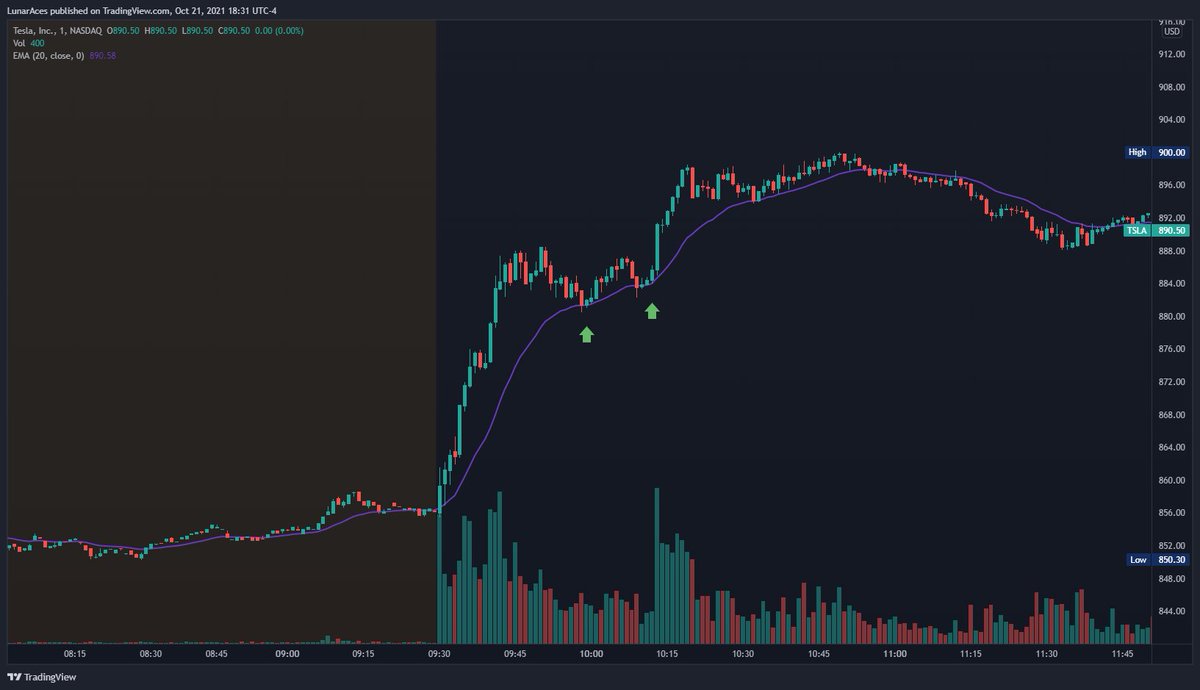
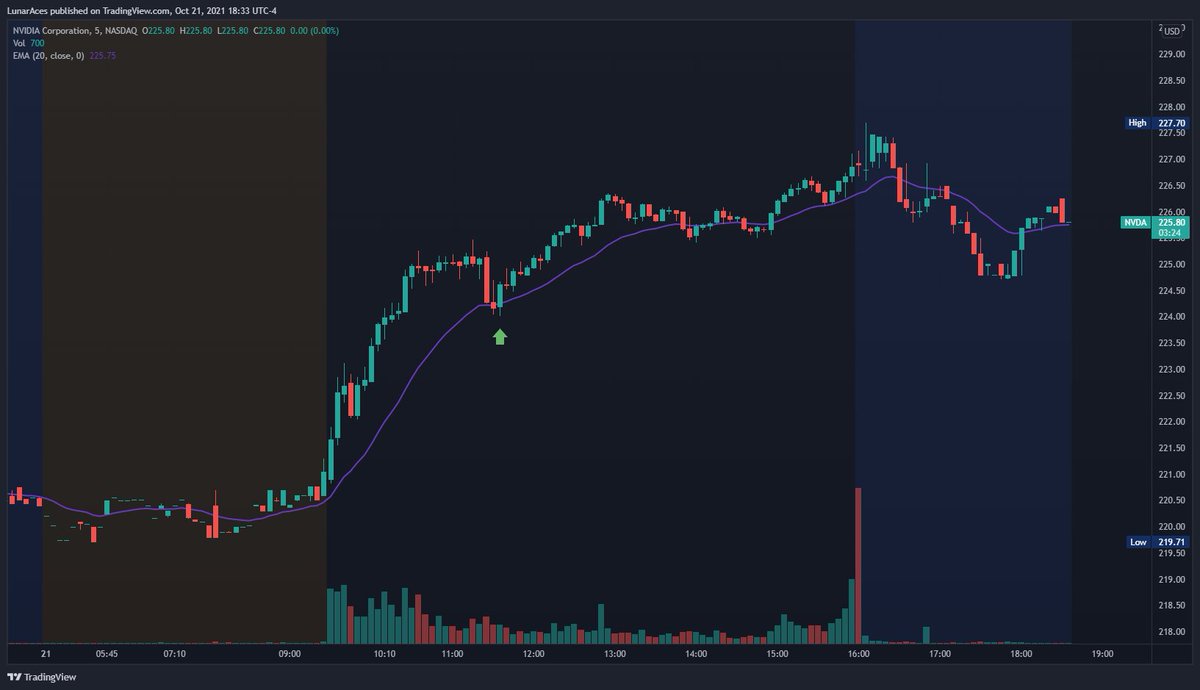
20 EMA is one of my favorite indicators. The smaller the time frame it's riding on, the stronger the trend/momentum. When it breaks below on x timeframe, it signals the momo is getting weaker.
I like using the 5, 10, 3 & 1 min frames.
5-10 can be used for your all-day trend. ImageImageImage
Regardless of which timeframe you're on, adhere to the momentum of it. If you're using the 3 minute and get a strong close below it, cut the trade and move on. Stick to the plan of whatever time frame you were trading with it on
I put some arrows at retests of it, but try and focus on how price glided along the indicator the whole way. When it deviates to the upside, that's indicative of stronger momentum
Read 5 tweets
Jul 31, 2021
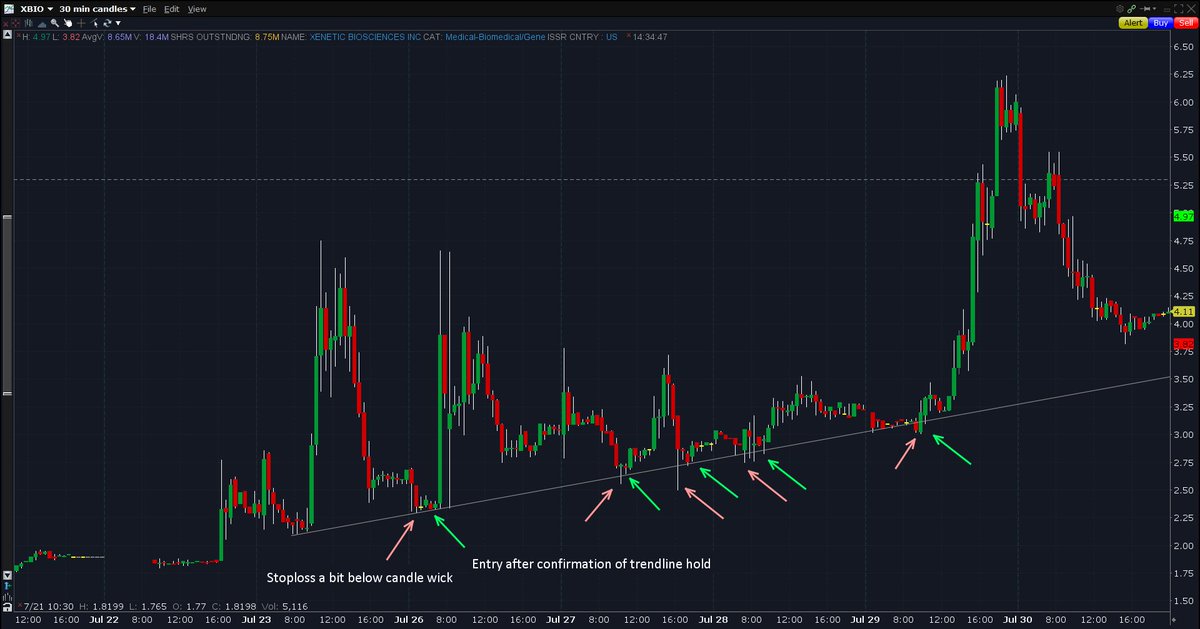
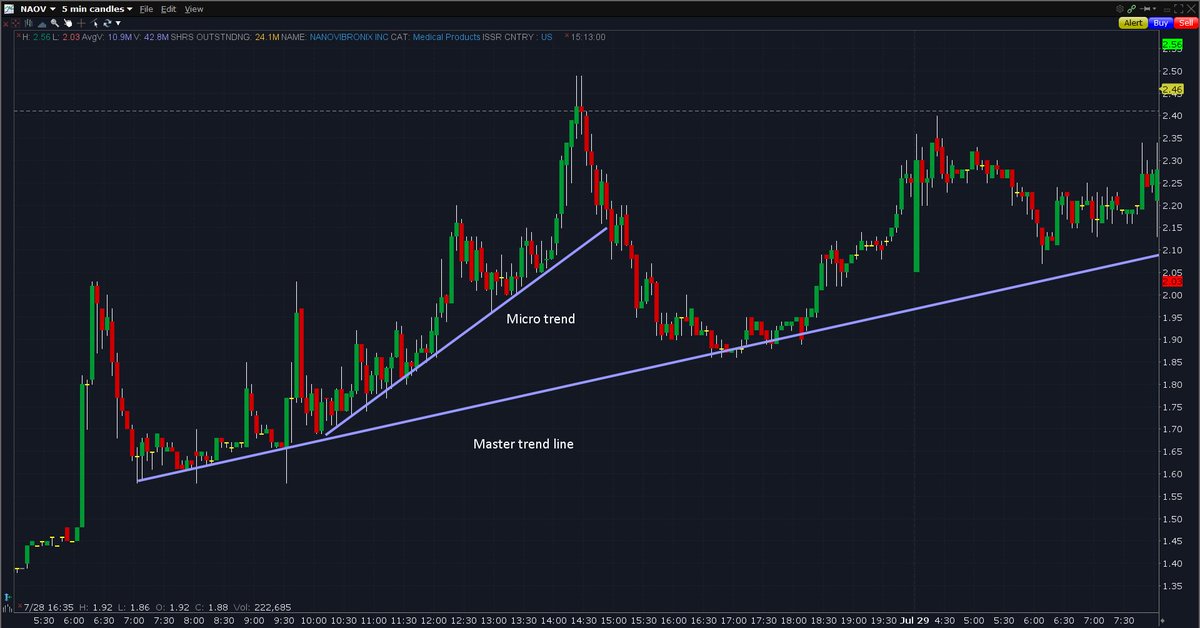
The largest issue from what I've seen for new traders is determining where to enter trades. Most traders get caught chasing or adding in poor areas and then sell for losses. Here's a thread on some areas where you can enter trades for minimal risk and maximum reward:
1. Master trend lines and micro
Enter on confirmation of the master trendline holding with a stop-loss a few cents below the prior wick lows to ensure you don't get wicked out. You can also build smaller micro-trends inside and use those with similar risk/reward.
$XBIO $NAOV
2. Pattern breakout retests
There are tons of great patterns you can use retests for confirmation with: flags, descending wedges, ascending triangles, etc. Learn and utilize them
$NAOV
Read 12 tweets
Jul 17, 2021
Something everyone needs to understand is whether there is artificial volume or real volume on a stock. If institutions are behind a move, zones will be respected because there is real demand. Usually when they’re on a ticker, there’s hundreds of million of volume on the day
If it’s a callout by someone on twitter or a chatroom, it’s not real volume and the zones don’t have any REAL demand. Sometimes callouts and artificial volume can lead to real institutional demand coming in, so you have to look at the average volume of a stock and compare it
with the volume on that day and determine whether it’s catching real traction or not. You’ll get burned otherwise trying to buy what you think is a demand zone dip, when in reality it’s the stock crashing after an artificial push
Read 5 tweets
Jul 4, 2021
After hours and premarket trading/algorithms and institutions - some insight. I shared this on MTA voice the other day.
To start, AH and PM trading is wonky as is because traders can manipulate prices to an incredible degree. Most algos and institutional trading turn off during PM and AH, and the volume is MUCH thinner, so larger retail traders can actually drag prices as they wish, to a degree.
How this works is through level 2 - they can set up asks that are incredibly far away from the current market price and smash through all the current asks, while also propping up bids higher and higher. Others pile on and this moves the price up significantly.
Read 7 tweets
Jun 14, 2021
Why and how 90% of retail traders lose and how you can join the 10% that win. This is by far the most important thread I've made. I truly hope this helps change your lives.
The contents of this thread will go against almost all conventional trading rules/strategies you may have learned through books and videos, but I'm incredibly confident this is how @MrZackMorris and other great traders trade
The concept is simply Supply and Demand. When stocks consolidate in a range, there is an agreement in price and institutional orders are being filled. When it deviates from that range (impulsive), big money orders are left unfilled until the stock reaches that area again
$AMC
Read 32 tweets

Did Thread Reader help you today?

Support us! We are indie developers!


This site is made by just two indie developers on a laptop doing marketing, support and development! Read more about the story.

Become a Premium Member ($3/month or $30/year) and get exclusive features!

Become Premium

Don't want to be a Premium member but still want to support us?

Make a small donation by buying us coffee ($5) or help with server cost ($10)

Donate via Paypal

Or Donate anonymously using crypto!

Ethereum

0xfe58350B80634f60Fa6Dc149a72b4DFbc17D341E copy

Bitcoin

3ATGMxNzCUFzxpMCHL5sWSt4DVtS8UqXpi copy

Thank you for your support!

Follow Us!

:(