THE STORY OF EUROPE'S CORPORATE DECLINE
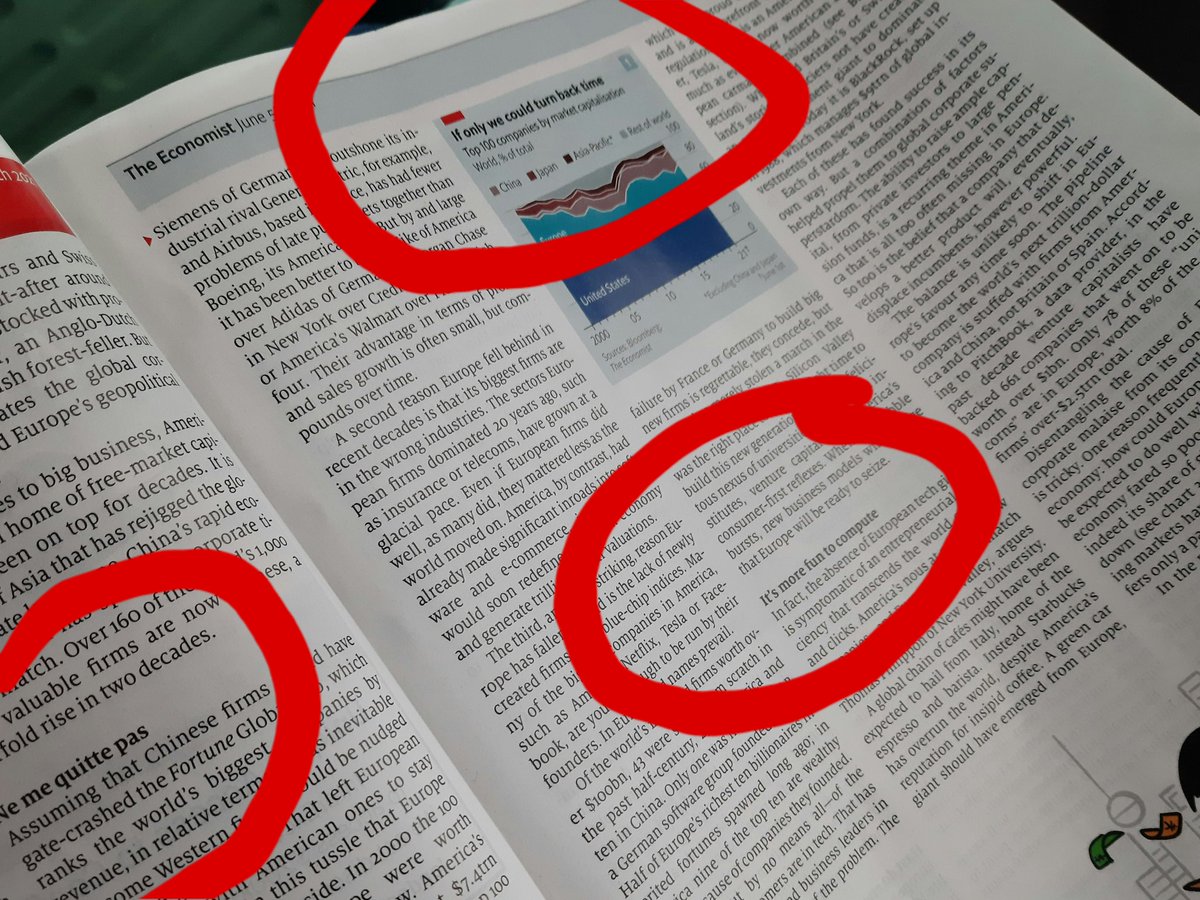
20 years ago, 41 of the world's 100 most valuable companies were in Europe. Now the figure is down to 15.
What on earth happened?
We take a look at this in this week's @TheEconomist cover package.
economist.com/briefing/2021/…
A 🧵
20 years ago, 41 of the world's 100 most valuable companies were in Europe. Now the figure is down to 15.
What on earth happened?
We take a look at this in this week's @TheEconomist cover package.
economist.com/briefing/2021/…
A 🧵
Europe's fall from the top tier of global business has been spectacular.
We call it "The Land that Ambition Forgot".
Remember the era of Nokia, Ericsson, BP, Vodafone? All were among the world's top 10 companies.
Look at profits, sales, etc - on every metric Europe has faded
We call it "The Land that Ambition Forgot".
Remember the era of Nokia, Ericsson, BP, Vodafone? All were among the world's top 10 companies.
Look at profits, sales, etc - on every metric Europe has faded

Now Europe's biggest firm (currently LVMH) barely scrapes into the top 20 most valuable firms in the world. Apple by itself is worth roughly as much as ALL the firms in the German DAX30 index or the CAC40 in France.
This isn't a EU thing btw, Europe here includes UK +Switzerland
This isn't a EU thing btw, Europe here includes UK +Switzerland
What happened?
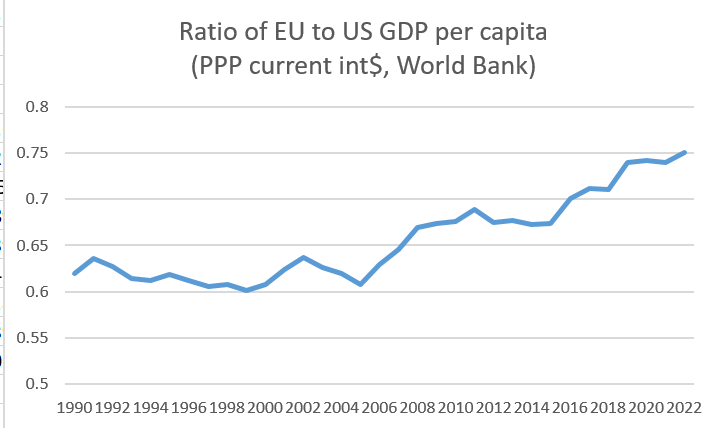
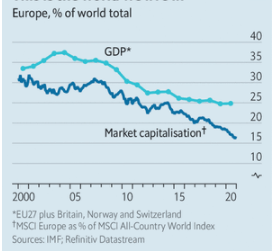
Was it the economy? Only partly. European companies have fallen further and faster than its share of global GDP.
China grew and created big companies. But the US managed to keep its position - Europe did not.
Was it the economy? Only partly. European companies have fallen further and faster than its share of global GDP.
China grew and created big companies. But the US managed to keep its position - Europe did not.
The 3 broad reasons why Europe fell behind.
- in same industries, US companies did better than European ones (eg. Walmart vs Tesco or Carrefour)
- European companies are in slow industries (eg insurance or utilities)
- No new firms have emerged in Europe to take on incumbents.
- in same industries, US companies did better than European ones (eg. Walmart vs Tesco or Carrefour)
- European companies are in slow industries (eg insurance or utilities)
- No new firms have emerged in Europe to take on incumbents.
Lots of people say Europe *just* missed the boat on tech.
First, that's a big boat to miss!
And second, it's not even really true. Lots of big American/Chinese firms have emerged outside of tech. Look at Starbucks or Tesla or Ping An.
First, that's a big boat to miss!
And second, it's not even really true. Lots of big American/Chinese firms have emerged outside of tech. Look at Starbucks or Tesla or Ping An.
There are 142 companies globally worth over $100bn now. 43 were set up (from scratch) in the past half-century. Only one of those was in Europe.
Look at billionaires in US: founders of companies
Billionaires in EU: some founders and LOTS of heirs.
Look at billionaires in US: founders of companies
Billionaires in EU: some founders and LOTS of heirs.
Of course there are European business success stories. BioNTech deserves all the Nobels in the world. Louis Vuitton (LVMH) can flog handbags like no other. Who doesn't love Ikea?
But for companies that really matter in the world, you have to look at US or China.
But for companies that really matter in the world, you have to look at US or China.
Why does this matter? Maybe it doesn't. Europe is 1/3 poorer than US but works a 1/3 less - could be we accept that as a suitable trade-off. Some US firms are profitable/valuable because they're crappy monopolies (but by and large this isn't the dominant reason for their success)
Big companies often sit at the frontier of innovation (Europe does a lousy job in R&D). Look at the biggest R&D spenders and there are more in China than EU now. And it is harder for Europe to regulate big companies (eg on privacy) if it has none of its own.
European policymakers know all this. But their gameplan is often more of the same policies that caused this decline. Politicians want to "guide" industries like it did in the 1970s. They want to allow big mergers (like Siemens-Alstom) that do nothing to promote competitiveness.
Ultimately the way you get big companies isn't to merge lots of existing ones together or protecting incumbents. There is nothing to cheer about Saudi Aramco.
What you want is an ecosystem where the next Apple or Amazon (or whoever will dethrone them) can emerge.
What you want is an ecosystem where the next Apple or Amazon (or whoever will dethrone them) can emerge.
A more prosaic - but far better - solution for Europe would be to focus on completing the single market. It has become less relevant as the economy has shifted away from goods (that SM covers well) to services (which it doesn't). But it would hugely help companies - and consumers
Finally, Europe's failure has shifted the geopolitics of global business. China and America dominate like never before. I think ultimately this is a bad position for my home continent - and I hope we can emerge from this spiral of decline. That's the cover economist.com/leaders/2021/0…
Bonus for weekend readers.
Editors at @TheEconomist are wont to sneak some quips in our chart headlines and sub-titles.
This week's theme, given the topic, is Europop: from Kraftwerk to Jacques Brel.
And here's the playlist!
open.spotify.com/playlist/3BRxq…
Editors at @TheEconomist are wont to sneak some quips in our chart headlines and sub-titles.
This week's theme, given the topic, is Europop: from Kraftwerk to Jacques Brel.
And here's the playlist!
open.spotify.com/playlist/3BRxq…
• • •
Missing some Tweet in this thread? You can try to
force a refresh