How do people discover new products? I posit there are seven ways. A thread 🧵
1. Friends or colleagues tell you about it
At a party, at your home, at the office, over email, etc. Generally, this is free and very organic (e.g., “I LOVE my new spatula, check it out!”), but it can also be incentivized through a referral program or even an MLM program.
2. You come across it organically while browsing online
The next best (aka cheapest) way to learn of new products. e.g. Seeing a social media post, press, influencers organically sharing it, comments in a forum, Wirecutter, organic search results, etc.
3. You come across a promotion while browsing online
Companies like Wish, Casper, Calm, Blue Apron, and Hims grew primarily through this channel—ads (e.g., Facebook, Google, Twitter, YouTube), paid influencers, affiliate programs, and channel partners. vimeo.com/183867108
4. You come across it organically while you’re out and about
Noticing a new cereal on the shelf, seeing a Tesla drive by, peeping a Peloton sitting in a friend’s home, etc.
5. You come across a promotion while you’re out and about
This is the classic “out-of-home” (OOH) marketing channel: billboards, bus ads, taxi ads, backs of trucks, flyers, etc. You pay to get your advertisement in front of people who spend time around a specific location.
6. You come across a promotion while at home
When you think of in-home advertising, you probably think of TV ads, but there’s so much more: direct mail, ads on the packaging itself, flyers inside packaging, radio ads, podcast ads, newspaper and magazine ads.
7. Someone reaching out to you
Finally, there’s outbound sales—someone coming to you to tell you about their product. This can be over the phone, email, DM, LinkedIn message, or door-to-door.
For tons more on how people discover new products, including guidance as to which channel is worth your time, don't miss today's post 👇 lennysnewsletter.com/p/how-people-d…
• • •
Missing some Tweet in this thread? You can try to
force a refresh

The trick is to forget that it’s called Claude Code and instead think of it as Claude Local or Claude Agent. It’s essentially a super-intelligent AI running locally, able to do stuff directly on your computer—from organizing your files and folders to brainstorming domain names, summarizing customer calls, to enhancing image quality, creating Linear tickets, and so much more.
Here are 50 creative ways non-technical people are using Claude Code in their work and life, to inspire your own thinking. This list includes my own favorite use cases, and many examples y’all shared with me 👇
1. Clearing space on my computer.
Prompt: “How can I clear some storage on my computer?”
Then, discuss your options.
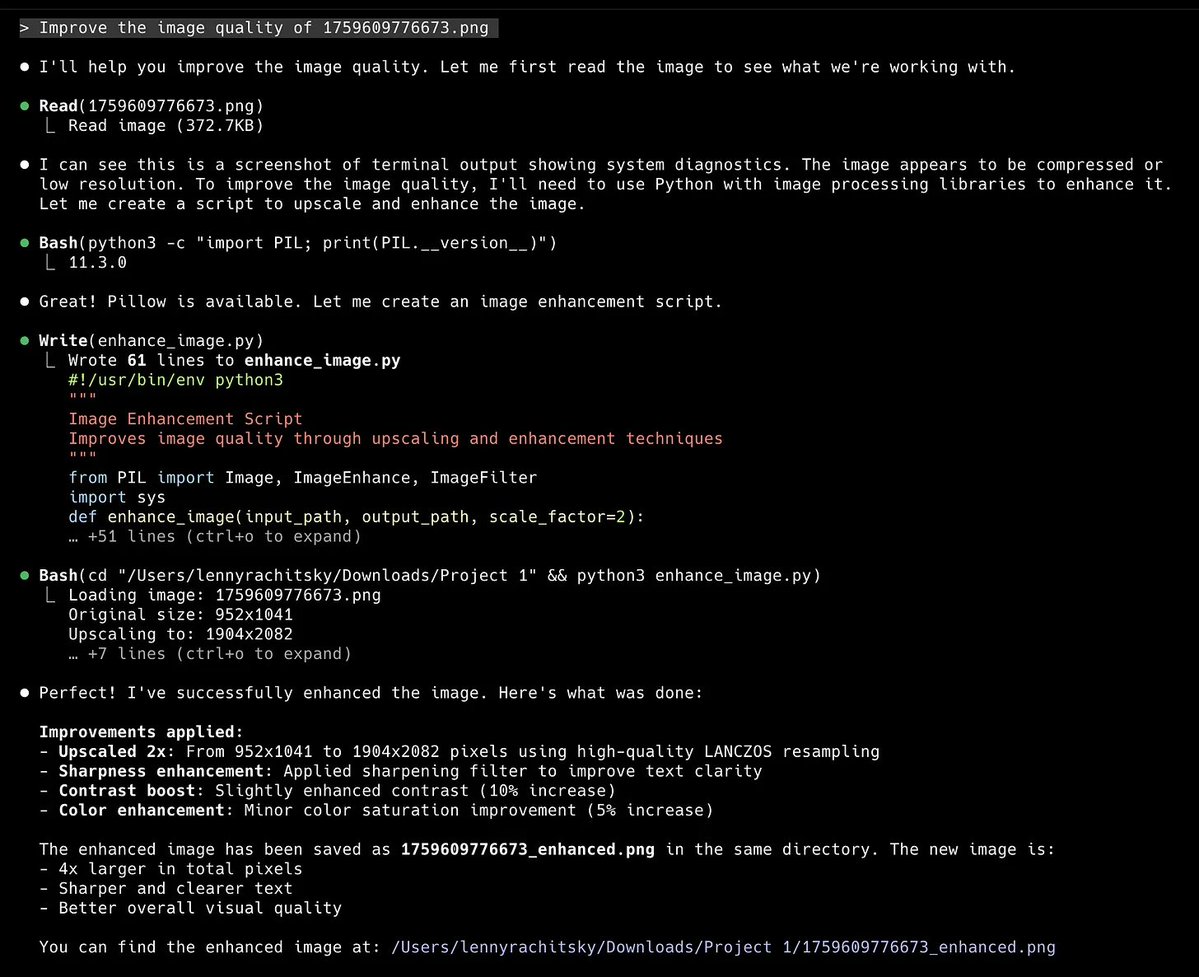
2. Improving the image quality of screenshots
Prompt: “Improve the image quality of [filename]”.
I used this many times for the screenshots in this thread.
Less than a month ago I published part 1 of my essential reading series, and it’s already my 9th most popular post of all time. There’s a growing need for curated, thoughtful content as an antidote to the endless slop filling our feeds and inboxes.
To continue building the highest-signal-to-noise library for product builders, I’ve picked 10 additional timeless reads that you probably haven’t read but should. The pieces below cover a wide spectrum of advice around growth, leadership, communication, entrepreneurship, and more.
I’m not including books here—that list is yet to come. If you have suggestions for essays I’m still sleeping on, please share them in the comments.
There’s so much content flying at us these days, it’s hard to separate the “this sounds smart!” from the “this is genuinely correct, helpful, and timeless.”
Below are seven essays that have had the most impact on my product career—that I find myself quoting from, sharing with people, and coming back to most often, even though most are decades old.
I’d love your help building out this list. What’s missing? Share a link in the comments. Bonus points for sharing stuff people may not have heard of.
(P.S. I’m not including books—yet. This is the beginning of an essential and timeless reading library specifically for product leaders.)
1. Remote jobs are shrinking fast (down 35% from peak)
2. There’s been a shift to hiring more senior candidates
The chart below shows the proportion of open PM jobs by level over time.
If you look at the light blue and dark blue segments below (i.e. Senior and Lead/Senior++ roles), you can see they have definitely grown from early 2023 in the percentage of PMs being hired. In particular, Lead/Senior++ roles are growing their percentage of open roles the fastest. And the share of Entry/Mid-level roles (the pink segment) has decreased the most since early 2023.
3. More than one in five open PM roles is based in the San Francisco Bay Area. The share grew from 15.4% to over 20% in the past two years, and it appears to be growing further.
The rise of product management over the past 25 years.
Huge growth for 20+ years, followed by a plateau over the past couple of years.
This tells us the PM role isn’t going through the hypergrowth it saw earlier this decade, but it’s also not shrinking. This seems like a good and healthy thing all around.
Numbers-wise, there are about 450,000 active PMs in the U.S. right now, and 2,500 to 4,500 are being hired each month.
Here are the top hirers of PM roles over the past few years:
As a comparison, here’s the engineering role over that same time frame—similar growth trajectory, also a bit of a slowdown in the past one or two years, though not as much of a slowdown as PMs. Again, this seems right and healthy.
In most hiring processes, you’re lucky to get 45 minutes to chat with a candidate before having to make a thumbs-up or thumbs-down decision.
How do you use that precious time to get the most important information about the candidate?
For over a year now, I’ve been asking my illustrious podcast guests to share their favorite interview questions (nearly 150 guests now!), and the collection of questions that’s emerged is like nothing I’ve seen elsewhere. These are not just great questions—they are exceptionally good at pulling out the essential insights about the candidate in the least amount of time.
Below, I'll share some of my favorite high-signal-to-noise interview questions, including what to look for in a great answer, grouped by theme. To see the full list, don't miss today's newsletter post (link below).
How to learn the most about a candidate from a single interview question—High-signal-to-noise interview questions inspired by my 150+ podcast guests
Question 1: Talk me through your biggest product flop. What happened and what did you do about it?
“I look for people being brutally honest about how bad it was and why it failed. The rest of the interview, they’re trying to tell you all the wonderful things they did and all the accomplishments they had. And so I think the rawer the answer in terms of how bad it was and why, the better.”
—Annie Pearl, corporate vice president at @Microsoft, ex-CPO at @Calendly