Here we go with some random-interesting facts about lactate and metabolism. A dynamic threat where everybody can add interesting info. (following the order) about lactate and its implication in exercise, health, and disease metabolism.
#Lactatefacts by @Glut4Science and @MVAitor
#Lactatefacts by @Glut4Science and @MVAitor
Let´s start learning!
1- Glycolysis byproduct that can be produced and utilized by various (almost every) body cell.
2- Highly dynamic metabolite as it can "travel" through different intra-extra cellular compartments.
#Lactatefacts by @Glut4Science and @MVAitor
1- Glycolysis byproduct that can be produced and utilized by various (almost every) body cell.
2- Highly dynamic metabolite as it can "travel" through different intra-extra cellular compartments.
#Lactatefacts by @Glut4Science and @MVAitor
3-LDH enzyme is responsible for its oxidation and reduction to pyruvate. But it has more affinity to Pyruvate? WTF!
4.1-MCT proteins "family" in charge of its transport in different tissues (different isoforms). Specific for L-Lactate
#Lactatefacts by @Glut4Science and @MVAitor
4.1-MCT proteins "family" in charge of its transport in different tissues (different isoforms). Specific for L-Lactate
#Lactatefacts by @Glut4Science and @MVAitor
4.2- MCTs are not only for L-lactate, but also other metabolites like pyruvate or Ketone Bodies (higher Km than Lactate, by the way).
5- ILS (intracellular lactate shuttle) + Cell-Cell lactate shuttle hypothesis support its dynamism.
#Lactatefacts by @Glut4Science and @MVAitor
5- ILS (intracellular lactate shuttle) + Cell-Cell lactate shuttle hypothesis support its dynamism.
#Lactatefacts by @Glut4Science and @MVAitor
6.1- It´s produced mainly in Type II fiber (highly glycolytic)
6.2- Consumed in Type I & IIa fibers = oxidation; Type IIx = glycogenesis).
6.3- It all depends on pH, muscle metabolic rate, blood flow, etc.
#Lactatefacts by @Glut4Science and @MVAitor
6.2- Consumed in Type I & IIa fibers = oxidation; Type IIx = glycogenesis).
6.3- It all depends on pH, muscle metabolic rate, blood flow, etc.
#Lactatefacts by @Glut4Science and @MVAitor
7- Heart´s mitochondria are big consumers of Lactate, especially during exercise.
8- Neurons can use it (preferably to others) as a fuel source: glycolysis or glycogenesis. The brain EATS lactate!
#Lactatefacts by @Glut4Science and @MVAitor
8- Neurons can use it (preferably to others) as a fuel source: glycolysis or glycogenesis. The brain EATS lactate!
#Lactatefacts by @Glut4Science and @MVAitor
9- Skeletal muscle is the main lactate producer and consumer tissue, especially during exercise = the lactate fabric.
10- High [La-] downregulates glycolytic flux decreasing PFK´s and hexokinase´s activities.
#Lactatefacts by @Glut4Science and @MVAitor
10- High [La-] downregulates glycolytic flux decreasing PFK´s and hexokinase´s activities.
#Lactatefacts by @Glut4Science and @MVAitor
11.1- Lactate is not only a fuel source but also a major gluconeogenic metabolite (liver, mainly).
11.2- And even a signalling molecule with important implications in metabolism and protein transcription.
#Lactatefacts by @Glut4Science and @MVAitor
11.2- And even a signalling molecule with important implications in metabolism and protein transcription.
#Lactatefacts by @Glut4Science and @MVAitor

11.3- It could play an important role in mitochondrial dynamics by stimulating mito. biogenesis. Exercise, training, production and oxidation, Z2, Fat max, blood [La-] and flux, eating carbohydrates... = all related concepts😊
#Lactatefacts by @Glut4Science and @MVAitor
#Lactatefacts by @Glut4Science and @MVAitor

12- It’s very difficult to compare absolute values of blood [La-] between individuals, but… the avg value among all elite/pro athletes I have tested in cycling and running, at VT1 intensity (~FatMax/slightly lower) is ~1,6mmol/L.
#Lactatefacts by @Glut4Science and @MVAitor
#Lactatefacts by @Glut4Science and @MVAitor
13- Lactate can also influence food behavior around exercise. Post-exercise appetite depression was associated with higher blood [La-] mediated by changes in GLP-1, PYY, and acylated-ghrelin. These peptides/hormones regulate appetite.
#Lactatefacts by @Glut4Science and @MVAitor
#Lactatefacts by @Glut4Science and @MVAitor
14-⬆️lactate flux in mitochondria can inhibit fatty acid lipolysis in peripheral tissues, transport into the inner membrane, and even beta-oxidation in TCA cycle.This happens through the regulation of CPT1, Malonil CoA, and Acetyl CoA.
#Lactatefacts by @Glut4Science and @MVAitor
#Lactatefacts by @Glut4Science and @MVAitor

15-As seen in some previous points, lactate can be a strong signalling metabolite in several cells/tissues. The tumoral cell is one of those environments where lactate plays an important signalling role. Check👇🏼
#Lactatefacts by @Glut4Science and @MVAitorfrontiersin.org/articles/10.33…
#Lactatefacts by @Glut4Science and @MVAitorfrontiersin.org/articles/10.33…
16- We can´t find "lactic acid" in physiological pH, so we should speak about "lactate" in the human body. In fact, our "lactate" concept refers to L-Lactate enantiomer, not D-Lactate (it could even be negative for the body).
#Lactatefacts by @Glut4Science and @MVAitor
#Lactatefacts by @Glut4Science and @MVAitor
@Glut4Science 17- Lactate has the capacity to regulate its own metabolism. It’s so cool!
The questions that arises: why has lactate this power?
#Lactatefacts by @Glut4Science and @MVAitorsciencedirect.com/science/articl…
The questions that arises: why has lactate this power?
#Lactatefacts by @Glut4Science and @MVAitorsciencedirect.com/science/articl…
@Glut4Science 18- A VERY important #Lactatefacts:
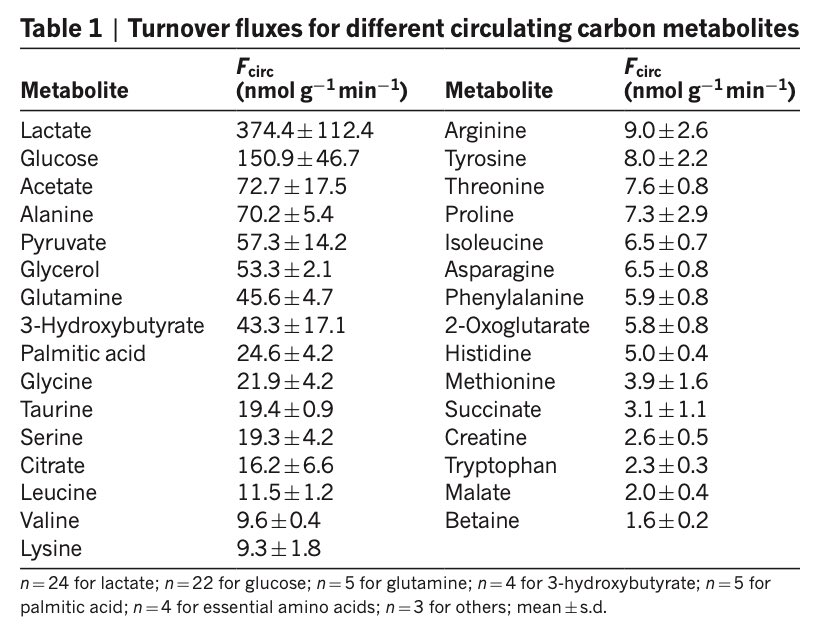
Lactate is the primary source of carbons for the TCA (our main energy producing pathway), and, therefore, the MAIN source of energy for the body🤯. Lactate showed the higher turnover flux among different carbon metabolites.
Hui S, et al. 2017.
Lactate is the primary source of carbons for the TCA (our main energy producing pathway), and, therefore, the MAIN source of energy for the body🤯. Lactate showed the higher turnover flux among different carbon metabolites.
Hui S, et al. 2017.
• • •
Missing some Tweet in this thread? You can try to
force a refresh