
1/ My post on product taste spent 1 day on the Hacker News front page.
In that piece, I argued that 'product validation frameworks like Lean Startup consist of two bits: an explicit bit which is process, and a tacit bit which is product taste.'
So what IS product taste?
In that piece, I argued that 'product validation frameworks like Lean Startup consist of two bits: an explicit bit which is process, and a tacit bit which is product taste.'
So what IS product taste?
2/ If you want to succeed at product, you need to build taste. This is really the hard bit of the game.
I've spent about a decade collecting links and snippets about product taste, mostly because I suck at it (and I'm still trying to get better).
Here are some of them.
I've spent about a decade collecting links and snippets about product taste, mostly because I suck at it (and I'm still trying to get better).
Here are some of them.
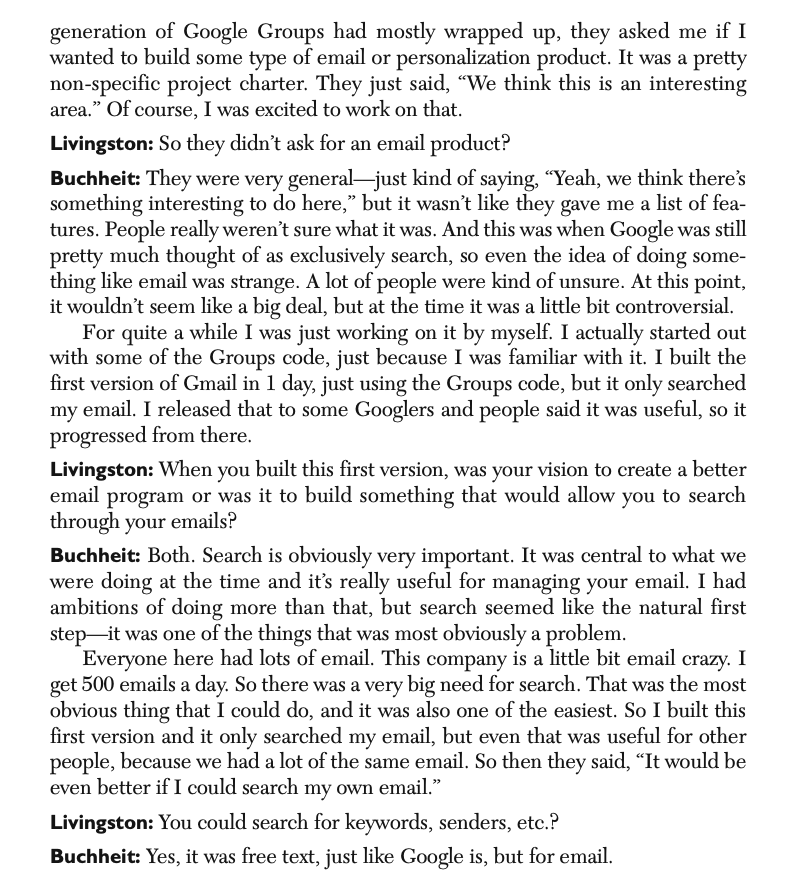
3/ Paul Buchheit, in 2010: 'if your product is great, it doesn't have to be good'.
paulbuchheit.blogspot.com/2010/02/if-you…
Buchheit's post is fascinating. It was the first time I'd seen this idea of 'just pick 3 great features, and half-ass everything else.'
paulbuchheit.blogspot.com/2010/02/if-you…
Buchheit's post is fascinating. It was the first time I'd seen this idea of 'just pick 3 great features, and half-ass everything else.'
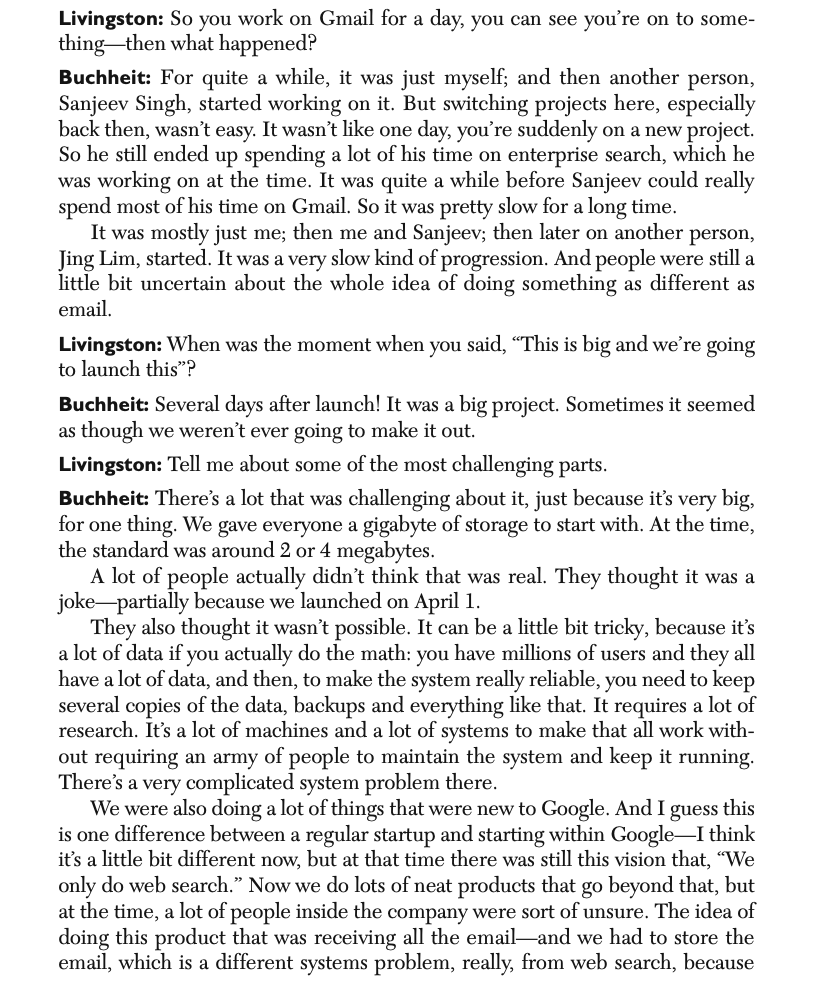
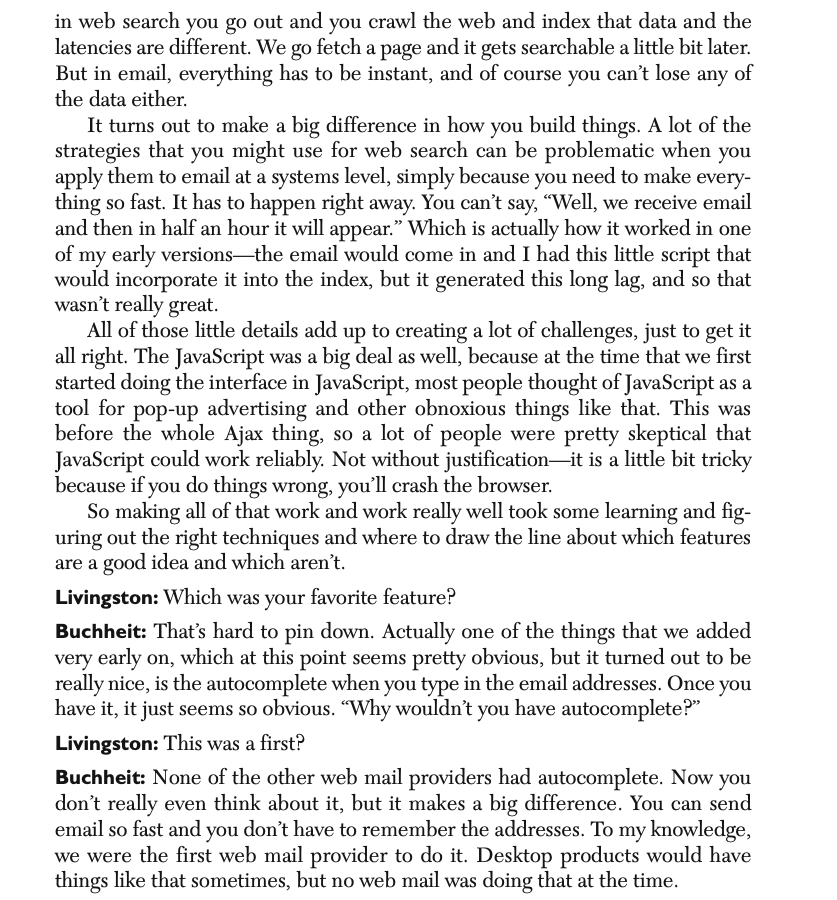
4/ But of course, how did Buchheit pick those 3? In his interview in Founders at Work, you get a sense that he iterated his way there.
So iteration matters, and picking a compelling core matters. Ok.
So iteration matters, and picking a compelling core matters. Ok.
5/ 3 years later, Slava Akhmechet wrote an extension to Buchheit's piece. He argued that product features may be categorised into 3 buckets:
1. Gamechangers
2. Showstoppers
3. Distractions
defmacro.org/2013/09/26/pro…
1. Gamechangers
2. Showstoppers
3. Distractions
defmacro.org/2013/09/26/pro…
6/ Like Buchheit, Slava argued that you only need 3 gamechanger features. (He used the word 'empirically', so I guess that's how you know it's serious shit).
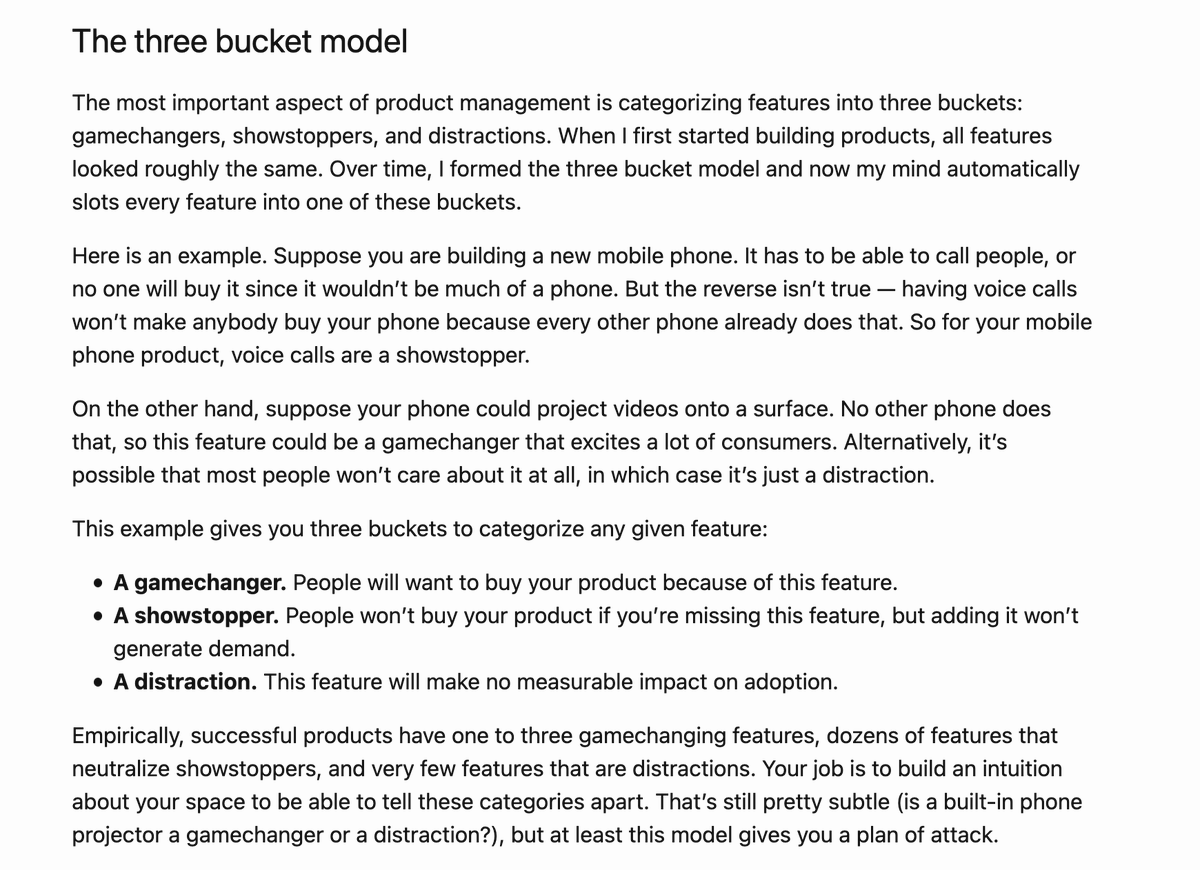
7/ So now we have some guardrails around our discussion. One aspect of product taste is the judgment necessary to differentiate between gamechangers, showstoppers, and distractions.
But how do you build this judgment?
But how do you build this judgment?
8/ I think @shreyas has a pretty good framework. He says that product sense decomposes to:
- Empathy
- Domain knowledge
- Creativity
- Empathy
- Domain knowledge
- Creativity
https://twitter.com/shreyas/status/1409247659613835265?s=20
9/ My only quibble is that he doesn't describe how he makes difficult product decisions himself.
But a model for how he thinks about evaluating other people's product ability is still useful! Shreyas argues you can improve in the first 2, and maaaybe the third.
But a model for how he thinks about evaluating other people's product ability is still useful! Shreyas argues you can improve in the first 2, and maaaybe the third.
10/ This seems similar to Slava's advice. Both authors write 'go talk to a lot of people (in your product domain)'. (See screenshot for Slava's exact words)
I've done this a lot, and can confirm it's common sense and it works.
I've done this a lot, and can confirm it's common sense and it works.
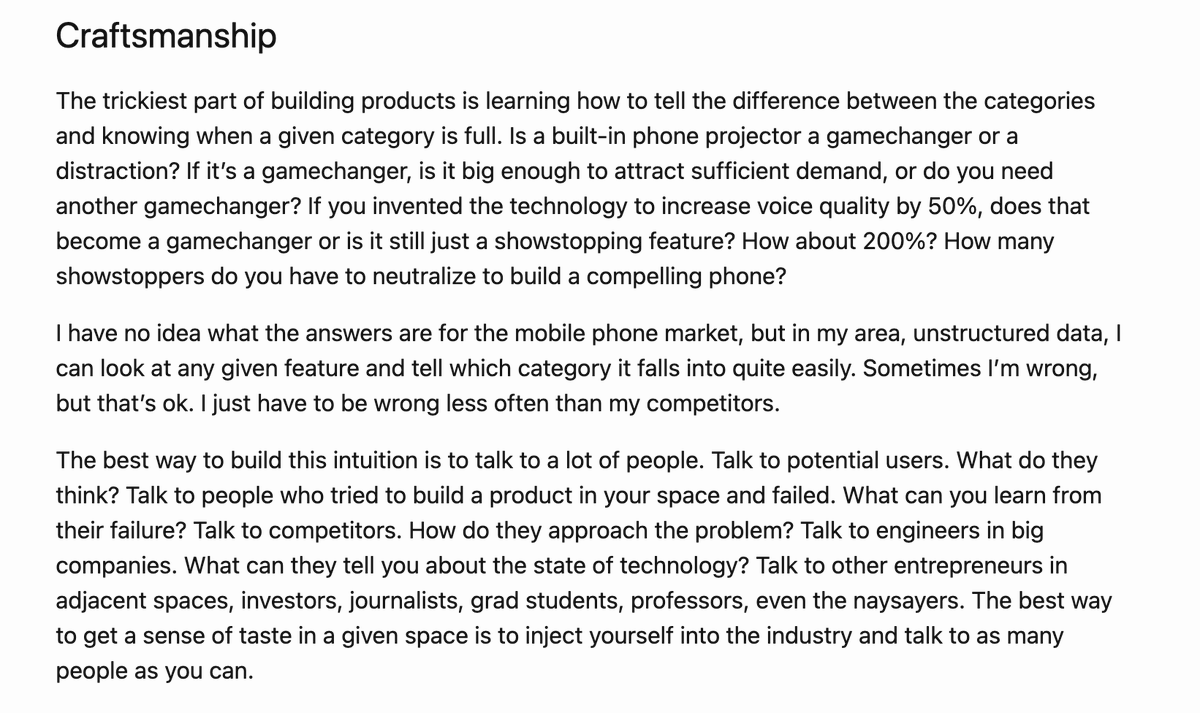
11/ But if you want to get at the inner mental models of product people exercising their judgment, what you'll want to get to is @rjs's summary of Christopher Alexander.
This is the good stuff. vimeo.com/491222729
This is the good stuff. vimeo.com/491222729
12/ I've always found Alexander incomprehensible. I think Singer's summary is the first time I've understood why so many good product people love Alexander. If you'd like a shorter summary, check out @edo's notes: edovanroyen.com/notes-of-ryan-…
13/ My 1 tweet pitch for the talk: how do the best product people design? They do so through iterations. They build something small, evaluate it, and then use that to inform the next.
Product taste in this context is the ability to pick the RIGHT order of things to design.
Product taste in this context is the ability to pick the RIGHT order of things to design.
14/ And Alexander's work is all about this 'step-by-step unfolding' process of design.
There's something deep and true about this that I didn't appreciate earlier, perhaps because I hadn't made enough mistakes. (A full accounting of my mistakes are in commoncog.com/blog/product-v…)
There's something deep and true about this that I didn't appreciate earlier, perhaps because I hadn't made enough mistakes. (A full accounting of my mistakes are in commoncog.com/blog/product-v…)
15/ To wrap up: good product people talk about taste and Christopher Alexander. (Or they don't, they just exercise taste). Novices talk about the trappings of process.
I couldn't resist, I made a meme for this:
I couldn't resist, I made a meme for this:

16/ This is a small section of my members-only post on product taste, found here: commoncog.com/blog/what-prod…
17/ Follow if you'd like more threads on business or career decision making. Or subscribe to the newsletter (which is like this, only with more career-related links): commoncog.com/blog/subscribe…
Thanks for reading!
Thanks for reading!
• • •
Missing some Tweet in this thread? You can try to
force a refresh






