
1/ I recently finished digging into a body of work around extracted tacit mental models of business expertise, and it is wild.
It turns out that business experts all share a common mental model of business, and you can do all sorts of interesting things if you have that model.
It turns out that business experts all share a common mental model of business, and you can do all sorts of interesting things if you have that model.
https://twitter.com/ejames_c/status/1416707600784060423
2/ Lia DiBello writes, of her work:
“… we noticed that highly talented business performers are very similar to each other. (…) business is an orderly closed system of relations between principles, and so-called intuitive experts in business have an implicit grasp of this.”
“… we noticed that highly talented business performers are very similar to each other. (…) business is an orderly closed system of relations between principles, and so-called intuitive experts in business have an implicit grasp of this.”
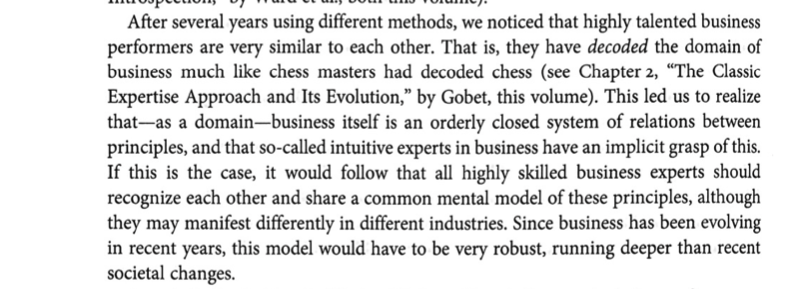
3/ That's an excerpt from her chapter in the Oxford Handbook of Expertise, a chonky book that I shouldn't have any right in owning.
The excerpt was so compelling I dove into Lia DiBello's entire publication history.
The excerpt was so compelling I dove into Lia DiBello's entire publication history.
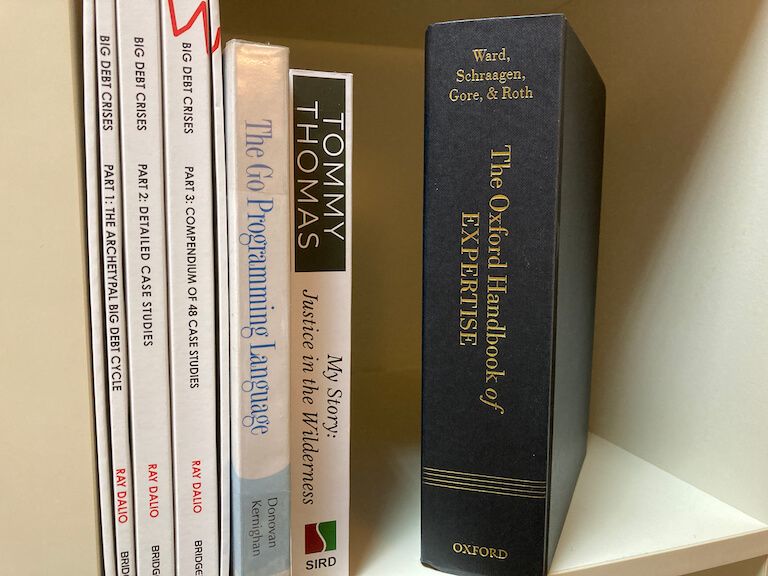
4/ What I found: DiBello has spent her entire career extracting tacit mental models of expertise from business experts.
To my surprise, she hasn't published as much, but that's mostly because she has spent the bulk of the past 20 years consulting for companies.
To my surprise, she hasn't published as much, but that's mostly because she has spent the bulk of the past 20 years consulting for companies.

5/ So what is that model? Glad you asked.
The basic idea is this:
Business expertise consists of two main things — domain-specific mental models, and a property called cognitive agility.
The domain-specific mental models map to a core shared model of business expertise.
The basic idea is this:
Business expertise consists of two main things — domain-specific mental models, and a property called cognitive agility.
The domain-specific mental models map to a core shared model of business expertise.
6/ That core shared mental model is basically a triad. For convenience we'll name it first, before diving in:
a) Supply
b) Demand
c) Capital
This is taken from her 2010 chapter in Informed by Knowledge (snippet below):
a) Supply
b) Demand
c) Capital
This is taken from her 2010 chapter in Informed by Knowledge (snippet below):
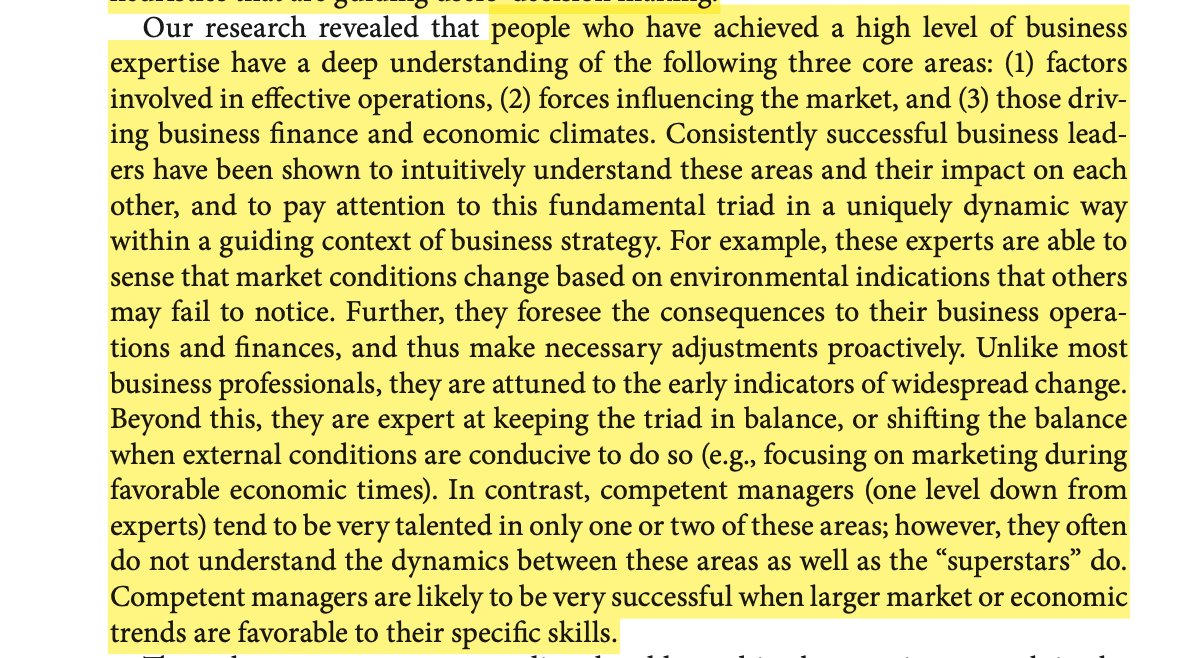
7/ It's important to understand that this triad is extremely general in nature. How it is expressed is radically different, depending on the industry.
So, for supply — factors involved in effective ops looks different in a yoghurt company vs a mining company vs a SaaS.
So, for supply — factors involved in effective ops looks different in a yoghurt company vs a mining company vs a SaaS.
8/ The key marker of skill is in the ability of the businessperson to intuitively understand how changes in one leg of the triad affects the other two legs.
This also explains how a good businessperson is able to recognise another good businessperson:
This also explains how a good businessperson is able to recognise another good businessperson:

9/ So for instance, if there's a change in the capital environment, how does that affect competition? (The market — the demand leg of the triad).
And what changes must the company make? (This is supply).
And what changes must the company make? (This is supply).
10/ DiBello also uses the names leadership/strategy/finance. To map it to our previous terms:
Supply — Leadership (factors that affect operations)
Demand — Strategy (factors that affect the market)
Capital — Finance (factors that affect business finance or access to capital)
Supply — Leadership (factors that affect operations)
Demand — Strategy (factors that affect the market)
Capital — Finance (factors that affect business finance or access to capital)
11/ How does this intuitive understanding of the triad express itself? DiBello's insight is that it allows the businessperson the ability to a) notice cues that novices do not, and b) predict changes as a result of those cues in each leg of the triad.
This was a profound insight
This was a profound insight
12/ It meant, for instance, that business expertise MAY BE EVALUATED. And that it may be trained.
Before we talk about the evaluation technique she invented, we need to talk about the second component of business expertise: cognitive agility.
Before we talk about the evaluation technique she invented, we need to talk about the second component of business expertise: cognitive agility.
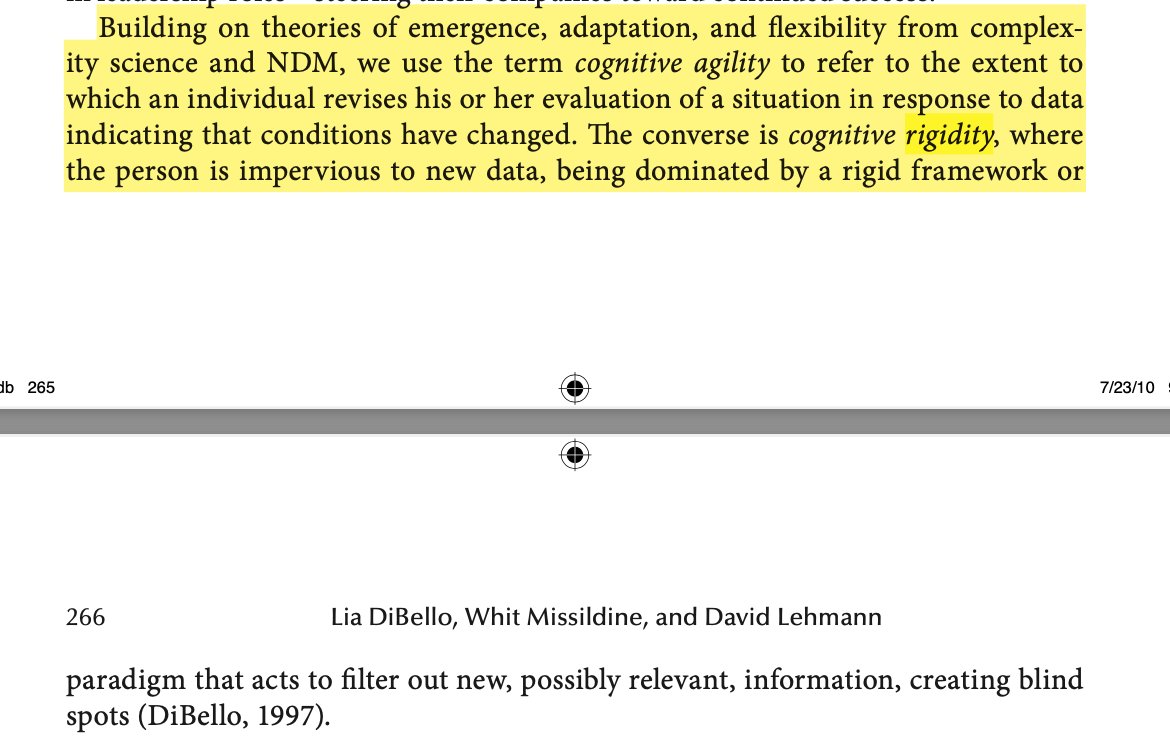
13/ Cognitive agility is defined as the ability of an exec to update his or her mental models in response to changing situations.
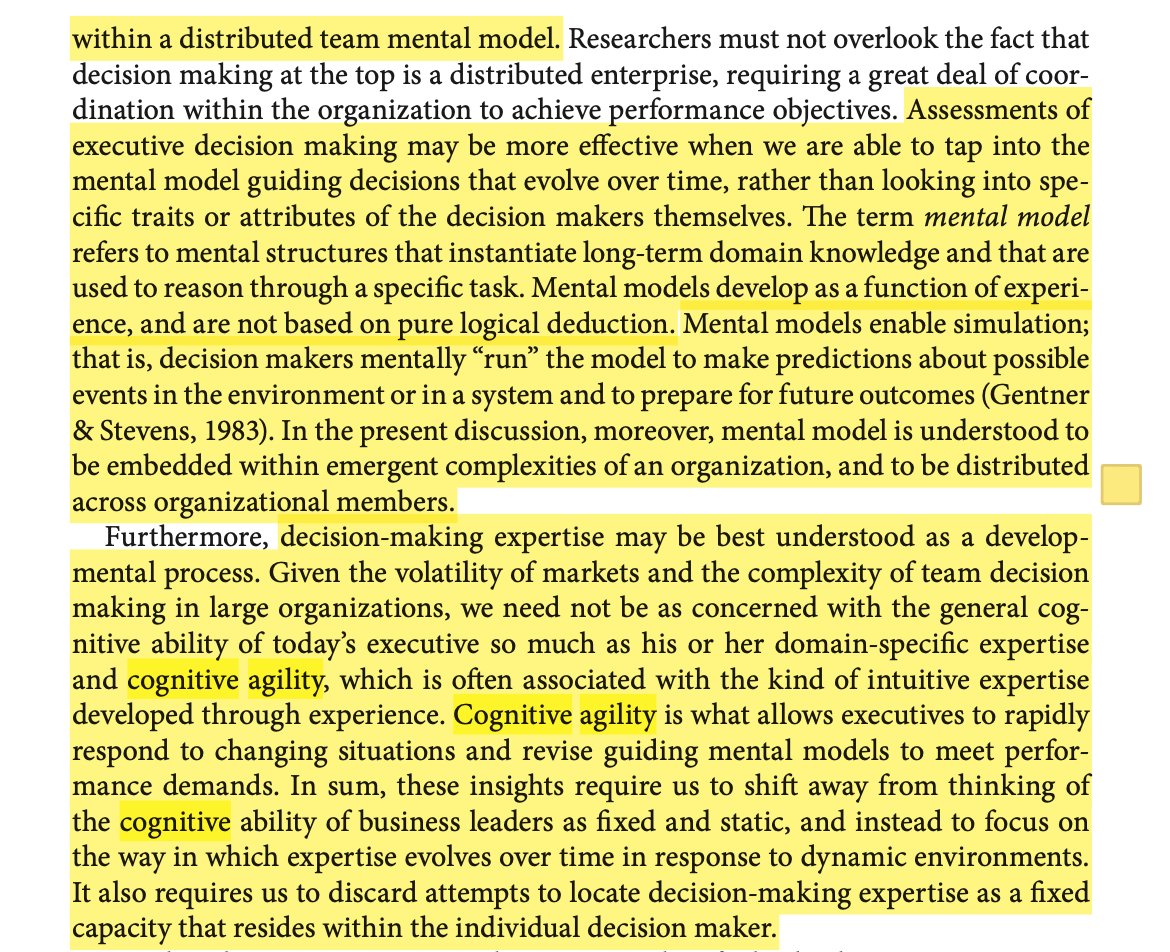
14/ Cognitive rigidity is the opposite: where the person is impervious to new data, and is 'dominated by a rigid framework or paradigm that acts to filter out new, possibly relevant, information, creating blind spots.
15/ This explains a LOT. I've written about how I am uncomfortable with frameworks in the past, because I've often been put in situations in business where no framework could fully explain the effects I saw around me. I've grappled with this topic a lot: commoncog.com/blog/reality-w…
16/ In fact, I've also observed that the WORST people to hire in a startup environment are those with high 'cognitive rigidity'. I even wrote an entire blog post attempting to pin down that property: commoncog.com/blog/dismissiv…
17/ DiBello got there more than a decade before I did. I was delighted to learn that other businesspeople have noticed:
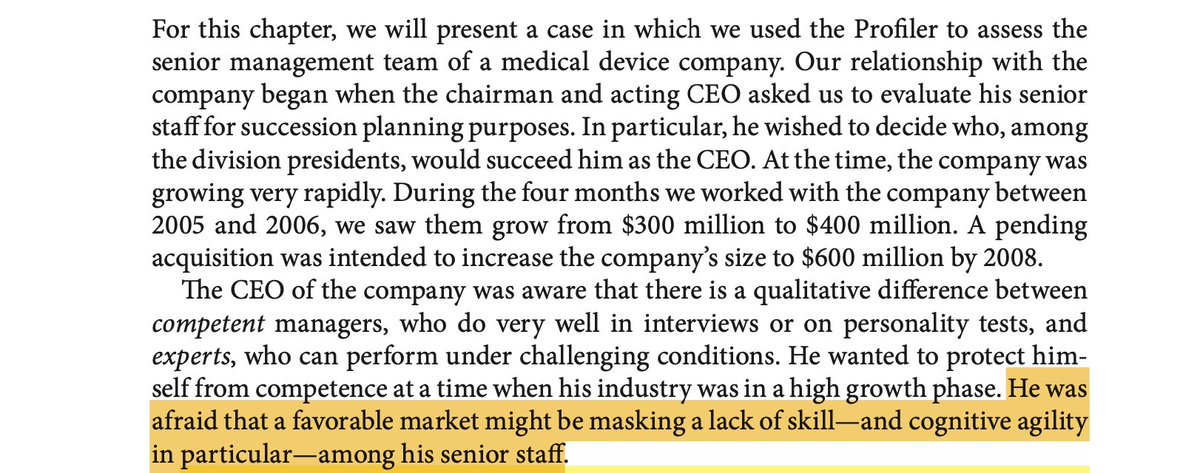
18/ The key point that DiBello makes re: cognitive agility is that it is by far the more important skill when it comes to business. More important than general problem solving ability.
And she developed a way to evaluate it, too.
And she developed a way to evaluate it, too.
19/ I'm skipping over a lot of methodological detail to justify the assessment, which you can read in the actual paper:
One last thing before we talk about the assessment. Expertise in a given company is by nature a form of distributed cognition.wtri.com/wp-content/upl…
One last thing before we talk about the assessment. Expertise in a given company is by nature a form of distributed cognition.wtri.com/wp-content/upl…
20/ The implication is that the entire exec team has to be evaluated together, because deficiencies in some legs of the triad may be shored up if some members have it and others don't. The best business experts have all 3, of course.
But a team can collectively have all 3 too.
But a team can collectively have all 3 too.
21/ DiBello's core innovation is something called a Profiler. It takes a similar company in the same industry, extracts public information about said company, and then presents it to execs.
The execs are asked to predict performance of that company, given cues in the data.
The execs are asked to predict performance of that company, given cues in the data.
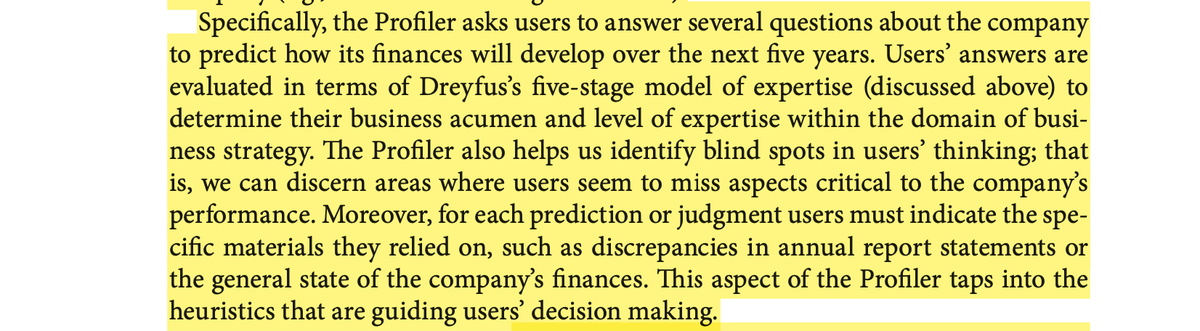
22/ The questions ask users to evaluate that company with respect to its (you guessed it!) strategy, leadership, and finances.
These questions are predictive of expertise because they map closely to real world decision-making these execs have to make.
These questions are predictive of expertise because they map closely to real world decision-making these execs have to make.
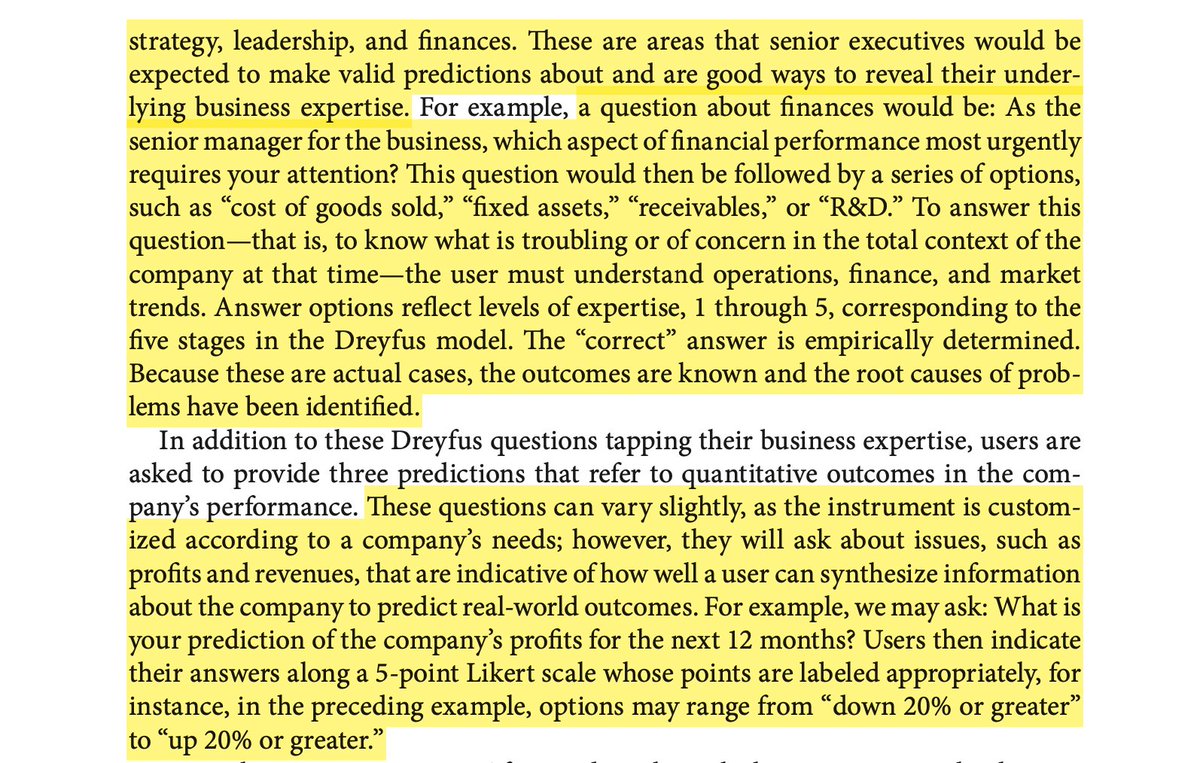
23/ Then, the users are presented with the next year of results, and they are given feedback on their predictions.
This is how DiBello is able to evaluate cognitive agility.
This is how DiBello is able to evaluate cognitive agility.
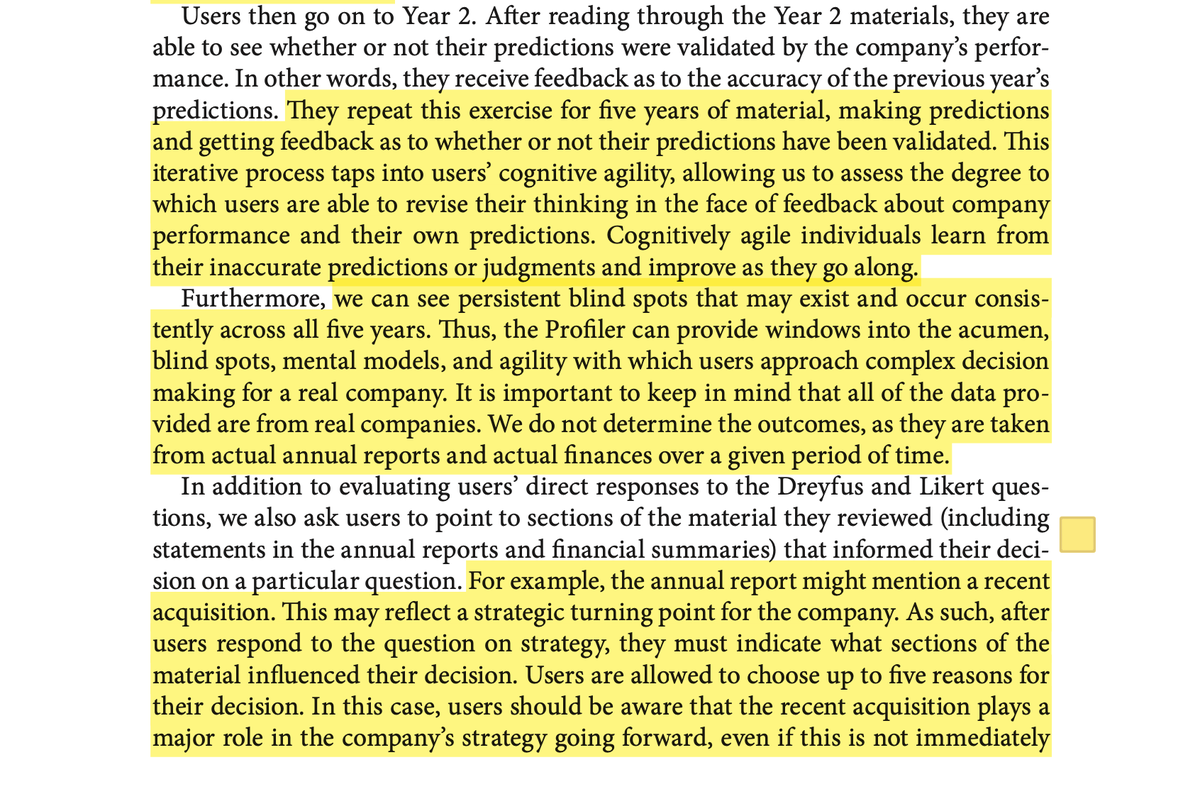
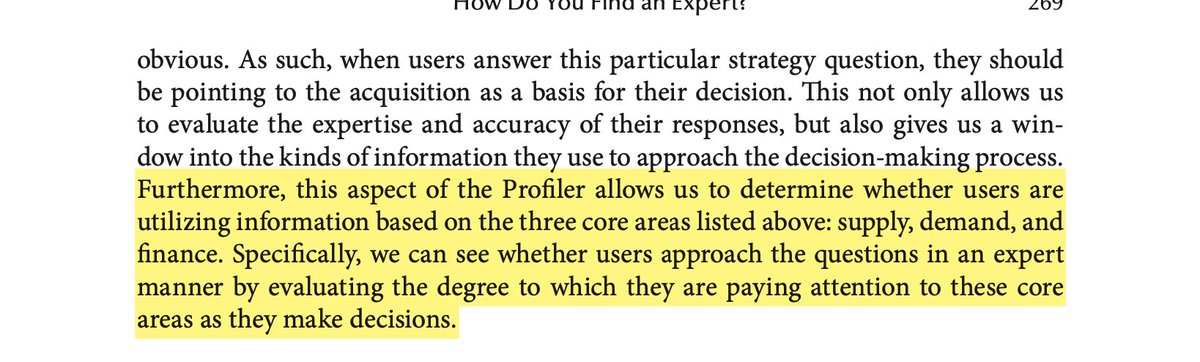
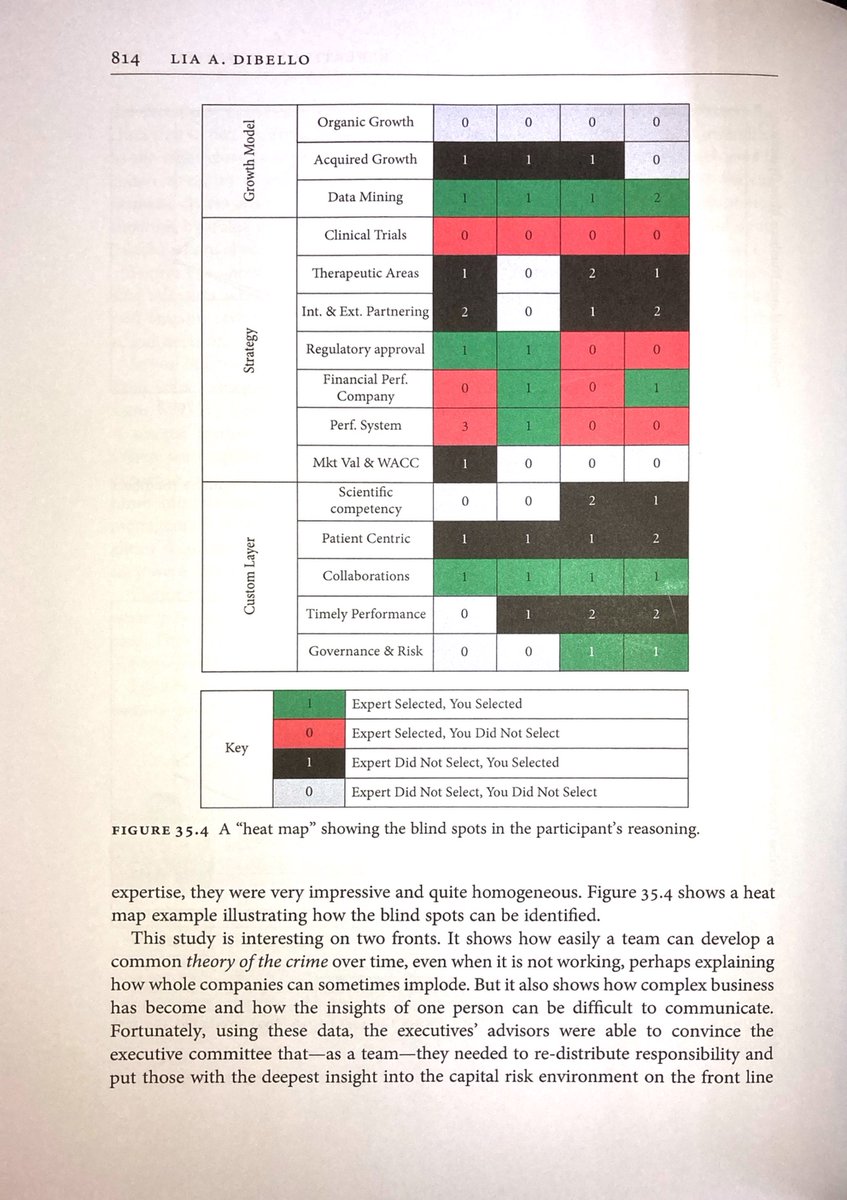
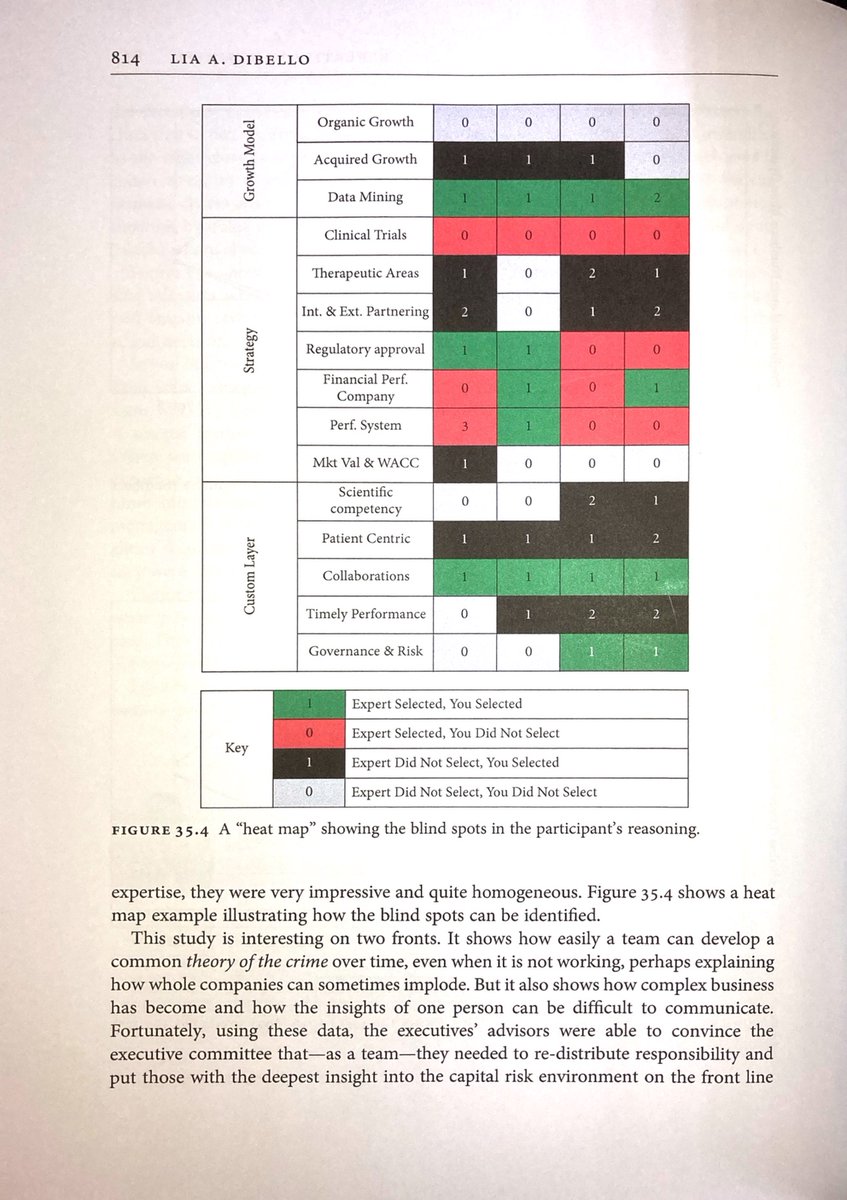
24/ The end result is that DiBello and team can generate a heatmap of exec team blindspots, and use that to guide their interventions/training.
Here's a picture of an actual Profiler heatmap of an exec team:
Here's a picture of an actual Profiler heatmap of an exec team:
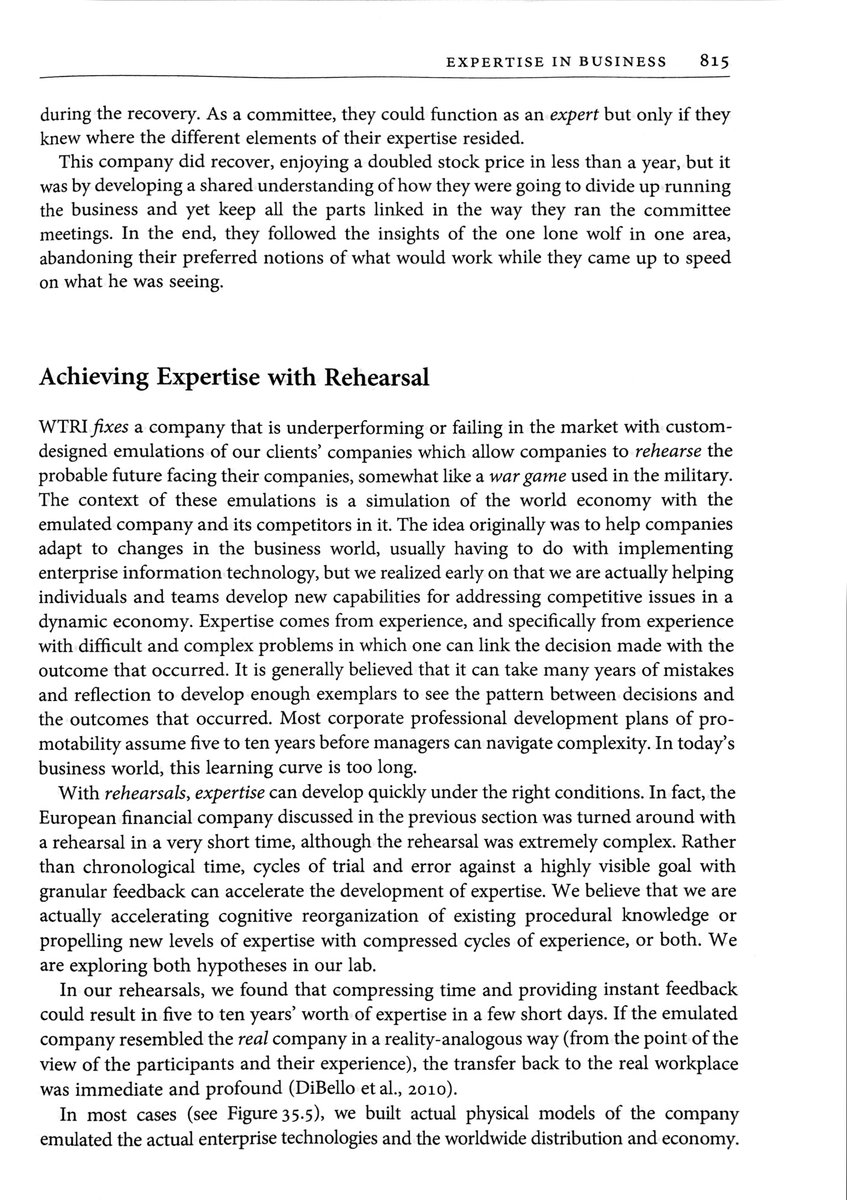
25/ Some of these intervention stories are wild. For instance, DiBello and team was called to do an assessment for a financial services company in the wake of the 2007 financial crisis. The exec team disagreed with the CEO and wanted to oust him. (Oxford Handbook):
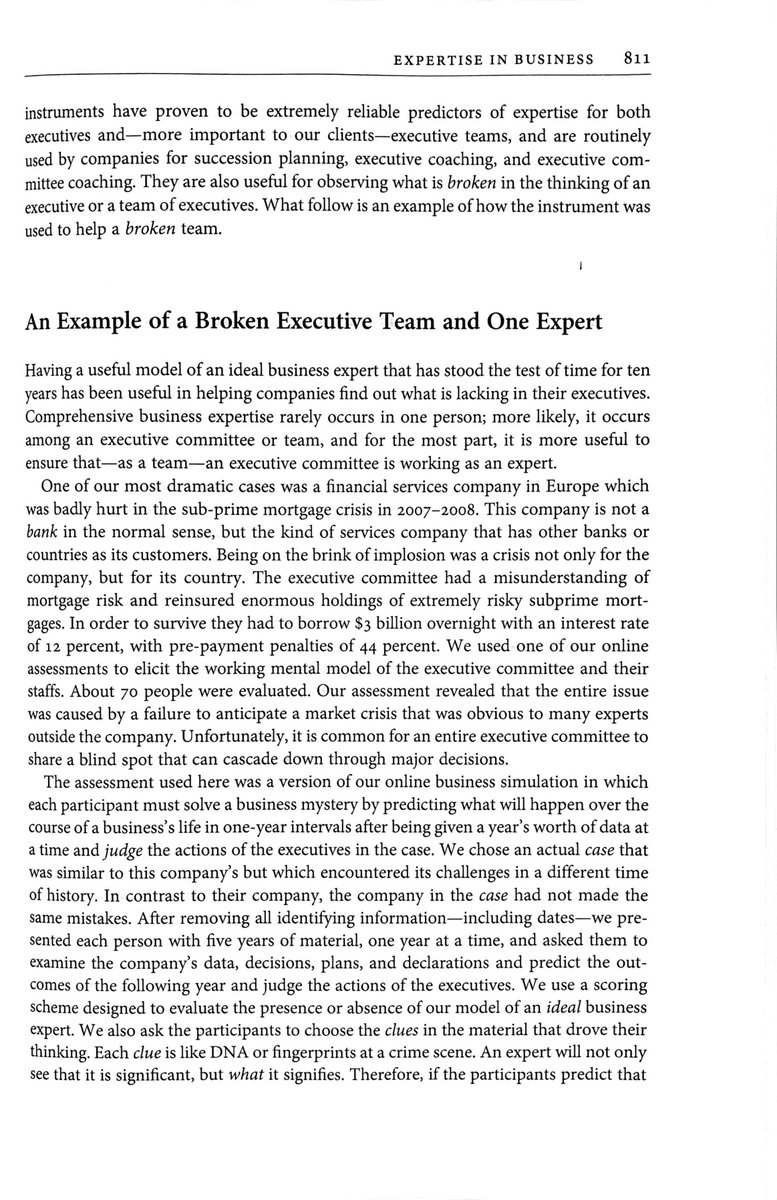
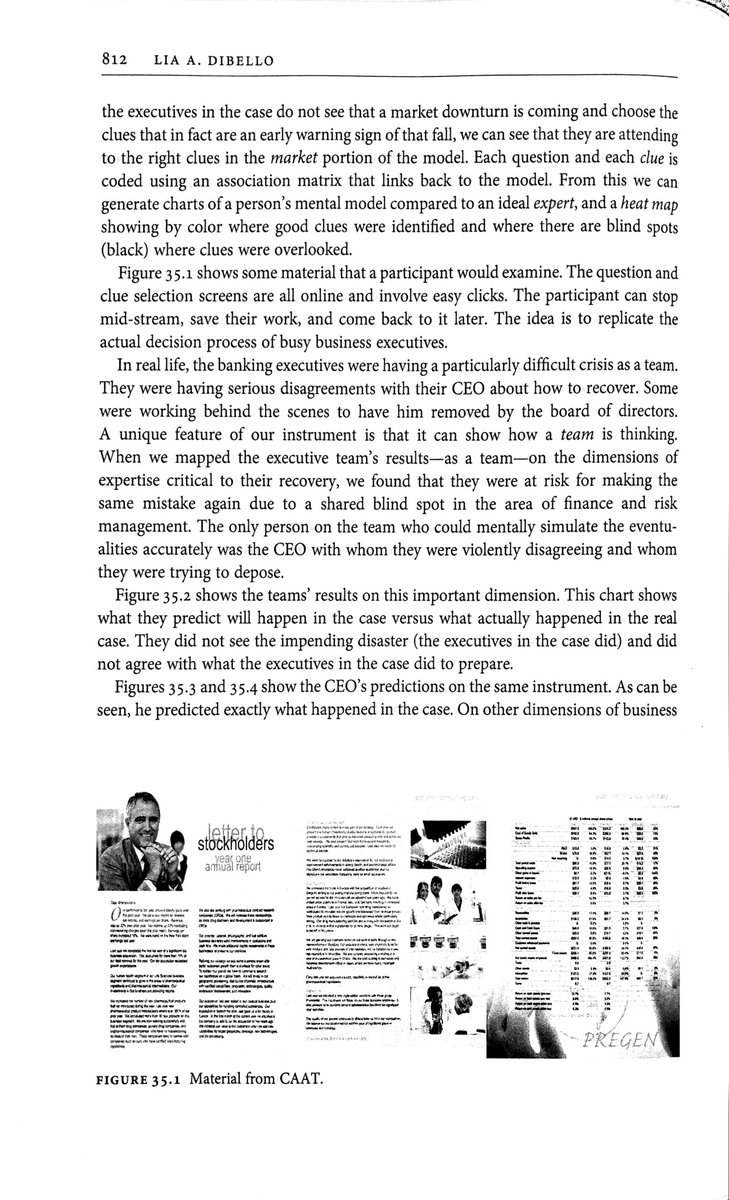
26/ But only the CEO showed high predictive accuracy for financial risk in the Profiler. With the results of the cognitive assessment, DiBello and team convinced the board of the firm not to fire the CEO.
Like I said, wild.
Like I said, wild.
27/ DiBello believes that business expertise relies not on superior analysis, but is instead on better organisation of knowledge, which allows the expert to perceive better, and therefore make better decisions.
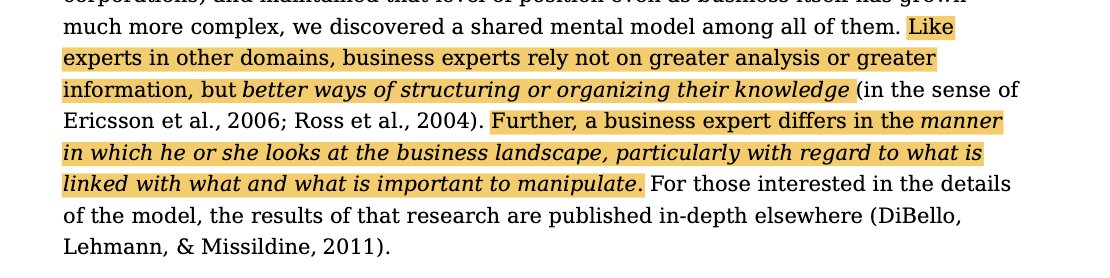
28/ As a result, her training methods focus on 'cognitive reorganisation' — she doesn't really aim to teach new mental models, but instead attempts to reorganise what existing domain-specific models they already have, perhaps by establishing the triad organisation in their heads.
29/ Ok, this is the high-level thread. I've written about this body of work (and linked to all the relevant papers) in this week's Commonplace members-only post: commoncog.com/blog/tacit-men…
30/ This happens to be Part 7 of my series on tacit knowledge, but also the first part of a new series on tacit business expertise. DiBello's work is fascinating enough that there are still a few elements I have yet to explore.
commoncog.com/blog/the-tacit…
commoncog.com/blog/the-tacit…
31/ For instance, how can we use this if we are business practitioners? My instinct is to use the core expertise model as a syllabus for learning.
Knowing that shape of business expertise looks like a triad of relationships is VERY useful to know.
Knowing that shape of business expertise looks like a triad of relationships is VERY useful to know.
32/ But the truth is that I'll have to test all of that. And I haven't even gotten into the meat of DiBello's training work.
(Again, if you're not aware, she contributed to Accelerated Expertise, a book prepared for the DoD on accelerating trial and error cycles).
(Again, if you're not aware, she contributed to Accelerated Expertise, a book prepared for the DoD on accelerating trial and error cycles).
33/ Follow if you'd like more tweets on business or career decision making. I have one on 7 Powers in action that I particularly like:
https://twitter.com/ejames_c/status/1403915367655776259?s=20
34/ Or subscribe to my newsletter, if you'd like notifications on new pieces:
The end!commoncog.com/blog/subscribe…
The end!commoncog.com/blog/subscribe…
• • •
Missing some Tweet in this thread? You can try to
force a refresh






