Deadly heat waves have swept the globe and will continue to because of climate change.
The trends are prompting doomsday questions: Will parts of the world soon become too hot to live in? How will we survive? washingtonpost.com/world/interact…
When it comes to heat, the human body is remarkably resilient — it’s the humidity that makes it harder to cool down.
And humidity, driven in part by climate change, is increasing. wapo.st/3f82hGG
A measurement of the combination of heat and humidity is called a “wet-bulb temperature,” a metric scientists are using to figure out which regions of the world may become too dangerous for humans. washingtonpost.com/weather/2021/0…
At a certain threshold of heat and humidity, “it’s no longer possible to be able to sweat fast enough to prevent overheating,” said Radley Horton, a professor at Columbia University’s Lamont-Doherty Earth Observatory. wapo.st/3f82hGG
You might think that being closer to the beach would be a great way to catch that ocean breeze and cool off.
But Horton said proximity to water in extreme conditions could make things worse. wapo.st/3f82hGG
Scientists have found that Mexico and Central America, the Persian Gulf, India, Pakistan and Southeast Asia are all careening toward dangerous thresholds of heat and humidity before the end of the century. wapo.st/3f82hGG
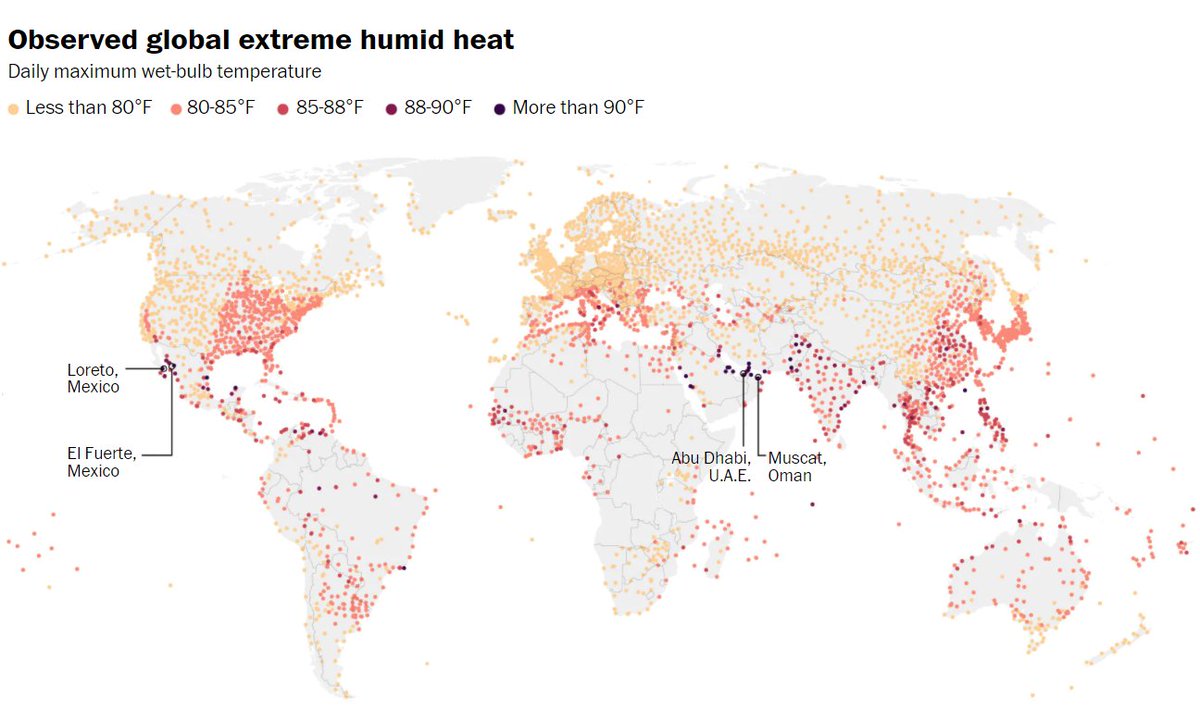
To better understand why these places are becoming too hot and humid for humans to endure, you have to first understand how the body cools itself.
Goods from nations with which the U.S. does hundreds of billions of dollars of trade, such as India, Switzerland and South Africa, will see new taxes of up to 39 percent, with India’s rate set to jump to 50 percent in three weeks.
Tariffs are like a sales tax applied at the border to an importer.
They're an opportunity to raise public revenue and can theoretically incentivize domestic production and protect certain industries from being undercut by foreign competitors.
President Trump announced full bans on 12 countries and partial bans on seven others on Wednesday. They are set to go in effect on June 9.
Here’s what you need to know:
The countries with a full ban are Afghanistan, Myanmar, Chad, Republic of Congo, Equatorial Guinea, Eritrea, Haiti, Iran, Libya, Somalia, Sudan and Yemen.
While Burundi, Cuba, Laos, Sierra Leone, Togo, Turkmenistan and Venezuela are affected by a partial ban.
How were the countries with travel bans selected? Trump said it’s in the interest of national security, writing that the U.S. must ensure those admitted to the country “do not bear hostile attitudes toward its citizens, culture, government, institutions, or founding principles.”
As the coronavirus tore through the world in 2020, and the United States confronted a shortage of tests designed to detect the illness, then-President Donald Trump secretly sent coveted tests to Russian President Vladimir Putin for his personal use. washingtonpost.com/politics/2024/…
Putin accepted the supplies but took pains to prevent political fallout.
He cautioned Trump not to reveal that he had dispatched the scarce medical equipment to Moscow, according to “War,” a new book by Washington Post associate editor Bob Woodward. washingtonpost.com/politics/2024/…
Four years later, the personal relationship between the two men appears to have persisted, Woodward reports, as Trump campaigns to return to the White House and Putin orchestrates his bloody assault on Ukraine.
Mark Robinson, the firebrand Republican nominee for governor in North Carolina, has for years made comments downplaying and making light of sexual assault and domestic violence. wapo.st/3KQffZ6
A review of Robinson’s social media posts over the past decade shows that he frequently questioned the credibility of women who aired allegations of sexual assault against prominent men, including Harvey Weinstein, Bill Cosby and now-U.S. Supreme Court Justice Brett M. Kavanaugh. wapo.st/3KQffZ6
In one post, Robinson, North Carolina’s lieutenant governor, characterized Weinstein and others as “sacrificial lambs” being “slaughtered.” wapo.st/3KQffZ6
Exclusive: A Washington Post investigation has found that over the past two decades, hundreds of law enforcement officers in the United States have sexually abused children while officials at every level of the criminal justice system have failed to protect kids, punish abusers and prevent additional crimes. wapo.st/3XiNgZC
The Post conducted an exclusive analysis of the nation’s most comprehensive database of police crimes.
From 2005 through 2022, reporters identified at least 1,800 state and local law enforcement officers who were charged with crimes involving child sexual abuse. wapo.st/3XiNgZC
Police and court documents show that abusive officers frequently spent months befriending and grooming kids.
Many used the threat of arrest or physical harm to make their victims comply. wapo.st/3XiNgZC
Exclusive: For decades, Catholic priests raped or molested Native American children who were taken from their homes by the U.S. government and forced to live at remote boarding schools, a Post investigation found. wapo.st/3yB2VZT
At least 122 priests, sisters and brothers assigned to 22 boarding schools since the 1890s were later accused of sexually abusing Native American children under their care, The Post found. wapo.st/3yB2VZT
Most of the documented abuse occurred in the 1950s and 1960s and involved more than 1,000 children.
Experts say the The Post’s findings are a window into the widespread sexual abuse at Indian boarding schools. wapo.st/3yB2VZT