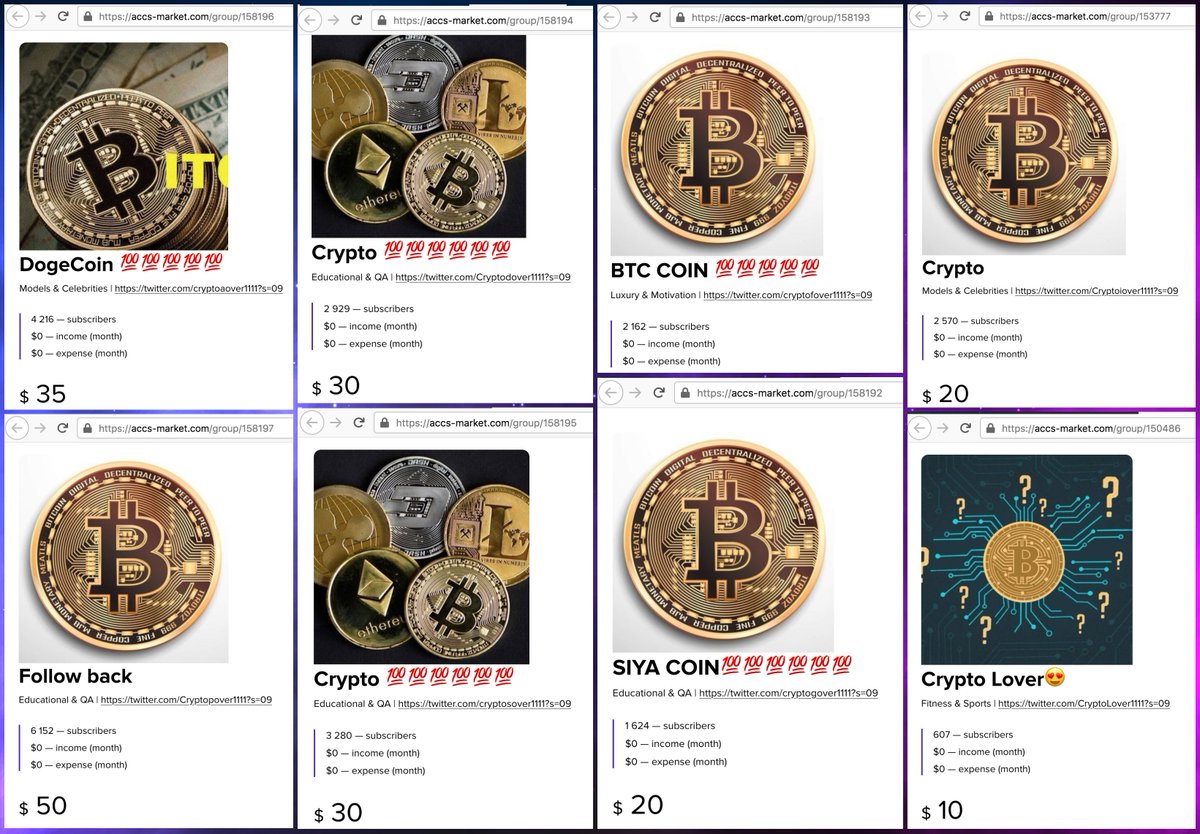
In addition to the eight accounts presently up for sale, we found two others with the same naming scheme: @cryptotover1111 and @cryptouover1111. All ten accounts were created in 2021 and have tweeted/retweeted a small amount of cryptocurrency content via Twitter for Android.
(BTW, buying/selling Twitter accounts is against TOS, and websites offering such services should be regarded as potentially unsafe and one should take precautions when visiting then, such as using Tor.)
Interestingly, @cryptoaover1111 and its nine similarly-named friends have a lot of the same followers. These appear to be a mix of legitimate cryptocurrency accounts, followback accounts, and various spam networks.
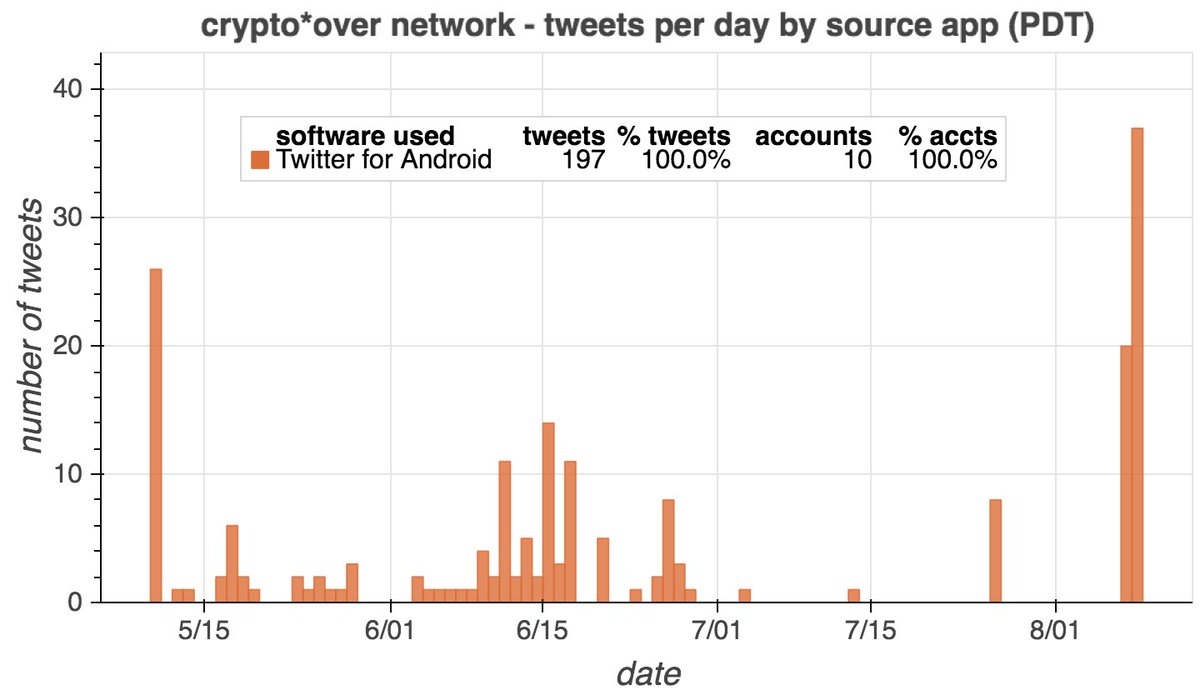
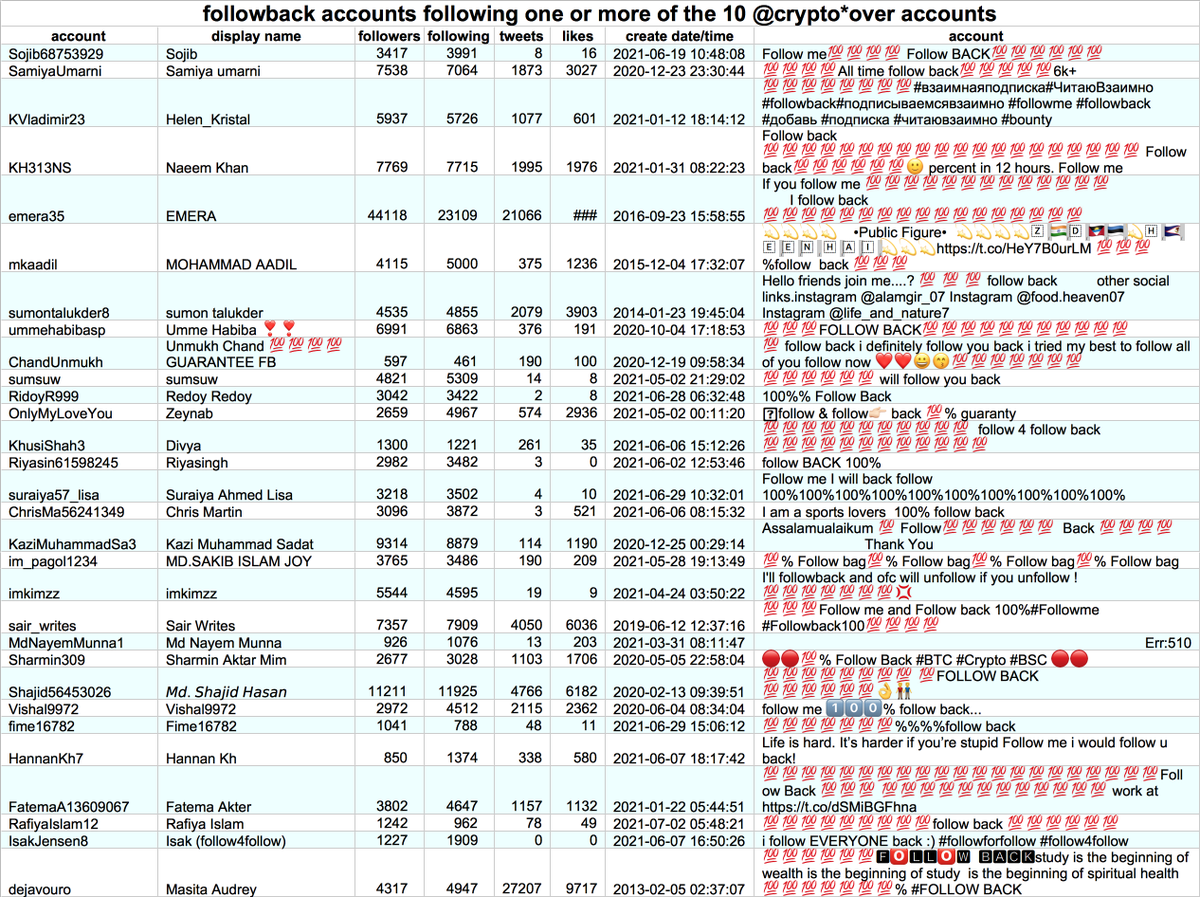
4022 of the accounts following one or more of the ten crypto*over1111 accounts are "followback" accounts - accounts that advertise in their profiles that they will follow any account back. This table shows some examples:
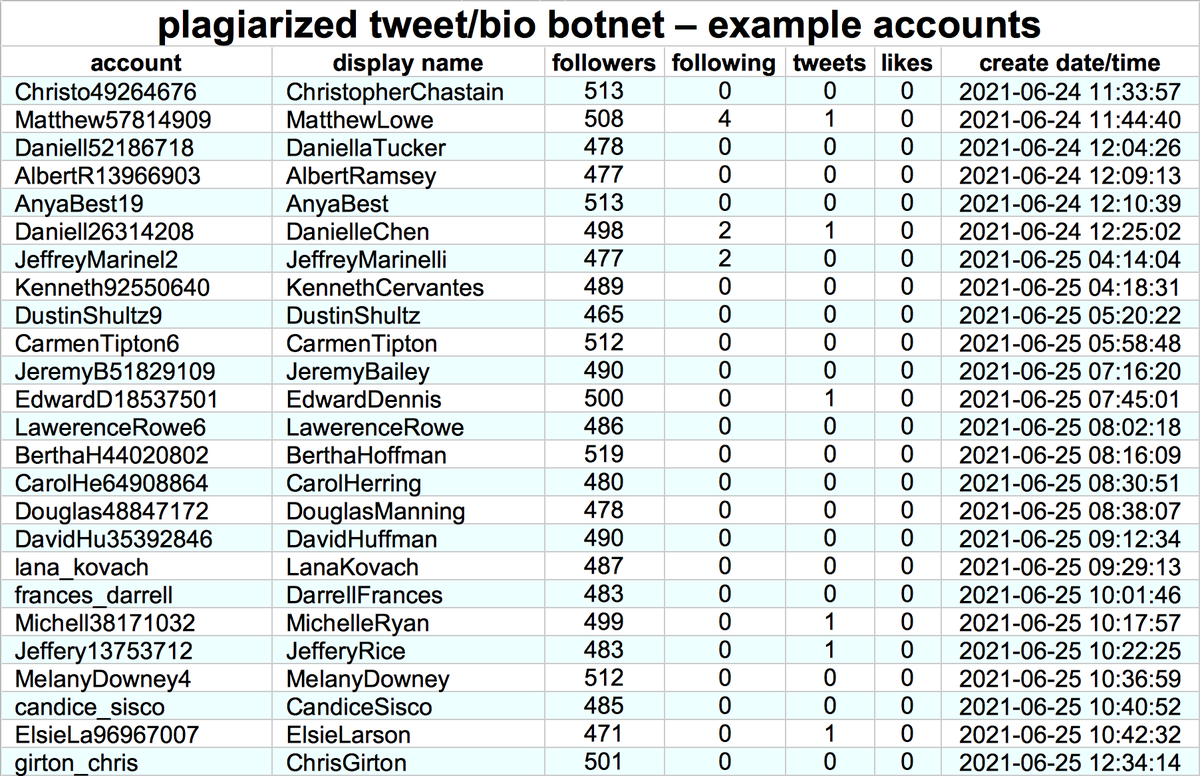
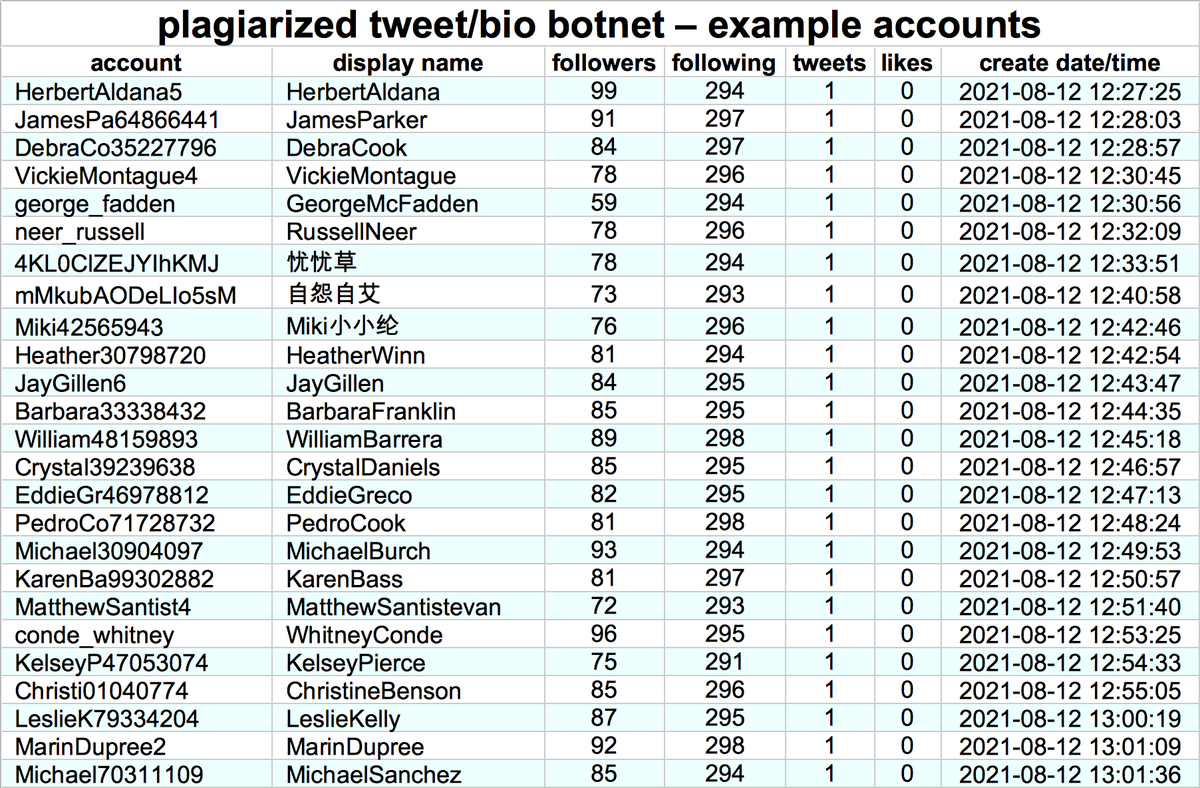
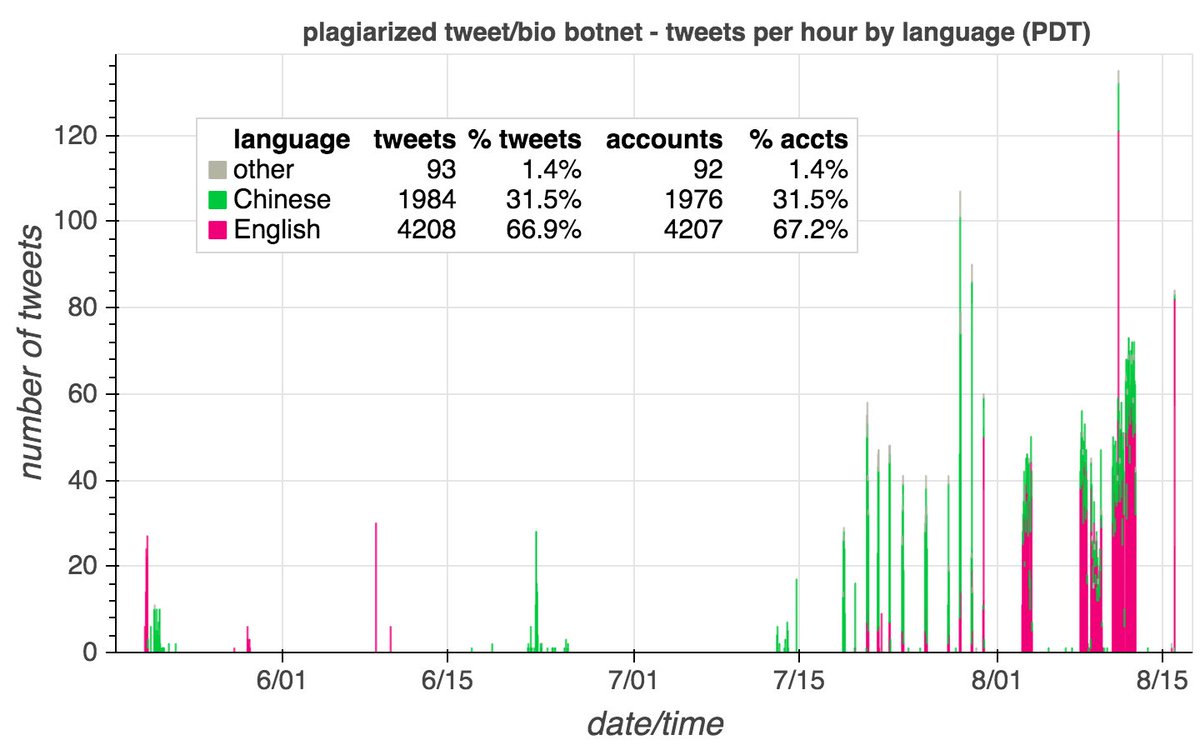
89 of the most recent followers of @cryptoaover1111 and its nine similarly-named friends are part of a much larger botnet whose members (so far) mostly follow one another. (The plagiarism mentioned in the graph title is explained further down the thread.)
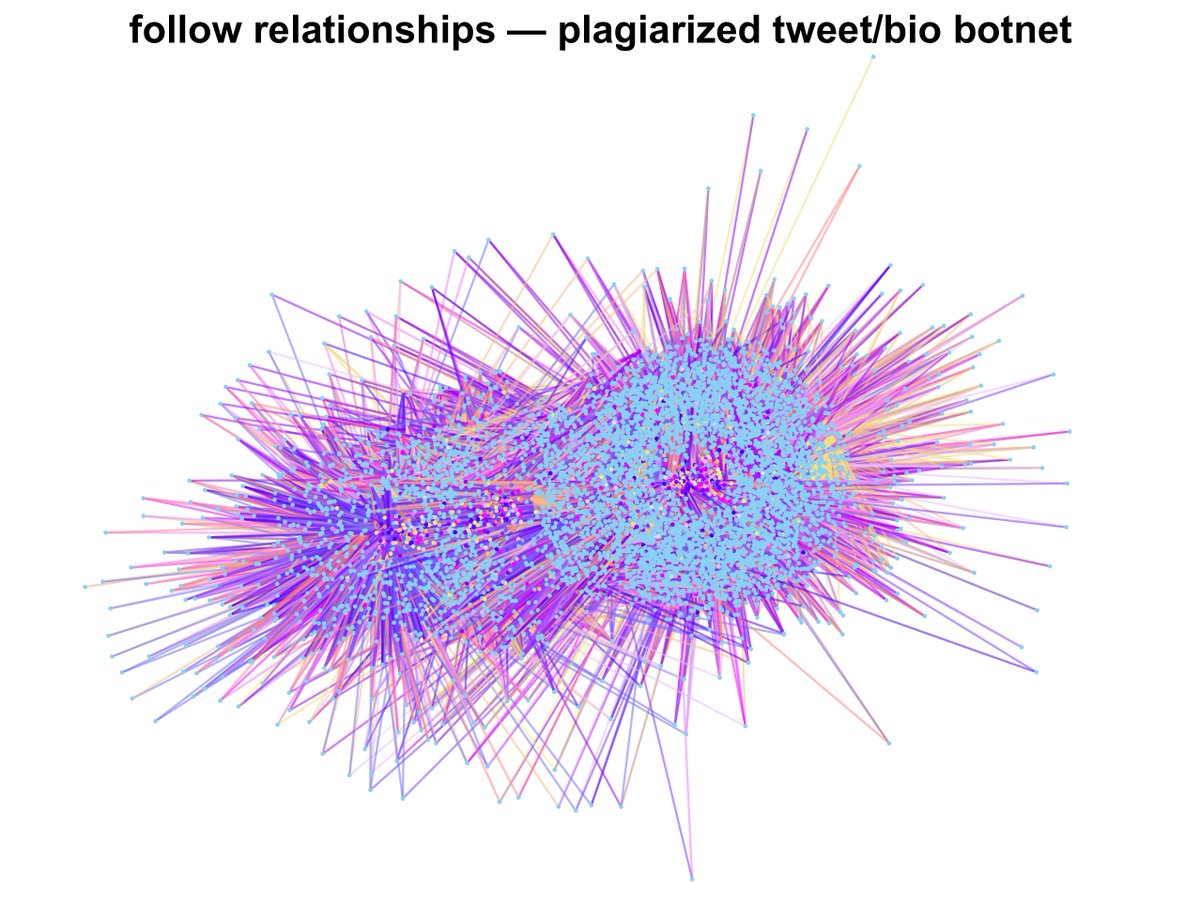
This botnet consists of 6716 accounts created in batches between May and August 2021. Most have tweeted exactly once, although some have no tweets and a few have up to five. None has ever liked a tweet, and all follow hundreds or thousands of other members of the botnet.
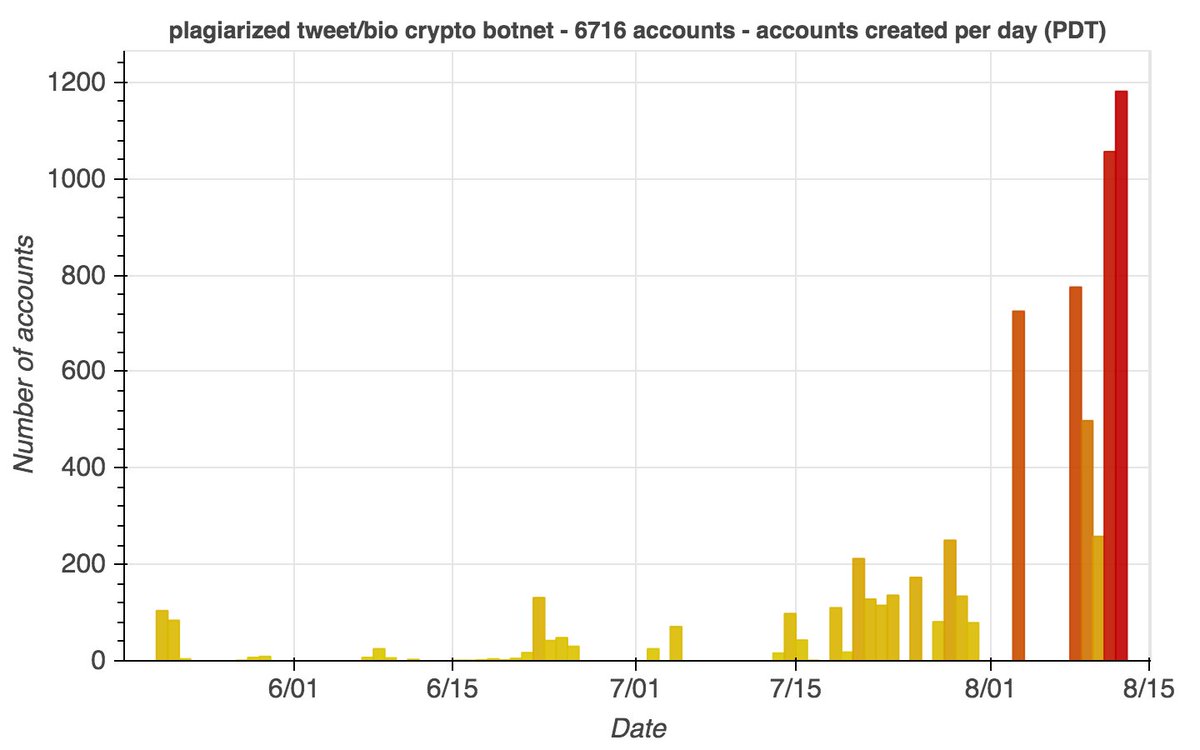
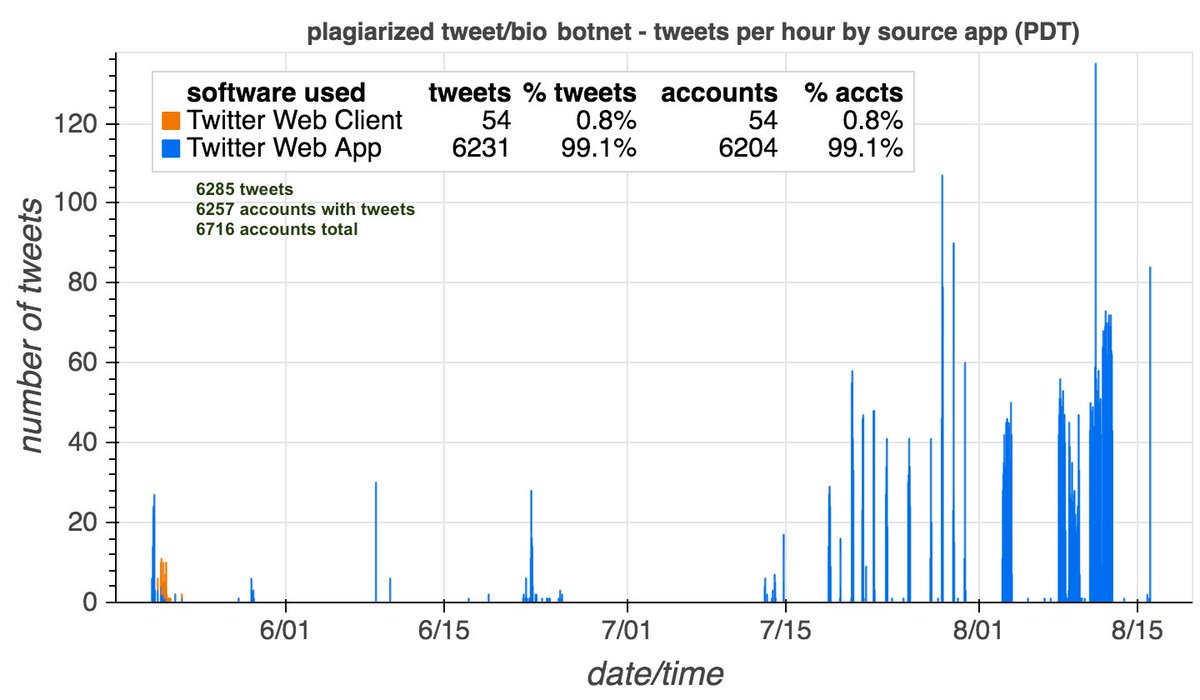
This network has (allegedly) posted all of its tweets thus far with Twitter web products, both the current "Twitter Web App" and the "Twitter Web Client" that Twitter shut down a year before these accounts were created. Tweet content is in a mix of English and Chinese.
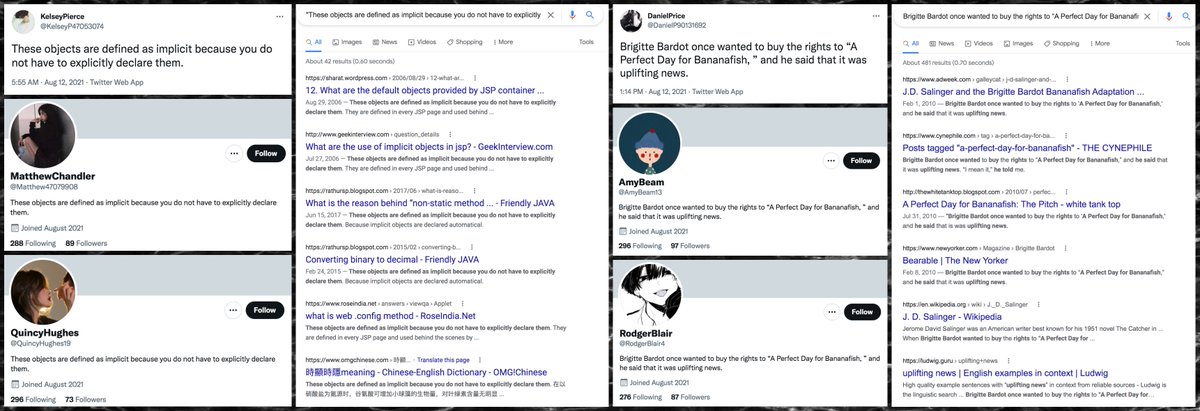
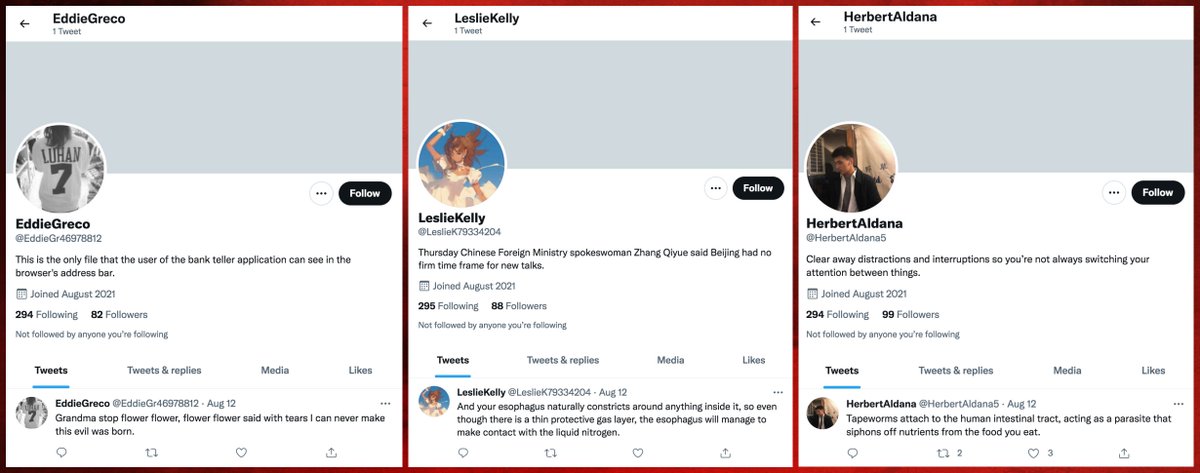
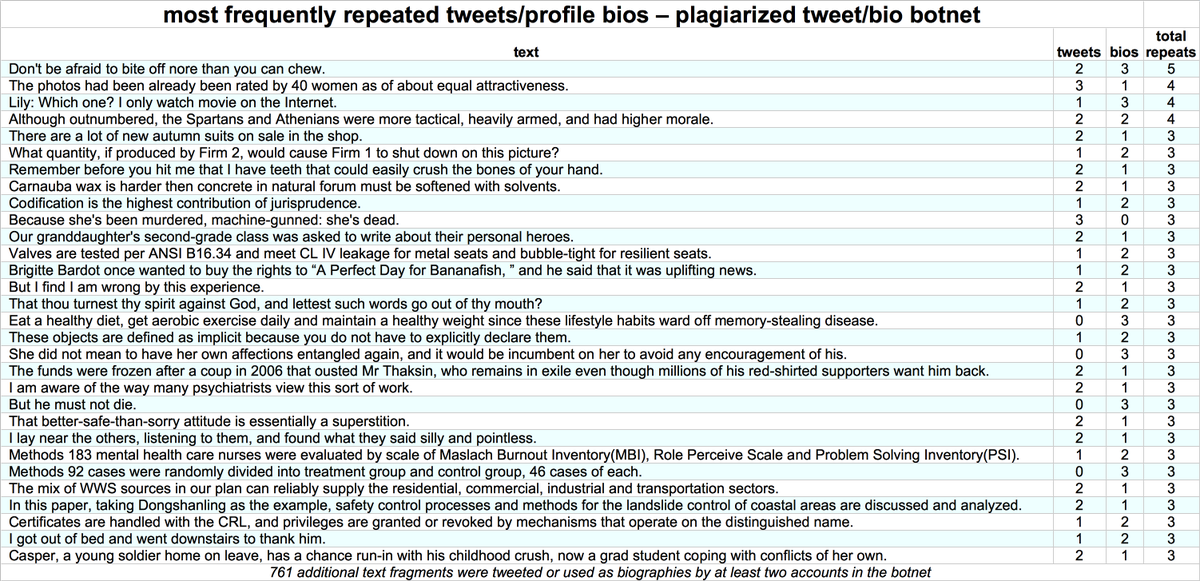
The accounts in this botnet use the same pool of repeated phrases for both tweet content and profile biographies. The phrases appear to be plagiarized from all over the internet, and are centered on no particular topic.
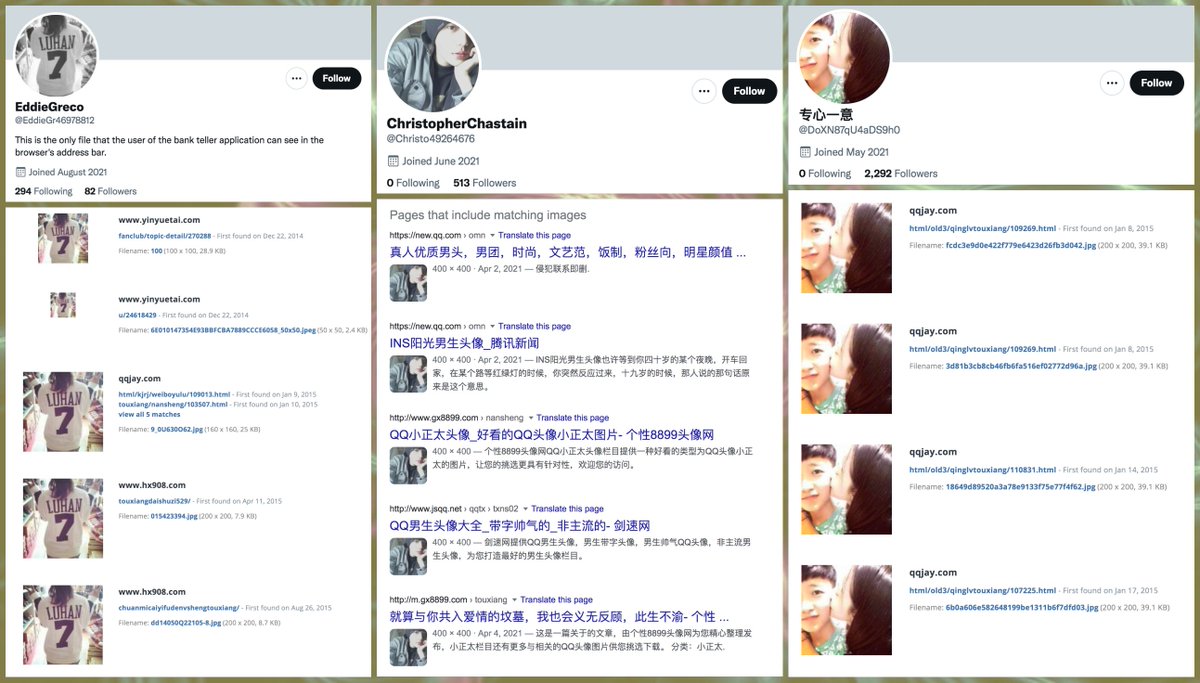
As with their tweet content and biographies, the profile images used by these bots are stolen. (A few have default pics rather than stolen ones.) TinEye and Google outperformed Yandex at tracking down previous uses of this set of images.
• • •
Missing some Tweet in this thread? You can try to
force a refresh

Some thoughts on perennial pitfalls in news coverage of social media manipulation that frequently result in reporting on fake accounts/bots/etc being far less accurate and informative than it ought to be...
The most common problem with news articles about fake accounts: failure to include any examples of fake accounts or evidence of their inauthenticity. Any or all of these headlines might be accurate, but you can't tell from the articles, due to absence of evidence.
A related issue: articles like the "Nearly Half of Biden/Trump's Followers Are Fake" and "Nearly Half Of Accounts Tweeting About Coronavirus Are Bots" pieces base their numbers on closed-source third party tools, which may or may not actually be detecting anything useful.
Former BNN employee Michael Gordon Douglas aka "Chicago Mike" has been found guilty of CSAM distribution.
In light of this, it's worth revisiting disinformation propagated by BNN and others to make excuses for Mr. Douglas's illegal content-related X/Twitter ban(s).
The disinfo in question originated somewhere seemingly unrelated, with false claims that several people (including me) were using a magic "console" to ban X users on behalf of Ron DeSantis. This hoax was invented by Texas bullshit purveyor Steven Jarvis.
Steven Jarvis peddled his "console" theory to BNN founder Gurbaksh Chahal, and when BNN employee Michael Gordon Douglas's @ChicagoMikeSD X account was suspended in early 2023, BNN published an article falsely attributing the ban to the imaginary "console". web.archive.org/web/2023012507…
Does thanking, praising, or insulting an LLM-based chatbot affect the speed or accuracy of its responses to questions involving basic arithmetic? Let's find out!
For this experiment, Meta’s Llama 3.1 model was asked to add and multiply random numbers between 10 and 100, with six different wordings: polite, rude, obsequious, urgent, and short and long neutral forms. Each combination of math operation and wording was tested 1000 times.
Results: asking the questions neutrally yielded a faster response than asking politely, rudely, obsequiously, or urgently, even if the neutral prompt was longer. Overall, obsequious math questions took the longest to process, followed by urgent, rude, and polite questions.
Just for fun, I decided to search Amazon for books about cryptocurrency a couple days ago. The first result that popped up was a sponsored listing for a book series by an "author" with a GAN-generated face, "Scott Jenkins".
cc: @ZellaQuixote
Alleged author "Scott Jenkins" is allegedly published by publishing company Tigress Publishing, which also publishes two other authors with GAN-generated faces, "Morgan Reid" and "Susan Jeffries". (A fourth author uses a photo of unknown origin.)
As is the case with all unmodified StyleGAN-generated faces, the facial feature positioning is extremely consistent between the three alleged author images. This becomes obvious when the images are blended together.
The people in these Facebook posts have been carving intricate wooden sculptures and baking massive loaves of bread shaped like bunnies, but nobody appreciates their work. That's not surprising, since both the "people" and their "work" are AI-generated images.
cc: @ZellaQuixote
In the last several days, Facebook's algorithm has served me posts of this sort from 18 different accounts that recycle many of the same AI-generated images. Six of these accounts have been renamed at least once.
The AI-generated images posted by these accounts include the aforementioned sculptures, sad birthdays, soldiers holding up cardboard signs with spelling errors, and farm scenes.
The common element: some sort of emotional appeal to real humans viewing the content.
As Bluesky approaches 30 million users, people who run spam-for-hire operations are taking note. Here's a look at a network of fake Bluesky accounts associated with a spam operation that provides fake followers for multiple platforms.
cc: @ZellaQuixote
This fake follower network consists of 8070 Bluesky accounts created between Nov 30 and Dec 30, 2024. None has posted, although some have reposted here and there. Almost all of their biographies are in Portuguese, with the exception of a few whose biographies only contain emoji.
The accounts in this fake follower network use a variety of repeated or otherwise formulaic biographies, some of which are repeated dozens or hundred of times. Some of the biographies begin with unnecessary leading commas, and a few consist entirely of punctuation.