
Let’s break down this claim!
In this thread, I’m going to demonstrate how I would take a claim like this and break down its underlying assumptions and conclusions to see if it still holds under scrutiny. Let’s practice thinking philosophically together!
In this thread, I’m going to demonstrate how I would take a claim like this and break down its underlying assumptions and conclusions to see if it still holds under scrutiny. Let’s practice thinking philosophically together!
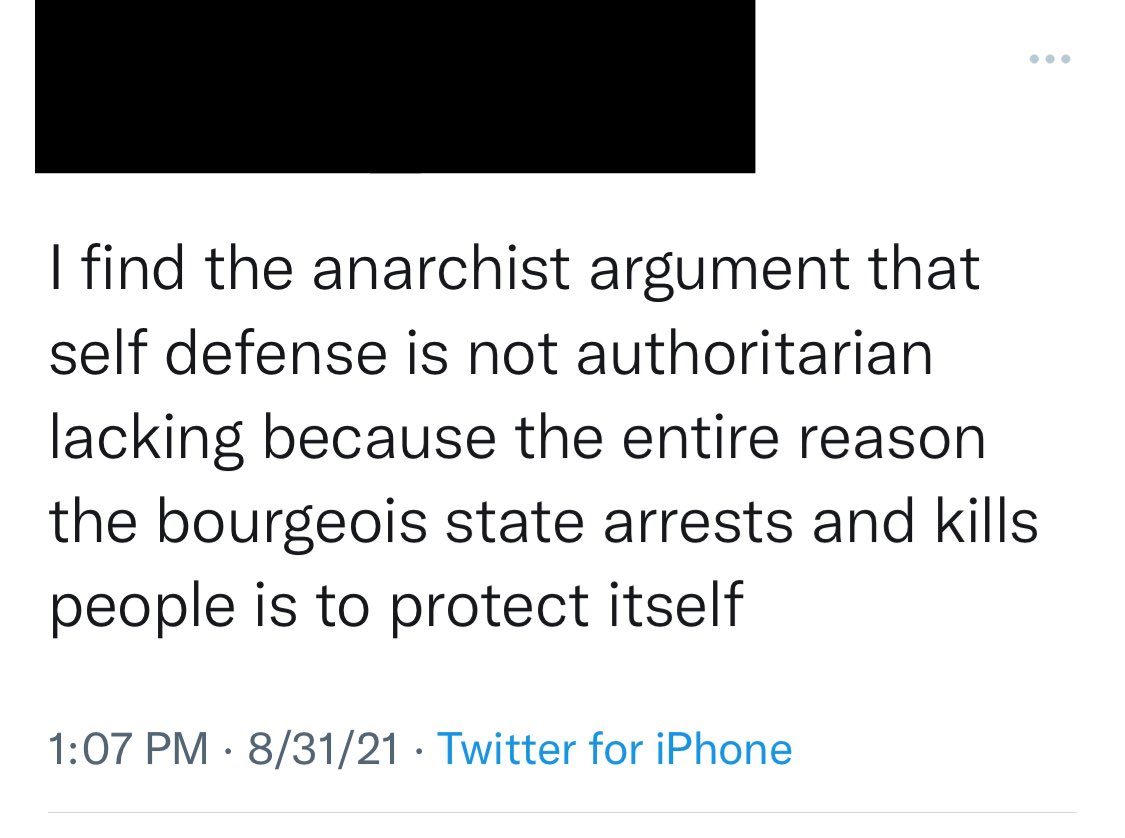
Okay, so this is a claim that folks in favor of gaining control of and wielding state power often bring up in response to anarchist opposition to authoritarianism. So I figured it might be helpful to actually fully break it down here.
Proposal: “Engaging in self-defense is itself authoritarian.”
Supporting argument: “The bourgeois state only targets people in its own self-defense, therefore, self-defense is an authoritarian act.”
Supporting argument: “The bourgeois state only targets people in its own self-defense, therefore, self-defense is an authoritarian act.”
Conclusion: “The anarchistic critique of authoritarianism is nonsensical because their own means of resistance is also authoritarian.”
Okay, so now that we’ve clarified what this claim is, on the surface, saying, we can break it down further. First, we need to investigate what “authoritarianism” actually means.
So, within the bounds of this claim, authoritarianism is any act of force against another, whether that other be another person or an entire system. Of course, with this definition we run into a endless host of issues.
Authoritarianism, as defined by this claim, covers a massive range of social interactions. In this definition, if someone comes up to me and grabs me, and I forcefully pull away, I am engaging in a form authoritarianism.
The distinctions between me & my assailant disappear. Rather than them being an aggressor on my bodily autonomy & me defending that bodily autonomy, we are both equal opponents in conflict trying to assert our authority, & MY autonomy becomes the spoils. Might makes right.
So there are two fundamental issues with this definition of authority:
1) it expands the definition of authority to the extent that its function as a term is destroyed.
2) it reduces all human social interaction to a series of equivalent struggles for power and domination.
1) it expands the definition of authority to the extent that its function as a term is destroyed.
2) it reduces all human social interaction to a series of equivalent struggles for power and domination.
In this definition, liberation itself becomes distorted from an articulation of freedom and autonomy to an articulation of who gets to have the ability to dominate others. Acts of rebellion against domination for the sake only of freedom from domination do not exist here.
It is a similar dynamic of when men accuse women of being sexist for pointing out their misogyny, or when white people call BIPOC racist for challenging white supremacy. It’s a means of flattening out structural systems of domination into a two-way interpersonal conflicts.
If I accept the terms that men put forth when they accuse me of being sexist for challenging patriarchy, what I am ultimately accepting is that there are no structural power imbalances between us, and I concede to the destruction of the political analysis of patriarchy.
Returning to our earlier example of someone grabbing me: in the claim that my re-assertion of my own bodily autonomy is an act of authoritarianism is the underlying assumption that my bodily autonomy can be reduced to spoils in an equal conflict.
What vanishes is the moral judgement that the person grabbing me without my consent is taking hold of something that is not, & could never be, theirs to claim. It denies that my act of self-defense is an assertion of that moral value, not an equal assertion of domination.
Moving back out to a macro-political view, the assertion in this claim denies the fundamental dynamic that is always at play in state power. The state is a means for a group of people to lay claim to something that is not & can never be theirs: our bodily & political autonomy.
This brings us to the next part of this claim: “The bourgeois state only targets people in its own self-defense, therefore, self-defense is an authoritarian act.”
The state is certainly defending something, but the question we need to be asking is: what?
The state is certainly defending something, but the question we need to be asking is: what?
When we engage in self-defense against the state, we are attempting to pull ourselves from the person who grabbed us: we’re asserting our own personal autonomy.
When the state defends itself against us, it is then defending its ability to have control over our autonomy.
When the state defends itself against us, it is then defending its ability to have control over our autonomy.
The State’s defense is on par with the person who grabbed me who, when I attempted to get free, held me tighter and struck me. That is not what an equal struggle for power looks like, it is an act of domination and an assertion of sovereignty. That is not self-defense.
To accept the State enforcing its sovereignty as an act of “self-defense” does two things here. 1) makes a complex social structure into a “self” with rights that should be respected and 2) accepts that people, regardless of their consent, are natural possessions of that “self.”
It will do us well to investigate, then, *why* there has been such a long tradition of statists expanding authoritarianism into meaninglessness. What is the point? What is the intended outcome?
The point, in light of what we explored here, is that when they can get people to concede that acts of resistance are acts of authoritarianism, it is simple to bypass an analysis of power & how hierarchy functions & to make people feel that a state project is their only option.
Complex dynamics of power and domination get flattened and simplified into what is essentially opposing sports teams fighting over who gets to claim masses of people as their rightful possessions, and who will be allowed to enforce their sovereignty and demand our submission.
What happens when people see politics this way, rather than a web of social relations that are determined & shaped by us collectively, is that they feel that their own political autonomy will always be up for grabs & they just need to choose the better master to fight for.
Of course, many also seek to become the master themselves. In that case, seeing authoritarianism this way serves another function: naturalizing their desire for power over others. Because everything is authority so it’s justified or at least inevitable!
We have to ask, then, what function we actually want “authoritarianism” to serve? What is *our* point in speaking about it? Why does it feel important to not let its definition be expanded into meaninglessness?
Well, like with terms such as “patriarchy” and “settler-colonialism” and “white supremacy” and “capitalism” the point is to speak to a dynamic of power that is at work in our world and shapes our social conditions and our struggle to make those conditions liberatory.
Authoritarianism allows us to speak about and challenge forms of social organization in which groups of people expand their own political power by undermining the political agency & autonomy of others via the use of force. It is a tool in an overall analysis of power.
Importantly, it allows us to offer pointed critiques of the very projects whose advocates seek to obliterate the definition of authoritarianism in order to obfuscate their goals to assert their own sovereignty.
Which should tell you why this discourse has continued for so long.
Which should tell you why this discourse has continued for so long.
There is more to say but I hope I’ve said enough to be helpful. Not just in breaking this claim down, but showing the practice of breaking claims down in general. It’s a vital skill I want to help people cultivate so we all can have practice in building our own robust analyses!
I try to do threads that make information & analysis more clear & accessible to others on a regular basis. I will always do it for free, but if you want to show your support/appreciation you can either give love to my tip jars or join my Patreon: patreon.com/butchanarchy


Oh gosh, I’ve actually missed an important aspect of this argument I wanted to tackle that this person very helpfully reminded me of. Which is the assertion that the state kills people only in its own defense.
https://twitter.com/Weisseneger/status/1433557058142437380
While this in, in one form, true, it is certainly not in the way the initial claim presented it.
The State absolutely cracks down on people who attempt to challenge its sovereignty, but we HAVE to speak to the reality that it is in the State’s very structure to coerce, torture, and kill people in basic maintenance of its power.
I cover this more in-depth in this thread here, as well as another thread I will link in 2 comments below this one, but the State can only function if it is constantly creating destinations between a constructed citizenry and noncitizenry.
https://twitter.com/butchanarchy/status/1354964276348219393
Here’s a graph of what I go over in that thread if that is an easier format for you:
https://twitter.com/butchanarchy/status/1428192146603929603
It does this because its fundamental function is in constantly extracting (stealing) resources just to be able to maintain its ability to hold on to centralized power.
https://twitter.com/butchanarchy/status/1408125951997665281
Again, we reveal the point of the claim that the State attacks only direct challenges to its authority and such attacks are “self-defense.” It serves to obfuscate the inherent exploitative nature of State power, and lets people believe it can be used for a different purpose.
In that framing, one can say “the bourgeoisie state attacks and kills us because we are its enemies in battle” and leads to the claim that “once we have control of the state, it will only be targeted at the “correct” people.”
This serves to obfuscate the extractive nature of State (centralized) power & lets us off the hook for asking questions such as “whose power will be extracted to maintain the apparatus of the State?” And “who will have to be constructed as “enemies” to validate that extraction?”
• • •
Missing some Tweet in this thread? You can try to
force a refresh




